Archy the Cockroach and Mehitabel the Cat were introduced to the world in 1916 by Don Marquis, a columnist for the New York Evening Sun. Marquis was more than a mere columnist; he was a social commentator and satirist admired by nearly every famous writer of the first quarter of the 20th century. Franklin P. Adams, for example, said Marquis was “far closer to Mark Twain than anybody I know” (see note).
As the story goes, Marquis said he came into his office one morning to find a big cockroach jumping about on his typewriter keys. The cockroach kept climbing up the metal frame and hurling itself headfirst onto a key, one slow letter after another. He couldn’t use the shift lock (except one time when he hit it accidentally and produced an entire uppercase column), so his writing is lowercase. After about an hour, Marquis reported, the cockroach fell to the floor, exhausted after typing just one page. He never could manage punctuation, and he also had trouble with the carriage return—how many of us remember how those old typewriters worked?—but he somehow hit it every time. (My grandfather had an old typewriter like this. The keys were very stiff. I felt like my little fingers were gonna break when I tried to type.)
In his previous life, Archy was a free verse poet. As he explains to Marquis,
expression is the need of my soul
i was once a vers libre bard
but i died and my soul went into the body of a cockroach
Isabella Ides’ White Monkey Chronicles is my lectio divina, the wisdom, humor, and wonder of her story savored daily. (For an overview, see BJ Austin’s review.) Although the titular white monkey is at the heart of the chronicles, and his charge, foundling/avatar Conrad Eppler, is a boy, I have never encountered a more vivid evocation of goddess—multi-dimensional, earthy, transcendent, fierce, compassionate. No one knows Godma better than the Sisters of the Joyous Mysteries, an order of rogue nuns, the focus of this interview with the author.
Give us a thumbnail sketch of the three remaining members of the order, Sister Mary Subordinary, Sister Merry Berry, and Mother Mary Extraordinary.
Mother Mary Extraordinary is ancient, icy white, her soul as scuffed as an old shoe. Extraordinary’s veil hides long white hair that reaches to her ankles. Sister Merry Berry is youthful, dark as an espresso truffle, her hair a disarray of dreadlocks. She ditches her veil, crochets a Rastafarian beret, and adopts a pair of florescent orange running shoes. Nun on the run. The orderly Sister Mary Subordinary is almost without physical detail. She is selfless, a giver, a maker of bread and soup. She is porous. Sometimes her soul escapes her. Mary Subordinary has visitations; the monkey god, for one, slips in. Subordinary herself can enter other minds, although she tries not to snoop.
Have you encountered rogue nuns in your own life?
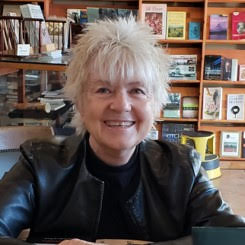
Author with Sr. Mary Agnus, Blessed Sacrament School
I spent my first-communion year at a Catholic school in Hollywood, on Sunset Boulevard. One day on the playground, Sister Mary Agnus asked if I wanted to see the bones of a saint. Yes, I did! She reached into her deep pocket and fetched out a small gold case with red velvet lining and a glass portal. Forget Mary Poppins. I was enthralled. Yet in my secret life, I did not believe in her god. I was a seven-year-old redactor, appalled by the vision of an ocean of children drowning as the ark of animals sails on.
Then years of public school in the suburbs drained the world of mystery. I jumped at the chance to enroll in an all-girls Catholic high school. My notions about nuns changed irrevocably the day I wore a faux zebra coat over my school uniform. Sister Mary Malua asked to try it on. Her Sister friends giggled like girls. And with a shock, I was made aware that they were girls. Like me. These young Sisters, fresh off the boat. Irish – they spoke Gaelic when ruffled — upper-class girls, smart, some of them brilliant, but not very pretty, and not necessarily traditionally gendered.
And none of them as rogue as my creations. Indignant on their behalf, I stepped into the role of fairy Godmother to the Sister Cinderellas — working for no pay, made to obey their priest confessors, denied agency, denied priesthood, doomed to be brides of an indifferent god. Waving my writer’s wand, I de-colonized their minds, redressed them, and sent them invitations to a spiritual ball, the likes of which they had never known.
Toni Morrison said that she wrote the novels she wanted to read. I wrote the world I wanted for my beloveds.
Their mysterious foundling, Conrad Eppler, is home-schooled by the sisters who have widely and wildly varied approaches to his education. Give us a brief description of their curricula.
Author costumed as Shakespeare’s Helena with Sr. Mary Joseph, Louisville High School
Paraphrasing Marx, from each according to her gifts. Sister Subordinary, mindful of Conrad’s origins, reads to him from the Ramayana, stories of the monkey god, Lord Hanuman, and the story of Guha, her idea of a perfect devotee. Guha’s practice is to faithfully kick the statue of Shiva that the Brahman priests have brought to his forest. She passes to Conrad the spiritual gifts of discernment and doubt.
Merry Berry gives Conrad the childhood that she never had. This is one of the fascinations of motherhood and mentorhood, how the child/student changes the teacher. Motherhood is actually one of the deep themes of the Chronicles, that and redemption. How we transform and are transformed by what we create, what we give birth to in the world.
Mothering a child, a planet, a poem, a prayer, a god.
Mother Mary Extraordinary teaches Conrad astral travel. She is a visionary, come to grief over dead and dying dreams. She is cranky, reluctant to crank up further investments in the material world that betrayed her. Her most potent gift comes late in the novel. She is the difficult parent. The dark side of the moon.
The sisters have a highly original approach to prayer, which lands them in mortal trouble with the Great Church. Tell us a little about the flowering of the heretical practices.
The Great Church cast out its rebel brides for ordaining sister priests. Unbound, all holy mayhem broke loose at the convent. New sacraments were invented, Sisters married each other, created scrumptious communion breads, and each sister wrote a personal mass, worshiping the gods as she imagined them. Then disaster. The prayer eaters came and licked the pages of the prayer books clean. When a Sister’s prayer book went blank, death soon followed. And then there were three. Mary Extraordinary. Mary Subordinary. Merry Berry.
When the sky-blue baby deity is delivered to the convent, the three survivors crack open one of the old prayer books to enter his name in the litany of infants. Theirs is a radical hospitality. All gods are welcome. Well. Almost. This hospitality doesn’t quite extend to those gods who deny that they have mothers, or that claim one-and-only status, or label their progeny the only begotten. In the Sisters’ theology every child is a coming, and a godsend.
We’ll close with an excerpt from one of the sisters’ prayers:
Litany of the Infants
The infants come
on fresh beds of hay
on sterile hospital sheets
down dark Calcutta streets
on the back seats of taxi-cabs
on the beds of Mack trucks
they come
in woodshed and chateau
in barn and bordello
on the snow belt
and bible belt
on the green veldt
and parched plains of Africa
they huddle
in refugee camps
in quarantined villages
they set sail in Moses-baskets
afloat on the Nile
launched
from Bodrum
from the shores of Vietnam
from the banks of the Rio Grande
let them come
with halo hair
and soft eyes shining
Divine Mother, Sweet Protectoress
shelter each foundling
in the house of your infinite kindness
in the womb of your joyous mystery
Holy of Holies, Mary Mother of God
teach us thy trade.
Isabella Ides was born under the Hollywood sign and attended a Catholic School on Sunset Boulevard. Her father ran search lights for movie openings. Thus she was bent towards stage lights and spirit lights from the get go. A poet and playwright, she considers her debut novel, White Monkey Chronicles, the mother lode. Everything leads to it. And away.
Elizabeth Cunningham is best known as the author of The Maeve Chronicles, a series of award winning novels featuring a feisty Celtic Magdalen. Her novels The Wild Mother and The Return of the Goddess have both been released in 25th anniversary editions. She is also the author of Murder at the Rummage Sale. The sequel, All the Perils of this Night, will be published in 2020. Tell Me the Story Again, her fourth collection of poems, is now in print. An interfaith minister, Cunningham is in private practice as a counselor. She is also a fellow emeritus of Black Earth Institute.
I binge-read White Monkey Chronicles The Complete Trilogy. The first time. It’s like Douglas Adams, Kurt Vonnegut, J.K. Rowling and Gloria Steinem got drunk one night and decided to write a book.A second, slower read was even sweeter.
The first paragraph of the Prologue tipped me headfirst and wide-eyed into this mind-bending, myth-busting, topsy-turvy tale. Its innocuous, traditional “Once Upon” opening was immediately blown up by the explosive words “infant deity abandoned,”, “famous bachelor Jew,”, and “A-list Hindu”. Wait. Whaaat? The stage was set for a rebellious, revolutionary saga destined to be voted “Most Popular” at a fundamentalist book burning!
A white monkey (part-time Plush toy, full-time guardian of an off-the-record baby boy deity) sets the book’s roller coaster ride in motion on a snowy night in Humbolt County, USA. There, at the withered and weathered Sisters of Immaculate Conceptions convent, we meet the three remaining Sister-resisters of The Great Church’s preening patriarchy. (Lets just say the clergy is strictly for the birds — in dress and demeanor.) Getting a whiff of the unauthorized deity’s arrival, a conclave of Cardinals swoop in to confirm (and possibly kidnap) the threatening newborn from the kind, caring, and radical hands of the rogue nuns. Not so fast. Continue reading “White Monkey Chronicles: Myth-busting in Eden BOOK REVIEW by BJ Austin”
Note: This story was originally posted early in 2016. I’m posting it again because, thanks to the state of UNkindness the Abuser-in-chief has pasted all over the semi-civilized Semi-United States, we need lessons in kindness more than ever before. I bet you agree with me!
“Curses on that grasshopper!” exclaimed the ever-busy Madame Fourmi. “All he ever does is play. He’ll be sorry when winter comes.”
And so it went. Every day, Mme. Fourmi spent the morning scrubbing her front steps. And Monsieur Cigale?
“Partaaaaayyyyy!” Every day, he sped by on his skateboard. “Hey, Auntie Ant, stop cleaning the concrete and come and play with us. We’re gonna start a band!”
“Not on your life,” muttered this grandmother, most of whose conversations with her many daughters and granddaughters consisted of instructions on how to properly clean their homes and hills and how to prepare and store food for the winter. “Life is serious business, it is, it is. We need to plan ahead.”
And so is born the “monster” most people associate with the name Frankenstein–a lone and lonely terrorist who lashes out against a world that has no place for him. One by one, he strangles all the people his “maker” holds dear: his brother William, his best friend Clerval, and his cousin/bride Elizabeth. Yet the novel invites us to have compassion for the creature, even while it condemns the society that makes him as he is. Victor, raised by a devoted mother and tenderly loved by a doting cousin, should have known better. As should we.
A few weeks ago, a former colleague invited me to visit one of his classes, to discuss Mary Wollstonecraft Shelley’s 1818 novel Frankenstein; or, The ModernPrometheus and the essay I’d published about it almost thirty years ago, “‘They Will Prove the Truth of My Tale: Safie’s Letters as the Feminist Core of Mary Shelley’s Frankenstein.” To prepare for that visit, I’ve spent the past few days re-reading the book, and I’m overwhelmed anew by the beauty of Shelley’s language, the brilliance of her plot, and the profoundness of her themes. The book moves me even more today than when I first read it.
Lately I’ve been reading a few Paulo Coelho books. I won’t say they are beyond feminist criticism, but it’s not what I’m going to focus on this post; but as always, feel free to say in the comments why/if you find them problematic. I expect and welcome it because it might be another layer of this conversation that I don’t have time or am not yet emotionally ready for myself.
What I want to focus on is the solution the author seems to advance in each of his books, at least those I’ve read, to our perpetual unhappiness despite the evidence that everything is fine, better than might otherwise be.
Adultery: I never finished this one, actually. I had to take it back to the library the last time I had to leave Ireland, but I’m sure I will find it again and read the rest of it soon. So I can’t say what the ending revealed, but what sticks in my mind was the predicament of the main character. She, from her perspective, had it all: wealth, an interesting career she liked, an attractive husband who was attentive and kind, a family, health. This was why she was so confused that she was unhappy. This is the premise of many of his books: the person who doesn’t know why they are unhappy. Also, the observation that no one is really happy.
It’s Friday. I drive down PCH, Highway 1, at five-o-clock in the morning on my way to the airport. I left early and avoided the evacuation traffic. The sky is pitch black—not just dark, but black. Smoke cloaks the sky, sky presses against black mountains. I can’t actually see the ocean right next to me. I don’t look either, because the wind is pushing my car around on the freeway and I need to pay attention. Don’t look at the invisible water Sara, pay attention.
I admit to myself that I am afraid even though I am doing something I do every day.
I am getting on a plane. Why am I getting on this plane? I need to be here. I want to be here. But life goes on, doesn’t it? We hope that life goes on; even if we live like it does not. All I know is that I want to tell everyone I see that my home is burning. Not my house-home. Not mine. I’m safe just south of Ventura. I’m not on the freeway. I’m safe on a plane. But my home is burning. MY HOME IS BURNING. (Again.) Please somebody talk to me while my home is burning. But instead, I check the news and twitter reports every 5 minutes and worry about my students and my friends. I want to cry.
The rising voices of female empowerment, consciousness, and position has been an undertaking in the last two centuries. Yet societies are still using fairy tales; tales that were written at least 500 years ago. Many of the fairy tales can be read in a 21st Feminism lens as being harmful and products of a patriarchal society. The movement can only gain more strength and momentum if we start from the ground up – reworking the stories, fables, and myths we teach our children, we make into movies, and that children want to dress up as.
In her novel, Kingdom of Women, Rosalie Morales Kearns imagines a reality that is post-patriarchy, and post male violence while showing us what near-future women had to go through in order to get to that reality. Morales Kearns weaves this story through the voices of multiple characters. One of these characters is Averil Parnell, a female Catholic priest. Part I of the book opens with a woman visiting Averil to seek her counsel in regards to taking revenge on her male college professor who has been harassing her ever since she refused to sleep with him.
While Averil seems to be of little help with this particular conversation, we learn that Averil was one of the twenty three original female priests that were to be ordained by the Catholic Church. On the day of their joint ordination however, the Cathedral Massacre took place and twenty two of the female seminarians were killed in cold blood. Averil then, is most definitely a woman who understands the yearning for revenge, the feeling of survivors guilt, and the expectation to be a wonderful priest for her dear friends who had that chance ripped away from them.
At the same time this conversation is taking place it has become clear that small groups of vigilante women are popping up around the world and punishing men for acts of violence against women. The male dominated government of course sees all these punishing acts as coincidental, explaining them away in one way or another, or ignoring them completely, never imagining that it is in fact the beginning of women rising up to truly end male dominance and violence.
“I am the Queen of Sheba and I am not impressed.” This is the first line of one of the monologues from chris wind’s book Thus Saith Eve. This book features 18 stories of biblical women, and a 19th, Lilith, from Jewish mythology. Each monologue offers a new interpretation and gives a voice to the women that we think we know.
In this book the voices and personalities of women such as Noah’s wife, Mary of Bethany, Zipporah, and Vashti are reimagined in an exciting and empowering way. Each of the stories also features an appendix where the reader can learn more about the biblical or mythological context of the woman who is telling her story.
As in her other works, wind uses historical people, events, and understandings to build a truly wonderful source of feminist fiction. In addition to being an extremely enjoyable and thought provoking read, the monologues can also be used for audition and performance pieces. On her website wind explains that two of the monologues, “I am Eve” and “I am Mary” can be performed with specific musical selections in the background. You can find those selections linked to her website above.






 I binge-read
 A few weeks ago, a former colleague invited me to visit one of his classes, to discuss Mary Wollstonecraft Shelley’s 1818 novel Frankenstein; or, The Modern Prometheus and the essay I’d published about it almost thirty years ago, “



 Feminism and Religion