Who Sits at the Center of this Story? By Elise M. Edwards

Elise EdwardsHave you ever heard of the Vitruvian Man? It’s an image from 1490 inked by Leonardo da Vinci that came to symbolize the centrality of the individual in the Renaissance. It is quite clearly a depiction of a muscular, European male. His body is perfectly proportionate and thus simultaneously represents ideal humanity and a microcosm of the universe. The Vitruvian Man is so named after the ancient Roman architect Vitruvius who describes the proportions and symmetry of a temple as being analogous to the proportions of a man.

As an architect and scholar in the humanities, I’ve been acquainted with the Vitruvian Man for many years now. I even had a da Vinci theme on my PC’s Windows software about 15 years ago, meaning that the image of the Vitruvian Man appeared regularly on my desktop and screen saver. There was nothing problematic to me about his presence until a few days ago, when I took part in a discussion about teaching philosophies with some new friends and academic colleagues.

I was listening to Tamara Lewis, an assistant professor in religion whose research and teaching addresses the medieval and Renaissance periods. When she described a metaphor for her teaching philosophy, she discussed replacing the symbol of Vitruvian Man with the “woman at the well.” The woman at the well is a figure in Christian stories about Jesus and his teachings. Her narrative in the Bible is placed in chapter 4 of the Gospel according to John. Int eh story, Jesus encounters a Samaritan woman at a well. He asks her for a drink, which begins a meaningful exchange about spiritual teachings. Jesus’ male disciples and surprised to witness this exchange, presumably because she is a woman and a Samaritan, as the text tells us that Jews do not associate with Samaritans. The woman goes back to her town, tells people about her encounter with Jesus, whom she believes is the Messiah, which prompts many of them to come to him and also believe.

Dr. Lewis described how her presence in the historical study of medieval or Renaissance periods is sometimes questioned and how the woman at the well represents this presumed misplacement. Her metaphor caught my attention not just because of its profound coherence within her own career trajectory and narrative, but its coherence within mine. As a black feminist, religion scholar, and practicing Christian, I often wrestle with questions of belonging and being in or out of place.

This summer, I’m taking the time to think about broad questions and do some vision casting. This past December, Grace Kao wrote about using sabbatical time differently, and I’ve connected this to my own practice of Sabbath keeping as a ritual. I dedicate specific times to cease work.  I am engaging in some productive activity this summer, but I’m also honoring one of the truest blessings and privileges of full-time employment in my profession, which is break time to rest, reflect, and plan for the seasons ahead.  The metaphor of woman at the well who intentionally replaces the Vitruvian Man provokes these questions in my reflection:

Who is the default person around which the places we inhabit are constructed? Who sits at the center of our stories about the places we will go? 

As the little bio that follows my posts says, in my professional career I examine issues of civic engagement and how beliefs and commitments are expressed publicly through aesthetic and artistic practices. I’m currently writing a book-length project about theological ethics and architectural design. So these days I’m thinking a lot about the way public spaces and built environments communicate the values of those who build them and inhabit them. One of the questions I’m wrestling with is the way “common” spaces are defined by the narratives of only some people in the community. What does it mean to be literally “out of place”? What exists as a “safe space” in a public park for a man may not feel safe at all for me as a black woman. A public bench upon which I can rest in the middle of an afternoon jog may not be so uncontested for a homeless man at night.

As I think about my future, I have to ask who sits at the center of my story.   I’m approaching a milestone birthday, and I don’t want to fall victim to someone else’s vision of what a 40 year old woman should be. What does the story look like with me at the center? What happens when I replace an idealized image of perfection, vitality, and beauty with an imperfect but gloriously alive and wonderfully formed vision of who I already am?

As I plan for a new academic year, who do I imagine in my classes? As I engage students in discourse about the history of Christianity, the development of its theology, and the ethical issues of today’s world, who do I place at the center? As the US becomes enmeshed in presidential election politics and ongoing racial tensions, what image to we present as the archetypal American?

I’m so grateful that I was brought to see the woman at the well as a metaphor of intentional displacement. Even in a religion that places a male Savior (Jesus) at its center, there are women who sit with him. Although they confound some of Jesus’ other followers by their presence, they remain meaningful conversation partners and witnesses to their faith.

Elise M. Edwards, PhD is a Lecturer in Christian Ethics at Baylor University and a graduate of Claremont Graduate University. She is also a registered architect in the State of Florida. Her interdisciplinary work examines issues of civic engagement and how beliefs and commitments are expressed publicly. As a black feminist, she primarily focuses on cultural expressions by, for, and about women and marginalized communities. Follow her on twitter, google+ or academia.edu.

Caitlyn Jenner is a Friend of Mine

To speak ones truth is oftentimes a difficult and nearly impossible act. However, to live one’s truth, on a day-to-day basis, is an aspect of life that has become so foreign to individuals who have become so comfortable in their own skin that I fear the activist and social justice roots that we all claim to hail from have fallen at the wayside and been replaced by complacency and reductionism.

caitlyn-jenner-transformation-high-cost-surgery-clothes-house-5I’m deeply troubled by some of the anti-trans and anti-queer commentary that has been taking place on some of the comments on this blog in recent months. I’ll never forget when this project first began—talking with the founders about its original purpose: to bring the “F” word back into the mainstream religious discourse and more importantly, to be a place where scholars, young and old, senior or junior, could write, collaborate and eventually converse with across cyberspace.

However, in recent months, I’ve found myself being more of a watchdog rather than a frequent commentator on issues pertaining to feminist religious discourse. I’ve found myself reading comments about issues I may not frankly identify or agree with just to make sure that the cisgendering or anti-trans narratives do not become symbolic of what this blog is now rather than what was supposed to be at the beginning.

When I sat down to write my very first post I was scared. I was terrified that feminists from all communities would see me only as I appeared and not for whom I actually was. I was afraid that all I had worked for throughout my life would be moot with the first bad comment on one of my posts. While all of those fears were real and valid they quickly faded away as I was embraced by this community and many others for my passion rather than my gender; my life’s work rather than my privilege; and more importantly, the personal mission to make the world a safer and better place for women and girls everywhere.

To speak ones truth is oftentimes a difficult and nearly impossible act. However, to live one’s truth, on a day-to-day basis, is an aspect of life that has become so foreign to individuals who have become so comfortable in their own skin that I fear the activist and social justice roots that we all claim to hail from have fallen at the wayside and been replaced by complacency and reductionism.

Caitlyn Jenner’s story is one that many individuals, often not highlighted on this blog, know all too well. Caitlyn Jenner’s story and personal experiences are valid and for members of the feminist community to refer to her as not “feminist” or merely as a man “masquerading” as a woman while still utilizing his privilege from being biologically born as a man is troubling and the root of the problem facing many trans individuals today when they’re negotiating coming out as their true selves.

Trans individuals face a cadre of other horrible social, physical and mental statistics that oftentimes lead them to be more likely to self-harm.   However, as feminists, isn’t it our job to make sure that all groups have access to the same freedoms rather than working towards denying it for certain groups while trolling the comments sections of posts?

Shakespeare said: “To thine own self be true” and for those of us who identify with the Golden Rule, if we no longer treat others as we would like to treat ourselves, then we really have failed as feminists; and if the comments on recent blogs are any indication, we still have a long way to go before all voices can feel welcomed not only on FAR but also in the world at-large.

John Erickson is a Ph.D. Candidate in American Religious History at Claremont Graduate University. He holds a MA in Women’s Studies in Religion; an MA in Applied Women’s Studies; and a BA in Women’s Literature and Women’s Studies. He is a Permanent Contributor to the blog Feminism and Religion, a Non-Fiction Reviewer for Lambda Literary, the leader in LGBT reviews, author interviews, opinions and news since 1989 and the Co-Chair of the Queer Studies in Religion section of the American Academy of Religion’s Western Region, the only regional section of the American Academy of Religion that is dedicated to the exploration of queer studies in religion and other relevant fields in the nation and the President of the University of Wisconsin Oshkosh’s LGBTQA+ Alumni Association. When he is not working on his dissertation, he can be found at West Hollywood City Hall where he is the Community Events Technician and works on policies and special events relating to women, gender, sexuality, and human rights issues that are sponsored or co-sponsored by the City of West Hollywood. He is the author of the blog From Wisconsin, with Love and can be followed on Twitter @JErickson85

Gender Identity, Religious Identity and Performance.

10953174_10152933322533089_8073456879508513260_oWhen I cover my head in respect for the Holy One, it feels right. This act touches on a religious truth of who I am. To me, it not only matches who I am, it also expresses something about who I strive to be and the relationship I want to have with G-d.

Seeing Caitlyn Jenner on the cover of Vanity Fair, I think she’d say something similar about herself. Her outward appearance touches to the very core of who she is and who she has had the strength and courage to become.   Not only that, it feels right.

Sure, there is a wide gulf between the public nature of Jenner’s cover photo and my public head covering, yet, in these two examples, I see a number of connections. First, there is the real possibility of harm and danger. Second, there is a link between outside actions that express something true about the person on the inside. Third, value is placed on the agency and autonomy of the individual carrying out those actions. Finally, there is a performativity connection between religiosity and gender. It is the last point that I find particularly compelling.

I don’t cover my head anymore on a daily basis although I used to before I moved to Europe. Even though it doesn’t feel right, with the rise of anti-Semitism, it seems like the safe and unfortunately prudent thing to do. I also don’t wear any signifying my religion except for a small star of David earring. In 2014, by the Jewish community’s own account, anti-Semitism grew 200% in the Czech Republic alone.  Statistics seems to support my actions.

Jenner too, like so many members of the trans community, now has the real threat of violence against her person. While her public persona may make her somewhat safer, too many trans men and women have been harmed and even murdered just for being themselves. In fact, many trans people live closeted lives because of this danger and the fear of rejection from family, friends and the larger society.

While not minimizing the fear and danger, I want to return to the more theoretical link between gender expression, gender identity and religious identity. In 1990, Judith Butler wrote Gender Trouble: Feminism and the Subversion of Identity. For Butler, what we think of sex and its connections to gender as masculinity and femininity often come down to a person performing gender in a way that is socially recognizable. People wear clothing, do actions, speak words and use body language that marks them as woman or man and therefore individual agents adhere to societal constructions of gender at the same time they reinforce societal expectations for men and women. Butler’s suggestion is that gender performances, that subvert “normal” discourses on gender expression, show the ways in which gender is culturally constructed. They also disrupt what has been seen as somehow inherently natural. In other words, biologically-sexed females acting, dressing, speaking and behaving in ways typically associated with masculinity disrupts what it means to be both a woman and to be masculine. This would be impossible if things were as natural as society thinks they are.

One of Butler’s goal, in my opinion, is not only to expose the culturally constructed nature of sex/gender, but also to open up individual agency to perform gender in ways that would disrupt the power these “natural notions” have over peoples’ lives. Subversive gender performances, for Butler, creates more freedom in society and would hopefully undermine blanket misogyny and disrupt patriarchal power.

Yes, Butler has often been criticized in many ways, including the attempt to erase any notion of substance behind personhood and its gendered expression especially as it relates to transgendered individuals. Butler has spoken to this specific criticism saying on transadvocate.com that, “…others have a strong sense of self bound up with their genders, so to get rid of gender would be to shatter their self-hood. I think we have to accept a wide variety of positions on gender. Some want to be gender-free, but others want to be free really to be a gender that is crucial to who they are.”20150128_132833

In the end, what is essential for Butler is individual autonomy and freedom to be. Performing sex/gender is one possible way to get there. Let me suggest another that builds off Butler’s ideas of performativity. Religiosity is a type of culturally-laden performance. After all, what are kippot, hijabi, nuns’ habits, ministers’ robes, etc.? They are religious markers tied up in gender identity.

Just as masculine women subvert and disrupt social constructions, couldn’t a Jewish lesbian perform gender in a way that she passes for an orthodox man (or woman)? Doesn’t this disrupt what it means to be both lesbian and orthodox? I think so. This passing person also destabilizes the power of orthodox men to define womanhood and women’s sexuality. She defines for herself who she is. She may very well consider herself to be orthodox and masculine, just as masculine women consider their masculinity as part of who they are.  She may connect deeply with Jewish orthodox feminine styles of dress.  Nonetheless, her outward performance expresses something about her commitment to G-d and who she is as a Jew at the same time it subverts received religious notions of gender and sexuality.  Another example is a woman minister who wears priestly attire including the black shirt and white collar.   She too disrupts power relations, gender assumptions and, for some people, the very notion of women and ordination.  Religious performance is powerful stuff.

To go back to the point I made at the beginning. I think expressions of religiosity are similar to expressions of gender. In addition, claiming for one’s self a religious identity subverts patriarchal notions of gender. Yet, most importantly, performing a religious identity often expresses an inner truth. In both of these ways, religious identity performances could create freedom, disrupt power-over and destabilize patriarchy just as Butler hopes gender performativity does.  I would modify Butler’s approach somewhat to say, “I think we have to accept a wide variety of positions on gender [and/or religious identity]. Some want to be gender-free [and/or religion-free], but others want to be free really to be a gender [and/or religious indentity] that is crucial to who they are.”

What’s Wrong with this Picture? by Elise M. Edwards

Elise EdwardsOn Monday, the picture was on my Facebook feed again: The picture of a girl lying face down in the grass under a police officer pressing his knee in her back. It was from the video of an African-American teenager being pinned to the ground by Eric Casebolt, the police officer in McKinney, Texas who was responding to calls about a pool party. When I saw the picture this time, it was in a screenshot with these words below it:

“Funny how a 14 year old bikini-clad black girl being publicly assaulted by an adult male does not accrue mainstream feminist outrage.” – Yohanna

The screenshot was taken of a post to Yohanna’s Twitter account (@maarnayeri). I don’t know her, but she troubled me.

If you haven’t seen the images we’re talking about, you can view the video here with a description of what is concurring or below from YouTube. I was reluctant to watch the video. It seems voyeuristic to view this young woman’s suffering and screaming. And, if I am honest with myself, it also seems useless. Viewing this from my computer screen, I’m in no position to help her. I hear her cries and it make me cry too. But I can’t push him off of her. When other teens tried to come to her defense, Casebolt pulled a gun on them and chased them. I don’t even have the power to get him fired from his position of authority immediately. No, we must have the investigations and inquiries and due process that seems so indiscriminately afforded to the privileged. Casebolt was put on administrative leave on Friday, and on Tuesday June 9, he resigned.

So how should I respond?

I had a conversation with one of my closest friends a couple days ago that provoked me to reflect on what to do when I’m conflicted about how to respond. Her background is in acting and theatre, and now she is a pastor and artistic director of a Christian church and arts initiative who believes in supporting arts, imagination and creativity. In our conversation about discerning the next steps in our lives, she was reminded of a book by Samuel Wells that proposes “theatrical improvisation as a model for Christian ethics.” That reminded me of books I’ve read that talk about musical improvisation or call-and-response as model for living, and some pieces I’ve written about that. Inspired by ethicists and theologians including Emilie M. Townes and H. Richard Niebuhr, I believe that to answer the question of how I should respond, I must first answer ‘What’s going on?” An improvised response or a fitting response is the response to what is already occurring. We must look at the situation critically to respond appropriately.

What’s going on in this video and the controversy surrounding it? I am certainly not an impartial or all-knowing observer, but here’s what I see:

  • A white man forcibly throws an unarmed, African-American teenager to the ground yelling “On your face!” We can see that she is unarmed because she is wearing a bikini.
  • The man is a police officer. He is upset that his authority is being challenged. Other officers are present and seem to be asking questions, but the violent one seems out of control and frantic, running around and yelling. He escalates the situation when he throws the girl to the sidewalk, which causes an outcry in the crowd.
  • As the video went viral, there were many protests and online statements against this violent event, but also statements of support for the officer. And sadly, I agree with Yohanna’s assessment. I may have missed it (and I hope I did), but I didn’t see a broad, mainstream feminist response against this violence.

I’m a feminist. I’m a black feminist. I’m a Christian feminist. I may not be a mainstream feminist (depending on your definition), but I’ll express my outrage anyway. It is sickening to watch his treatment of this teenage girl. This man’s mistreatment of a young black girl’s body is chilling. It is wrong and he should be held accountable for it.

I don’t think outrage is enough. But outrage does express that our moral sensibilities have been awakened and that we recognize that something profoundly wrong has occurred. In the face of comments that say she deserved this treatment, we as feminists must insist on the officer’s wrongdoing. “She had it coming.” “She incited him.” As feminists, we know that these kinds of statements are used in cases of rape and intimate partner violence to explain away violent actions and to shift the guilt from perpetrator to victim. The backlash against feminists and others who oppose these explanations argues that we ignore the victim’s responsibility or agency.

Bloggers and social media users know all too well the horrific statements that often appear in the comments section of online posts, videos, and articles. One comment I saw about the McKinney video says that the girl was “sassing back” at the police and that “if she wants to talk like adult then she’s going to be treated like an adult.” This kind of justification makes my blood boil! Sassing back is speaking up and saying something to an authority figure when you are expected to be silent.  While the term sassing back doesn’t exclusively apply to women and girls, it is nonetheless a phrase with gendered connotations. How many boys are called “sassy”? Is it that no one had the right to say anything to this officer running around yelling at black teen boys to sit on the ground, or is it that this black female should have kept quiet? Regardless, throwing an unarmed person to the sidewalk for supposedly saying something disrespectful is not justifiable behavior to adults or children.

I wish I knew more about what’s going on and how to respond to the violence I see in the world. I know these perennial questions subvert easy answers. I only have a partial response. I am responding with outrage and questioning and take this to my feminist community and into my spiritual practice. “What’s going on?” and “How should I respond?” are questions I ask God. I pray for justice. I pray for God’s presence in the outrage and in the investigations, and in the lives of those children who were violated.

Elise M. Edwards, PhD is a Lecturer in Christian Ethics at Baylor University and a graduate of Claremont Graduate University. She is also a registered architect in the State of Florida. Her interdisciplinary work examines issues of civic engagement and how beliefs and commitments are expressed publicly. As a black feminist, she primarily focuses on cultural expressions by, for, and about women and marginalized communities. Follow her on twitter, google+ or academia.edu.

The Religiosity of Silence by John Erickson

In a repetitive culture of abuse and silence, is it really shocking to find out that an individual who preached such hate and discontent for others actually perpetuated other forms of heinous abuse against others?

John Erickson, sports, coming out.In 2013, I wrote an article about the then latest reality TV scandal featuring A&E’s Duck Dynasty’s Phil Robertson and his rampant foot-in-mouth disease that caused him to express, in the pages of GQ, his true distaste for the LGBT community and specifically for the sexual proclivities of gay men.

Now, two years later in another reality TV show, TLC’s ’19 Kids and Counting’, it isn’t star Josh Duggar’s anti-LGBT statements getting him into trouble but rather his sexual assault and molestation of 5 girls, including two of his sisters. However, while the Internet explodes with attacks against Josh Duggar and his Quiverfull background, it is vital to remember that the silence that he and his family inflicted upon his victims since 2006 has not only been ongoing since then but is also being reemphasized today with each keystroke focusing on the assailant rather than the victims. Continue reading “The Religiosity of Silence by John Erickson”

Does God have Cleavage? The Avengers and Why the Sheroe We Need is Goddess by Trista Hendren

trista_bkgr_greenMost days I am not certain that anyone really cares about what happens to girls. As a mother of a soon-9-year-old daughter, this burns me.

Because I also have a 12-year-old son, I often end up watching movies I wouldn’t chose on my own. Last Friday, we went to see The Avengers sequel, and I left feeling angry. There were two sheroes shadowed by testosterone; both were highly sexualized. After all the hype over Joss Whedon and his “strong female characters” I began to wonder if the Sheroe we really need is Goddess.

Saturday night we had a lively discussion after dinner with my son’s best friend. I shared my observations on the movie and asked for feedback. They told me the only girl heroes they could think of had “huge boobs.” I asked them why they thought there was not equal amounts of sheroes in movies like this and whether they could think of any movies that were comparable in budget to the Superman, Batman, and Spiderman movies that continue to come out year after year. Continue reading “Does God have Cleavage? The Avengers and Why the Sheroe We Need is Goddess by Trista Hendren”

Reconstructions of the Past 2: Hafsa bint Sirin (“Women’s Mosque Attendance”) by Laury Silvers

silvers-bio-pic-frblog - Version 2There is significant historical scholarship demonstrating that women’s public lives were coming under increasing restriction during the first few hundred years of Islam. Despite the differing modes of analyses and conclusions of such scholarship, there seems to be agreement that the Qur’an, Hadith, legal, and biographical literature advocate for increasingly restricted public social and religious engagement for women.

While piety and Sufi literature may have called for and depicted women in seclusion, in practical terms, the available historical sources suggest that women’s “secular” public activities–such as manual labor, buying and selling, teaching, and socializing–could not be controlled. Likewise unofficial religious activity such as pious and Sufi men and women visiting each other, attending mixed-gender gatherings, and, in some extreme cases, women setting up camp at the Kaaba or even preaching in the streets was not uncommon. Continue reading “Reconstructions of the Past 2: Hafsa bint Sirin (“Women’s Mosque Attendance”) by Laury Silvers”

Thoughts on Nuns and Sisters and Perpetual Indulgence by Marie Cartier

helen prejean
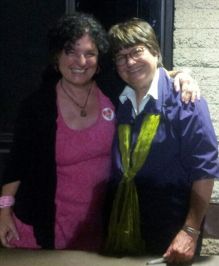
Marie and Sister Helen Prejean

The word “nun” can conjure images from traditional to irreverent in terms of gender. The gender of those who call themselves nuns can range from feminine to masculine, from a woman who looks like a woman dressed as a woman, a contemporary sister or “nun,” who does not wear the traditional black habit, but contemporary female clothing and perhaps a short veil or “wimple” and a cross around her neck; to a man dressed as nun in extremely sexual female garb, a “drag queen” nun; to the traditionally dressed nun, whose habit is a full-length black gown, and full veil covering everything but her face and hands, who means to conceal gender and become something else – a “nun.”

The physical space of “nun” then has opened the realm of gender for women, and recently men, since the creation of the category “nun” was established with the first order of female religious. Cloistered orders of women began in the fifth century, with the more liberated orders of “sisters” forming in the sixteenth century. The Encyclopedia of Catholicism lists approximately twelve Roman Catholic religious orders of sisters, or as they are commonly called, “nuns.” However, this terminology should be amended to allow for the difference between “sisters”- non-cloistered orders, and “nuns”- cloistered orders. Most traditionally the word nun officially refers to Roman Catholic nuns – those who take solemn vows of chastity, poverty and obedience, and live cloistered lives of silence, and prayerful meditation. Choir nuns, such as that of the famous convent headed by Hildegard de Bingen, (1098-1179), German nun, mystic and composer, chant the Liturgy of the Hours daily – consisting of a set order of readings and prayers, including Morning, Evening, Daytime and Night Prayers. Continue reading “Thoughts on Nuns and Sisters and Perpetual Indulgence by Marie Cartier”

Guanyin Revisited: Queer, Pacifist, Vegan Icon by Angela Yarber

Each month, I delight in writing about a revolutionary woman. Whether she is from history or mythology, sharing the stories of my Holy Women Icons with a folk feminist twist is one of my favorite things to do as a feminist, artist, scholar, and clergywoman. Yet, no matter how much research I’ve done, or how many times I’ve taught about an icon, new discoveries are made, revelations within my own heart and mind cracked open, so that there is sometimes the need to revisit a particular holy woman afresh. Such is the case this month with Guanyin. Though I wrote about her nearly two years ago, published a book including her story, and have taught a course with one session focused on her compassion and mercy, I realized that much about her has gone unsaid. Namely, she is an icon for queers, pacifists, and vegans. Before explaining why, let’s have a quick review…

Guanyin is the Buddhist Goddess of Mercy and Compassion. In the Lotus Sutras, she originates from a bodhisattva named Avalokitesyara. Avalokitesyara is identified as male in the Lotus Sutras. Overtime, however, Avalokitesyara transitions from being identified as a male to becoming Guanyin, most often portrayed in feminine terms and referred to as “she.” Many scholars assert that Guanyin is androgynous and can take on the form of any sentient being. And this is how I’ve always written about Guanyin, as the divinely androgynous one who is most often portrayed in feminine form. Continue reading “Guanyin Revisited: Queer, Pacifist, Vegan Icon by Angela Yarber”

It is a Matter of Focus by Deanne Quarrie

deanne_2011_B_smMany of the young women I meet tell me that they think feminism is not what they are about, that they prefer to work for the good of all. I understand that and certainly we can all choose where we wish to place our focus. However, it does make me wonder how effective we can be with our focus placed on so broad a scope. Certainly, we want equal rights for all and some call that “feminism” these days but is it?

In my 73 years, I have lived through quite a few years of women working for equal rights. I have seen many successes as well as the failures. I am incredibly proud of those successes. When I was in the early stages of my career and had just entered management, I was able to implement leadership methods, which now have become models for employers such as team building and servant leadership. Then however, there were no names for them. I led my teams based simply on how I wished my employers to treat me. Continue reading “It is a Matter of Focus by Deanne Quarrie”