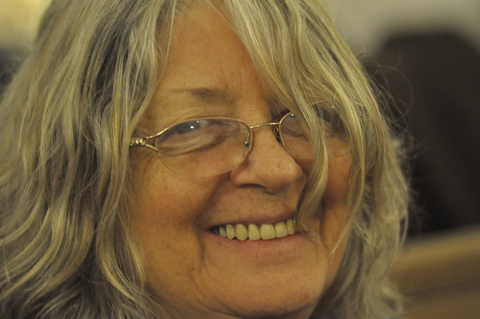
Boys Don’t Cry (or at least the shouldn’t when they are interviewing you for a job) by Natalie Weaver

Natalie Weaver

I want to begin by saying that I am grateful for my work.  It is no small thing to have a relatively secure academic position, especially in a climate when tenured and full-time appointments represent a disgracefully small percentage of all teaching positions throughout the country.  Nevertheless, a certain degree of professional movement is welcome for the purposes of growth and renewal if and when opportunity arises.  It is on this basis that I have been receptive on a few occasions to apply for appointments at the invitation of search committee chairpersons.  When I have been solicited for an application, I have in turn applied.

It is a curious thing because when you are contacted out of the blue you think something like… “ah, they must like me… they must know something about my work.”  And, it is true that on the occasions when I was asked to apply for something, I was invited to come in for an interview.  This furthers, of course, thoughts like… “great, this is going somewhere.”  And, in my case anyway, I start thinking about and even planning in a tentative way for what a move would constitute, the logistics of change, the impact on my family, the disruption of my current obligations, and so on.  Showing up for an academic interview midcareer involves much more than preparing a research presentation, which is also no small task.  The whole affair is psycho-socially weighty, and that reality is intensified by the fact that it drags on for months.  It can take more than six months from the time of the initial contact to the interview to receiving news of the final outcome. Continue reading “Boys Don’t Cry (or at least the shouldn’t when they are interviewing you for a job) by Natalie Weaver”

Apathy by Deanne Quarrie

DeanneWhen I sat down to write my article this month, I browsed through my computer for ideas.  As I did, I found this article that I wrote about 18 years ago for a newsletter I prepared for my workplace.  Because it is still a very relevant topic to me today, I thought I would share it here. ( food for thought – I am an introvert,  a triple Aries and a Myers Briggs INFJ)

I have spent a lot of my life sorting through very strong feelings in order to decide to express them or not. Of course, there are those that erupt before given the opportunity for that kind of sorting!  Just ask my friends and family!  I have often wondered if everyone has this going on inside their heads.  It is part and parcel of being an introvert to ponder such things. I have even wondered if perhaps some just  don’t have that experience of heavy duty “feeling”!  Of course, that’s a ridiculous idea.  We all have feelings.  We all just have varying levels of willingness to share them.  Continue reading “Apathy by Deanne Quarrie”

Christian Sex Ain’t So Vanilla by Andreea Nica

Andreea Nica, pentecostalismMy recent literary digests have included memoirs and nonfiction audiobooks on sex, relationships, and non-monogamy. A recent listen, Open: Love, Sex and Life in an Open Marriage by feminist activist Jenny Block, provides insight into the paradigmatic features of open marriage drawing on the personal experiences of a bisexual woman. Currently, I’m musing over my latest read: The Ethical Slut: A Practical Guide to Polyamory, Open Relationships & Other Adventures written by psychotherapist Dossie Easton and author and sex educator Janet W. Hardy. Through my literary adventures, I can’t help but reflect on my own sexual conditioning and upbringing in the Pentecostal church.

The authors of these feminist-friendly, sex-positive books and social movements did not exist in the church I grew up in, and I feel quite saddened by this. While my sexual conditioning in the church was far from liberating, these reads have helped me realize that the religious community wasn’t as mundane as I thought. My early sex education which was conservative consisted of the anatomical and biological basics (Arizona education system, need I say more?) and early conditioning of sex morals and ethics in the church. The latter was more influential to my perception of sex, gender, and relationships. Of course the media and my peers constructed my views of sexual culture and gender norms, but the church had the greatest impact during my childhood and adolescence. Continue reading “Christian Sex Ain’t So Vanilla by Andreea Nica”

Film Radical Grace Highlights Nuns’ Response to Vatican Reprimand

Radical GraceWhile the Catholic Church has sought to control US Nuns through what has been called the “New Inquisition,” it has been unsuccessful in its efforts.  The film Radical Grace documents the response of Sr. Simone Campbell, Sr. Jean Hughes, and Sr. Chris Shenk and is nothing short of brilliant.  Producers Rebecca Parrish and Nicole Bernardi-Reis chronicle their holy journeys in maintaining their vows by challenging the Vatican.  A full review of the film can be read here.

Please consider supporting the film through its crowdfund campaign.  The opportunity to meditate with Sr. Simone is incentive enough!  Congrats to Rebecca and Nicole on their fantastic project and much gratitude to Sr. Simone, Sr. Jean, and Sr. Chris for reminding us that “love is blind but obedience shouldn’t be.”

On April 30, the Vatican Doctrine of Faith “told the leadership group they were ignoring procedures for choosing speakers for their annual conferences and questioned if their programs were promoting heresy,” dashing hopes that the new pope would take a different attitude toward the nuns.

Continue reading “Film Radical Grace Highlights Nuns’ Response to Vatican Reprimand”

A feminist closet? by Linn Marie Tonstad

Linn Marie TonstadEvery now and again, a budding systematic theologian comes to my office and wants to talk about how to avoid being pegged as a feminist, and therewith avoid not being taken seriously as a theologian. Sometimes the students are feminists, but don’t want that aspect of their work to dominate or perhaps even to be visible for a time; in other cases, the students aren’t feminist – or didn’t start out that way – but are having experiences as they enter the guild that are raising these concerns for them in a new way. Perhaps professors are assuming that they are feminist simply because they are female, or perhaps male students are dominating in class and the professor is doing nothing to rein them in.

These students seek me out knowing that I am an avowed feminist and an avowedly feminist theologian. But they are concerned about the effects being or appearing feminist might have on their future careers. After all, they want to join the theological conversation in order to shape it – and their ambitions are right and justified. Continue reading “A feminist closet? by Linn Marie Tonstad”

Gendered Imagery of God (Part 2) by Elise M. Edwards

Elise Edwards

In my previous post, I shared some of the ways in which I’ve been wrestling with gendered imagery for God, the first person of the Christian Trinity often referred to as God the Father. In this entry, I’d like to reflect on ways I am reconsidering the gender of the Christ.

It is only recently, after reading Melinda Bielas’ post “Waiting for Jesus… I mean, Superman” (December 17, 2013), that I began to question male language for the Christ. I got into an interesting conversation with Grace Kao in January about it. My thoughts on this topic are still unformed and more theologically “speculative” than I usually share on this site, but I’d love to hear what you think. I think it is important for Christian feminists to consider the doctrines of the faith and assess where they support the co-humanity of women and when they degrade it. Continue reading “Gendered Imagery of God (Part 2) by Elise M. Edwards”

I Believe Anita! by Marie Cartier

Marie CartierDuring the past week I attended a Los Angeles premiere of a new documentary Anita: Speaking Truth to Power (Dir: Freida Lee Mock USA, 2013). The screening was sold out and I had great seats saved for me– sitting with a friend who works at Samuel Goldwyn, the distributor of this fine film.

In 1991, Anita Hill provided testimony she hoped would serve to dissemble the nomination of Clarence Thomas as a Supreme Court justice. Although the vote would end up being close (52-48) Hill’s testimony did not serve to dissuade the decision — Clarence Thomas’ nomination was confirmed and he was appointed to a life term on the Supreme Court four days after Hill’s testimony concluded. Here is an outline of the debate. Continue reading “I Believe Anita! by Marie Cartier”

In Memoriam – God Hates Fags

Phelps didn’t just live a life filled with hate but he also embodied the very reasoning why so many communities cannot cross that proverbial bridge to work together to see past their differences and maybe never will. In the case of Phelps, sticks and stones may break our bones, but words really do hurt.

Fred Phelps, an American PasFred Phelpstor who headed the Westboro Baptist Church in Topeka, Kansas died at the age of 84 on March 19, 2014.  While some individuals leave behind legacies of their good deeds and loving memories, the only thing Phelps left behind was a family and church founded on the principle of hate.

A frequent eyesore at various events ranging from military funerals and gay pride gatherings to mainstream events that captured the attention of our pop-culture obsessed society, Fred Phelps and his clan believed it was their sacred duty to warn others of God’s anger over the growing acceptance of not only modernity in general but also issues like gay rights and abortion.  From slogans and signs such as ‘God Hates Fags’ to ‘Thank God for IEDs (Improvised Explosive Devices), Phelps has caused many controversies both during his lifetime and after his death.

Continue reading “In Memoriam – God Hates Fags”

Dr. Debbie Downer Discourses on the Lives of Early Pious and Sufi Women by Laury Silvers

Silvers, Bio Pic FRBlogI’ve been called a downer because I take what seems like a jaundiced perspective on the early history of pious and Sufi women. There is a tendency in some scholarship, and nearly all contemporary popular treatments of these women’s lives, to over-focus on the positive. They fasten to aspects of their lives that we (post) moderns regard as “positive” or even “liberating,” while ignoring what we find less attractive or troubling. For them, these treatments tell a story of a lost tradition of feminine and egalitarian spirituality representing a golden period that we only need to reclaim to overcome the present state of sexist affairs in our religion. I know these kinds of stories work for women, or they would not keep retelling them. But they don’t work for me. Continue reading “Dr. Debbie Downer Discourses on the Lives of Early Pious and Sufi Women by Laury Silvers”

Gendered Imagery of God (Part 1) by Elise M. Edwards

Elise Edwards

I have been doing a lot of thinking about gendered imagery and language for God over the past few months. Honestly, a lot of this reflection was provoked by hostile comments I got from my college students at the end of the fall semester because I require gender-neutral language for God and gender-inclusive language when referring to people. The policy in my syllabus is this:

For academic discourse, spoken and written, students are expected to use gender-inclusive language for human beings, and gender-neutral language for God. (e.g. “God” instead of “He;” “God’s” instead of “His;” etc.) This is to prepare students to communicate to the world beyond the Christian university setting. I want to equip you to succeed in graduate school, in the corporate world, and in public communication, all settings in which gender inclusive language for is increasingly expected.

I provide links to websites that discuss the issue, and we talk about it more when we discuss 20th century feminist issues in my course on the Christian Heritage and when we discuss prejudice and sexism in my ethics class.  Some students have thanked me for the policy. But many students are perplexed by it, and I’m perplexed by their confusion. It shocks my system when I hear people refer to “man” for all people; I first became aware of the issue when I was in 2nd or 3rd grade and the Girl Scouts changed their pledge because it referred to “mankind.” That was over 30 years ago!

While I’m confused as to why replacing “man” with “people” is such a difficult task, I am more empathetic to the reorientation required to replace “He” with “God.”  (And I also acknowledge that the term “God” is not completely genderless either.) I recognize that for many of my students, I might be the first one to challenge their gendered conceptions of God.  So I am empathetic, but insistent.

The way discussions about the “gender” of God and Savior are often dismissed as irrelevant, unimportant, silly, or the remote concern of “those feminists” bothers me. Traditional Christian theology asserts that God is a different kind of being than humans are.  Therefore, God (the first person of the Trinity) and the Holy Spirit do not have a sex or gender, as sex is a characteristic associated with physical creature-ness and gender is (to simplify) a social construction related to sex. The second person of the Trinity, Jesus, is thought to be male.  In the Incarnation, the eternal God became human while also divine, and therefore has a sex and gender in the person of Jesus.  But the Trinity as a whole is without sex and has characteristics that we would associate with femininity, masculinity, and genders in between.  According to this logic, references to the maleness of God should only be understood metaphoricall,y not literally, and therefore replacing that language with genderless/sexless language should not be inherently problematic.

I’m not saying that the use of any language in reference to God is appropriate or acceptable within the bounds of traditional theology.  We (traditionals and non-traditionals alike) should be concerned with how we refer to God, because as Sallie McFague and others remind us, these metaphors/models of God have consequences in the world beyond language.  Maleness becomes deified or closer to godliness than femaleness, maleness becomes the model for the priesthood, maleness is the true form of authority, etc.  I believe that many of the concerns about feminine imagery for God are based in this same concern: that by associating God with one sex or gender, we claim God’s preference for that sex or gender.  In a patriarchal system, this correlation between God and the feminine simply will not do.  Feminists who assert feminine qualities of God are merely making projections of themselves, critics claim.

How we conceptualize the being we worship matters. It matters to me, at least. While I acknowledge that there is a danger of simply projecting an image of myself as a deity that I worship, I also think there is great harm in loving and worshiping the divine imaged as those who are at times hostile to me, and historically have been so to my ancestors and kin. So although I know and have good relationships with older, white males, I see no reason why I should image and worship God “the Father” who looks like an old white man. How would that benefit my spiritual practice?

Thank you Carol Christ, for asking me to state my views about this in the comments to my last post. I look forward to more discussions with you and the members of this community.  When I read your work years ago, I was convinced about the validity and rightness of affirming feminine forms of divinity. Although the Christian (patriarchal) tradition does not have much room for Goddess language, I am comfortable with it, at least for the first and third persons of the Trinity. In my next post, I’ll talk more about the ways I am considering the gender of the Christ.

Elise M. Edwards, PhD is a Lecturer in Christian Ethics at Baylor University and a graduate of Claremont Graduate University. She is also a registered architect in the State of Florida. Her interdisciplinary work examines issues of civic engagement and how beliefs and commitments are expressed publicly. As a black feminist, she primarily focuses on cultural expressions by, for, and about women and marginalized communities. Follow her on twitter, google+ or academia.edu.