Becoming a Godfather was more than just a reentry into the Catholic traditions I had long given up but rather a journey back in time that would grant me the ability to rewrite the wrongs I felt as a kid growing up in a tradition I not only didn’t understand but also didn’t feel like I belonged in.
I often wondered why I wasn’t asked to be the Godfather of my niece and nephew. It made perfect sense to me that I would be the best person to guide and provide spiritual care for either of them as I was the only member, in both my family and my brother-in-law’s, getting a PhD in Religion. I didn’t think there would be much to it. I would go, hold my nephew, and watch a priest pour water over his head, and then go and enjoy some very sugary cake in my sister’s backyard.
On August 18th, 2012 my wish came true and I became the Godfather to my sister’s second child, Drew. I had always believed that there was nothing to being a Godfather. That it was a title in name only and a tradition that many individuals bestowed upon members of their family as ritualistic habit rather than a sacred institution of spiritual care and upbringing. Boy, was I wrong. Continue reading “8 Simple Rules for Being a Queer Godfather by John Erickson”
As many feminists invest their life fighting for women’s rights to be the center of attention – no one could predict the occurrences of this election year. In my previous post “Rape is Not a Political Platform – Rape is a Violent Crime!” Carol P. Christ made a comment about women’s issues and politics:
“I have been waiting all my life for women’s issues to become central in an election campaign, but I guess I should have been more specific in my wish: this is not the format I imagined…”
Christ’s reaction is like so many others in the election; no one could have imagined such a bizarre and backwards slide being lobbied against women’s rights. Issues being bantered around continue to be rooted in a purported pro-life stance. This ranges from trans-vaginal ultrasounds, definitions of “legitimate” rape, and now using an Ob/Gyn’s “best guess” to define the gestational age of a baby from the time of a woman’s last period. This is not a game – this is semantics, this is politics, this rhetoric, and frankly, this needs to stop. Continue reading “Is the Republican Party Platform Truly Pro-Life? by Michele Stopera Freyhauf”
Just when you think you have heard it all, here we go again – another politician with “open mouth-insert foot” syndrome. Discussing his zero-tolerance policy for abortion, Missouri Representative Todd Akin made the following statement last Sunday about pregnancies that result from rape:
“from what I understand from doctors, that’s really rare. If it’s a legitimate rape, the female body has ways to try to shut that whole thing down. But let’s assume that maybe that didn’t work or something. I think there should be some punishment, but the punishment ought to be on the rapist and not attacking the child.”
In an inadequate attempt to apologize and clarify his words, Akin stated that he meant to say “forcible rape.” This clarification fares no better nor does the fact that he later acknowledges that women “do become pregnant” during a “forcible rape.” It is interesting to note what Akin considers to be “rare.” According to the Washington Post, approximately 5% of rape victims become pregnant. Akin reduced this to a statistic – 1 out of 32,000 women. This, for Akin, is a rare occurrence.
Stating that a woman’s body is capable of preventing pregnancy in the case of “legitimate rape” demonstrates how out of touch politicians are and further (re)affirms the bigotry that exists within our political system. The same politicians who have waived a “war against women” this year, try to promote policies that exercise control over what a woman can and cannot do with her body; policies that are based on ill-advised misinformation. Decisions politicians make for a woman – what she can and cannot do with her body – are rooted in personal faith beliefs, party-line agendas, and supporters (campaign financing dollars and lobbyists). This year, a woman’s body has become a platform for votes.
Sometimes I think it happened gradually. Other times it feels like sudden change. Either way I find myself in an in-between space that is my life.
With apologies to Victor Turner and his cultural anthropological appropriation of liminality as a threshold space, I have come to view my liminal living as a more permanent dwelling place these days. Turner’s category of liminality locates subjects in the betwixt and between as they move from one manifestation of identity in community to a new kind of integration or role in community. I am starting to wonder, however, if the thresholds are actually dwelling places for some of us in this world.
I don’t know if that means I am actually more marginal than I am liminal. The margins are margins because they remain on the outskirts and they help define the boundaries. Margins are permanent. Am I marginalized if I live at the edges of the communities and identities I use to occupy, perhaps never to return to the bosom of the center? I hesitate to make such a claim mostly because I still occupy privileged spaces not the least of which are those constructed from how whiteness grants access and authority in this world. Continue reading “Living Liminality: Of Thresholds and Dwelling Places by Marcia W. Mount Shoop”
What I realized was that my ability was different from hers and that I really could, as in ‘I had the ability to,’ decrease our time. I carried our arms differently; and it surprised me. I’ve never forgotten this sudden sense of myself and of my own power.
Watching the Olympics this week, I found myself very inspired… and very reflective. You see I was once an athlete. Not an Olympic caliber athlete, but an athlete none-the-less. I swam competitively for eight years. My events were the 100 and 200 freestyle and the 200 and 400 Individual Medley. I started swimming in 8th grade. I worked out 30 hours a week through my last two years of high school; and I was relieved when I started swimming for an NCAA division one team in college because the NCAA limited workout hours to *approximately* 20 per week—so I had more time to study. I was a swimmer and I was completely dedicated to my sport.
But as I got older, my times slowed and I no longer felt successful; so I began to deny myself the title “athlete.” It’s still hard for me to claim this title (even when applying it to the past) because my body has changed so much, as has my competitive drive. I am more comfortable identifying as an academic. Plus, as therapy and my feminist academic studies helped me to realize, I had often used my swimming to physically punish myself, literally. Continue reading “Olympic Inspiration: My Athletic Mirror by Sara Frykenberg”
Once what happened was after people started believing someone around also started believing in this temple and one person kept a statue on their steps. Her Aunty she believed and she is very much interested in small things. So she started decorating it up. And what happened was the statue starting getting bleeding, like monthly monthly. And the dress which the statue wore during those periods was stained with red bleeding. So they asked Guruji about what is this and he said that the shakti has come into the statue. So if you keep this in the home it will turn into a temple so go and leave it outside. This was followed by entry of snakes, king cobras, so what they did was they went and left it in the sea, after which her grandmother had a dream that you have left me in the water but still I am with you. I am the temple opposite here, put a lamp everyday at that place. So they started putting it out there, and now there is an earthen Kali which as come up in that place by nature. –Interview with Premila, March 18, 2008 Continue reading “Through Body and Space: A Glimpse into Women Worshippers of Aadhi Parashakthi by Amy Levin”
The prophetess Miriam, Aaron’s sister, took a tambourine in her hand, while all the women went out after her with tambourines, dancing; and she led them in the refrain: Sing to the LORD, for he is gloriously triumphant; horse and chariot he has cast into the sea.”(NAB, Exodus 15:20-21)
The Song of Miriam is not a story of death and destruction, but rather liberation. It is a poetic celebration of God’s liberation of the Israelites from the oppressive Egyptians, which, according to Bernhard W. Anderson in “The Song of Miriam Poetically and Theologically Considered,” marks the beginning of the Israelite tradition (292). Phyllis Trible in “Bringing Miriam out of the Shadows” states that this act marks the end of the Exodus, which was started by Miriam, not Moses (169, 172). The act of liberation reveals God’s action in humanity. Gerald Janzen in Exodus believes this act also moved the Israelites “to fear the LORD and believe in the LORD and in his servant Moses” (109). The uniqueness of this passage is that the most unlikely person leads – this person is not a man but rather a woman.
This brief passage in the Hebrew Scriptures is revelatory – Miriam is revealed for the first time. She is a prophetess, Aaron’s sister, and the role of leader of the victory dance to honor the Divine Warrior.
Can women have it all? Possibly. Can men ever have it all? Maybe. Regardless of however we put it, the are ills to every good deed in the world and we need to get back to understanding how and why we use each other in order to fully understand that behind every good man might be a good woman but also behind every good women there might also be a good man.
Growing up, my favorite movie was The Associate staring Whoopi Goldberg as a woman at a Wall Street firm attempting to climb her way up the corporate ladder through hard work and dedication. Her character Laurel Ayres does all the work and comes up with the ideas that clients eventually invest in, her partner Frank takes all the credit and eventually surpasses her at work by getting the promotion she had been vying for. In a prodigious scene that I still vividly remember from my childhood, Laurel quits her job and starts an investment firm on her own; betting every cent and piece of property she has on the eventual success of her new business adventure.
In an attempt to break through the proverbial glass ceiling and play with the big boys of Wall Street, Laurel eventually discovers that although she can be (and is) the genius behind many of the great ideas that would save companies millions, she still needs to have her ideas expelled by a man she creates in order to win over clients, which eventually leads her to become successful. However, while Laurel is reaping in the benefits of having Mr. Cutty, her made up business partner, by her side, she eventually learns that no matter what she does she will always be secondary to her male business partner. Continue reading “Why Men (and Women) Can’t Have It All by John Erickson”
Spiritual Power is arguably the most dangerous power of all. In the wrong hands, it gives the power to make judgments even about the eternal fate of another person. It needs a sign on it at all times saying, ‘Handle with extreme care.’ The greater the power a person exercises, the more need there is for checks and balances before it is used and accountability after it is used.” – – Bishop Geoffrey Robinson
May 6th, I addressed the issue of abuse of power in the Catholic Church and how we seem to be unraveling any kind of progress made since Vatican II. Since writing that article, the Leadership of the LCWR met with Vatican Officials and expressed their concerns openly. A dialogue occurred and left no resolution, just information that the leadership will discuss with the community at their August meeting. That meeting will reveal their next step in this controversy – concede and follow the conditions and rules sets forth by the CDF or disband and form a new religious community or maybe there will be another option revealed.
I have to ask though – Was this a meaningful meeting or was it meant to pacify the Sisters and their supporters? Will the Vatican change its stance? Certainly, the U. S. Catholic Sisters have not been
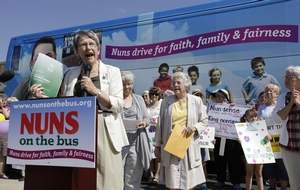
pacified, nor have their supporters. For example, there is a “Nuns on the Bus” tour traveling around the United States, prayer services for the Sisters, #nunjustice and #whatthesistersmeantome campaigns on Twitter. Even the Women’s Ordination Conference delivered a petition containing over 57,000 signatures to the Vatican in support of the Sisters. Certainly, the support for the sisters and their mission is not dwindling, but growing stronger every day.
As for the Vatican, a change in their position is doubtful, but we can continue to pray. I am, however, very discouraged by a statement attributed to Pope Benedict that indicates a desire to have a smaller more faithful Church of Catholics then a large Church of people who do not adhere to Church Teaching – seeking out a small, strong, holy community.
Obviously, it is my hope that this statement was taken out of context, but I have to be honest and say
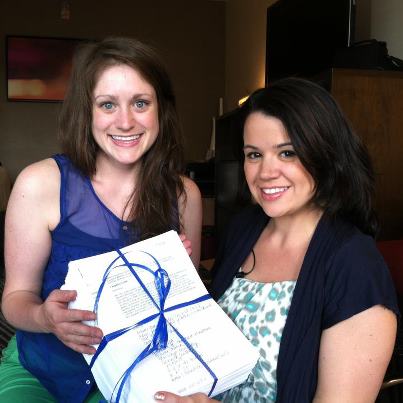
Women’s Ordination Conference delivering Petition Picture reprinted from WOC’s page on Facebook
that my hope is filled with doubt. This is not the first time I have heard clergy make this statement. Priests have made this statement in my presence – wanting a more faithful flock and dismissing those that do not adhere to their interpretation of Church teaching. This stance does not bear fruit, but is rather a power play – a play that can be called many things – misogynist, arrogant, non-pastoral, cold-hearted, and frankly un-Christian. It also plays with a person’s spiritual fate and in many cases their soul. The psychological impact of something like this is dangerous for some. Some ordained will go so far as to withhold sacraments or even compromise the person’s status in the Church, including their role in ministry, for the sole purpose of inducing compliance – a tactic that dates to the medieval period.
This is a moment we all face—the moment when we slay the enemy, only to realize we have slain ourselves and the enemy is still at large.
In Part I of this blog, I analyzed the themes of power and beauty in the film Snow White and the Huntsman in relation to the character of the Queen. In Part II, I would like to continue exploring these themes in light of Snow White’s character and her relationship with the Queen. That Snow White’s power is her beauty is clear. True, it is stated right up front that Snow White is admired throughout her father’s kingdom “as much for defiant spirit as for her beauty.” However, it is her beauty that grants her agency and power, not her free and defiant spirit. The battle scene in the climax of the film illustrates this connection between power and beauty well—as Snow White drives her dagger into Ravenna’s heart she repeats the mantra: “By fairest blood it is done; by fairest blood it is undone.” After Ravenna breathes her last, we see Snow White looking into the mirror on the wall, the victor, the fairest. Her beauty has allowed her to ascend to power. Her beauty has allowed her to defeat Ravenna. We are left wondering—who has won exactly? Continue reading “A Tale of Power and Beauty, Part II: Snow White by Amanda Kieffer”


 I often wondered why I wasn’t asked to be the Godfather of my niece and nephew. It made perfect sense to me that I would be the best person to guide and provide spiritual care for either of them as I was the only member, in both my family and my brother-in-law’s, getting a PhD in Religion. I didn’t think there would be much to it. I would go, hold my nephew, and watch a priest pour water over his head, and then go and enjoy some very sugary cake in my sister’s backyard.




 Feminism and Religion