This post was originally published on Feb. 17th, 2014.
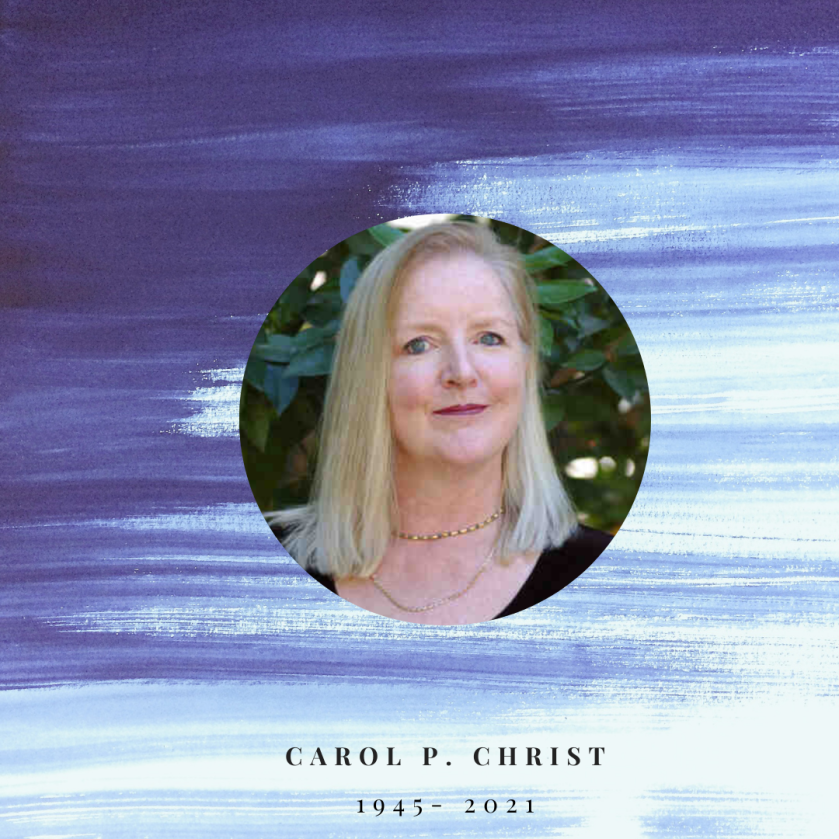
For me the word “matriarchy” expresses the certainty that “another world” can exist—a world not based in domination and hierarchy or violence and war.
The word “matriarchy” makes people’s hair stand on end as they imagine the mirror-image of patriarchy: societies in which women dominate men, beat men, rape men, hold men as slaves, and demand obedience from men. Some who do not protest very loudly or at all against patriarchy are horrified by the very idea of matriarchy. To be fair, most feminists have also been schooled not to use the “m” word.
Early in my academic career, I read “The Myth of Matriarchy” by Joan Bamberger and learned that the idea of matriarchy gone wrong has been used by men to justify patriarchy. From other academics I learned that in matrilineal societies, uncles have a great deal of power—so therefore there never was a matriarchy. I was also aware that Jungian and other proponents of a “matriarchal stage” in the development of culture have argued that matriarchy had to be succeeded by patriarchy in order for societies to evolve to a “higher” stage. Unlike many of my colleagues I stubbornly held onto the belief that there must have been “a better way” prior to patriarchy. Continue reading “Legacy of Carol P. Christ: MATRIARCHY: DARING TO USE THE “M” WORD”
This post was originally published on Feb. 3rd, 2014.
A rabbi known as Jesus of Nazareth taught that you should “love God with all your heart and your neighbor as yourself.” Charles Hartshorne, philosopher of relationship and a twentieth century advocate of the “two great commandments,” added that it should be understood that this means that God wants you to love yourself too.
The scent of balsam wafts through the room as I cut the boughs to make my annual wreath to honor all trees, those that still stand, those who are slaughtered. My intention each year is twofold – acknowledge my love for these sentient beings and to participate in the unfolding of the Great Round. Other intentions vary from year to year until recently when a prayer for protection from the dark forces that permeate the psyches of so many peoples of this earth becomes a yearly part of this winter ceremony, even as a multitude of others suffer intolerable losses.
Today’s American culture creates endless non-religious festivals to celebrate the entrance into this winter season that are totally devoid of meaning beyond consumerism – buy more ‘stuff’ – chop down more trees. These devourers can never be satiated because the chasm is too wide and deep.
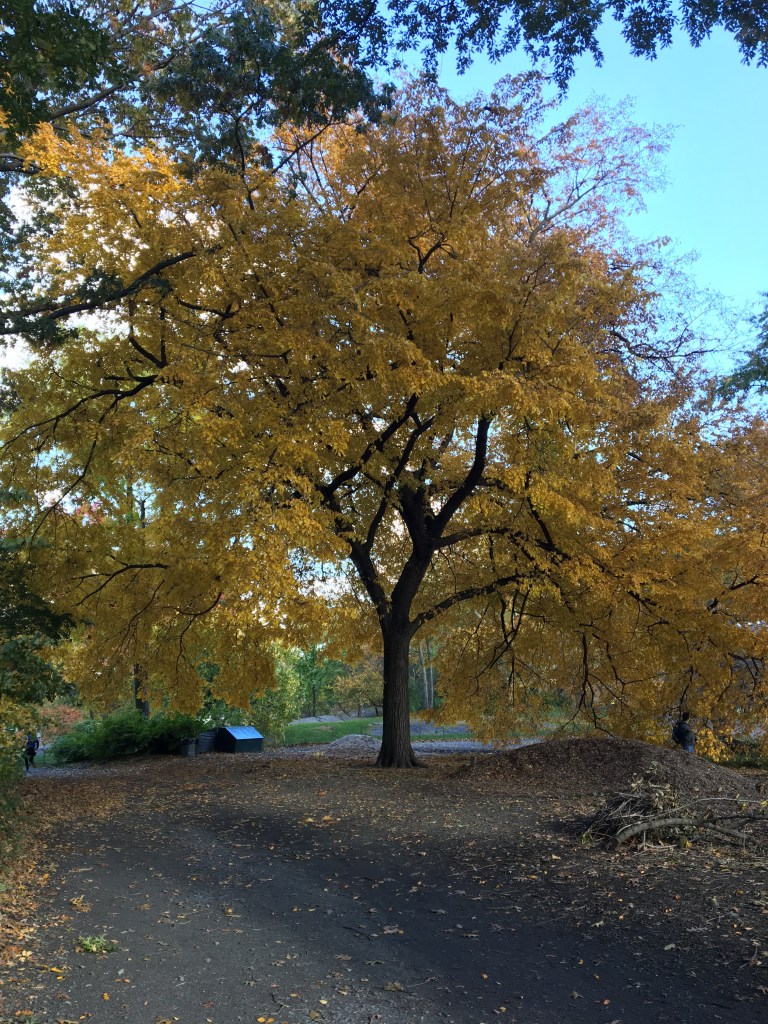
Almost every day, I walk in Central Park. There are certain trees there I’ve come to know: the gnarled cherry trees by the reservoir, the bending willows and tall bald cypress by the pond, the sycamores that drop their bark each summer, the hawthorn not far from Central Park West. Lately I’ve been taking photos of the trees to try to capture their essence, their posture in the world. The trees around me feel like friends, which is what an ancient midrash (interpretation/legend) called Genesis Rabbah says about trees: that they are friends to humankind. To me, they’ve always been a central manifestation of Mother Earth.
Currently, the national parks in the United States have no staff because of the government shutdown. Some people have taken the opportunity to cut down the rare and endangered Joshua trees in the Joshua Tree National Park—just for fun, I guess, or as a trophy of some kind. Meanwhile, President Bolsonaro of Brazil recently has indicted that he wants to remove protection for the rainforest, in order to allow development. It appears that my friends the trees have enemies. Sometimes the enmity is for personal/corporate gain, and sometimes the enmity seems to have no reason at all.
Even though the world is full of injustices, system breakdowns, and wars, I am thankful to be alive.
Even though the current trajectory of climate change, together with inaction to change the way society is organized, promises the collapse of modern industrial civilization, I am thankful to be alive.
Even though my own life has had many set backs and personal disappointments, I am thankful to be alive.
Practicing gratitude helps me deal with these adversities. But practicing gratitude goes beyond its ability to deal with adversity. It helps me to feel more positive, to appreciate small everyday occurrences like sunsets and running water, to treasure good experiences, and to build strong relationships.
In the 1960s and 1970s, American-born Genevieve Vaughan was living in Rome with her husband, philosopher Ferruccio Rossi-Landi, and their three daughters. When Rossi-Landi, using Marxist models, began to write about language as a form of “exchange,” Vaughan was inspired to articulate her alternative theory based on the idea that language was developed and is learned through the gifts of the mother to the child. From that beginning, Vaughn developed an alternative theory of culture based on what she calls the “gift economy.”
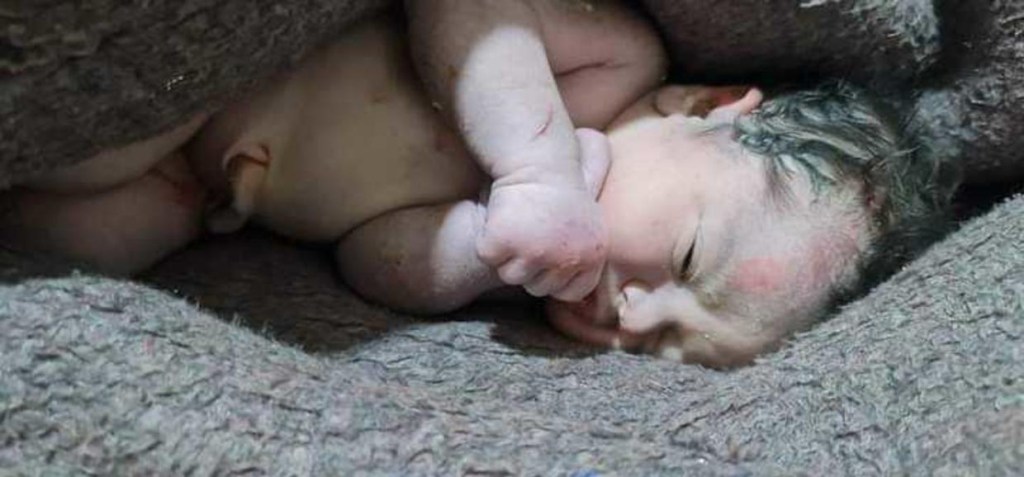
The image of the baby born under the rubble of the earthquake in Syria has been haunting me. So has the image in my mind of her mother, giving birth to her baby while trapped after the building, where she, her husband, and their children were sleeping, collapsed. The baby’s uncle, when digging through the debris hoping to reach his brother and family, found the baby alive, her umbilical cord still attached to her mother. When he cut the cord, the baby let out a cry. Tragically, her mother had died after giving birth, as had her father and siblings.
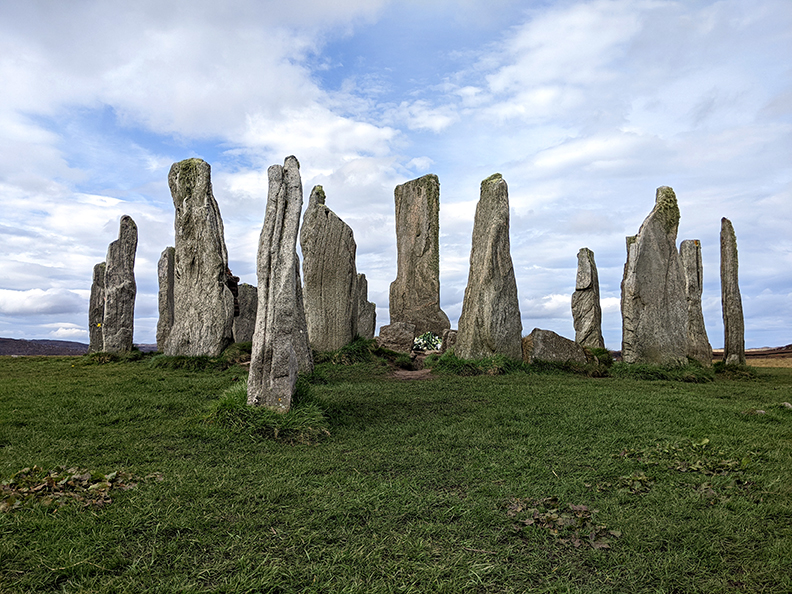
I felt compelled to visit Scotland without truly understanding why. I said I was called by my studies of Celtic mythology and by images I had seen of the land. I told people in Scotland I was on an artist’s journey. But now I see that Mother Earth wanted my attention – and in Scotland, particularly in the Highlands, Earth energy is strongly present. From the start, a major part of that calling was the ancient Callanais Stones – pronounced like the English translation “Callanish” – located on the remote Isle of Lewis.
Getting around the Hebrides and the Highlands was difficult without a car as bus access is very limited. Though a little restricting, it kept me connected to Earth as I walked and I walked. With every step I felt the call of Earth – from even before the human family began.
It was a glorious sunny afternoon when I arrived by ferry on the Isle of Lewis/Harris. Next was a bus ride north to Stornoway, my base for exploring Callanais. Here I first learned of the Stones connection to the Cailleich, an ancient goddess whose origins are unknown. Her name literally means “the Veiled One” but has come to mean “Old Woman or Wife.” Yet she was all powerful and ageless.
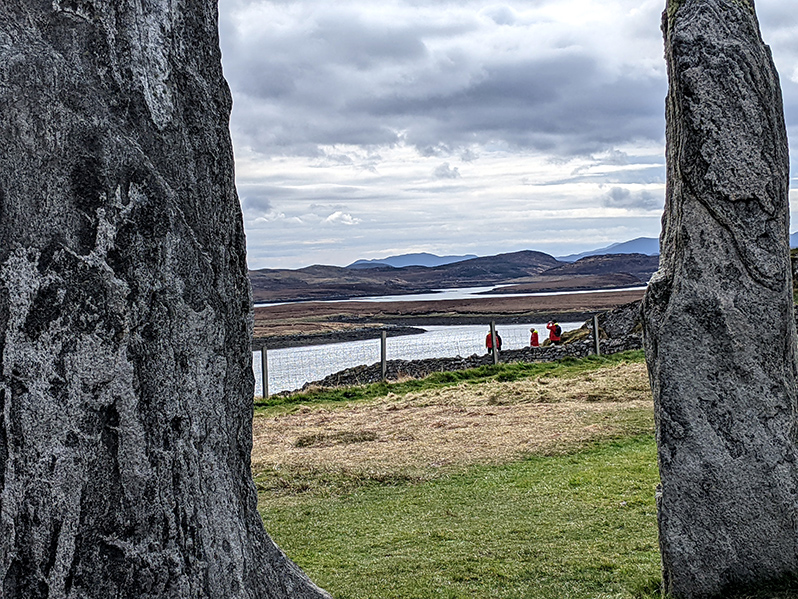
An elder man spoke about Callanias and the Stones’ connection to the nearby mountain – “Cailleach na Mointeach” – Gaelic for “The Old Woman of the Moors” or affectionately called “Sleeping Beauty” as the mountain looks like a woman lying on her back with bent knees. He said you could see this mountain through the stones. His storytelling got me searching for more info on the Cailleach’s connection to the Stones.
Cailleach na Mointeach, Isle of Lewis
First, I learned of the extreme age of the islands and of the stones that make up the land. The Callanais Stones date back to 3500 BC but the rocks that created Scotland come from an inconceivable 3 billion years ago as the landmasses of Earth were created from out of the waters.
Around 450 million years ago, at the beginning of the Caledonian Orogeny, Scotland, Scandinavia and North America were one continent with the now, non-existent Iapetu Ocean separating them from England, which was joined with the rest of northern Europe. This was a long geological period of continental collision and mountain building, that turned Iapetu Ocean into land and fused Scotland and England together.
Quieter conditions occurred for several millennia, covering Scotland with layers of sediment forming various sedimentary rocks until 60 million years ago when Earth moved again and the continent split apart forming the North Atlantic Ocean with volcanoes erupting all along Scotland’s new western edge.
These are the creation stories the science of geology tells us. But our ancient ancestors told a different story of the creation of Scotland and the other Celtic lands. Long, long before the Celts arrived in Ireland and Scotland, the indigenous people worshipped The Cailleach, as both the goddess of creation and the goddess of destruction. She became Calleach Bheur to the Scots. “Bheur” means sharp and she was credited with creating the sharp and biting winter weather, which helped to shape Scotland.
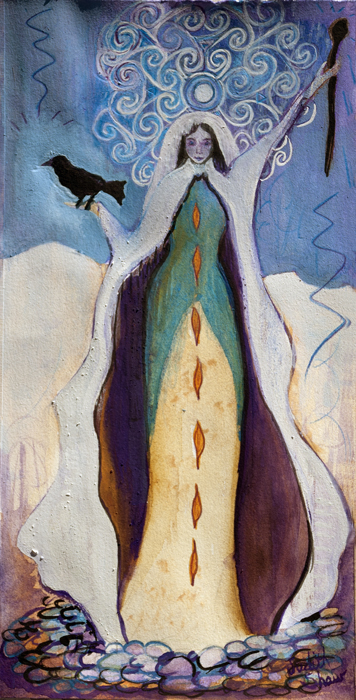
The Cailleach, a Dark Goddess of nature, is one with the land. Sometimes depicted with one eye, she sees beyond duality peering into the Oneness of all Being. She is the embodiment of winter, clothing the land with snow. Sacred Stones are her special places.
She leapt from mountaintop to mountaintop, dropping rocks to create hills, mountains and islands. She carried a slachdam – the Druidic rod, or a hammer with which she wielded power over the seasons and weather.
She is the guardian of the life force, finding and nourishing the seeds, commanding the power of life and death. The Cailleach personifies death and the transformative power of darkness, leading us through death to rebirth.
Our ancestors believed that the rocks on the Isle of Lewis used to create the Callanais Stone Circle were gifts from the Cailleach – from her acts of Earth building. These metamorphic gneiss rocks are among the oldest in Europe and are embedded with various types of crystal such as quartz, feldspar and hornblende. Perhaps these crystals in the ancient rocks create the energy field I felt so strongly on my visit – all coming from the hand of the Cailleach, a personification of the power of Mother Earth.
Archeologists theorize that the 5,000 year old Callanais Stones were a sacred site created for ritual and prayer, in particular from which to mark the 18.6 year lunar cycle – similar and yet more complicated than the yearly Sun cycle of Summer and Winter Solstices.
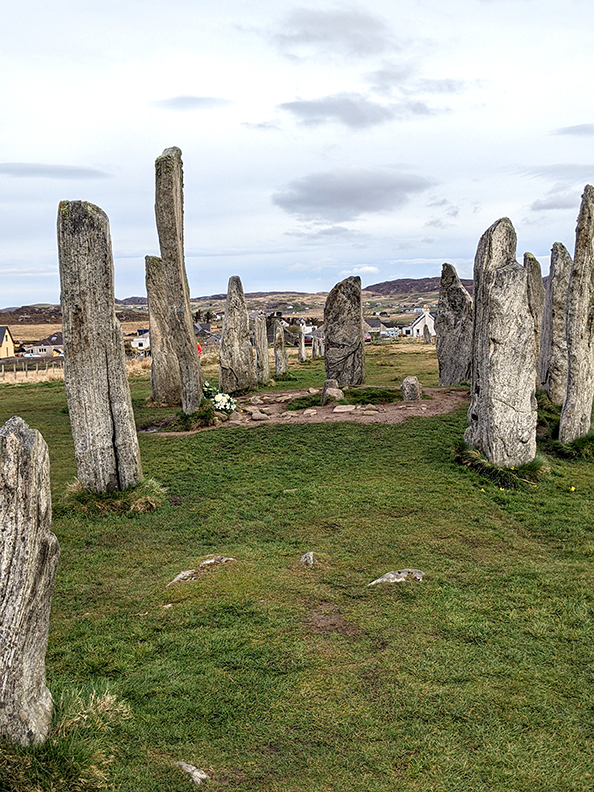
Callanais Stone Circle seen from Cross Entrance on East
Every 18.6 years, this moon cycle reaches Major Lunar Standstill with the full moon nearest the Summer Solstice. It is viewed through the Callanais Stones rising out of Cailleach na Mointeach – our Earth Mother. Being so far north it only skims the horizon then appears to set among the stones.
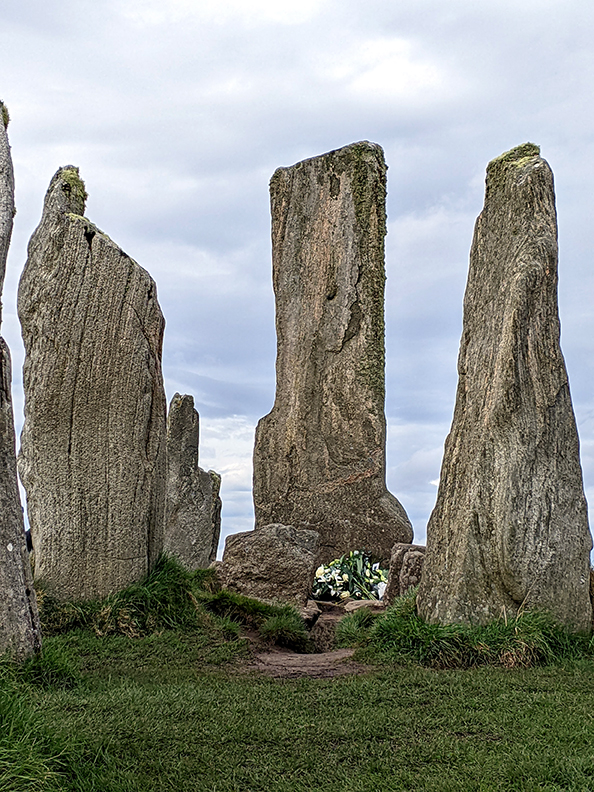
Two stones of the Callanais 13 stone inner circle framing Cailleach na Mointeach
It is hard for our modern minds to understand the awe these ancient people must have felt at the beauty and terror of nature during the Megalithic Era – when the human family was first beginning to settle in one place though had not yet discovered agriculture.
Perhaps the ceremonies held at Callanais helped hold the terror at bay. Closing my eyes I can imagine being there on this short night, near mid-summer, for the ritual marking of the passing of winter – I and my tribe had survived the season of long, dark nights. This was the special time that our tribal shaman knew how to mark. We all understood the precariousness of life and that marking the circuits of Earth and Sky provided invaluable knowledge for our survival. I can imagine feeling immense gratitude witnessing the cycles of life unfold as Earth and Sky and human minds interacted and the full moon rose out of our Earth Mother – Cailleach na Mointeach – and then set within the Sacred Stone Circle.
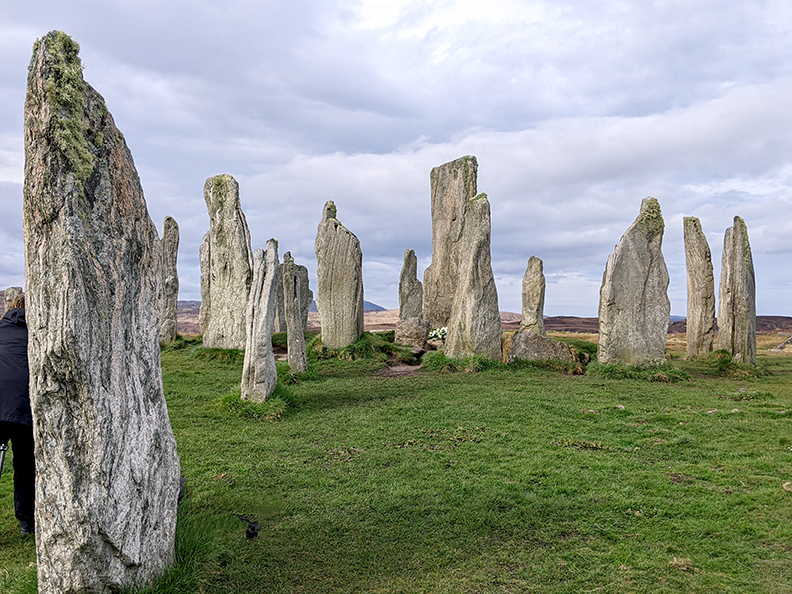
Further illustrating Callanais’ connection to Goddess, its original construction was comprised of 13 stones arranged in a circle – both number and shape are symbols of Moon and Goddess. At some point an even-armed cross was added around the perimeter – symbolic of the sun and of the meeting place of the divine and the mundane.
It seems unlikely that such a magnificent structure was created for use only once every 18.6 years. Of course these people left no written account of their actions, but local legend and lore suggests the Callanais Stones were seen as a fertility power spot. Given the Stones connection to Moon and Goddess that is not surprising. An old legend claims that Callanais is a promising spot to consummate a marriage or become engaged. In fact I overheard a couple of visitors while I was there claiming to have become engaged at Callanais.
But what does a site like the Callanais Stones hold for us today? Can Mother Earth still speak to us there?
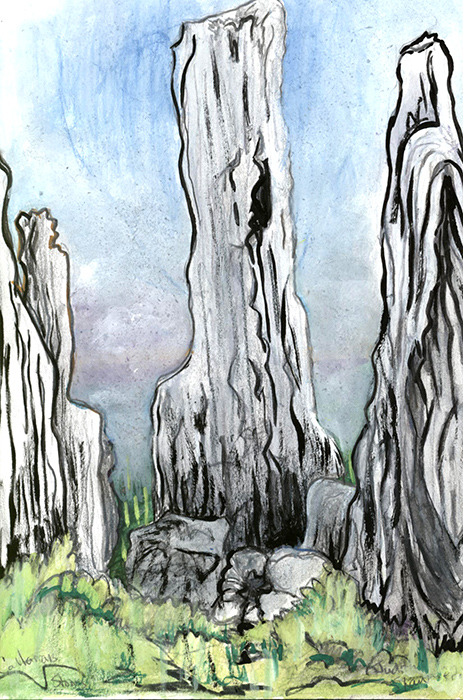
After a bit of a wander through and around the Stones, I sat and sketched. Slowly through that act of eye to hand to pencil to paper I began to feel the deep connection that always comes in when I attempt to translate 3D reality onto a 2D piece of paper.
Time passed and soon the only return bus would arrive so I stopped and just sat quietly, listening to the wind and feeling the energy. I felt strongly a sacred presence in this spot where long, long ago ceremonies for Goddess had been held. I heard the Cailleach’s calling – to an acceptance of our modern world and the difficult days of transformation the 21st century offers up. The winds carried her message – a glimmer of hope that we can find our way back to living in balance with her natural rhythms of creation, destruction and creation. I felt her reassurance that though the geography of Earth changes and the epochs of humankind and the flesh and bones of all creatures pass away, the magnificence of life continues. The Cailleach touched my heart there at her Sacred Stone circle, reminding me that, though pain and suffering has been and will always be with us, life is a gift to be cherished.
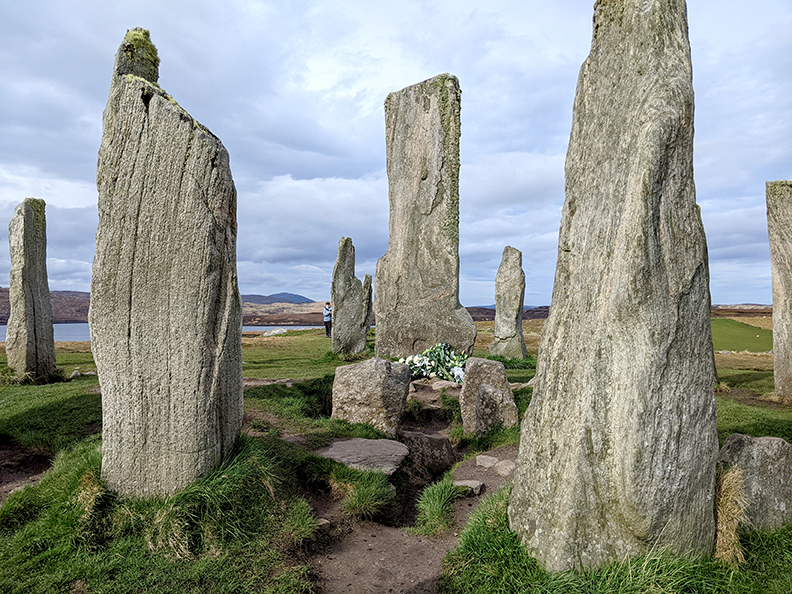
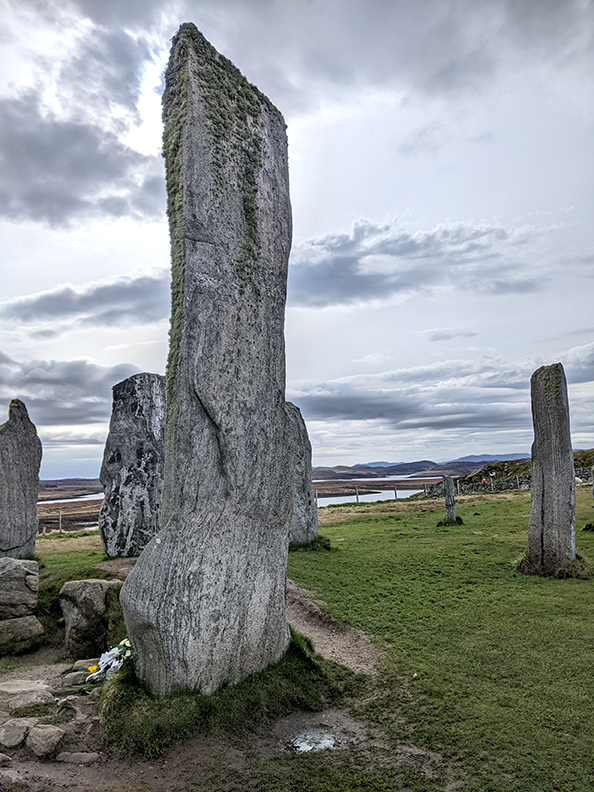
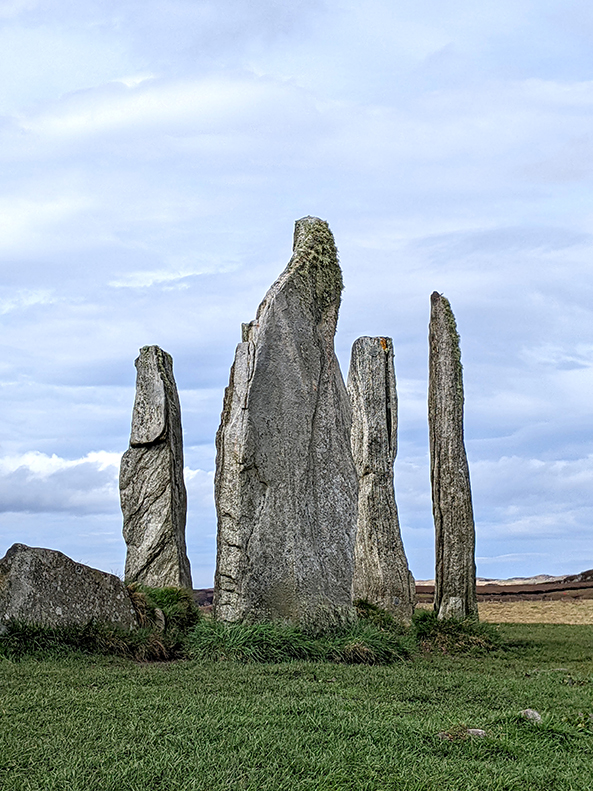
Here are a few more photos of the Callanais Stones
Judith Shaw, a graduate of the San Francisco Art Institute, has been interested in myth, culture and mystical studies all her life. Not long after graduating from SFAI, while living in Greece, Judith began exploring the Goddess in her art. She continues to be inspired by the Goddess in all of Her manifestations. She is now working on her next deck of oracle cards – Animal Wisdom. Originally from New Orleans, Judith makes her home in New Mexico where she paints as much as time allows and sells real estate part-time. Give yourself the gift of one of Judith’s prints or paintings.
Judith’s deck of Celtic Goddess Oracle Cards is available now. You can order your deck from Judith’s website – click here. Experience the wisdom of the Celtic Goddesses!
Last month I wrote about the Garden of Eden. You can read it here:
In that post, I described how Eden is essentially a garden of treasures. What are those treasures? I believe that they are seeds, the most prolific and creative element for spreading life here on Earth. Below is my own fantastical story about the Garden and how the seeds came to reside there.
Sinuous and serpentine, Hawwah, Hayyat, Eve emerged from Apsû, carrying within her seeds, fertilized eggs, and all the fruitfulness and abundance therein.
Today’s biblical poetry reflects on two passages in Exodus 15:2 and 15:3. Both deal with the vibrational essence that gives rise to the splendors of life.
KJV is the traditional King James Version. MPV is my own Mystic Pagan translation.See notes below for my translations of various words including LORD.
Exodus 15:2
The LORD is my strength and song, and he is become my salvation: he is my God, and I will prepare him an habitation; my father’s God, and I will exalt him. KJV
YaaaHaaaVaaaHaaa, is the source of my vivacity and song Unveiling pathways of liberation. Rooted in the potentiality of my ancestors Resplendent in beauty. MPV





 Feminism and Religion