Imbolc brings an invitation into change, to step into the forge of transformation, to sink into the holy well of healing, to open ourselves up to an evolving path of growth and discovery. It is now that we remember we are our own seeds of promise and while there is time yet to stay in the waiting place biding our time and strengthening our resources so we have what we need to grow, soon we will feel the wheel urging us onward, the call to set forth becoming unmistakable and strong. Let us settle ourselves into center, nestle into trust and determination, and extend outward from here feeling the sweet wind caress us and the fiery forge beckon us as we heed the summons to roll on, the path opening up before us as we move.
In this blog post I’d like to take you with me on a recent visit to the special exhibition “Arts and Prehistory”* in the Museum of Mankind (Musée de l’Homme) in Paris.**
Like the Feminine Power in London exhibition I wrote about last year, this is another ode to human imagination and creativity in connection to the mystery of life.
The exhibition features women figurines and cave paintings from dating between 26.000-34.000 years old, and I wonder how these prehistoric icons can inspire us to look at female bodies today…
Brigid, the Celtic Goddess of Healing, Poetry, and Smithcraft, begins her reign on Imbolic, February 2, the midpoint between winter solstice and spring equinox. On this day the ancient Celts held their Fire Festival in honor of Brigid and the growing light. In Scotland, as recently as the mid-twentieth century, houses were cleaned and the hearth fires rekindled on February 2, to welcome in Brigid. Remnants of this festival are found in America today on Groundhog Day.
Like the Cailleach, She existed in many places and was known by many names. The Irish called her Brighde; she was Bride in Scotland, Brigantia in Northern Britain, and Brigandu in France. Some called her Brid, Brig or Brighid. Later she was transformed by Christianity into Saint Bridget. Her older name was BREO SAIGHEAD. Her name has various interpretations, many relating to fire – “Power,” “Renown” “Fiery Arrow of Power ” “Bright Arrow”, “The Bright One”, “The Powerful One”, “The High One” and “The Exalted One”.
The past few years have been way too busy. Every winter I longed for quietness and solitude – for time and space to see and feel the strong bones of tree trunks and branches standing sharp against the sky and to gaze in awe into the fathomless winter night. And yet responsibilities and duties continued to yell at me for attention. The quiet gifted by Winter slipped away and soon I was on the treadmill of action offered by Spring and Summer once again.
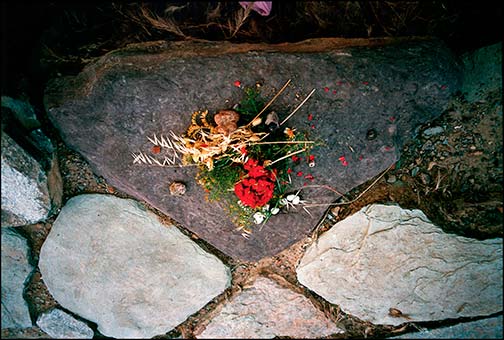
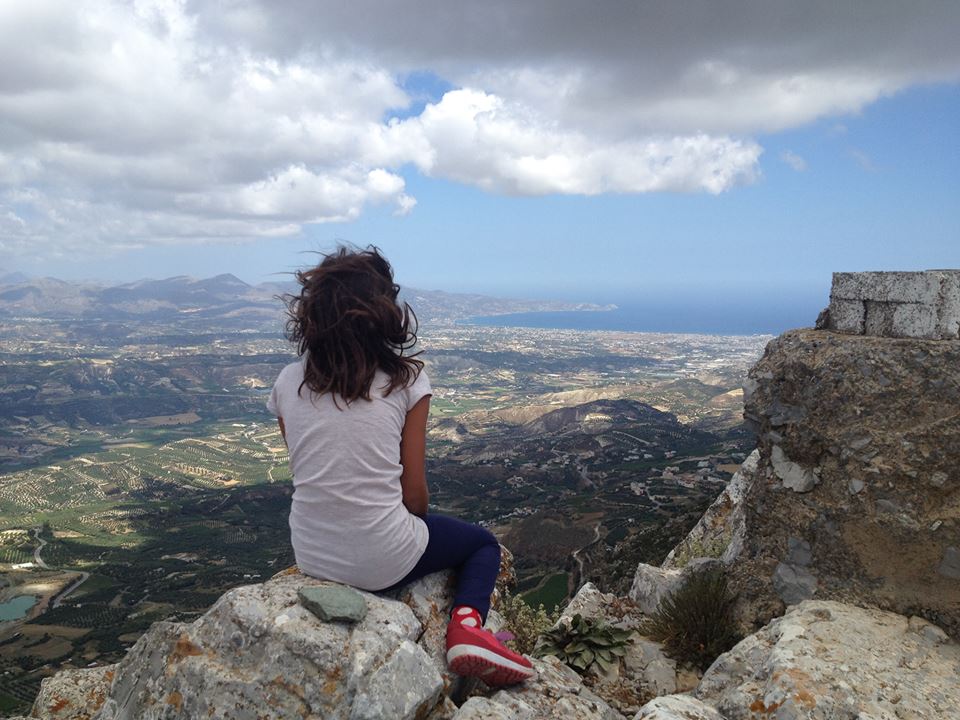
The mountaintop shrines of Mount Juctas in Archanes, Crete are situated on twin peaks, which may have symbolized breasts. Ancient shrines on the northern peak date from 2200 BCE until at least the end of the Ariadnian (Minoan) period in 1450 BCE. A crevice in the rock was filled with offerings of pottery, clay images of women and men in ritual dress, diseased bodies and body parts, sheep and cattle, and other objects. Excavations to a depth of 13 meters did not reach the bottom layers. Many offerings had been burned, suggesting that the objects were first thrown into fire and then dropped into the crevice. People who climbed the mountain for the festivals would have spilled over both peaks and there may have been shrines as well as fires on both of them.
Speak the truth about conflict, pain, and suffering.
Take only what you need.
Think about the consequences of your actions for seven generations.
Approach the taking of life with great restraint.
Practice great generosity.
Repair the web
In Rebirth of the Goddess, I offered Nine Touchstones of Goddess Spirituality as an alternative to the Ten Commandments. The Nine Touchstones are intended to inform all our relationships, whether personal, communal, social, or political.
Though I have not been Christian for many years, I love to decorate my house for the holidays. I have many decorations that I have collected over the years, including a Hummel angel gazing at the Christ child that was my father’s mother’s and a small crocheted Christmas tree given to me by my mother. My Christmas tree is a living one in a pot, and I usually manage to keep it alive on the balcony or outside for several years. One of my hobbies is collecting ornaments for the tree. Among my favorites are glass icicles and snowflakes crocheted by my friend Alexis many decades ago. There are white doves and brown birds that land on the tree branches and glass balls that have come into the stores again in recent years.
Just for right now, let the swirling soften. Exhale into the day, wherever you are, whatever is happening. Allow a cloak of comfort to settle across your shoulders and enfold you with peace and restoration. Draw up strength from the earth beneath your feet. Settle one hand on your belly and one hand on your heart. Feel the pulse of the sacred you always carry within. Breathe in and know you are loved. Breathe out and know you are free. Trust that you are carried and enfolded as you go along your way.
A chill is in the air and Winter’s Queen has spread her gray cloak across the land. She has stilled the leaves and frosted the hills, has quieted the scurrying, and placed her fingers firmly on the pause. In this waiting place, hushed and chilled, we remember the preciousness of the light of renewal, we remember how essential the warmth of connection. Just as the earth does, let us, too, lay aside what is unnecessary and draw close to one another once more, rekindling the fire of community, offering one another what nourishment we can. Let us enter a time of deep restoration with intention. Let us listen to the call of contemplation that twinkles in these dusky hours of replenishment and renewal. Let us pause and wait with grace.
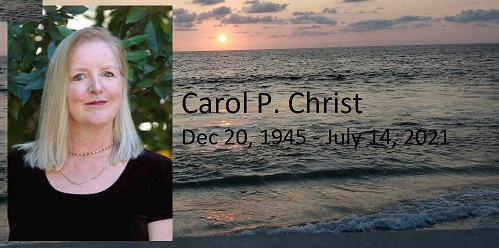
Thirty years ago, Carol P. Christ founded her Goddess Pilgrimage to Crete, which she wrote about in her book A Serpentine Path: Mysteries of the Goddess (original 1995 title Odyssey with the Goddess) and in numerous posts on this site over the years. She led over 40 groups of women Pilgrims to encounter the history and sacred sites of the peaceful, egalitarian civilisation of Bronze Age Crete.
Here, the Goddess-honouring culture of Old Europe survived the longest, when patriarchal Indo-Europeans were taking over in the ‘Kurgan waves’ Marija Gimbutas has described. The sophisticated artworks of ‘Minoan’ Crete show women in positions of honour and authority, and do not depict violence, slavery, or war. People celebrated at ceremonial centres, made offerings at cave and mountain shrines, and worshipped the Goddess in sacred trees and stones.
As many readers know, before Carol passed away, she asked me to take on the leadership of her Goddess Pilgrimage, and to serve as her literary executor and the director of her Ariadne Institute for the Study of Myth and Ritual. Deeply moved by her trust in me, and guided by very clear dreams I received around the time of her death, I accepted Carol’s request. In October 2022, after a three-year delay due to the pandemic, the Goddess Pilgrimage to Crete was reborn.
How ‘at one’ are you with your body, and what reasons might there be if your body-sense got separate(d) from your soul-sense?
This piece starts with the difference between feminine and masculine spirituality, and introduces a few reasons why living in a physical body isn’t always easy.
It then invites a shift to the beloved body and how we can start to re-instate our body as a sacred place and love it from within.