A Rescue Remedy, Part I by Barbara Ardinger

A year, now. It has been a full year since the phony election that put El Presidente in the Golden Office. A year since people began leaving the capital and the nation’s other large cities. While some of the refugees emigrated to quasi-democratic nations, most of them settled in the small towns and on the farms across the countryside, where they began building new, rural lives. A year ago, it was a flood of refugees. Now fewer people are able to escape.

A year, now, and even though she has studied and practiced, the wicked witch is no wickeder than she ever was. Nowadays she even forgets to put on the wicked-witch mask that she used to think scared people. But it’s easy for everyone to see that, masked or not, she’s just an ordinary woman practicing an old-time religion. She’s never fooled anyone, not the sixty or so refugees who now live on her farm, especially not the various ravens who drop by regularly for snacks in exchange for gossip.

Continue reading “A Rescue Remedy, Part I by Barbara Ardinger”
Saving Joan of Arc by Natalie Weaver

I’m finished with my first semester as a studio arts major at Kent State University.  I am not sure whether I’ll be registering for a second one.  There were pros and cons about the experience, and I am not sure if one set outweighed the other. Regardless, I am on sabbatical this spring, have two books to complete, and figured I would do well not to be trekking back and forth in an hours worth of snow and ice over the next few months from my home to the school.  So, I am taking a semester off, and I have become one of those retention risks. I am grateful for the opportunity to reflect on the experience with only minimal consequence to my bank account and my (laughing) future in the arts.

It wasn’t a bad experience; it wasn’t a good one either, really.  I learned some things in drawing, but I am very much on the fence about my experience in sculpture.  For starters, I imagined playing with clay and making pinch pots while some Swayzesque spirit from beyond rubbed my shoulders.  Instead, I was more Jessica Beal with a welding mask, except, instead of wearing a swanky black leotard and off-the-shoulder-slouch-dance tunic, I was wearing ugly jeans and steal-toed shoes under the green welding suit that had half-dollar size holes in it.  The protective gear only partially worked; I was scared of the tools after a classmate almost lost a finger; and the top of my hair went up in smoke when a spark shot under my ill-fitting Vader hat on week two.  I put it out quickly, fortunately.

Continue reading “Saving Joan of Arc by Natalie Weaver”

Letting Go by Joyce Zonana

How many objects have I clung to, how many pasts have I tried to preserve–beginning, of course, with the first loss, of Egypt where I’d been born and where my family had flourished? How many habits, feelings, fears, and beliefs continue to constrain me? The new year approaches, and my resolution today is simple: to let go. Again and again and again. As often as it takes.

temp_0218_Zonana_JoyceDuring the summer of 2005, I was living alone on Venus Street, in New Orleans’ Gentilly Terrace neighborhood, in a small Craftsman cottage I’d purchased two years earlier after breaking up with my longtime partner. I loved the house: modest yet gracious, it had a dining room with French doors that opened onto a screened porch, gleaming wood floors, cove ceilings, numerous multi-paned windows, a large bedroom, and a comfortable study looking out on royal palm trees where a flock of green parrots nested. I liked to think it resembled the home my parents had left behind in Cairo, Egypt when they emigrated to the U.S. in 1951.

For the first time ever, I’d carefully chosen and purchased furniture specially for the new space: a wide, heavy, round wooden dining table; a velvet camelback sofa; a coffee table, lamps, curtains, and a hooked rug. This was my “dream home,” the room of my own I’d always longed for, and I dwelt there in deep contentment–gardening, reading, writing, entertaining. Continue reading “Letting Go by Joyce Zonana”

Grieving through the Holidays: Painting Holy Women Icons of Grief by Angela Yarber

The holiday season is a particularly difficult time for grief. Whether it is grieving someone who died earlier in the year as you celebrate your first holiday season without them, or the lasting memories of loved ones who are no longer present at family gatherings, this time of year makes grief bubble to the surface. Since this is my first holiday season without my little brother, who died in March, I’ve planned ahead with coping strategies that I’d like to share with other feminists struggling to grieve through the holidays.

Upon the death of a loved one, most people in the West are offered commodified grief, costly funerals, and stifled feelings pre-packaged as dignified tradition. When deathcare became a commercial enterprise at the turn of the twentieth century, there was what mortician and author Caitlin Doughty calls a seismic shift in who was responsible for the dead. “Caring for the corpse went from visceral, primeval work performed by women to a ‘profession,’ an ‘art,’ and even a ‘science,’ performed by well-paid men. The corpse, with all its physical and emotional messiness, was taken from women. It was made neat and clean, and placed in its casket on a pedestal, always just out of our grasp (Caitlin Doughty, From Here to Eternity: Traveling the World to Find the Good Death, 136).”

Continue reading “Grieving through the Holidays: Painting Holy Women Icons of Grief by Angela Yarber”

Kintsugi for the Soul – Part II – by Vanessa Rivera de la Fuente

IMG_20170723_113240

Continued from Part 1.

How do you start to put the pieces together? For me, it was imperative to keep a space to express emotions without self-censorship or self-prejudice, to identify exactly what was hurting me. It was not the What, but the How. A split is always sad, but part of life. I could have been the “ungrateful” partner.

What aches …

Well, just to mention some, it was not the obstacles of a relationship between two people used to singleness, with different cultural backgrounds and family styles, but the neglecting, insults, and public belittling, leading to my progressive invisibility and objectification in the daily life. It was not his one night stand a few years ago with an Islamic feminist I know. Every adult has a sexual past, that is not a problem, but discovering that past was quite current (thanks Whatssap) is the problem. Someone decided I was not smart enough to understand it, so triangulation and lies were employed, with the consequent mind games, an emotional roller coaster that included gaslighting and violation of trust.

Continue reading “Kintsugi for the Soul – Part II – by Vanessa Rivera de la Fuente”

High Stakes for Women in Leadership: A Reflection and a Prayer by Elise M. Edwards

elise-edwardsA few weeks ago, I was asked to give the invocation for a luncheon at my university.  Baylor University was celebrating our presidential inauguration and there were several events leading up to the installation of the university’s 15th president. The inauguration was historic because it ceremonially marks the beginning of a term for our first female president, Dr. Linda A. Livingstone.

As I write, it is a year after Hillary Rodham Clinton lost the election for President of the United States of America. Like many of us, I’m still coming to terms with the choice my nation made, and how we came to it.  I’m thinking about women in leadership, especially occasions such leadership marks a first, a departure for an institution or system marked by male privilege.

What does it mean when an institution is willing to deviate from its long-established patterns of leadership and entrust its governance to women?

Continue reading “High Stakes for Women in Leadership: A Reflection and a Prayer by Elise M. Edwards”

Forgiveness and Faith by Chris Ash

Christy CroftSome of the most brutal weapons ever used against me were crafted and wielded by my own hands, forged in grief and self-loathing out of the words of others. In my better moments, I recognize that while another’s frustration with me frequently may be justified, any cruel words towards me never are, and are more a reflection of their speakers’ relationship with themselves than of any facts about me.

The parent who criticized me for being a “crybaby” saw in me a freedom of emotion that challenged the stoic denial of their own pain. The friend who criticized my optimism as “naïveté” and ignorance resented their own lack of hope about their future. The loved one who lashed out against my precious family deeply wished to experience that profound sense of belonging and acceptance that they’d not yet allowed themselves to feel.

In my heavier moments, when I’m questioning my choices and feeling the weight of responsibility that comes with adulthood, parenthood, and awareness, those words slither back into my brain, taking hold of my memory and trying to convince me of my own inadequacy and brokenness. Hopeful Me looks at my traits – my sensitivity, optimism, and devotion to loved ones – as strengths to be honed into tools I can use for my good and that of the world. Overwhelmed Me looks as these same traits as evidence of my damage – artifacts left behind by childhood trauma and occasional adulthood bouts of depression and anxiety. Continue reading “Forgiveness and Faith by Chris Ash”

Painting Breast Cancer Goddess by Rev. Dr. Angela Yarber

October is Breast Cancer Awareness Month, though I imagine most of us are already relatively aware. One in eight women will have breast cancer. Pink is everywhere. It’s difficult to find a person who hasn’t been impacted by breast cancer on a personal level. In 2003, my mom was diagnosed. Radiation, a lumpectomy, and ten years later she was dubbed cancer free. When I finished my Ph.D. in 2009, I did a stint as a Research Assistant for a fabulous liturgical studies scholar working on a book that examined and created rituals for women with breast cancer. My task was researching everything written on breast cancer that intersected with feminism, womanism, religion, spirituality, and ritual.


Audre Lorde’s Cancer Journals struck me profoundly. The critiques weighed heavy as a movement that began with destigmatizing breast cancer and offering solidarity to patients has transformed into a pinkified commodity. Whether it’s the lack of transparency in major breast cancer foundations, pinkification, the essentializing conversations that equate breasts with womanhood, lack of access to comprehensive health coverage, the role of the meat and dairy industry in increased risks of breast cancer, the talk of “surviving” and “fighting” as though those who don’t survive aren’t fighters, or the complete lack of representation of women of color in any pink marketing (seriously, do a google image search of “breast cancer headwraps” and feast your eyes upon an endless array of young, white women), breast cancer awareness has been commodified so that helping cancer patients is second to profit. Amidst these pink teddy bears delicately embroidered with the word “fighter,” one can only wonder what we can actually do and offer and create to be supportive of those with breast cancer. What rituals might we offer? What sacred spaces might we create? What is a feminist response? A spiritual response?

Continue reading “Painting Breast Cancer Goddess by Rev. Dr. Angela Yarber”

Healing from beyond the Grave by Carol P. Christ

Despite having thought that I had resolved my issues with my father, shortly after his death I fell into a lethargy accompanied by stomach flu and a cold. After about two weeks, the only symptom was a lingering cough. But I had no energy. I knew there were a number of essays to write or edit in the pending file on my computer, but didn’t have the will to do anything.

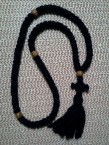
During this time, I came across the Greek Orthodox prayer rope (komboskini) that had been spontaneously removed from her person and given to me by the Mother Superior of the Paliani Convent in Crete a few years previously. Made of black wool yarn with one hundred intricately woven knots and a cross, it was not something I could easily wear in my everyday life. But as I was still lounging around in a black jersey nightgown, I put it on. I felt it on my skin and cradled between my breasts. Continue reading “Healing from beyond the Grave by Carol P. Christ”

Self-Care is a Feminist Issue: Holy Women Icons Project’s 7-Day Online Self-Care Retreat by Rev. Dr. Angela Yarber

Several years ago, I was pastor of a welcoming and affirming church. As a queer clergywoman, I thought that such a place would be the perfect place to flourish and thrive as a pastor. And yet, because of heterosexist and sexist microaggressions, I found myself anxious, depressed, and in need of physical, emotional, psychological, and spiritual care.

After a three-day retreat filled with self-care and soul-nourishment at a non-profit retreat center that catered to activists and artists , I felt as though a tremendous weight was lifted off my shoulders, that I could focus and find clarity in my vocation. Pausing to care for myself gave me the courage to leave my toxic job and live more fully into my calling. This experience taught me the vital importance of self-care.

Womanist Audre Lorde once proclaimed, “Caring for myself is not self-indulgence, it is self-preservation, and that is an act of political warfare.” Because caring for the self violates the patriarchal norms that traditionally dictate that you should be the one caring for everyone else. Yes, everyone needs to pause to care for the self. But oppressed minorities have a particular need for self-care, not simply as a way of refreshing oneself in order to do the work of justice, but as a vital part of the work of social justice. Because caring for yourself in a society—and a church—that wishes for you to do otherwise is an act of political warfare. When feminists care for themselves, it is a radical act of soul redemption, spirit rejuvenation, and a political and spiritual act of acknowledging your holy and innate self-worth. In case anyone has told you that you are not worthy, let me reassure you. You are worthy. And you deserve to care for yourself.

Continue reading “Self-Care is a Feminist Issue: Holy Women Icons Project’s 7-Day Online Self-Care Retreat by Rev. Dr. Angela Yarber”