High Stakes for Women in Leadership: A Reflection and a Prayer by Elise M. Edwards

elise-edwardsA few weeks ago, I was asked to give the invocation for a luncheon at my university.  Baylor University was celebrating our presidential inauguration and there were several events leading up to the installation of the university’s 15th president. The inauguration was historic because it ceremonially marks the beginning of a term for our first female president, Dr. Linda A. Livingstone.

As I write, it is a year after Hillary Rodham Clinton lost the election for President of the United States of America. Like many of us, I’m still coming to terms with the choice my nation made, and how we came to it.  I’m thinking about women in leadership, especially occasions such leadership marks a first, a departure for an institution or system marked by male privilege.

What does it mean when an institution is willing to deviate from its long-established patterns of leadership and entrust its governance to women?

Continue reading “High Stakes for Women in Leadership: A Reflection and a Prayer by Elise M. Edwards”

Forgiveness and Faith by Chris Ash

Christy CroftSome of the most brutal weapons ever used against me were crafted and wielded by my own hands, forged in grief and self-loathing out of the words of others. In my better moments, I recognize that while another’s frustration with me frequently may be justified, any cruel words towards me never are, and are more a reflection of their speakers’ relationship with themselves than of any facts about me.

The parent who criticized me for being a “crybaby” saw in me a freedom of emotion that challenged the stoic denial of their own pain. The friend who criticized my optimism as “naïveté” and ignorance resented their own lack of hope about their future. The loved one who lashed out against my precious family deeply wished to experience that profound sense of belonging and acceptance that they’d not yet allowed themselves to feel.

In my heavier moments, when I’m questioning my choices and feeling the weight of responsibility that comes with adulthood, parenthood, and awareness, those words slither back into my brain, taking hold of my memory and trying to convince me of my own inadequacy and brokenness. Hopeful Me looks at my traits – my sensitivity, optimism, and devotion to loved ones – as strengths to be honed into tools I can use for my good and that of the world. Overwhelmed Me looks as these same traits as evidence of my damage – artifacts left behind by childhood trauma and occasional adulthood bouts of depression and anxiety. Continue reading “Forgiveness and Faith by Chris Ash”

Painting Breast Cancer Goddess by Rev. Dr. Angela Yarber

October is Breast Cancer Awareness Month, though I imagine most of us are already relatively aware. One in eight women will have breast cancer. Pink is everywhere. It’s difficult to find a person who hasn’t been impacted by breast cancer on a personal level. In 2003, my mom was diagnosed. Radiation, a lumpectomy, and ten years later she was dubbed cancer free. When I finished my Ph.D. in 2009, I did a stint as a Research Assistant for a fabulous liturgical studies scholar working on a book that examined and created rituals for women with breast cancer. My task was researching everything written on breast cancer that intersected with feminism, womanism, religion, spirituality, and ritual.


Audre Lorde’s Cancer Journals struck me profoundly. The critiques weighed heavy as a movement that began with destigmatizing breast cancer and offering solidarity to patients has transformed into a pinkified commodity. Whether it’s the lack of transparency in major breast cancer foundations, pinkification, the essentializing conversations that equate breasts with womanhood, lack of access to comprehensive health coverage, the role of the meat and dairy industry in increased risks of breast cancer, the talk of “surviving” and “fighting” as though those who don’t survive aren’t fighters, or the complete lack of representation of women of color in any pink marketing (seriously, do a google image search of “breast cancer headwraps” and feast your eyes upon an endless array of young, white women), breast cancer awareness has been commodified so that helping cancer patients is second to profit. Amidst these pink teddy bears delicately embroidered with the word “fighter,” one can only wonder what we can actually do and offer and create to be supportive of those with breast cancer. What rituals might we offer? What sacred spaces might we create? What is a feminist response? A spiritual response?

Continue reading “Painting Breast Cancer Goddess by Rev. Dr. Angela Yarber”

Healing from beyond the Grave by Carol P. Christ

Despite having thought that I had resolved my issues with my father, shortly after his death I fell into a lethargy accompanied by stomach flu and a cold. After about two weeks, the only symptom was a lingering cough. But I had no energy. I knew there were a number of essays to write or edit in the pending file on my computer, but didn’t have the will to do anything.

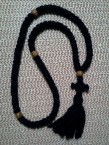
During this time, I came across the Greek Orthodox prayer rope (komboskini) that had been spontaneously removed from her person and given to me by the Mother Superior of the Paliani Convent in Crete a few years previously. Made of black wool yarn with one hundred intricately woven knots and a cross, it was not something I could easily wear in my everyday life. But as I was still lounging around in a black jersey nightgown, I put it on. I felt it on my skin and cradled between my breasts. Continue reading “Healing from beyond the Grave by Carol P. Christ”

Self-Care is a Feminist Issue: Holy Women Icons Project’s 7-Day Online Self-Care Retreat by Rev. Dr. Angela Yarber

Several years ago, I was pastor of a welcoming and affirming church. As a queer clergywoman, I thought that such a place would be the perfect place to flourish and thrive as a pastor. And yet, because of heterosexist and sexist microaggressions, I found myself anxious, depressed, and in need of physical, emotional, psychological, and spiritual care.

After a three-day retreat filled with self-care and soul-nourishment at a non-profit retreat center that catered to activists and artists , I felt as though a tremendous weight was lifted off my shoulders, that I could focus and find clarity in my vocation. Pausing to care for myself gave me the courage to leave my toxic job and live more fully into my calling. This experience taught me the vital importance of self-care.

Womanist Audre Lorde once proclaimed, “Caring for myself is not self-indulgence, it is self-preservation, and that is an act of political warfare.” Because caring for the self violates the patriarchal norms that traditionally dictate that you should be the one caring for everyone else. Yes, everyone needs to pause to care for the self. But oppressed minorities have a particular need for self-care, not simply as a way of refreshing oneself in order to do the work of justice, but as a vital part of the work of social justice. Because caring for yourself in a society—and a church—that wishes for you to do otherwise is an act of political warfare. When feminists care for themselves, it is a radical act of soul redemption, spirit rejuvenation, and a political and spiritual act of acknowledging your holy and innate self-worth. In case anyone has told you that you are not worthy, let me reassure you. You are worthy. And you deserve to care for yourself.

Continue reading “Self-Care is a Feminist Issue: Holy Women Icons Project’s 7-Day Online Self-Care Retreat by Rev. Dr. Angela Yarber”

Learning Compassion from Inmate Number 74799 by Cynthia Garrity-Bond

Technically I was employed as a lab assistant at our community hospital. This position entailed multiple responsibilities, from receptionist to actual bench work within the laboratory. The task I dreaded most was my assistance at autopsies. Beyond a strong constitution, it required no measurable skill set. This job was not the high-tech, immaculate setting of any of the CSI programs of today; instead the morgue was a stark, condensed room with two pullout refrigerators for the deceased, a stainless steel table the autopsy was performed on, and the necessary instruments and accouterments, some suspended from what appeared thin air. These tools of the trade ranged from the expected scalpels and retractors to saws and garden-like shears.

Fast-forward fifteen years. It is the morning of July 11, 1991. Prisoner number 74799 has just been transferred from the Department of Corrections, Arizona State Prison in Florence to Tucson County General Hospital in critical condition. Eight months prior to his admittance to the prison hospital, Prisoner 74799 was diagnosed with metastatic lung cancer. While considered inoperable, he was administered the customary chemotherapy treatments until four months later when the cancer spread to his brain, taking most if not all of his cognitive abilities away. Within one hour of his transport, Prisoner 74799, my brother, Michael Paul, died at the age of thirty-nine.

Continue reading “Learning Compassion from Inmate Number 74799 by Cynthia Garrity-Bond”

Rape, Community and Healing by Vanessa Rivera de la Fuente

During my last months in Cape Town I have been facilitating a series of workshops on Rape, Gender Justice and Culture of Consent. I am blissful for the opportunity to teach and learn with a group of people with whom we have navigated in the approach of Rape and Sexual Assault in their different perspectives, from the socio-political to the intimate tenets.

This has been an exciting journey of healing and soul blooming. I have realized the critical role that Cape Town has played in pushing me towards empowerment and thriving, enhancing my taking back ownership of my body and all the experiences happening through it.

This journey started few years ago when I decided to come out of the closet as a rape survivor. I wrote about it on Feminism and Religion. This was the first step of my breakthrough. Little by little I became confident and shameless about saying: “Yes, I was raped”.

Continue reading “Rape, Community and Healing by Vanessa Rivera de la Fuente”

With Women by Kay Bee

Someone told me the other day that Death Doulas are one of the fastest growing career fields out there right now. As a (currently not practicing) Birth Doula, this does not surprise me. The term Doula came into its modern – predominately American – usage in the early 1970s, in reference to a woman who provided non-medical care for a birthing woman. The word is Greek in origin and depending on who you ask, means “with woman” or “servant woman.”

While I suspect the earlier “servant woman” version is the correct etymology, the romantic in me appreciates the “with woman” version, even in its technical inaccuracy. This is because at its core, the role of the Birth/Postpartum Doula is the formalized return of what I believe in my bones to be an ancient cultural practice of women being with each other as a woman passes through an intense life transition.

Whereas before, when a woman gave birth, the older, multiparous women of the local culture would gather around her to see her through her passage from expectant to postpartum motherhood; now some of us approaching that same rite of passage use the Internet to reach out into the culture to hire a Doula to do that very same thing. How we bring it about has changed, but what we desire has not. We desire to be supported, cared for, & loved by someone who has gone through what we are about to — we desire to be with women.

The number of Birth Doulas in the U.S. and abroad, at this point, has increased dramatically over the last ten years and now it would seem that the Conscious Birth movement has birthed a Conscious Death movement, complete with Death Doulas. Again, how we secure the care we want at birth or at death has changed, but what we desire in those powerful moments of passage has not.

The fundamental physical, emotional, and spiritual craving to be with women at life’s major rites of passage runs incredibly deep within us. It is also something denied to us by the patriarchal structures of most major religious systems, but over the last sixty years or so, we’ve worked hard at taking that back. Continue reading “With Women by Kay Bee”

The Definition of Strength, Gaslight Edition by Vibha Shetiya

13327613_10208448645447348_6913754683590458893_nRecently when I was feeling low and a little devoid of hope, a friend of mine paid me a fabulous compliment: “Things will get better. You’re a very strong person.” I know it was a real compliment and not an underhanded cutting remark. You may be surprised as to why I am referring at all to the latter. After all, it’s straight forward – having strength and fortitude are admirable qualities and how could one possibly even think otherwise. But you may be equally surprised to know that there are very special circumstances under which the word “strong” gets to acquire extended meanings of: “devoid of feelings,” “someone who needs zero support,” “a social insult.”

Take the time when I got divorced several years ago, undoubtedly one of the most difficult periods of my life, compounded by the fact that I found myself despondently alone. Continue reading “The Definition of Strength, Gaslight Edition by Vibha Shetiya”

A Healing Home of Dreams by Joyce Zonana

I had few expectations before my visit in the winter of 1999 to Cairo’s Rav Moshe Synagogue, also called the “Rambam.” I only knew it to be an obscure synagogue and yeshiva associated with the renowned twelfth-century theologian, sage, and physician, Moses Maimonides.

I left Egypt as an infant with my parents in 1951. Now I was finally back, hoping to experience the place that had shaped my family. Accompanied by a Muslim Egyptian friend, I walked the streets my parents had walked, attended services in the elegant downtown synagogue where they’d been married, tasted the familiar foods of my childhood, listened with delight to the melodious sounds of Egyptian Arabic. But seeking the Rambam was little more than a whim, sparked by a few lines in a Guide to Jewish Travel in Egypt. “Not on any tourist itinerary,” the brief blurb stated about the derelict synagogue in ‘Haret al Yahud, the city’s medieval Jewish quarter, far from where my parents had lived. Still, I had to go.

Continue reading “A Healing Home of Dreams by Joyce Zonana”