Just South of Ventura by Sara Frykenberg

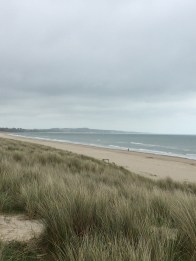
For those of us living in Southern California, it has been a tense week to say the least: flames ravaging up and down the coast, homes lost, thousands displaced, freeway and school closures, smoke thick in the air, and ash raining from the sky.

And the fires are still raging. 

Whether or not one is directly impacted by the wildfires here in Ventura and Los Angeles County, you can’t walk through the grocery store, turn on the radio, or get a cup of coffee without engaging the fear and concern, or hearing about the devastation left behind. We are sharing a trauma, howbeit differently, and with different levels of need.

I have been lucky during the fires.  I live just south of Ventura. My work is on the Getty side of the 405: it was threatened, but not in flames.  I spent the week checking in with family and friends, offering my home, and breathing the toxic air. I also made dinner, picked my brother up from the airport, attended a baby shower, and graded papers. … This is a strange juxtaposition, and like many Californians, I have had a hard time processing what’s going on.

On Sunday afternoon, surrounded by the unnatural darkness of an ash filled sky while traveling down the 101 freeway, I wrote the following. This is my effort to make sense.  And I offer it to you all here, in case this helps you make sense too.  Continue reading “Just South of Ventura by Sara Frykenberg”

Looking for a Mouth to Tell the Story by Esther Nelson

In Chinua Achebe’s novel, THINGS FALL APART, Okonkwo, a proud, hard-working, albeit quick-tempered tribesman living in the village of Umuofia, fires a gun at Ekwefi, one of his three wives, almost killing her.  Chielo, a widow with two children, who also serves as the priestess of Agbala, Oracle of the Hills and Caves, asks Ekwefi, “Is it true that Okonkwo nearly killed you with his gun?”

Ekwefi replies, “It is true indeed, my dear friend.  I cannot yet find a mouth with which to tell the story.”

I love Ekwefi’s turn of phrase as she responds to Chielo.  Shaken, distraught, and outraged over being shot at by her fiery husband, she “cannot yet find a mouth with which to tell the story.”  That’s exactly how I feel these days.

Continue reading “Looking for a Mouth to Tell the Story by Esther Nelson”

Freedom and Speech by Sara Frykenberg

Feminist theories and theo/alogies are often concerned with voice, naming and re-membering. Many feminists do this work, again and again, because of persistent silence and silencing, invisibility, erasure of stories, desires, religions and ways of being, because of missing histories, and a dominating culture’s inability and unwillingness to hear those they marginalize. We “hear each other into speech,” to counteract and recreate, to find power in ourselves and with those whom we share common cause.

We hear each other into ….speech.

Speech is treated as a sacred thing; and certainly, I hold the stories and voices of those with whom I’ve shared parts of my own feminist journey very sacred. I find the ability ‘to voice’ sacred. But I am also aware that as a citizen of the United States, “speech” or more specifically, “freedom of speech,” is sacralized as a part of my national mythology.

It is an implicit myth: all one needs to do is utter the word “speech” in the United States to conjure images of protest, civil rights, the free press, revolution, etc. There are many heroes in this mythology, most of whom “spoke truth to power,” rebuffing domination for the “common good.” The ‘free speaker,’ is often cast as the subjugated “everyman” (sic) whose autonomy and purpose drive society towards greater freedom. “He” and “his” subjugation, real or “alternative fact,” are then made to serve the larger myth of the American Dream. There is a major problem here: “the American Dream” is about freedom and independence for the white, Western male. So is it any wonder, then, that the myths surrounding “freedom of speech,” are so easily turned around to villianize those who might challenge this hegemonic power? Continue reading “Freedom and Speech by Sara Frykenberg”

Of Monument(al) Importance by Esther Nelson

I remember being blown away when I read Judith Plaskow’s book, Standing Again at Sinai: Judaism from a Feminist Perspective, shortly after it was published in 1990. She writes, “The need for a feminist Judaism begins with hearing silence.” She notes it’s a “silence so vast [it] tends to fade into the natural order….”  Women’s presence throughout Judaism has not been reflected in Jewish scripture, Jewish law, or in liturgical expression.

Plaskow zeroes in on the story in Exodus where the entire Israelite congregation, gathered at the base of Mt. Sinai, eagerly anticipates entry into the covenant, “the central event that established the Jewish people.” Before this communal event, the covenant had been entered into by way of the individual patriarchs—Abraham, Isaac, and Jacob.  The particularly disturbing verse for Plaskow is Exodus 19:15: “Be ready for the third day; do not go near a woman.”

The specific issue Moses addresses is ritual impurity since the emission of semen renders both parties that engage in coitus temporarily unfit to engage with the sacred.  Both women and men need to be ceremonially purified before approaching the holy.  However, Moses does not say “Men and women do not go near each other.”  At this crucial juncture in Jewish history, “Moses addresses the community only as men.” The text makes women invisible. Clearly it was men’s experience that shaped Torah.

Plaskow writes that “[Jewish] women have always known or assumed our presence at Sinai.” Exodus 19:15 “is painful because it seems to deny what we have always taken for granted. Of course we were at Sinai; how is it then that the text could imply we were not there?”

Why make a big deal of this? Can’t the text, asks Plaskow, be relegated to a time in history “way back then” when people and communities accepted gender inequality as the natural order?  Why not just accept the past for what it was and get on with things?  Because Torah (Hebrew Bible) is not “just” history, “but also living memory.” When the story of Sinai is read and recited in services as part of the lectionary reading over and over again, year after year, “women each time hear ourselves thrust aside anew, eavesdropping on a conversation among men and between men and God.” Continue reading “Of Monument(al) Importance by Esther Nelson”

Nobel Peace Prize 2017: ICAN and Those Who Can’t by Elisabeth Schilling

If there is any sanity in the world, it has come from the Nobel Peace Prize of 2017, which was awarded to ICAN, the International Campaign to Abolish Nuclear Weapons. They received the award for the work they have done on the Treaty for the Prohibition of Nuclear Weapons. According to the ICAN site, the agreement was adopted July 2017 and is backed by 122 nations. If signing the Treaty, a nation must agree to refrain from the following:

“[. . .] developing, testing, producing, manufacturing, transferring, possessing, stockpiling, using or threatening to use nuclear weapons, or allowing nuclear weapons to be stationed on their territory. [. . .] A nation that possesses nuclear weapons may join the treaty, so long as it agrees to destroy them in accordance with a legally binding, time-bound plan.”[1] A nation cannot encourage or support another nation to hold them either.

Continue reading “Nobel Peace Prize 2017: ICAN and Those Who Can’t by Elisabeth Schilling”

A Total Eclipse of My Heart by Marie Cartier

Kim and I with our hosts and new family friends

I’ve known for years and years that on my wife’s, Kim, bucket list was to see a total eclipse of the sun. She began over a year ago researching weather conditions and making reservations, researching camera equipment, buying the special eclipse lens so that she could shoot the sun.

By the time we left on our road trip to visit first our tribe of sister family in the Midwest at an annual gathering, and then to visit various friends, she had four reservations for the eclipse viewing—all in different states. She patiently explained to me (again) that she would be checking weather conditions and “chasing” the eclipse if need be. I understood, because as I said, I’d heard about the eclipse for a while (lol). I knew we’d be making friends with the NASA weather page which I checked continuously for the last two weeks. I would put in the different locations where Kim had made reservations over six months ago, cities near the center line of totality: Illinois, Nebraska, Missouri…then there were cloud predictions in all of those states and it seemed she should have stayed on the west coast and gone to Oregon or Wyoming.   Continue reading “A Total Eclipse of My Heart by Marie Cartier”

Reclaiming My Time: A Meditation about Mindfulness and Faithfulness to One’s Purpose by Elise M. Edwards

elise-edwardsYou may have seen the viral video of Congressional Representative Maxine Waters’ demands for “Reclaiming my time!”  Video was taken during a proceeding in which Representative Waters is questioning Treasury Secretary Steven Mnuchin, who responds with long-winded answers and indirect statements.  Ms. Waters appears annoyed, and she is not interested in flattery.  She wants a direct response to her question.  When she does not get it, she appeals to protocol, which allows her to “reclaim” the time allotted to her (intentionally) wasted by a man who wants to dodge her questions.

The video was very popular on my social media feeds.  I know of preachers who used “Reclaiming my Time” in their sermons the following Sunday.  There were memes, of course.  There was even another viral video of Mykal Kilgore singing his gospel composition of Waters’ words.  He and Waters appeared on a TV show soon after.

It’s fairly obvious why this video–and the sentiment behind it–struck such a chord with so many people.  We wish we could reclaim our time in situations where we are moving forward with a purpose, only to be met with delays and roadblocks from those who want to deter us.  Sometimes, these delays are unintentional.  But too often, they are strategic attempts to wear us down, distract us, and redirect our energy away from our goal.  Ms. Waters wasn’t having it.  She called out the delay tactics and held firm to what was rightfully hers.  Her time.

Continue reading “Reclaiming My Time: A Meditation about Mindfulness and Faithfulness to One’s Purpose by Elise M. Edwards”

Pride by John Erickson

When we come together, we are the Divine.  I didn’t think I could experience that twice in one year; clearly, I was wrong. 

If you’re anything like me you not only hate opening up your Twitter feed each morning but also feel compelled to in order to make sure you didn’t miss whatever new atrocity to come out of 1600 Pennsylvania Ave. After the Women’s March, I felt charged. I felt that whatever this administration threw at the proverbial “us,” I knew we could and would overcome it. Although that charge kept me going for a few months, there came a time where I just couldn’t go on anymore and that I was completely drained; then walked in a man named Brian Pendleton.

After the Women’s March on January 21, I didn’t know what to expect. The event was truly so successful that many of the organizers and coordinators were on an activist high as a result of what was a truly magical and divine moment. A few months came and went and the 45th President of the United States continued (much to our surprise) to be as awful as we all knew and expected. However, while I am able to exist in a world, no matter how oppressive, as a cisgendered white male and the full on privilege and power that comes along with that territory, many of the individuals and communities being attacked did not have those same freedoms; and like with the Women’s March and how that all took shape, in walked Brian Pendleton to my life to talk to me about the #ResistMarch.

Cover PhotoAlthough my involvement during the 120 days or more that led up to the #ResistMarch happened in a flash, one thing is for certain: miracles exist not because of divine intervention but because G-d places people on this Earth to make positive impacts. The beauty of the #ResistMarch was not just the passion of the organizers but the beauty of the rainbow that came out in full force on June 11

The strength shown by our community was one that, for all intensive purposes, proves that love does conquer all. RuPaul couldn’t have expressed the common and conquering theme better than when he said: “It’s all about love; giving love and being able to receive love. That’s our secret weapon; that’s the one thing they don’t have: our love and our music. That is our activism. That is what we use and what we always use to fight the ugliness.”

That is the one experience that I took most out of the #ResistMarch: the power of love and friendship; the beauty in the unexpected conversation that leads to changing the world, again.  Thank you, Brian. Thank you, for bringing us all together to resist, recharge, and love.

19055531_10158898620590385_6920780108892374453_o

When we come together, we are the Divine.  I didn’t think I could experience that twice in one year; clearly, I was wrong.

John Erickson is the President of the Hollywood Chapter of the National Organization for Women. John is a Ph.D. Candidate in American Religious History at Claremont Graduate University where he is finishing up his dissertation tentatively titled “Step Sons and Step Daughter”: Chosen Communities, Religion, and LGBT Liberation.” John holds a MA in Women’s Studies in Religion; an MA in Applied Women’s Studies; and a BA in English and Women’s Studies. He is the Founding and Past President of the University of Wisconsin Oshkosh’s LGBTQA+ Alumni Association and currently serves as the Chair of the Legislative Committee for the Stonewall Democratic Club, a Diversity and Inclusion Fellow at Claremont Graduate University. He is a permanent contributor to the blog Feminism and Religion, a Co-Founder of the blog The Engaged Gaze, and the Co-Chair of the Queer Studies in Religion Section of the American Academy of Religion’s Western Region, the only regional section of the American Academy of Religion that is dedicated to the exploration of queer studies in religion and other relevant fields in the nation. In April 2017, he was the first openly gay athlete to be inducted into the Wisconsin Volleyball Conference Hall of Fame. Most recently, John was one of the coordinators of the Women’s March Los Angeles, which brought together 750,000 people in downtown Los Angeles on January 21, 2017, and a Committee Member for the #ResistMarch, which brought together 100,000 people from Hollywood to West Hollywood in honor of LA Pride on June 11, 2017.


Moonlight Reflections by Elise M. Edwards

As I post this, May 10, a full moon, known as the “Bright Moon” or “Flower Moon” is in the sky. This full moon occurs during a season of transition when living thing things renew and bloom. For those of us in the Northern Hemisphere, it’s spring, but another transition is already underway. For many of us, spring is nearing close to summer in temperatures; in plant, animal, and insect life; and in our schedules. I am concluding a long, demanding spring semester and yearning for summer. Even though I welcome the transition, I know that like all change, it holds both opportunity and challenge. The full moon prompts me to look at the upcoming summer with clear, examining eyes

elise-edwardsAs I post this, May 10, a full moon, known as the “Bright Moon” or “Flower Moon” is in the sky.  This full moon occurs during a season of transition when living thing things renew and bloom.  For those of us in the Northern Hemisphere, it’s spring, but another transition is already underway.  For many of us, spring is nearing close to summer in temperatures; in plant, animal, and insect life; and in our schedules.  I am concluding a long, demanding spring semester and yearning for summer.  Even though I welcome the transition, I know that like all change, it holds both opportunity and challenge.  The full moon prompts me to look at the upcoming summer with clear, examining eyes.

It’s strange–perhaps downright heretical–for a Christian to talk about the power of the moon. Continue reading “Moonlight Reflections by Elise M. Edwards”

After the First 100 Days—What Do We Do Now? by Marie Cartier

deb-and-i
Marie & Deb

I am sitting here again with my friend Deb—you can see our first conversation here,  where we were excited about the activism ensuing from the Women’s March. A photo essay of the Los Angeles Women’s March is here. However, like so many conversations we are all having still, we ask each other— “after the first 100 days…what do we do now?” We are speaking of the first 100 days of the 45th president. When we last got together, we gave a list of options for doing activism as a daily part of life. In this blog, we want to expand on that idea.

Let’s first take stock of where we have gone since the last blog that Deb and I collaborated on February 24th . . Among other things Trump accused President Obama of illegally wiretapping his phones. Here is a list of many other terrifying things he has done. As we write this, we have also recently bombed Syria, sent warships to Korea, and appointed an extremely conservative Supreme Court Justice, because the Republican Senate voted to remove the ability to filibuster, which allowed Gorsuch’s appointment to go through with only 54 votes (rather than the formally required 60). Continue reading “After the First 100 Days—What Do We Do Now? by Marie Cartier”