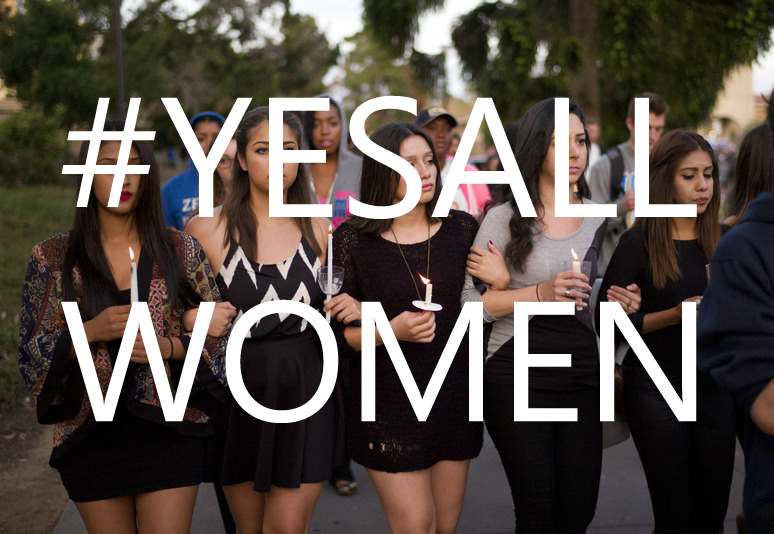
#YesAllWomen, the Darwin Debate, and the God Complex by John Erickson

#YesAllWomen proved that although not all men commit horrible crimes against women, the men that often get the headlines and create the most controversy are the ones that need to be watched out for.

John EricksonThe one thing I typically will choose to do on the rare occasion that I’m able to sit down and relax is to watch a documentary.  While some people may go to the gym, read a book, or hang with friends, I typically choose to stay in, nestle up on my couch, and learn.  While on my last bout of relaxation, I chose to watch the HBO documentary Questioning Darwin. Although it offers very little new insight into the evolution vs. creationism debate, it does offer an interesting new way to look at the recent social media hashtag war feminists, allies, and supporters found themselves in over the #YesAllWomen movement that took the world by storm.

yesallwomen

Now, before I discuss #YesAllWomen, I have to admit that I did not enter into the safe space women created for themselves to tell tales of the horrible things they have and have had to face on a daily basis.  I firmly believe that men should not have entered into the digital space Continue reading “#YesAllWomen, the Darwin Debate, and the God Complex by John Erickson”

Jesus, Mary and Joseph: Who Are Our Saints? by Marie Cartier

Tomorrow I will be going to a friend’s 7th grade classroom presentation of “famous people in history.” She has 120 students who will be dressing up as someone in history and doing a presentation board about this person—as well as dressing in costume. She asked me to come in costume as Frida Kahlo. As many of you know, I admire/adore Frida Kahlo and wrote a blog last year extolling her praises; actually it was a “valentine towards an ethics of loving women and art.” (And every year I dress as Frida and help a friend do a lively lotería game at an LGBT celebration of Cinco de Mayo at our Church.)

My friend told me that while there would not be a Diego Rivera in her crowd of costumed living historians—there would be Frida’s lover Josephine Baker (someone saw the movie Frida and knew Josephine and Frida were “friends”), and there would be several Guadalupes.

This got me thinking that for children/teens – especially children brought up in religious households (and especially Catholic households, of which I was such a child) – saints and real people are often conflated. And famous real people one admires often are given “sainthood” in one’s imaginary church. Continue reading “Jesus, Mary and Joseph: Who Are Our Saints? by Marie Cartier”

Taking Time to Smell Your Roses: What Are You Grateful for This Spring? by Marie Cartier

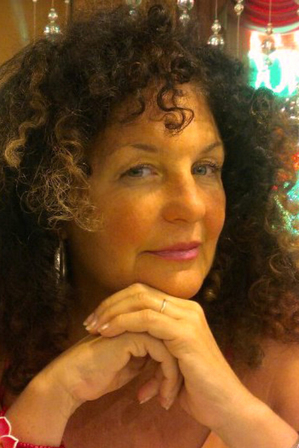
MarieCartierforKCETa-thumb-300x448-72405I am taking this space, this month to share two very wonderful pieces of news. And I will make the caveat opening here: this is a blog about the benefits of gratitude and I am reaping them here—with a bit of shameless self-promotion. I am advocating here again for my work, my “book child”, as I did in my birth announcement blog!

As we move into spring, I want to step back and take stock of what I have planted that is coming into bloom. And with this, I hope to suggest to you all, dear readers, that you do the same. I (I’ll speak for myself here) tend to rush so much and feel I have so much to do that sometimes when something amazing happens that I have worked so hard for—it just passes me by, and I am on to the next thing before I get a chance to really acknowledge even what that amazing thing was. Continue reading “Taking Time to Smell Your Roses: What Are You Grateful for This Spring? by Marie Cartier”

In Memoriam – God Hates Fags

Phelps didn’t just live a life filled with hate but he also embodied the very reasoning why so many communities cannot cross that proverbial bridge to work together to see past their differences and maybe never will. In the case of Phelps, sticks and stones may break our bones, but words really do hurt.

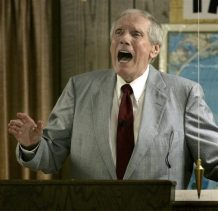
Fred Phelps, an American PasFred Phelpstor who headed the Westboro Baptist Church in Topeka, Kansas died at the age of 84 on March 19, 2014.  While some individuals leave behind legacies of their good deeds and loving memories, the only thing Phelps left behind was a family and church founded on the principle of hate.

A frequent eyesore at various events ranging from military funerals and gay pride gatherings to mainstream events that captured the attention of our pop-culture obsessed society, Fred Phelps and his clan believed it was their sacred duty to warn others of God’s anger over the growing acceptance of not only modernity in general but also issues like gay rights and abortion.  From slogans and signs such as ‘God Hates Fags’ to ‘Thank God for IEDs (Improvised Explosive Devices), Phelps has caused many controversies both during his lifetime and after his death.

Continue reading “In Memoriam – God Hates Fags”

Sex, Religion, and Discourse: An Interview with Judith Butler

One of my academic joys is interviewing people I find particularly interesting (see most of my posts here). This time I am honored to present a recent interview I did with Judith Butler.

Image from The European Graduate School

Many wonder how gender performance relates to chromosomes, phenotypes, genitalia, and other scientific “evidence” for innate sexual differences. Continue reading “Sex, Religion, and Discourse: An Interview with Judith Butler”

Anti-sex feminism? by Linn Marie Tonstad

Linn Marie TonstadLori Gottlieb’s article in the February 9 New York Times magazine, “The Egalitarian-Marriage Conundrum,” was yet another tired entry in the New York Times’s annual clickbait misogyny Olympics. Who doesn’t remember the supposed opt-out revolution, and the sadness of the decade-later follow-up demonstrating every single consequence that any feminist could have predicted? Or the weekly gender terrorism spewed by Maureen Dowd, who somehow gets people to believe that constant belittling and feminizing male Democratic politicians counts as incisive, progressive political commentary? To name just a few of the most memorable, and most infuriating, examples.  

Gottlieb’s article rehashed the studies – I’ve lost count of how many times I’ve read about them in one version or another – that suggest that equality in household labor leads to decreased frequency of intercourse among married heterosexual couples. The most revolting lines in the article – among many contenders – start with a quote from Julie Brines, the author of the study in question: ‘”The less gender differentiation, the less sexual desire.’ In other words, in an attempt to be gender-neutral, we may have become gender-neutered.” It is possible that Brines may be quoted out of context, or that what she intended to say was something quite different, but as the quotation stands, it implicitly suggests that so-called “traditional” gender differentiation is necessary for sexually satisfying heterosexual relationships. (For, of course, there are plenty of other ways in which gender differentiation might be present in heterosexual relationships. Gender differentiation is here being equated with a very particular set of decisions about ‘housework’, a notion that arguably exists only to render some parts of women’s work invisible.) That’s before getting into the implications of the word “neutered” used in the second sentence. Why would egalitarian distribution of household labor be considered “gender-neutral” to begin with? Continue reading “Anti-sex feminism? by Linn Marie Tonstad”

The Day I Re-Learned How to Love My Femininity: This Butch’s Experiment in Healing by _Melody F.

I feel like I am a bit of a typical white, middle class, butch. Maybe not, but I feel like I’ve met me: I dress like a dude, take on what I consider masculine roles in relationships, and do ‘guy things’ like play video games or carry heavy objects. And then there’s that really feminine part of me, the soft-butch side that comes out when I can’t take something macho I’m trying to do seriously, or when my voice (already high) hits that pitch that (not ‘screams,’ but) sort of sweetly says ‘hello, I’m girly.’ When my soft butch side comes out, my students coo at me. It’s all very embarrassing.

But under a face which turns blotchy red in such moments, something my ex used to think was cute, I have been privately wishing that feminine part of me would die away. For the last year, I’ve silently hated her. This post is about when I decided to stop.

I’ve been having an ongoing conversation with a fiercely femme friend of mine about misogyny and masculine privilege in LGBTQ communities. About a month ago she sent me an article by Gabrielle Rivera titled Fat-Booty Butch Wears Leggings — Confuses World, Confronts Self. In it, Rivera dons a pair of leggings for the day and writes a post about her experience that addresses invisibility of femmes, butch privilege, and other well-thought-out and honest observations about queer folks and communities from the perspective of a butch/Queer Person of Color. Rivera rocked both the leggings and the post. (I highly recommend giving it a read.) What struck me most was how very much herself Rivera seemed to stay. Even as she engages a complex shift in the way in which her communities received and read her, she protests her invisibility – nothing about switching codes had erased her or her queerness. I wasn’t sure I would feel the same. I was so alienated from my feminine side that the idea of looking even a little bit feminine, just to touch her, seemed as though it might blank out my identity. Continue reading “The Day I Re-Learned How to Love My Femininity: This Butch’s Experiment in Healing by _Melody F.”

Slavery and God/dess by amina wadud

amina 2014 - croppedWell the Golden Globe awards have been handed out.  I don’t have a television, so I didn’t actually watch, but a quick google search gives the results.  Highest honors go to a movie about blacks as slaves and whites as criminals.  That’s appropriate. 

But this is feminism and religion, so let me get to the point.  It’s about a chance discussion on social media about the “merciful god” and historical institutions like slavery (holocaust, or oppressions like misogyny, homophobia, Islamaphobia and others…).

My view of the divine, the cosmos and of the world is shaped by my slave ancestry.  Recent area studies about Islam in America estimate that one third of the Africans forced to the Americas were Muslim.   My first African relative on US soil identified as Moor (another term used for “Muslim”).  But Islam did not survive slavery. Continue reading “Slavery and God/dess by amina wadud”

Evangelical Missionaries Preach Death in Uganda by Andreea Nica

Andreea Nica, pentecostalismA former evangelical Christian friend of mine sent me information on the intriguing documentary God Loves Uganda. The newly released documentary addresses how the American evangelical movement has prompted a political and social shockwave in the country of Uganda. While missionaries are typically associated with delivering aid and improving the conditions of third world countries, the spreading of Christian values and ideals has inflicted suffering upon ethnic communities through evangelical indoctrination.

The intent of the film is to raise awareness of the political and social brutality that the evangelical missionaries are instigating; specifically through their teaching that homosexuality is a sin and should be dealt with accordingly. In Uganda this means death. Given the rise of globalization, transnational religious actors have been more enabled to engender other nations with their respective religious beliefs, often with minimal regard for the cultural and political landscape of the nation they wish to transform. Continue reading “Evangelical Missionaries Preach Death in Uganda by Andreea Nica”

5 Interesting Facts about Religion and Modern Society by Kile Jones

Kile

Following up on an older (and my most popular) post, 5 Interesting Facts about Women and Religion, I am going to draw your attention to 5 other telling facts.

1: Women clergy are blowing up in the Anglican Church!

In U.K. Church Statistics, 2005-2015, Dr. Peter Brierly shows that out of 9,615 Anglican ministers, 1,928 are women.  This is a radical spike since 2005.  That is 20.05% of all Anglican ministers.  This is about double compared to lead pastoral roles in U.S. Protestant Churches (see here).  The year of 2010 showed the first time women outnumbered men in Anglican ordination, and it continues to rise up to the present day.  And although they are growing as ministers, they are still blocked from becoming Bishops.  The vote for allowing female bishops at a General Synod in 2012 failed to get the 2/3 support BY 6 VOTES! Continue reading “5 Interesting Facts about Religion and Modern Society by Kile Jones”