Lucy’s Light by Sara Wright

12/?/ 13 – 7/21/25 written morning after her death 22nd

Lucy in the light, 3 years ago

Purple and scarlet
orange flames
lemon and gold
lavender blue
cobalt hues
we are
dogs,
bees, bears,
butterflies,
hummingbirds too
Innocence seeking
a place
we once knew…
Grief pulled us down
into an old familiar
place. Darkness reigned
hopelessness too.
All we had was each other
At Hecate’s Crossroad
she couldn’t let go
and either could I
Lucy was my dog
you see
A ‘familiar’
just like me.
I couldn’t read her.
Forced to make
the decision
for us both
I let her go…
When we lay together
that one last time
nestled under
a purple shroud
she breathed
Feathers of Light
a Tree circle
marks her grave
Earth took her in
roots, soil, leaves
Hemlock
holds
her body
like
I once did.
Between North and East
Bear Medicine flowed
through a crack
in the Round…
Rising
on the wings
of cool green lights
she lives …
Firefly Nights.

Continue reading ” Lucy’s Light by Sara Wright”

Legacy of Carol P. Christ: GODDESS WITH US: IS A RELATIONAL GOD POWERFUL ENOUGH?

This was originally posted on Sept 2, 2013

Last week I wrote about Protestant Neo-Orthodoxy’s deification of male power as power over.  This week I want to ask why the relational Goddess or God* of process philosophy has not been more widely embraced, both generally and in feminist theologies.

Could it be that a relational God just isn’t powerful enough? Are some of us still hoping that an omnipotent God can and will intervene in history to set things right?  Do we believe an omnipotent God can save us from death?

Process philosophy provides an attractive alternative to the concept of divine power modeled on male power as domination.  According to leading process philosopher Charles Hartshorne, the power to coerce, power as power over and domination, is not the kind of power God has.

The concept of divine power as omnipotent (having all the power) leads to what Hartshorne called “the zero fallacy.”  If God has all the power and can dominate in all situations, then the power of individuals* other than God is reduced to zero.  In effect, this means that individuals other than God do not really exist, but at most are puppets whose strings are pulled by the divine power.

Continue reading “Legacy of Carol P. Christ: GODDESS WITH US: IS A RELATIONAL GOD POWERFUL ENOUGH?”

Fight, Fight, Fight? by Caryn MacGrandle

I have two divorces under my belt. I’m not proud. I made bad choices. I didn’t have the support network nor the mental ability to thrive in the situations. But I had gumption. And I didn’t stay.


So here I am. 54. And starting over. 


It can be rather terrifying as motherhood and family has always been my focus.


After my recent second divorce, part of my stability plan was Land. The Blue Ridge mountains in North Carolina called me. The Appalachians. I spent a year looking. I had a list: unrestricted land, at least five acres, a water feature. 
I had several adventures on my own looking, but I will never forget the day I found it. I was with my son James, and I knew it right away.


Ten acres. A third of it a bog along a creek. Away from it all, but not ‘too away’ as it has a road running through it that leads to a partly developed mountain subdivision. 


Home. 


I can breathe.

Continue reading “Fight, Fight, Fight? by Caryn MacGrandle”

Archives from the FAR Founders: Learning Compassion from Inmate Number 74799 by Cynthia Garrity-Bond

This was originally posted on July 21, 2017. This is the first post of our new series to highlight the work of the four founders of FAR, Garrity-Bond, Caroline Kline, Gina Messina and Xochitl Alvizo

Technically I was employed as a lab assistant at our community

Considered standard prison procedure, Michael was scheduled for an autopsy the following day. While my grief over Michael’s death was considerable, it was the pending autopsy that caused my immediate concern. As I pictured Michael on the cold table of steel, the crude instruments sawing and cutting into his already weathered body, I took it upon myself to somehow ease this last assault. I phoned the Tucson corner’s office, hoping to speak to the pathologist who would be performing Michael’s autopsy. With surprising bureaucratic ease, I was transferred to him. After introducing myself, I explained he would be receiving Prisoner 74799, my brother, from Tucson General, and that by all appearances this was just another disposable inmate whose criminal past simply caught up with him, sort of a karma-like ending. His thin, emaciated body, I warned, is covered in tattoos, which I feared might induce a harsher judgment upon this cast away soul. I asked the pathologist that when he begins the post, he please remember Prisoner 74799 was somebody’s son, somebody’s brother, father and friend and more importantly, that this man was loved. “Please” I pleaded, “try to see beyond the obvious signs of poor choices mapped onto his body, instead see he is more than his prison issued number and that Michael Paul, while far from saint, was a man who loved and was loved.”

Continue reading “Archives from the FAR Founders: Learning Compassion from Inmate Number 74799 by Cynthia Garrity-Bond”

From the Archives: “What If We Touched Ourselves Lovingly Every Day?” by Trelawney Grenfell-Muir

This was originally posted on June 5, 2020

I watched her hand stroke along my arm, so gently, so lovingly. Her voice whispered, “I love you, Trelawney. I love you, Trelawney.” The soft, tender caress felt poignant, healing, magical. I wept with gratitude.

It was my own hand stroking me. My own voice.

I want you to take a moment and imagine the person you love best in the world. Is there anyone? Is there someone you love utterly, you think of with pure, unconditional, compassionate, embracing, affirming, tender, protective, loyal, sacred love? Close your eyes a moment and let that feeling of pure love fill your heart until you understand that feeling with every fiber of your being. Do you have that Love? Truly feel it and know it with all your heart, soul, mind, and strength?

Continue reading “From the Archives: “What If We Touched Ourselves Lovingly Every Day?” by Trelawney Grenfell-Muir”

That Old, Old, OLD Story – The Warts and Wisdom of the Ancient

My grandmother Clarine was an incredible human being. I absolutely could not be more proud to be her granddaughter. She started her first teaching position in 1927 at age 17. She met my grandfather in seminary; but despite her clear talent and call, the church apparently felt one minister was enough for the family and refused to ordain her. Undaunted, she famously wrote a one line reply to the bishop: Well, Moses got along fine without it, and Jesus got along fine without it, so I’ll be fine without it, too.

Continue reading “That Old, Old, OLD Story – The Warts and Wisdom of the Ancient”

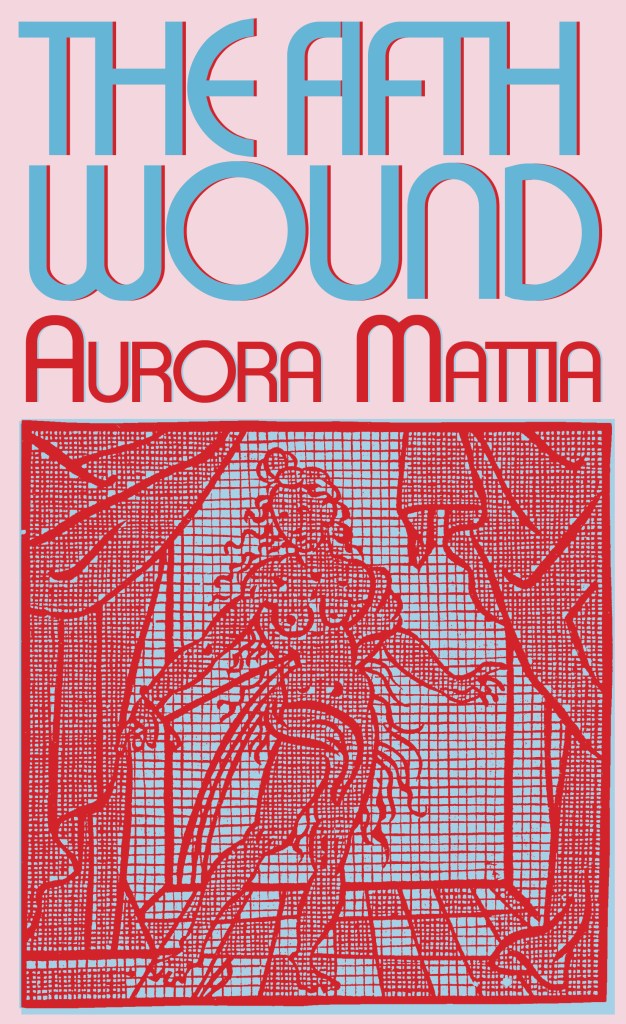
The Fifth Wound by Aurora Mattia, Book Review by Janet Maika’i Rudolph

Dreams are a confluence of lifefragments, swelling and dissolving in waves, perpetually on the verge of meanings. What in Physics is called ‘potential energy,’ I refer to as ‘potential meaning,’ the maximum of which is dreaming.

The Fifth Wound, pg 34

There is so much to like about this book even as it is painful to witness Mattia’s journey. It is also confusing at times which might be by design because life, itself, is so confusing. The prepublication material describes this book as a love story between Aurora and Ezekiel. Both Ezekiel and Aurora begin by describing themselves as “fairies.” Ezekiel remains so, Aurora transitions. She calls herself a tgirl or a transgirl.

Mattia leads a life that refuses to be boxed into any “norm.” The vulnerable wounds that she collects as she navigates this challenging path are both internal and external. Ezekiel and Aurora know and love each other both before and after Mattia’s gender confirmation surgery. It takes some work to understand the hardships of those who don’t fit into societies’ norms; these are norms that too often float through our consciousness often without our even being aware. I believe that wrestling with such issues expands our humanity and for this (but not this alone), The Fifth Wound is an important book.


Continue reading “The Fifth Wound by Aurora Mattia, Book Review by Janet Maika’i Rudolph”

“A new heart I will give you . . . “: Part Two by Beth Bartlett

You can read part 1 here.

Hope: What is a heart transplant if not hope? In granting the possibility of new life out of death, it is the essence of hope. Yet, hopefulness is also knowing death is imminent and finding a way to live well into that knowledge. The impulse of hope encourages us to go on despite the odds. Hope indeed seems to spring eternal. In my darkest days, something would come along and lift me up. Hope is a testimony of the human spirit, lifting us up, refusing to refuse us. This new heart brought hope to me, and I believe that in our going on together, we carry the hopes of my donor’s loved ones as well. 

Continue reading ““A new heart I will give you . . . “: Part Two by Beth Bartlett”

Love and Other Fruits by Esther Nelson

The modern-day play “J.B.,” authored by Archibald MacLeish (1892–1982) and published in 1958, portrays a modern rendition of the Biblical character, Job, someone who became a pawn in a battle between God and Satan. God “allowed” all kinds of misery (sickness, loss of reputation, loss of wealth, and loss of children) to befall his faithful servant, Job. In MacLeish’s telling, we see that J.B. (like the biblical Job) undergoes setback after setback. In the end, J.B. comes to the realization that “He [God] does not love. He is.” Sarah, his wife, responds, “But we do. That’s the wonder.”

We (humans) spend a lot of time talking, singing, and writing about love. Sometimes we even claim to behave in loving ways. Yet, just what is love? Why do we love?  How do we love?

Continue reading “Love and Other Fruits by Esther Nelson”

Deconstructing and Reconstructing Love by Chasity Jones

Note: This is based on a podcast which can be heard here.

“Black love exists and Black women deserve love that does not require pain.”

What is love? What’s love got to do with pain and suffering? Are they related? Pain and love? Must one always be present with the other? In this blogpost I explore pain and suffering through a womanist perspective (centering the perspectives and lived experiences of Black women) and discuss how to live into wholeness and wellness. This is especially important because the Black community/women in particular’s experience in the US (and globally) has been and continues to be defined by pain and suffering. What are the theological implications?

How have Christian frameworks at associating love with sacrifice and pain justified the pain and suffering of Black women? How can we decolonize love so that liberated Black women are empowered to embrace a love that does not hurt first with false promises of rewards later in life or afterlife? Black women, pain does not equal love.

Continue reading “Deconstructing and Reconstructing Love by Chasity Jones”