

 June 2, 2017 saw a boost in the revolution led by a former Israeli soldier turned model and actor in the iconic role of Wonder Woman, a role that has been around for over 76 years. The movie has shattered projections of first weekend profits as well as the notion that no female directed, female super hero movie could bring in as much as its male counterparts. This movie has created a fervor of positive female representation on the big screen and more importantly a resurgence for continuing the fight against oppression, racism, and sexism.
Category: Popular Culture
Mulling over Movies: Moana, Pt. 1 by Elise M. Edwards
 I love going to outdoor movie screenings. Sitting outdoors on a summer evening with good company brings me joy. Last week, I went to an screening of Moana, the Disney movie about a teenager who goes on a quest through the Pacific Ocean with the demi-god Maui. Moana goes on this journey to help her people. The movie came out last year, but I didn’t see it. I have to admit that I wasn’t even interested in it until Simone Biles performed a dance to one of Moana’s songs on Dancing with the Stars. It was then that I realized that the movie has an empowering message. I asked my friend Natalie, who is also a feminist religion scholar, about Moana. She has three young daughters, so I trusted her to be more current than I am. Her enthusiastic response sold me, as did her remark, “There’s not even a love story in it!”
Ah, Disney princesses and their love stories! I’m old enough that I didn’t grow up with the Disney culture that children in the past few decades have, but I haven’t been immune to the Disney princess phenomenon. I childhood pre-dated DVDs and digital downloads, but I still knew and cherished the Disney characterizations of Snow White, Cinderella, and Sleeping Beauty. These young women were kind and virtuous and beautiful (according to Eurocentric standards), but their stories culminate with marriage to a charming prince. It’s also problematic that so often, the villains in these movies were older women—wicked stepmothers or evil witches—who were motivated by jealousy and hate.
Continue reading “Mulling over Movies: Moana, Pt. 1 by Elise M. Edwards”
Bikini Season by Sarah Kiefer

I grew up in a suburban town stuck in the middle of rural Indiana. I drove through corn fields to get to school and on more than one occasion I did have to crawl through my sun roof to get into my car because I was sandwiched between two monster trucks. My grandfather, an avid bird watcher, waged a personal war against the chipmunks and within one summer caught and drowned anywhere between fifteen and twenty of them until my mom pointed out that he was probably attracting them by putting bird seed on the ground.
I was raised in the non-denominational Christian church and part of my weekly activities was attending youth group. For those of you not familiar with youth group, it’s usually held on Wednesday night for the youth in the church. It’s basically church geared towards pre-teens and teenagers. Some of my fondest memories of my teen years are from youth group. You foster deep friendships in a fun environment and have good role models all the while learning about the Bible in a way that is more easily understood by a young person.
When I was about thirteen I went to a conference with the rest of the girls in youth group. It was a “modesty conference” geared at teaching young women the “biblical” truth of their role as a female and how that translates into how one dresses. We were taught that we are responsible for the relationship between our brothers in Christ and Jesus. One of the ways that we can make them fall is wearing too revealing clothes. If we wore something too tight, too low, or too short, the men wouldn’t be able to control themselves and would sin in the eyes of Jesus. We were encouraged to wear loose t-shirts and shorts that went to the knee in order to keep our brothers from sinning.

The last night was the long awaited fashion show of the conference and we had all stayed up the night before eagerly finishing the dresses we would be modeling the next day. At the end of the fashion show the lead pastor’s wife came out wearing a bikini. We were all cheering her on because she looked great. She stood at the end of the runway shaking and grabbed the microphone. As she spoke, the mood of the room dramatically shifted. She said she would never wear a bikini in public because her body is for her husband alone and other men looking at her would cause them to sin. The sadness and guilt her voice conveyed sobered all of us. We all vowed we would never wear a bikini again and from here on out it was modest, one piece bathing suits for us.
Looking back at this experience, I recognize quite a few issues I want to address. First, teaching young Christian girls that we are not only responsible for our own relationship with Christ, but also the relationship of all men feels wrong to my spirit and isn’t even biblical. Second, teaching us to be ashamed of our body’s natural shape and covering it in baggy clothing so men won’t sin when they look at us is detrimental to both men and women. The detriment to a young girl’s self-esteem because she has strict guidelines reinforced with guilt around dressing herself leads her to thinking there is something “wrong” or “bad” about her body. This also perpetuates the lack of accountability for men, as they grow up thinking they can’t control their sexual being so they don’t even try, placing the responsibility on women. Why do you think the question “well what was she wearing?” asked in the case of a woman’s rape comes up so often? (This thinking comes from the common misconception that rape is an act of uncontrollable sexual urges, not a man exercising an intentional act of power.) These innocent teachings have further reaching effects on society than we think.
Lastly, I want to address what the pastor’s wife shared with the group, particularly her comment on her body being her husband’s. True, our bodies are not our own, they are a gift from God. 1 Corinthians 6: 19 says “Do you not know that your bodies are temples of the Holy Spirit, who is in you, whom you have received from God? You are not your own; you were bought at a price. Therefore honor God with your bodies.” All God asks in return is that we treat our body respectfully. I don’t know about you, but I see nothing in that verse about a woman’s body being owned by a man. A woman’s body is not to be owned by a significant other no matter what their marital status is, just like a man’s body is not to be owned by a significant other. Language of possession and ownership in romantic relationships needs to be struck from the dialogue of Christianity and replaced with the language of respect.
Since I’m not the gatekeeper of heaven and hell I can’t say for sure, but I’m relatively certain if you wore a bikini you won’t be sending three men plus yourself into eternal damnation. With bikini season around the corner, take some time to reflect on the way you view your body. Do you treat it with respect? Do you own it? Do you love your body? Or have you given away that privilege to someone else? I say as a Christian woman, we unburden ourselves of the responsibility for our brother’s sin. We have enough to do. Like bikini shopping.
Sarah is graduating with her undergraduate degree as a psychology major with a pre-law concentration and minor in women’s studies in 2017. She has accepted a full ride scholarship to law school and is expecting to pursue prosecutorial work. Outside of the classroom, she serves as a Resident Assistant, plays on the championship lacrosse team, and also serves as president of Women’s Circle—the feminist student group that she helped to establish and for which she continues to lead discussion and events.
Do We Need Wonder Woman Today? by Barbara Ardinger
We all remember the protests—and the pink knitted caps with the pussy ears—that filled the streets of our major cities after the inauguration of the Troll-in-Chief. Some members of this FAR community went to those marches and wrote about their thoughts and feelings in this space. I don’t go to marches and demonstrations anymore, mainly because it would be majorly inconvenient if I had an asthma attack right in the middle of when other people are trying to do important things. But I always send my thoughts.
And so I have recently been thinking about a feminist hera who can inspire us resisters. (Note that “hera” is not only the name of the queen of the Olympians, but it’s also the feminine form of “hero.” I’ve heard some women say “shero.” I guess that works, but it’s an ungainly word. Let’s call our courageous women heras and superheras. But I digress.) I’ve been thinking about Wonder Woman since the election. Here’s what I wrote about her in my book Pagan Every Day. (Note that I’m expanding what I wrote in 2003.) Continue reading “Do We Need Wonder Woman Today? by Barbara Ardinger”
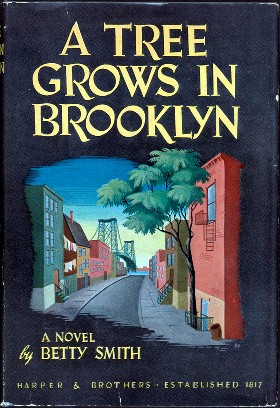
Writing Through the Body: Betty Smith’s A TREE GROWS IN BROOKLYN by Joyce Zonana
 In her 1975 manifesto, “The Laugh of the Medusa,” French feminist Hélène Cixous urges women to write: “Writing is for you, you are for you; your body is yours, take it. . . . Women must write through their bodies, they must invent the impregnable language that will wreck partitions, classes, and rhetorics, regulations and codes . . .”
“The Laugh of the Medusa” remains a thrilling essay, challenging and inspiring women to “return to the body” and to language. “Woman must write woman,” Cixous insists, “for, with a few rare exceptions there has not yet been any writing that inscribes femininity.”
Although Cixous may not have been aware of it, Betty Smith’s beloved, perennially popular 1943 novel, A Tree Grows in Brooklyn is one of those “rare exceptions” that “inscribes femininity” in precisely the way she advocates. This autobiographical novel, so often dismissed as sentimental or as a children’s book, is actually written through the female body—which may explain its lasting popularity and power. Continue reading “Writing Through the Body: Betty Smith’s A TREE GROWS IN BROOKLYN by Joyce Zonana”
Safe Spaces Found in Fan Conventions By Anjeanette LeBoeuf
 This is the post where we are going to enter the world of fan conventions. Fan Conventions can be considered anything that carries a fan base – film, television, comics, books, actors, or genres of literature. Fan conventions have evolved to include aspects of role-playing, costume play, and direct interaction with the producers, actors, and writers of the selected item.
There is a large and prospering community that centers around comics, anime, television, and movies. As early as 1936, science fiction conventions were starting to develop. They range from local, regional, national, and international. They can carry broad topics to specific films, shows, or genres. Continue reading “Safe Spaces Found in Fan Conventions By Anjeanette LeBoeuf”
The Last Man on Earth, Noah, and the Fantasy of Humanity’s Destruction by Elisabeth Schilling
 There are quite a few post-apocalyptic shows out these days. The Last Man on Earth is one example, a television series that is set in 2020, a year after a deadly virus has wiped (almost) everyone out. A handful of people have natural immunity, which the main character, Phil (Will Forte) soon discovers after spray painting billboards across the U.S. with the message “Alive in Tuscon.” It seems to be a lonely life for Phil before he realizes he isn’t really the only person left alive, but he can choose any mansion to live in, drive any car on the empty, open roads, and the grocery stores are abandoned for his taking (only non-perishables are really edible though). There are downsides such as no electricity, no running water, and an end to all of the other modern-day conveniences that an urbanite would be used to, which were, in the past, handled by “someone else.” It would be much better if a farmer or botanist were left behind, but I guess it is supposed to be relatable to most of us.
Watching this show has compelled me to think about other apocalypses in sacred literature, mainly Noah and the global flood. I always have thought it was rather chilling that gods were created to be such harsh punishers of humankind. In the Qur’an, this story is used as one of many examples of the communities that were sent a messenger but disobeyed and so endured the promised wipe-out. It always seemed strange to me that God would be discussed to be so violent when the immediate messages in these literatures were that human beings should be kind, charitable, and moderate with each other. Continue reading “The Last Man on Earth, Noah, and the Fantasy of Humanity’s Destruction by Elisabeth Schilling”
Despite Hollywood’s Activism, the Oscars are still White by Anjeanette LeBoeuf
 Activism and Politics have had a complex relationship with Hollywood. Now more than ever actors, directors, and many more associated with the media industry are using their voices, their positions, and their money to causes, political parties, and movements. More and more groups and reports are being generated stating the power of positive representation and even of the necessity of forward progress. Yet, despite the pressure and call for action, there still is heavy resistance, which can be most clearly seen during award season. Continue reading “Despite Hollywood’s Activism, the Oscars are still White by Anjeanette LeBoeuf”
Part Three: Magic, Destiny, and Acceptance by Anjeanette LeBoeuf
 The last young adult fantasy book series I will be looking at is Sarah Maas’s Throne of Glass. Sarah Maas’s Throne of Glass is a combination of all the elements which we have looked at in the previous two series, Girl of Fire and Thrones and Daughter of Smoke and Bone. Throne of Glass was originally conceived of as a remake of Cinderella but mingled with action. It is so much more than, weaving fantasy with gripping action, hard emotions, and love stories to revel any romance novel. And like the previous two series, it has been picked up to be turned into a TV series. Continue reading “Part Three: Magic, Destiny, and Acceptance by Anjeanette LeBoeuf”
A Letter to Those I’ve Lost by John Erickson
Out of all of these things, the one thing that has kept coming to my mind is G-d. What is he (or she) thinking? I feel like I’m back in one of my Old Testament classes discussing the harsh and cruel G-d that thrust so many horrible things onto their believers. Maybe, the worst part about the election isn’t Donald Trump, but it is the realization that G-d may be dead after all.
Dear [Insert Name Here],
Something died on November 8, 2016, and I do not think I’ll ever be able to get it back. I sat there, walking back to my house, in disbelief and utter shock and scared about the next 4 years of my life.
For weeks leading up to the election, I had found myself praying in the copy room at my work almost daily. I would sit there, silent and alone, having just read some misleading article or alt-right post from a family member that called Hillary Clinton the devil, and wonder: when did everything go so off the rails?
Although we’ll spend years trying to figure the answer to my above question out, for me, it is a question I have been asking myself ever since election night and specifically knowing how certain members of my family would, and ultimately did, vote. Continue reading “A Letter to Those I’ve Lost by John Erickson”
 Feminism and Religion