From the Archives:“Vaginas are Everywhere!”: The Power of the Female Reproductive System by John Erickson

Moderator’s note: This marvelous FAR site has been running for 10 years and has had more than 3,600 posts in that time. There are so many treasures that have been posted in this decade that they tend to get lost in the archives. We are beginning this column so that we can all revisit some of these gems. Today’s blogpost was originally posted June 19, 2012. You can visit it to see the original comments here.
I have a beautiful picture of vagina hanging on my wall.  However, for the longest time it was in the back of my closet, with a plastic bag covering it.  I wasn’t ashamed of it but my ex-boyfriend, like most gay men, refused to have it on the wall where he could see it.  He is now long gone; the vagina is now out and proud.

I bid on the picture one fall during a showing of the Vagina Monologues at Claremont School of Theology.  One of my best friends was in the show and I had always loved its powerful message.  I walked out of the theatre, waiting for my friend, and there it was: the picture of the vagina.  I found myself caught up in its beauty.  Its gaze had mesmerized me.  The outlying layers of red, the contours of its shape, they all began to mold into a figure before my eyes.  While I have never thought of myself as a religious person, I realized that at that moment I was no longer looking the old photo but rather I was staring at the outline of the Virgin Mary.  At that moment, I realized that I had to have the picture.

Continue reading “From the Archives:“Vaginas are Everywhere!”: The Power of the Female Reproductive System by John Erickson”
Coming to Terms with Privilege: A Personal Reflection by Elise M. Edwards

elise-edwardsIn my two previous posts, I shared my recent experience talking about privilege at a church near me.  Today, I will wrap up this short series with a more personal reflection about privilege from a Christian perspective.  Last month, I was thinking theologically about what those of us who have privilege should do with it.  But, as feminists and womanists, acknowledging our privilege can be complicated.  Most of us in this FAR community do possess some forms of privilege while, at the same time, we lack other forms of privilege.  Each of us remains the same person wherever we go, yet our status can change when we switch contexts.  As a black woman, I do not have white privilege or male privilege.  But I am privileged when it comes to education and class and physical ability.  I am a Christian who works at a Christian university in a part of Texas that is culturally predominantly Christian. So that’s a form of privilege.  Although as a single woman without children, I don’t fit the cultural norm where I live, my sexual orientation and cis-gendered identity afford me some privilege, too.

Continue reading “Coming to Terms with Privilege: A Personal Reflection by Elise M. Edwards”

What Can We Do to Weaken Privilege? by Elise M. Edwards

elise-edwardsIn my previous post, I talked about discussing the concept of privilege (male privilege, white privilege, and class privilege) with nuance.  Earlier that week, I had led a workshop at a local church on “Fine-tuning Privilege,” using Peggy McIntosh’s 1989 essay “White Privilege: Unpacking the Invisible Knapsack” as a resource.  (If you are unfamiliar with it, take a few minutes to read it and reflect upon it.)  Part of my talk was about naming and understanding privilege.  Discussion and comprehension are not enough, though.  We must counter it.

One strategy for fighting privilege is making it visible. The recipients of privilege are often unaware that they have to systemic advantage over others. Privilege, used in the context of racism, sexism, heterosexism, classism, and religious dominance, is not something earned on merit alone. In the essay linked above, McIntosh describes it like this: “I have come to see white privilege as an invisible package of unearned assets which I can count on cashing in each day, but about which I was meant to remain oblivious.” These are conditions built into our culture that some groups receive which benefit them to the detriment of others. Making privilege visible means naming it and calling it out. Wage gaps, digital divides, and racial profiling practices exist; ignoring them perpetrates the problems.

Continue reading “What Can We Do to Weaken Privilege? by Elise M. Edwards”

Talking about Privilege with Nuance by Elise M. Edwards

elise-edwardsYesterday evening, I led a seminar at a local church as part of their series on “Unpacking Privilege.” Once before, I’d been invited to this church, Lake Shore Baptist Church, to speak about intersectional feminism with one of my colleagues, so I expected them to be open-minded and welcoming.  They were.  Although the attendees were overwhelmingly white and older than me, they were attentive and engaged.  We had an enriching time together diving into topics like male privilege, white privilege, and class privilege with Peggy McIntosh’s 1989 essay “White Privilege: Unpacking the Invisible Knapsack” as a resource.  (If you are unfamiliar with it, I recommend taking a few minutes to read it and reflect.)

In the essay, McIntosh writes about becoming critical of male privilege and men’s obliviousness to it through her work in Women’s Studies, which then led her to see her own race privilege (as a white woman) and her obliviousness to it.  The essay does not offer a precise definition of white privilege, but the entire piece is a reflection about it.  She explains:

“I have come to see white privilege as an invisible package of unearned assets which I can count on cashing in each day, but about which I was ‘meant’ to remain oblivious. White privilege is like an invisible weightless knapsack of special provisions, maps, passports, codebooks, visas, clothes, tools and blank checks.”

Continue reading “Talking about Privilege with Nuance by Elise M. Edwards”

The Modern Problematic Nature of the Sabarimala Temple, Part 2 by Anjeanette LeBoeuf

AnjeanetteThe Sabarimala Temple has received an influx of global attention since last October. In my last FAR post, I researched the origin story of the Sabarimala Temple and its dedicated deity, Ayyappan. Ayyappan’s unusual parentage and chosen attributes and patronage made him adverse to all forms of sexual activity and more importantly, not very keen in having female devotees.
Ayyappan, also known as Dharmasastha, is devoted to protecting the dharma, living a yogic life, and more importantly, a celibate life. Ayyappan demands that all his followers when undertaking his pilgrimage, take a vow of celibacy for the duration. No form of sexual impurity must enter Ayyappan’s Sabarimala temple. This is where the problematic elements really start to come to head. Due to the restriction of sexual impurities, females from the age of 10-50 are denied access, as their very biological state of being female, makes them sexually impure. Their ability to menstruate makes them vessels of this apparent sexual impurity that the god Ayyappan does not want. Continue reading “The Modern Problematic Nature of the Sabarimala Temple, Part 2 by Anjeanette LeBoeuf”

Past Transgressions by Esther Nelson

Governor Ralph Northam, a Democrat in the state of Virginia, has many people calling for his resignation after a picture from a 1984 medical school yearbook surfaced showing what some people assert to be Northam wearing blackface or a KKK costume.  (Northam insists he is neither one of the people in the photograph and he, as I write this, vows to fulfill his term in office.) This is a link to the recent firestorm along with other people in the public eye who have been censored due to their racial insensitivity. 

Recently I posted an essay on this blog (FAR) titled, “All Are Welcome—Even Tom.”  One of the broad questions I raise in the piece dealing with sexual assault surrounds our shared human dignity.  “If we are all one (as many people assert), do we not hurt and diminish our own selves when we seek revenge or become embittered instead of practicing compassion towards both parties—the one who has inflicted an injury as well as the one who has been injured? [Here is the link]. Continue reading “Past Transgressions by Esther Nelson”

Activism Helps You Heal: #RESIST #NeverAgain by Marie Cartier

Here we are, as I write this,  a week after the horrible shooting of 17 students and teachers in Parkland, Florida. And the beginnings of a new student led movement: #NeverAgain—never another school massacre like what happened in Florida.

Today, one week after this horrific event, you had massive student walk-outs all over the country to protest the government’s refusal to do anything substantive about it. Here are images of student protests.

One of the out spoken survivors of the Parkland shootings, Emma Gonazlez, has turned into a spokeswoman/teen, for the movement, fueled by her fiery speech the day after the shootings.

Emma Gonzalez

She has continued to speak out as have the other students.

And the movement grows. 

I am a college teacher, a college teacher in two public universities. I teach students one to four years older than the students at Parkland. Last week at one of the public schools I teach at there was an active shooter warning that turned into a hoax. I have in the past been on lock down because an active shooter was on campus. This is a very real problem for me.

Today I heard the president of the United States suggest that the solution to the every growing problem of gun violence is to arm teachers or other school officials with weapons. As a black belt in karate, I have had gun training and gun safety as part of my training and it is part of my self-defense resume. I had to learn it. What I can tell you about owning a gun (which I don’t) is that having a gun is not the same as knowing how to us one. I know how to disarm someone, if I am lucky and the fight goes in my favor. Anyone with any experience in self-defense will tell you that the quickest way to escalate a situation is to introduce a gun into the situation.

Continue reading “Activism Helps You Heal: #RESIST #NeverAgain by Marie Cartier”

Hope for the New Year by Katie M. Deaver

I have never been one to set major resolutions at the beginning of the new year, but this year feels different somehow.  I can’t say that I am sad to see the end of 2017.  This year has felt like an unpredictable roller coaster both on a national and personal level.  The highs of finishing a doctoral program and building a relationship with my boyfriend’s six year-old daughter were met with the complications of job searching, concern over losing access to affordable health care, and my feeble attempts to balance appropriate and timely responses to the constant onslaught of ridiculous, or often downright appalling, headlines with my need to remain at least somewhat sane.  All in all I am ready for 2018 to begin and I feel a new drive to find ways to make this a better year for myself and for those around me.

How do I go about accomplishing this? I don’t want my new goals to go the way of so many resolutions… given up on or discarded by mid-January or perhaps February if I’m lucky.  Rather I want to find ways to dedicate myself to small changes that I can sustain long-term, small changes that help me feel as though I am having an impact.  In addition, I want to find ways to rejuvenate and reinvigorate myself and my actions on a regular basis… to make 2018 feel more like an enjoyable walk in lightly falling snow and less like slogging through five feet of that snow while carrying a heavy burden on my back.

Continue reading “Hope for the New Year by Katie M. Deaver”

How Do We Heal Rape Culture? Part 2: How to Help Men Become Safer by Trelawney Grenfell-Muir

In Part 1, I presented a spectrum of male behaviors and attitudes, from violently misogynistic to safe ally. Next it is time to think about how we – as women, male allies, and society – can help men move up that scale to become increasingly safer for women. The strategies will differ depending on where a man starts out. However, using current research about change theory, we can find some concrete strategies to help us start to make progress.

The Research

Social scientists have conducted many studies about persuasion and social change, and I encourage everyone to follow these research trends. For this piece, I will focus on a few simple ideas about what works. I’m gearing this advice mainly toward men who want to become safer and to help other men become safer, but some of it applies to women as well. It also applies to religious communities – if they prioritize this issue, the men who attend will learn to be safer.

Continue reading “How Do We Heal Rape Culture? Part 2: How to Help Men Become Safer by Trelawney Grenfell-Muir”

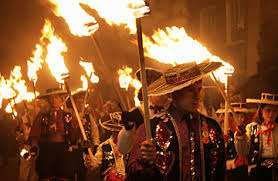
Tonight Is Guy Fawkes Night by Barbara Ardinger

Mark Twain is reported to have said that while history does not repeat itself, it often rhymes. Let’s see what rhymes we can find in Tudor and Jacobean England and Trumpean America. Here’s the history lesson. What has changed in 400 years?

After about a thousand years of Roman Catholicism in the British Isles (with a few thrusts toward reform, like the 14th century theologian John Wycliffe, who translated the Bible into medieval English), it is Henry VIII who is usually given credit for “reforming” the English church, i.e., declaring his independence from the Roman church and the pope in 1534. While Henry still called himself a good Catholic (and even condemned Martin Luther), it was the Tudors and their advisors that thrust a militant and puritanical Protestantism on the people.

The Tudor dynasty, which lasted just over a century, began with the victory of Henry Tudor (who became Henry VII) over Richard III at Bosworth Field in 1485. (Shakespeare turned Richard’s story into a Tudor propaganda play. In real life, Richard was a good king.) Henry’s second son, Henry VIII, was a tyrant who is best known today for his six wives. He was also more interested in luxury (in his day synonymous with vice) and self-aggrandizement than anything else.

Continue reading “Tonight Is Guy Fawkes Night by Barbara Ardinger”