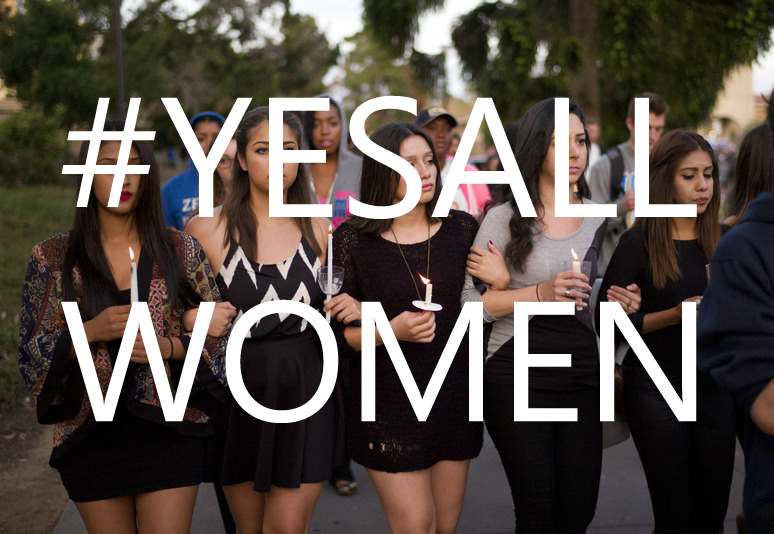
#YesAllWomen, the Darwin Debate, and the God Complex by John Erickson

#YesAllWomen proved that although not all men commit horrible crimes against women, the men that often get the headlines and create the most controversy are the ones that need to be watched out for.

John EricksonThe one thing I typically will choose to do on the rare occasion that I’m able to sit down and relax is to watch a documentary.  While some people may go to the gym, read a book, or hang with friends, I typically choose to stay in, nestle up on my couch, and learn.  While on my last bout of relaxation, I chose to watch the HBO documentary Questioning Darwin. Although it offers very little new insight into the evolution vs. creationism debate, it does offer an interesting new way to look at the recent social media hashtag war feminists, allies, and supporters found themselves in over the #YesAllWomen movement that took the world by storm.

yesallwomen

Now, before I discuss #YesAllWomen, I have to admit that I did not enter into the safe space women created for themselves to tell tales of the horrible things they have and have had to face on a daily basis.  I firmly believe that men should not have entered into the digital space Continue reading “#YesAllWomen, the Darwin Debate, and the God Complex by John Erickson”

Sexism and “Jerusalem” by Ivy Helman

headshot2Three weeks ago, I played a video entitled “Kingdom of David: Rivers of Babylon” from the PBS Empires series.  The series first aired in 2003.  For the first time, and I’ve played the video in class for probably six semesters in a row, I noticed that all of the biblical scholars, archaeologists and rabbis interviewed to discuss the Torah, the history of the Jews, the Talmud, the exile and the prophetic tradition were men.  This reminds me of a few months back when a female colleague of mine discussed about an encounter she had had with the producers of another documentary about the Hebrew Bible.  They had only interviewed one woman.  When asked about this decision, the producers told her that their audience finds men more authoritative than women when it comes to explaining topics of a religious nature.

***

Two weeks ago, on a Wednesday, an older woman walked into the liquor store where I work.  She wandered around for awhile and then appeared somewhat overwhelmed, which is usually my cue to inquire if the customer needs help.  She said she was just fine.  Five minutes later she was still wandering the store apparently unsure what to purchase so again I approached her and asked if she’d like some help.  She seemed somewhat desperate at this point and asked for my opinion on the Irish Cream Liquors and which one tasted the most like Bailey’s.  I told her I wasn’t exactly sure.  I had not tried them all but the one she was holding in her arms was very popular and we sell quite a bit of it.  She continued to hem and haw explaining to me that she was having a bunch of old ladies over for lunch.  She intended to offer them sips of Irish Cream afterwards.  Then out of the blue she looked at me and said that she still couldn’t decide so she was going to ask a man for his opinion.  This man also happened to be my boss.  He said that he hadn’t tried it, but that it was very popular.  His words, exactly the same as Continue reading “Sexism and “Jerusalem” by Ivy Helman”

Boys Don’t Cry (or at least the shouldn’t when they are interviewing you for a job) by Natalie Weaver

Natalie Weaver

I want to begin by saying that I am grateful for my work.  It is no small thing to have a relatively secure academic position, especially in a climate when tenured and full-time appointments represent a disgracefully small percentage of all teaching positions throughout the country.  Nevertheless, a certain degree of professional movement is welcome for the purposes of growth and renewal if and when opportunity arises.  It is on this basis that I have been receptive on a few occasions to apply for appointments at the invitation of search committee chairpersons.  When I have been solicited for an application, I have in turn applied.

It is a curious thing because when you are contacted out of the blue you think something like… “ah, they must like me… they must know something about my work.”  And, it is true that on the occasions when I was asked to apply for something, I was invited to come in for an interview.  This furthers, of course, thoughts like… “great, this is going somewhere.”  And, in my case anyway, I start thinking about and even planning in a tentative way for what a move would constitute, the logistics of change, the impact on my family, the disruption of my current obligations, and so on.  Showing up for an academic interview midcareer involves much more than preparing a research presentation, which is also no small task.  The whole affair is psycho-socially weighty, and that reality is intensified by the fact that it drags on for months.  It can take more than six months from the time of the initial contact to the interview to receiving news of the final outcome. Continue reading “Boys Don’t Cry (or at least the shouldn’t when they are interviewing you for a job) by Natalie Weaver”

Christian Sex Ain’t So Vanilla by Andreea Nica

Andreea Nica, pentecostalismMy recent literary digests have included memoirs and nonfiction audiobooks on sex, relationships, and non-monogamy. A recent listen, Open: Love, Sex and Life in an Open Marriage by feminist activist Jenny Block, provides insight into the paradigmatic features of open marriage drawing on the personal experiences of a bisexual woman. Currently, I’m musing over my latest read: The Ethical Slut: A Practical Guide to Polyamory, Open Relationships & Other Adventures written by psychotherapist Dossie Easton and author and sex educator Janet W. Hardy. Through my literary adventures, I can’t help but reflect on my own sexual conditioning and upbringing in the Pentecostal church.

The authors of these feminist-friendly, sex-positive books and social movements did not exist in the church I grew up in, and I feel quite saddened by this. While my sexual conditioning in the church was far from liberating, these reads have helped me realize that the religious community wasn’t as mundane as I thought. My early sex education which was conservative consisted of the anatomical and biological basics (Arizona education system, need I say more?) and early conditioning of sex morals and ethics in the church. The latter was more influential to my perception of sex, gender, and relationships. Of course the media and my peers constructed my views of sexual culture and gender norms, but the church had the greatest impact during my childhood and adolescence. Continue reading “Christian Sex Ain’t So Vanilla by Andreea Nica”

A feminist closet? by Linn Marie Tonstad

Linn Marie TonstadEvery now and again, a budding systematic theologian comes to my office and wants to talk about how to avoid being pegged as a feminist, and therewith avoid not being taken seriously as a theologian. Sometimes the students are feminists, but don’t want that aspect of their work to dominate or perhaps even to be visible for a time; in other cases, the students aren’t feminist – or didn’t start out that way – but are having experiences as they enter the guild that are raising these concerns for them in a new way. Perhaps professors are assuming that they are feminist simply because they are female, or perhaps male students are dominating in class and the professor is doing nothing to rein them in.

These students seek me out knowing that I am an avowed feminist and an avowedly feminist theologian. But they are concerned about the effects being or appearing feminist might have on their future careers. After all, they want to join the theological conversation in order to shape it – and their ambitions are right and justified. Continue reading “A feminist closet? by Linn Marie Tonstad”

The Politics of Miztvot by Ivy Helman

headshotRecently, Ben of Ben’s Tallit Shop commented on an older post of mine on this website entitled: “How Literal is Too Literal? My Experience with Tallit Katan.   He wrote, “In my opinion, it makes sense to first try the mitzvah of tzitzit in private for a month or two to ensure you are undertaking it for the right reasons.  Making a political statement is not a valid reason (though some people, I imagine, would argue otherwise).  Mitzvahs and politics don’t mix.”

First of all, this comment is both sexist and patronizing!  A man would never suggest to another man to do what he suggested I do and “try the mitzvah… in private… to ensure you are undertaking it for the right reasons.”  I’d dismiss it entirely if I was that kind of person, but I’m not.  Sexism and patronizing aside (as if one could do that really), I would like to engage with his thoughts on the mixing of politics and mitzvot because I think that can lead to great reflection and insight for Jewish feminists.

Not all mitzvot have an inherently political nature, but many do.  In fact, one could even argue something as seemingly apolitical as lighting Shabbat candles could be political.  Lighting candles ushers in Shabbat peace for one’s household and ideally for one’s community even if that peace is only for one day a week.  Since this is at odds with the world’s political environment of fighting, war and violence, it could be interpreted as a political act.  After all, won’t every day in the redeemed world be Shabbat? Continue reading “The Politics of Miztvot by Ivy Helman”

Anti-sex feminism? by Linn Marie Tonstad

Linn Marie TonstadLori Gottlieb’s article in the February 9 New York Times magazine, “The Egalitarian-Marriage Conundrum,” was yet another tired entry in the New York Times’s annual clickbait misogyny Olympics. Who doesn’t remember the supposed opt-out revolution, and the sadness of the decade-later follow-up demonstrating every single consequence that any feminist could have predicted? Or the weekly gender terrorism spewed by Maureen Dowd, who somehow gets people to believe that constant belittling and feminizing male Democratic politicians counts as incisive, progressive political commentary? To name just a few of the most memorable, and most infuriating, examples.  

Gottlieb’s article rehashed the studies – I’ve lost count of how many times I’ve read about them in one version or another – that suggest that equality in household labor leads to decreased frequency of intercourse among married heterosexual couples. The most revolting lines in the article – among many contenders – start with a quote from Julie Brines, the author of the study in question: ‘”The less gender differentiation, the less sexual desire.’ In other words, in an attempt to be gender-neutral, we may have become gender-neutered.” It is possible that Brines may be quoted out of context, or that what she intended to say was something quite different, but as the quotation stands, it implicitly suggests that so-called “traditional” gender differentiation is necessary for sexually satisfying heterosexual relationships. (For, of course, there are plenty of other ways in which gender differentiation might be present in heterosexual relationships. Gender differentiation is here being equated with a very particular set of decisions about ‘housework’, a notion that arguably exists only to render some parts of women’s work invisible.) That’s before getting into the implications of the word “neutered” used in the second sentence. Why would egalitarian distribution of household labor be considered “gender-neutral” to begin with? Continue reading “Anti-sex feminism? by Linn Marie Tonstad”

Is My Baha’i Faith Compatible with Feminism? by Saba Farbodkia

I am a Ph.D student of Neuroscience at Queen's University, Kingston, Ontario. I was born in Iran into a Baha'i family, adopted the Baha'i Faith at 15, and did my B.Sc in biology and M.Sc in Neuroscience in Iran, at the Baha'i Institute for Higher Education (BIHE), an institute founded by Baha'is after the Islamic Republic of Iran (IRI) stopped Baha'i students to higher education at the formal universities of the country.  My interest in feminism started as a response to the influence of a woman-suppressive culture that I was surrounded by, even before I knew the word existed. Before I move to Canada and get to know progressive readings of Islam that begged to differ from how IRI reads Islam, I mostly blamed Islam for the sexist environment that I suffered from, and my questions about the Baha'i Faith and feminism started to rise in response to such thoughts: I kept asking myself, if one day the Baha'i Faith finds majority, or if it gets an opportunity to influence the culture as widely as Islam has in Iran, will it become a source of sexism, as well?As a Baha’i woman, I often ask myself if feminism is compatible with religion. And most of the times, I tend to answer no. Feminism is defined as a movement to end sexism, which is further defined as prejudice, stereotyping, or discrimination, typically against women, on the basis of sex. Any such movement should attempt to eradicate the social norms and religious and cultural values that pressure people into adopting certain roles, attributes or duties, or limit their rights and responsibilities, based on their sex.  Religions, on the other hand, very often do assign roles, duties and rights to people based on their sex. A religion can be compatible with feminism only if it is silent on the subject of people’s sex, unless it asserts that sex is not a factor in determining people’s roles or lifestyles.

The Baha’i Faith is definitely not so. Born around 170 years ago in Iran, the Baha’i faith is a somewhat new religion, supposedly meant for the current time. Still, there are particular cases of assignment of different roles to women and men at the level of individual life, family, and society. Men are, for example, required to do a pilgrimage if they are financially capable of it, and women have the right to choose it, though are not required. Women can choose between fasting or not, and saying obligatory prayers or an alternative prayer, during menstruation. Women are deprived the right to be elected as members of the Universal House of Justice. Mothers have a right for financial support from their husbands, but not the opposite, while they still retain their other rights. A dowry is required to be given from man to woman for a marriage. In cases where there is no ‘last will and testament’ of a deceased person (which is not supposed to happen very often, since Baha’is are required by Bahaullah to write a will to determine how to dispose their property as they wish), some of their female relatives receive an inheritance slightly less than the male relatives. Girls get the priority in education if the opportunities for educating all children are limited. Continue reading “Is My Baha’i Faith Compatible with Feminism? by Saba Farbodkia”

Men, Men, Everywhere by Kecia Ali

dissertation, Advising, feminism and religion

I recently published an essay in the British quarterly Critical Muslim. In it, I chose books on Muslim thought and reform by three prominent, well-regarded male scholars and I counted mentions of individual women in their indexes, their texts, or both. I didn’t have to count very high. I looked at how often they cited – or didn’t cite – books by women in their notes and bibliographies. And then I wailed and gnashed my teeth.

I didn’t really. But I wanted to.

Consider:

A study of modern Muslim intellectuals with a chapter on women, law, and society, that names only three women, none of them Muslim as far as I can tell, in an index which names 240 individuals?

Two books about Blackamerican Muslim thought and identity that do not mention Amina Wadud, the African-American Muslim thinker who has had the most significant global impact?

A book about Muslim reform that names only four Muslim women, all from Muhammad’s seventh-century community, and all but one from his household, in the main body of the work? Which segregates every book by a Muslim woman into one lengthy endnote, and says nothing about them or their authors anywhere else? Continue reading “Men, Men, Everywhere by Kecia Ali”

Theopoesis and the Interior Divine by Natalie Weaver

Natalie Weaver

Last week I traveled to Leuven, Belgium for the 9th Leuven Encounters in Systematic Theology conference.  I have been to this conference before, and I find that my perspective is generously enlarged by hearing voices that emerge from contexts and concerns that differ from my own in the USA.   This year, the conference theme was “Mediating Mysteries: Understanding Liturgies.”  The keynote speakers offered inspiring investigations into what “full, active, and conscious” participation of people in the Catholic liturgy means today (for, such were the goals for liturgy articulated at the Second Vatican Council).  Some provided critical evaluation of the newly revived Roman missal.  One speaker offered a searing critique of the distinction between true mystery and fabricated mystique in the Mass.  The breakout sessions were exceptionally well designed.  Here I noticed a common thread of people searching beyond the formal magisterial liturgies and studying the value of those mediated mysteries that are celebrated and communicated in culture, literature, and art. Continue reading “Theopoesis and the Interior Divine by Natalie Weaver”