An Indecent Reading of Mary Magdalene by Cynthia Garrity-Bond

cynthia garrity bondRecently I took one of those on-line quizzes that show up on Facebook. Based on my response to particular questions, it promised to tell me what my Biblical name would be. To my joy I received Mary Magdalene. To my disappointment her bio lacked any of the historical tensions we have come to expect.

On July 22 we celebrate the Feast Day of Mary Magdalene, witness to the Resurrection and therefore deemed, “apostle to the apostles.” For as many depictions of Mary there are just as many interpretations. Her status in early Christianity surpassed the Virgin Mother in popularity but by the fourth century her positive image began to decline. In 594 Pope Gregory the Great delivered a sermon in which he conflated the story of the unnamed woman anointing Jesus in the Gospel of Luke with Mary of Magdala as penitent whore, a title she would embody for nearly 1,400 years until in 1969 when the Catholic Church repealed its teaching of Mary as prostitute.

On the other hand, recent feminist theological scholarship, especially by Karen King, offers a depiction of Mary as leader within ecclesial settings, where, “From the second to the twenty-first century, women prophets and preachers have continued to appeal to her to legitimate their own leadership roles,” (King, 153). By casting Mary as prostitute and adulteress, King argues, the church tarnished the image of Mary as a spiritual leader. It is this binary of Mary as repentant whore or “prominent disciple of Jesus, a visionary, and a spiritual teacher” (King, 154) that I wish to explore.

To begin I ask the question what does it mean for Mary’s role as leader for her to have been a prostitute who also functioned, in the words of King, as disciple of Jesus, a visionary and spiritual teacher? Continue reading “An Indecent Reading of Mary Magdalene by Cynthia Garrity-Bond”

A Christian Response to Racism, Sexism, & the Rise of American Terrorism by Trelawney Grenfell-Muir

Trelawney bio pictureAs our country reels in horror at the brutal massacre of nine worshipers at Emanuel African Methodist Episcopal Church, one particularly important detail has emerged: the young man who killed those nine people entered the world of white supremacism after the object of his romantic interest rejected him and dated a black man.

According to his cousin, the experience dramatically changed the young man, led to his obsession with racist hatred, and motivated him to commit the atrocity. In some ways, the event resembles the 2014 Santa Barbara massacre, in which a young white man with strong racist tendencies massacred young women because he felt angry that women generally did not respond favorably to his romantic advances. Other mass murderers have also exhibited violent misogyny. Moreover, our country has begun to notice that most mass shootings are carried out by white males, and to point out that white masculinity may lead young men into feeling like failures if they do not achieve all the trappings of their supposedly superior race and gender identity.

My questions are: how did we, as a society, fail these young men? And how have we, as a church, failed society? And, most important, how can we help heal these diseases that are killing us? Continue reading “A Christian Response to Racism, Sexism, & the Rise of American Terrorism by Trelawney Grenfell-Muir”

The Importance of Rituals (Part 2) by Elise M. Edwards

elise-edwards

In my previous post, I wrote about the importance of rituals. The rituals of the Easter season helped me process some difficult emotions. The way that rituals mark time and demonstrate consistency has been a comfort for me when facing new challenges and settings. But I am quite aware that rituals can become empty.   In one of the comments to that post, a woman named Barbara responded, “There came a time for me when familiar and meaningful ritual no longer made sense. I had changed in understanding of what the ritual symbolized and celebrated. And haven’t found new rituals that make sense for me now…or at least I’m not aware of any.” Barbara’s remarks capture not only the loss from no longer being able to relate to existing rituals after life changes, but also the difficulty in finding or creating new rituals to take their place. I thanked Barbara for her honesty and decided that this post would continue the discussion, focusing more on discovery and creation of new rituals.

As I was preparing that post, I watched an episode of Call the Midwife that prompted me to reflect on the need to create rituals when existing ones just don’t work. Call the Midwife is a BBC-PBS show about nurses and midwives living in a convent in London’s East End at the end of the 1950s and early 1960s. The show is based on the memoirs of Jennifer Worth, and it does a better job than most primetime dramas of showing female characters’ experiences the joys and challenges of their professional lives and personal lives. As it is set in a convent with several characters who are both nuns and midwives, the show also explores the theme of vocation. What does it mean to be called to the religious life? Called to nursing? What does motherhood demand? Continue reading “The Importance of Rituals (Part 2) by Elise M. Edwards”

Buddhas In Snowflakes, Enlightenment In A Bathtub

Stuart WordPress photoThis year’s Tibet House Benefit Concert coincided with a snowstorm in Manhattan and though snow is not uncommon in Manhattan (especially this past season), it is particularly associated with Tibet and its high, perennially snow covered peaks.  The timing of the snowstorm was thus peculiarly appropriate, leading Robert Thurman, US President of the Tibet House, to muse in his opening remarks about there being Buddhas in the snowflakes.

I was lucky enough to attend that concert thanks to my wife and some of her colleagues being invited by Thurman to attend in appreciation for work they had done on a book consisting of a collection of speeches by the Dalai Lama, My Appeal to the World.  Snow had been a topic of conversation at the dinner we had before the concert not just because of the coincidence of the snowstorm and concert, but also because one person in our group had recently broken her wrist slipping on what was left from an earlier snowstorm.  She was lamenting being sidelined from her yoga practice, at which point I brought up the topic of the therapeutic benefits of bathing.  As is typical of dinner conversations, that quickly morphed into a discussion of other issues; soon it was time for the concert and off we went.

Several weeks later, while taking a bath after my own yoga practice, as I often do, it occurred to me that being in a bathtub was analogous to being in a snowflake–a very large and warmed up snowflake.  The basis for the analogy is that ‘buddha’ is not a name but commonly interpreted to be the past participle of a verb, the primary meaning of which is to awaken.  The roots of Indo-European (IE) verbs only refer to bare existence or an action and as such can ‘belong’ to any noun (person, place or thing) of any gender (female, male or neuter).  Any person of any gender can be ‘awake.’  As a participle ‘buddha’ is a hybrid–part verb and part noun–and thus specifies gender (masculine), but that is an artifact of grammar, a way of speaking, that manifests its interdependence with other elements of language and how that language is used at any particular point in time.

There are a number of fascinating implications in analyzing language in this way (what used to be called ‘speculative grammar’ in Medieval times), but the single most important is that by itself language is not particularly enlightening, but rather quite dependent upon the context in which it is used.  It helps explain why the tradition of rejecting textual authority in favor of direct enlightenment, the ‘moment of zen,’ became particularly prominent in Chinese, Korean and Japanese Buddhism.  The grammatical differences between Sanskrit and Chinese are relatively substantial compared, for example, to those between any one IE language and another IE language.  Grappling with translating and interpreting first Sanskrit and then Chinese and then Korean or Japanese, seems to have heightened the sensitivity to the limitations of language, especially with respect to spiritual beliefs and practices.

This aspect of Buddhism can be readily demonstrated to share roots in an equally ancient tradition of Greek poetic culture.  It seems, however, that the guardians of the text based religious traditions emanating primarily from regions controlled directly or indirectly, at one time or another, by Roman emperors, are more than happy to let that aspect of the Western heritage go unnoticed.  Instead these guardians seem to emulate the command and control tactics of Roman emperors with what can be fairly characterized as intellectual imperialism.

Because of its importance to all such traditions, Song of Songs (Songs) is a useful example to cite.  Only by walling off a substantial amount of evidence is it possible to prevent Songs from being seen to be in part or whole a product of female spirituality that celebrates sexuality in a manner a Buddhist would identify as tantric.  Proof that is exactly what the guardians of the text based religious traditions have been doing is not hard to find, for the fact that few women have authoritative positions within any organization associated with such traditions is an artifact of just such a wall.

Such tactics ironically expose the vulnerability of these traditions to decline and fall.  One way that might happen can be discerned in what happened to Buddhism as it spread east.  It was creatively interpreted in harmony with a far more ancient tradition of nature worship associated with early Taoism, a tradition that privileges individual artistic expression, such as poetry, over textual study or ritualized recitation.  That tradition is comparable to the Western philosophy of nature evidenced, for example, in the poetry of the ancient mystic Greek of Sicily, Empedocles.

Though I have referred to this philosophy in previous posts, I hope to discuss it in more detail in upcoming ones as it relates both to ancient traditions such as Taoism and Buddhism as well as to how spirituality might evolve in the future.  Suffice it for now to say that what is essential is appreciating that experience itself is the ultimate, authoritative a priori of all spirituality.  That can mean doing yoga, meditating upon snowflakes or sloshing about in a tub of water.

Eventually, though, it leads within, to what the poet Holderlin calls ‘Innigkeit,’ a state of inwardness that is itself speechless, but which is the source of poetic/artistic inspiration.  That is in an essay on Empedocles, but given what was then known about him, Holderlin was largely projecting onto Empedocles his own beliefs (shared with his friend Schelling) about nature, with “all her melodies,” as the ultimate source of inspiration.  Decades after that essay was written, Schelling used Innigkeit in a lecture on mythology to translate a key term from the Bhagavad Gita: yoga, a term that as used there many scholars today think betrays Buddhist influence.  Several other translations were then available and it seems likely Schelling’s unprecedented choice of Innigkeit was an homage to Holderlin.

As it happens, substantial new fragments of Empedocles’s poetry were discovered in the 1990s.  In 2004, after piecing together those fragments with many of the other previously discovered ones, Richard Janko suggested Empedocles should be thought of as the Greek equivalent of Buddha.  Be that as it may, there is no question who Empedocles would say is in snowflakes: Aphrodite.

Stuart Dean has a B.A. (Tulane, 1976) and J.D. (Cornell, 1995) and is currently an independent researcher and writer living in New York City.  Previously he worked in a variety of other capacities, including 15 years as a corporate attorney.

The Case of Mary’s Decency by Xochitl Alvizo

Incarnation, Goddess spirituality, Xochitl Alvizo, god became flesh

This post builds on yesterday’s post on Marcella Althaus-Reid’s indecent theology.

In her book, From Feminist Theology to Indecent Theology, Marcella Althaus-Reid states that liberation theology has two dominant characteristics: the familiar ‘preferential option for the poor,’ with its suspicion of class structures and the influence these have on faith and church teachings to perpetuate and preserve its unjust systems of oppression and domination; and  for its praxis of transformation of said unjust systems (FFTIT, 11). Marcella Althaus-Reid credits liberation theology for “systematically and structurally using the concept of ideological formation in order to unveil class economic interests embedded in theology” (FFTIT, 11).

To build on this, Althaus-Reid uses the concepts of ‘decency’ and ‘indecency’ to challenge theology’s obsession to regulate and control “sexual performances, roles and behavioral patterns of people…through a sexually based patriarchal hierarchy based in a particular androcentric understanding of life according to predetermined identities” – in other words, heterosexism. Indecent theology, then, aims to strip away theology’s false claim to sexual neutrality and its obsession to control, and instead aims to develop a theology free from the heterosexism that confines it (FFTIT, 83). One key place in theology she seeks to indecent (she used the word as a verb) is the “legend of Mary” (IT, 40).

Continue reading “The Case of Mary’s Decency by Xochitl Alvizo”

A Little Indecency with Marcella Althaus-Reid by Xochitl Alvizo

Incarnation, Goddess spirituality, Xochitl Alvizo, god became fleshInspired by the conversation following Vanessa Rivera de la Fuente’s post yesterday, I offer here a little synopsis of Marcella Althaus-Reid’s work in Indecent Theology: Theological Perversion in Sex, Gender, and Politics.

Marcella Althaus-Reid opens her book by recalling a question she received from one of her colleagues: “What has sexuality to do with a Feminist Liberation Theology?” To answer she reflected on early liberation theology when it was still in formation and later liberation theology as it gained its place in the academy and the church:

[T]imes change and subversive theology becomes incorporated: church leaders claim that they themselves have always been liberation theologians. They guarantee to the state that there is no danger here…It is acceptable in the academy, entertaining to the wider public and a valuable commodity to publishers. Having reached calm waters, why would I as a feminist liberation theologian risk rocking the boat by introducing such a scandalous theme as sexuality, especially when it is not the theology of sanctified sexuality? (Indecent Theology, 2)

Continue reading “A Little Indecency with Marcella Althaus-Reid by Xochitl Alvizo”

To Be an Advent People by Kelly Brown Douglas

Rev.-Dr.-Kelly-Brown-Douglas - Version 2

In my church tradition, we have just entered the 3rd week of Advent.  In today’s blog I share just a brief excerpt from the sermon which I preached on Sunday.  I hope it at least inspires reflection on where we go from here as a nation, as a people and our responsibility in moving forward.  I preached:

On this 3rd Sunday of Advent the stories and testimonies of four women have in many ways pricked the collective consciousness if not the conscious of our nation. These women, mothers all—are names that we sadly have become all too familiar with. They are Sybrina Fulton, the mother of Trayvon , Leslie McFadden, the mother of Michael, Gwen Carr, the mother of Eric and added to the list most recently Samira Rice, the mother of 12 year old Tamir.  To call the names of these women and their sons, is to be confronted with the unsettling if not frightening times in which we now live and thus to be reminded of the ways in which our world is broken, the ways indeed in which the sacredness of our very humanity has been betrayed by our separation one from one another. Yet, it is into this unsettled time of brokenness that this season of Advent comes. Continue reading “To Be an Advent People by Kelly Brown Douglas”

The Mosaic Language of God by Andreea Nica

Andreea Nica, pentecostalismThroughout my “bible-thumping, smitten with God” years, I scribbled countless thoughts and prayers in four devotional journals. Recently I came across these journals, wiping away the years of dust accumulated. As I have been detaching from the Pentecostal god, it was a painful, downright mortifying experience to read through my past communication with god. This god seemed so foreign now given my liberated, enlightened, evolved self. I remember writing to and about Him, but I couldn’t help thinking how dysfunctional and convoluted the language I used really was.

I love you Father. Take me…surrender me to your will…your ways. Let me not lean on my own understanding and foolishness.

Mary Daly in Beyond God the Father advocates, “Time to go beyond God the Father. Don’t you see? If God is male, then the male is God. Reclaim the right to name your self, your world, your God. The liberation of language is rooted in the liberation of ourselves. Be a wild woman…God is not A Being. God is Be-ing.”

Many social scientists contend that language is the foundation of our socially constructed realities. We use language as a creative tool and guide to frame our perceptions of the world around us. We also use language to create our own unique creative expressions. That even though we share and appropriate from the accessible pool of creative expressions, each individual designs and discovers their own true form. Continue reading “The Mosaic Language of God by Andreea Nica”

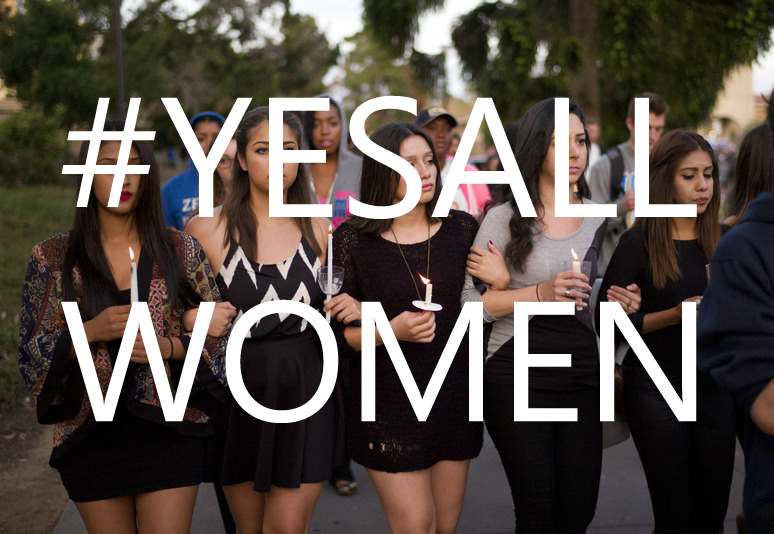
#YesAllWomen, the Darwin Debate, and the God Complex by John Erickson

#YesAllWomen proved that although not all men commit horrible crimes against women, the men that often get the headlines and create the most controversy are the ones that need to be watched out for.

John EricksonThe one thing I typically will choose to do on the rare occasion that I’m able to sit down and relax is to watch a documentary.  While some people may go to the gym, read a book, or hang with friends, I typically choose to stay in, nestle up on my couch, and learn.  While on my last bout of relaxation, I chose to watch the HBO documentary Questioning Darwin. Although it offers very little new insight into the evolution vs. creationism debate, it does offer an interesting new way to look at the recent social media hashtag war feminists, allies, and supporters found themselves in over the #YesAllWomen movement that took the world by storm.

yesallwomen

Now, before I discuss #YesAllWomen, I have to admit that I did not enter into the safe space women created for themselves to tell tales of the horrible things they have and have had to face on a daily basis.  I firmly believe that men should not have entered into the digital space Continue reading “#YesAllWomen, the Darwin Debate, and the God Complex by John Erickson”

Theological Reflection: Outward, Not Inward by Kelly Brown Douglas

Rev.-Dr.-Kelly-Brown-Douglas - Version 2I was asked recently what frustrates me most about theology. I am a theologian, and love doing theology. Nevertheless, I do have my moments of frustration with the theological enterprise. I am most frustrated when theology loses its dynamic edge and focus. Too much of theological reflection has become “navel gazing” falling prey to the infamous accusation of Medieval theology, that is, wondering “how many angels can dance at the end of a pin.” It seems to me, that we must not lose sight of the fact that the foundation of theological reflection is the revelation of god, which is nothing less than god’s movement that is god’s dance, in human history. All that we know about the transcendent reality is made known to us by that reality making itself known by entering into our world. The best of theological reflection, then, is a response to that revelation, wrestling with the meanings and challenges of god’s revelation to us. Again, far too often our theology is consumed by intellectual strivings as opposed to struggling with god. We, as theologians and religious thinkers, find ourselves debating the essence of god—who god is in god-self, what we call the godhead—as opposed to who god is in relationship to us and our world. Too often we focus our attention on the appropriate pronouns and nouns that we should use to define god as opposed to the verbs that describe the very movement of god in our world. And so, despite the fact that we do not know god in “god-self” or in the god head, theological reflection is spent debating it, and has a long history of debating it. In the meantime, the world stays just as it is—which is anything but a reflection of the gods/goddesses we claim to follow. Even as we can assume that who god reveals god-self to be is a reflection of the very essence of god, theological reflection is best served not by this upward, inward turn to god, but by following god outward into our world. As god moves toward us and into our world, so too are we to move toward one another and into the world, for this is where we will find god. Theological reflection must not be about who god is in god-self, but rather about who god is for us and who we are to be for god. Theology, as it is essentially grounded in the notion that god acts first, is at best an attempt to discern how god is acting so that we can act back in a responsive and responsible way. So what does this mean? Continue reading “Theological Reflection: Outward, Not Inward by Kelly Brown Douglas”