Reflections On Bone Black: Memories Of GirlHood by Zoe Carlin

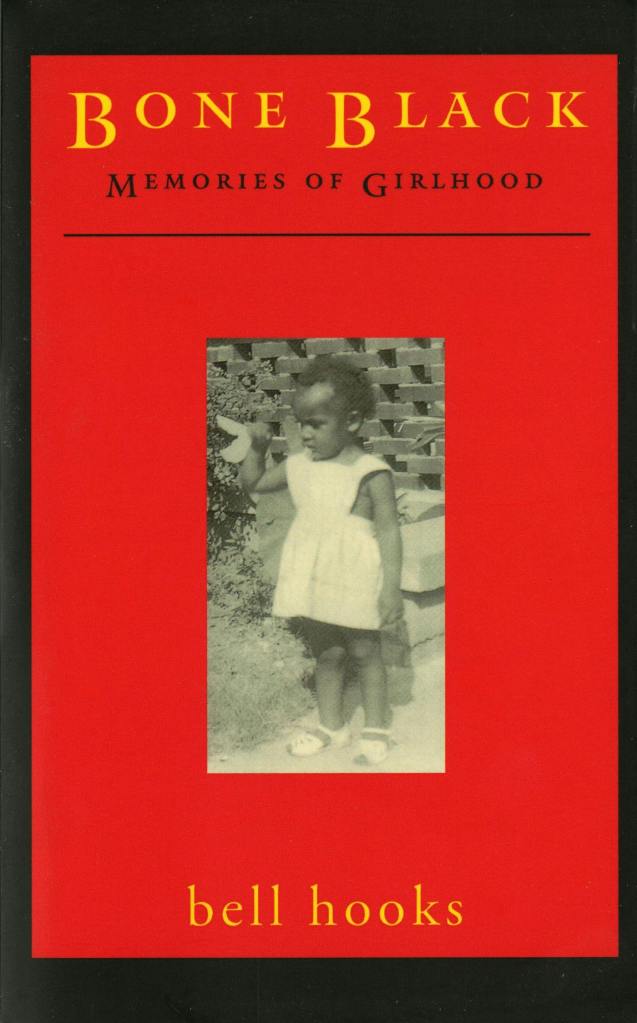
Bell Hooks explores in the memoir Bone Black: Memories of Girlhood the extreme effects of race, gender, and class on her identity and self esteem as a Black woman. Each chapter of Bone Black showcases stories of Bell Hooks’ childhood experiences growing up in a racially segregated environment. Through these experiences, she shares how the mainstream beauty standard, the racism towards Black people, and the limitations imposed by class and gender have shaped her perceptions of herself and her worth. Hooks also discusses how white supremacy, the patriarchy, and societal neglect intertwine.

What particularly stood out to me is how her story and the themes mentioned connect to spirituality and are offering further ideas on resistance and empowerment. It also touches on connections with identity formation and our sense of self. For example, the memoir shared insight of how the beauty standards at the time were typically associated with being white. As a Black woman, Hooks shared how she had felt undesirable due to not being included in these standards that were set in place. She does not just reflect on the pain of being marginalized but she also delves into the complexity of being a Black woman in a masculine dominated world. Hooks had to navigate both the oppression of racist behavior by others around her and the misogyny of a patriarchal system that was determined to define her worth based on her appearance.

Continue reading “Reflections On Bone Black: Memories Of GirlHood by Zoe Carlin”

Journey to Freedom: Harriet Tubman Still on the Move, part 1 by Maria Dintino

Moderator’s Note: This post is brought to you by a collaboration by FAR and Nasty Women Writers written and hosted by Maria and Theresa Dintino. This post originally appeared on their website on Feb. 20,2024. It has been updated to reflect recent events. the post is subtitled: Nasty Women Writers: Breaking the Bronze Ceiling – Statues of Real Women in Public Spaces

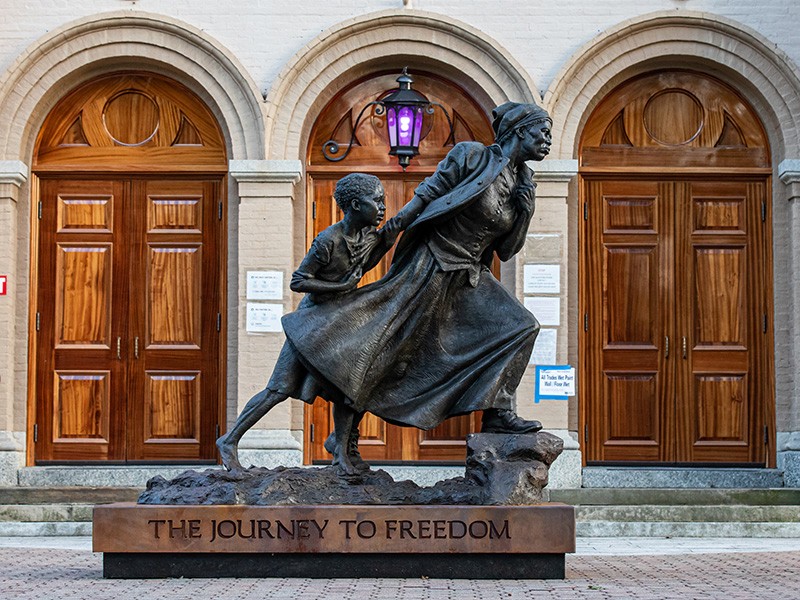
It’s quite fitting that the 9-foot bronze statue of Harriet Tubman, named Journey to Freedom is still on the move, as was Tubman for much of her life.

Since 2020, the statue has traveled around the country. It’s currently on Hilton Head Island, South Carolina, in Historic Mitcheville Freedom Park. The monument will remain on Hilton Head through April 2025 and from there be transported to Vienna, Virginia.

Continue reading “Journey to Freedom: Harriet Tubman Still on the Move, part 1 by Maria Dintino”

Practicing Mistakes in Karate by Xochitl Alvizo

One of my earliest lessons from karate, which I am still working to integrate, is about the necessity of making mistakes. I used to apologize every time I make a mistake, “I’m sorry,” I’d immediately say to my instructor. She would smile at me and at the end of class would say, “You don’t have to apologize for making a mistake; your body is just learning to do this for the first time, so of course you’re going to make mistakes. Mistakes are part of the process.”   

The necessity of making mistakes was something I needed to learn to embrace. As with other areas of life, making mistakes in karate made me feel like a fool. I would get frustrated with myself and would feel embarrassed, and would feel like my teachers were disappointed in me too. But one of the things that has helped me embrace my mistakes is seeing how I have indeed improved in my practice. The mistakes I now make are new ones and are about higher level forms and techniques—things that used to absolutely seem impossible for me. 

Continue reading “Practicing Mistakes in Karate by Xochitl Alvizo”

I Am Wicked by Chaz J.

*When I refer to Black women, I am referring specifically to descendants of African peoples that were forced to experience the dehumanization of chattel slavery in the United States.  I refer to those who would build the foundation of the country, uncredited. Those whose descendants continue the legacy of fighting for liberation.  

When a sister-friend invited me to see Wicked, I was hesitant. I’d never seen the show, and my attention span hadn’t even allowed me to finish The Wizard of Oz or The Wiz (the Black rendition). However, seeing the wicked witch, Elphaba, portrayed as a Black woman changed everything. It felt deeply personal; a reflection of my own life as a Black woman in predominantly white environments. As a womanist theologian, centering Black women’s experiences is central to my daily and theological framework, and this felt like a powerful synchronicity and spiritual experience aligning with my newly entered villain era!

Continue reading “I Am Wicked by Chaz J.”

From the Archives: “Shemot: Women’s Misbehaving and Disobeying as the Key to Liberation.”

Author’s Note: This blog was originally published five years ago to the day (12 January 2020). It rings as true then as it does today.

Shemot will be read in synagogues on 18 January 2025.

This week’s Torah portion, or parshah, is Shemot (Exodus 1:1-6:1).  This parshah sets the scene for the liberation of the Israelites from slavery both by introducing main characters and elaborating on just how difficult life was for the Isrealites under Pharoah’s rule.  The parshah contains many noteworthy aspects: the death of Joseph and the multiplication of the Isrealites in Egypt; the increasing wrath of the Egptians; the birth and adoption of Moses; Moses’ encounter with the Divine in the form of a burning, yet unconsumed, bush; the revelation of the divine name, G-d’s plan for Moses’ role in the liberation of the Israelites from slavery; Moses’ attempts to get out of his assigned role; and Moses’ first confrontation with Pharoah.   

In addition, there are many women, who are integral to the salvation of the Israelites, in this parshah.  For the most part, Jewish tradition has acknowledged their part when it comes to discussions of this parshah, especially Shifra and Puah.  Yet, their role is often overshadowed by Moses’ varied miracles, the mighty power of the divine, the revelation of the Torah, the wanderings in the desert, and so on.  However, the Israelites’ liberation from slavery would have looked quite different without women.  

Continue reading “From the Archives: “Shemot: Women’s Misbehaving and Disobeying as the Key to Liberation.””

St. Brigid: Reproductive Justice and the Realms of the Miraculous by Elanur Williams

St Brigid being carried away by angels, in a painting by John
Duncan (1913)

One of my favorite saints is St. Brigid of Kildare, the patroness of poetry, learning, healing and protection. She is frequently called upon during childbirth. Brigid’s hagiographies are noteworthy for her remarkable abilities to heal and perform miracles—including her ability to make pregnancies vanish, for those who ask. In Vita Prima and Vita Brigitae (Life of Saint Brigit) published around 650 C.E. by Cogitosus, an Irish monk from Kildare, it is claimed that “Saint Brigid, by the very powerful strength of her faith, blessed a woman who had fallen [pregnant]…and the conception in the woman’s womb decreased and she restored her to health…without childbirth and its pangs.” The pregnant people in Brigid’s tales turned to Brigid to help them reclaim and restore their dignity. Consequently, their abortions served as catalysts for change. “Abortion miracles” have narrative and theological functions: they expose constructs of sexuality, chastity, purity, and sin. In addition, they test our understandings of healing—physical and spiritual—by revealing the intersectionality between medicine, pregnant people, power, and personal agency. Scholars have theorized the presence of “abortion miracles” in hagiographies, and whether they are to be read as a kind of defiance towards early Christian morality, or as a demonstration of chastity’s role and value in early medieval Irish Christianity. Some Irish penitentials view medieval abortions as malefic acts or as a kind of malevolent magic; however, according to Arica Roberts (2020), it can be argued the abortion miracles found in Irish hagiography can instead be read as “medicines of penance” and as contributing to healing.

Continue reading “St. Brigid: Reproductive Justice and the Realms of the Miraculous by Elanur Williams”

From the Archives: A Chorus of Need: I Need an Abortion by Marie Cartier

This was originally posted June, 2022

I need an abortion and I can’t get one

Because I don’t have the money to fly somewhere else other than …here

Where I can’t get one

I need an abortion and I can’t get one

Because the kid, or the cells of a maybe kid, were put in here by the guy that raped me and if I have to have it, I will kill myself

I need an abortion and I can’t get one

Because I have four kids already and I can’t feed another one

I need an abortion and I can’t get one

Because it’s my dad’s…did you hear me say that? I have never said that. I have never said what he does to me…and now I have to show everyone… if I can’t get this out of me I will…

I have to get this thing out of me

I need an abortion and I can’t get one

Continue reading “From the Archives: A Chorus of Need: I Need an Abortion by Marie Cartier”

The Awakened Woman: Remembering and Reigniting Our Sacred Dreams by Woman Writer Dr. Tererai Trent by Maria Dintino

Moderator’s Note: This piece is in co-operation with The Nasty Women Writers Project, a site dedicated to highlighting and amplifying the voices and visions of powerful women. The site was founded by sisters Theresa and Maria Dintino. To quote Theresa, “by doing this work we are expanding our own writer’s web for nourishment and support.” This was originally posted on their site on January 14, 2020. You can see more of their posts here. 

Breaking the Bronze Ceiling – Statues of Real Women in Public Spaces

I cannot imagine a woman more deserving than Dr. Tererai Trent, her likeness one of ten life-size bronze statues unveiled in New York City on Women’s Equality Day on August 26, 2019.

Australian global public artists and activists, Gillie and Marc Schattner, revealed the statues of these inspirational women on 6th Avenue (Avenue of the Americas) that glorious summer day! Their organization, Statues for Equality, is on a mission to achieve gender balance in public statues worldwide. In NYC prior to their unveiling, only 3% of the statues depicted females; this climbed to 10% on August 26.

Continue reading “The Awakened Woman: Remembering and Reigniting Our Sacred Dreams by Woman Writer Dr. Tererai Trent by Maria Dintino”

Fight, Fight, Fight? by Caryn MacGrandle

I have two divorces under my belt. I’m not proud. I made bad choices. I didn’t have the support network nor the mental ability to thrive in the situations. But I had gumption. And I didn’t stay.


So here I am. 54. And starting over. 


It can be rather terrifying as motherhood and family has always been my focus.


After my recent second divorce, part of my stability plan was Land. The Blue Ridge mountains in North Carolina called me. The Appalachians. I spent a year looking. I had a list: unrestricted land, at least five acres, a water feature. 
I had several adventures on my own looking, but I will never forget the day I found it. I was with my son James, and I knew it right away.


Ten acres. A third of it a bog along a creek. Away from it all, but not ‘too away’ as it has a road running through it that leads to a partly developed mountain subdivision. 


Home. 


I can breathe.

Continue reading “Fight, Fight, Fight? by Caryn MacGrandle”

Sojourner Truth, the photos by Beth Bartlett

Moderator’s Note: We inadvertently left out the photos from Beth’s posts on Sojourner Truth. The photos, all by themselves, pack an emotional punch and so we want to be sure they can be seen. These are Beth’s photos from Sojourner Truth Legacy Plaza in Akron, Ohio

You can see Beth’s posts here. Part 1 and Part 2

close- up of statue