We cannot force a connection with God through a faulty conduit. What is important is that we affirm ourselves when we find it — when we feel it. Embrace those experiences, name them for what they are and recognize that you are sacred and the divine – whatever that means to you – is present.
When I’m in a funk, I generally feed into it and make it worse. Once we are in a rut it is easy to continue the spiral downward. I’m good at admonishing myself for lacking gratitude when I feel this way. It might be a Catholic guilt thing.
A few days ago, I was in a dark place; but this time I tried to own my sadness, acknowledge it, and let it go. The only thing I could think to do in hopes of shifting my emotions was to put on music – something up beat that would allow me to transcend the moment.
I listened to a live version of “Stay” by The Dave Matthews Band, a song about embracing the beauty of our lives and the idea that those moments where it feels like we are just wasting time are often our most precious; the ones that allow us to connect with each other and ourselves. It was the sermon I needed — and an important lesson my uncle taught me — but more on that shortly.
I often say that I think music is the sound of my spirit — our spirits. As I started writing this, I struggled with finding the words to articulate the feeling music provokes within me. There is little else that creates such an indescribable experience and that is why I think that music is where I find my connection to the divine.
Traditional religious services have always felt challenging to me. I don’t connect to much of anything and generally find myself feeling angry and rejected by the Church and the community where I am supposed to find God. My grappling with Catholicism aside, we are told that our spiritual lives must take place within particular dimensions, and for many of us God is not there. Continue reading “Finding God in Music by Gina Messina”
What can we learn from each other? Some people teach us that we need help with boundaries. Some remind us that we are easy to love. We can observe the way some lovers make us want to escape, simmering a queasy feeling in our stomach that we practice patience and non-attachment with so that we are not harmed too much whilst in their presence and other lovers are always ready with a supportive word, assuring us that what we desire is valid, that we do not need to justify our path.
The people who we react to the most intensely, most of the time negatively, are these people our lessons? That sounds rather crass when thought to apply to anyone in an extremely oppressive and/or abusive situation. I would not suggest we apply this to anyone but ourselves, if indeed, it works for us. This is not the fatalistic idea of people belonging in a certain state or being punished for something. This is more a strategic curiosity of looking at our own agency from a back door. For example, my body might contort in frustration and sadness with someone, which could indicate I need to not be in relationship with their energies, but until I can create another path (maybe due to work commitments, relational obligations, financial situations, etc.), I feel more empowered reflecting so that I can learn about myself and others so as to perhaps not invite the same energies in during the future or to not have them affect me so harshly so that it doesn’t matter.
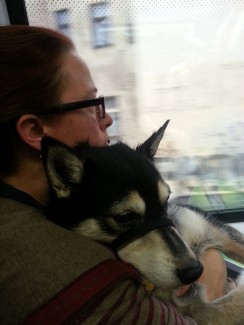
I wish, desperately, that you were still here. I miss you everyday. My body aches with grief. Tears run down my face.
It was so hard to say goodbye. Sometimes, I feel like I should have done more. I always thought you’d live to be older even though you made it to (nearly) 16. I couldn’t imagine life without you. Some days I still can’t.
But, the vet said you’d broken your jaw, probably from cancer. You struggled to walk from the arthritis and now your balance was off. The medication we put you on to help the infection in your jaw caused you to not eat for two days. You were so skinny. I couldn’t even keep you comfortable anymore. You cried so much. I knew, even though I didn’t want for it to be time, it was.Continue reading “Goodbye…and Hello by Ivy Helman”
On July 4 countless people in the United States celebrated Independence Day and many enjoyed a long leisurely Independence Day weekend. While there’s nothing wrong with celebrating freedom and all that is good in your country, I’ve become increasingly nervous about any form of unchecked, uncritical nationalism. Lately in global politics there’s been a resurgence of nationalism, populism, and isolationism of the ugliest kind. The kind that says, “Our own people first,” and “We need to build a wall,” and “Let’s drive out the immigrants,” and “Let’s start a trade war with China.” In Europe this sort of nationalism manifests itself in political movements like Brexit and in right wing populist parties like Front National in France.
To counter these divisive trends, I believe we need a new global holiday and a global Declaration of INTER-dependence. Our stark reality is that we inhabit an increasingly densely populated and fragile planet with finite resources. All human and non-human life on the planet is facing the specter of climate change and other environmental factors that threaten the fabric of our very existence. We live in an increasingly interdependent global economy. If China crashes, we will all feel the repercussions. Russian interference tipped the 2016 US election. A war in Syria and wars and grinding poverty in Africa have flooded Europe with refugees, which, in part, gave rise to this right wing, populist, anti-immigration push back. But if people in the developing world continue to suffer the worst ravages of climate change and the resulting famine, war, and poverty, our global refugee crisis is only going to escalate. Continue reading “Declaration of INTER-Dependence by Mary Sharratt”
My daily practice isn’t what I’d like it to be these days what with working two jobs, raising three teenagers, and going to grad school. I am clocking about 60 hours of work and school every week, which doesn’t leave very many spare hours for formal ritual, prayer, or meditation.
During previous phases of my life, I’ve had a daily devotional practice that’s taken on many different forms as my spiritual studies deepen. I’ve learned to use new tools, and gone from singing other people’s chants to writing my own and creating my own prayers. As my path unfolded, my practice evolved. But last autumn, life shifted when I went back to school and shifted again a couple of months ago when I added a second job to the mix. My spiritual practice over the last month has been sporadic, random moments stolen from other obligations to say a rushed prayer, a chant sung on the drive to work, or an energy center balancing done in the shower before bed.
Meanwhile, in the back of my mind was the fact that I had committed to attending a 4-day training intensive within the Avalonian Tradition, followed immediately by a 4-day leadership retreat for the Sisterhood of Avalon. A couple of weeks ago, with my daily practice in what felt like utter shambles, I suffered an bout of extreme self-doubt. What was I thinking committing to this training intensive and leadership work when I couldn’t even manage to find 15 minutes every day to engage the practice of my faith? How on earth could I think I was ready for this? Should I even still go? Continue reading “It’s Called Practice For a Reason by Kay Bee”
In my two previous posts, I shared my recent experience talking about privilege at a church near me. Today, I will wrap up this short series with a more personal reflection about privilege from a Christian perspective. Last month, I was thinking theologically about what those of us who have privilege should do with it. But, as feminists and womanists, acknowledging our privilege can be complicated. Most of us in this FAR community do possess some forms of privilege while, at the same time, we lack other forms of privilege. Each of us remains the same person wherever we go, yet our status can change when we switch contexts. As a black woman, I do not have white privilege or male privilege. But I am privileged when it comes to education and class and physical ability. I am a Christian who works at a Christian university in a part of Texas that is culturally predominantly Christian. So that’s a form of privilege. Although as a single woman without children, I don’t fit the cultural norm where I live, my sexual orientation and cis-gendered identity afford me some privilege, too.
Pay attention to your footfalls, make sure you are landing correctly, breathe and count…
Breathe in deep… fill your lungs… and breathe out the stress and the heaviness.
Over the last few weeks I have been trying to get back into running. A few years ago I discovered that I loved running. I loved being alone with my thoughts, focusing only on how my feet hit the ground and continuing to breathe as I ran far more consecutive miles than I ever would have imagined possible. I even ran a half marathon, which I never would have believed I would be capable of… but, somehow, I was… and actually it wasn’t too bad, I looked forward to doing it again and even started to day dream of the possibility of one day running a full marathon.
In the typical day to day busy-ness of life I hadn’t been able to run much last fall and then this winter I took a bad fall on the ice that left me barely able to hobble along at a walk let alone run any distance. After many months of physical therapy and (mostly) sticking to my stretching and strengthening routine, I finally decided I was brave enough (and trusted my knee enough) to try and get back into my running groove.
It wasn’t really fire. I came home to Lesbos from a soulful Goddess Pilgrimage to Crete and a discouraging emergency meeting of the Green Party Greece totally exhausted and wanting nothing more than to rest. It was the hottest June on record and my house with its many windows felt like a furnace. Due to a dispute with the installer, it took eleven days to get the air-conditioning fixed. My little dog who could see when I left for Crete, was blind when I returned. I wondered if I would have to put her down and could not bear the thought. I was so tired and so hot that I could not think straight. It was beyond my capacity to even consider moving to a hotel. I didn’t have the energy to unpack. And I didn’t have a car as the old one had been sold and the new one was still at the dealership in Crete. So I couldn’t escape. Instead I tried to hold back tears.
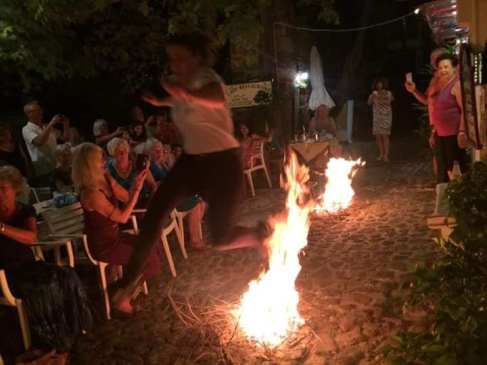
After the air-conditioning was finally fixed, I was able to unpack, wash my clothes, and repack for my return to Crete. The night before I was to leave, I jumped the St. John’s day (midsummer) fires. The locals say they jump the fires for fertility (jumping fires does warm the nether parts) and health. In the photo I am sitting at a table directly behind the first fire, but I soon got up and jumped all three of them, affirming the powers of birth, death, and regeneration.


 When I’m in a funk, I generally feed into it and make it worse. Once we are in a rut it is easy to continue the spiral downward. I’m good at admonishing myself for lacking gratitude when I feel this way. It might be a Catholic guilt thing.
 I have never had so much trouble trying to find a topic for blog and to begin writing it as I have this time. It is 6:58 am in Greece, three hours and two minutes before my blog is due to be posted, and I still do not have a topic. It is not that topics have not occurred to me. There is the
  Dear Mini,

 It wasn’t really fire. I came home to Lesbos from a soulful