I am at such a loss over the state of things these days. What’s left for me seems to be a process of assessing where I have agency at this exact moment and of taking refuge in small things.
After a terrible drought year and an awful fire season, it is raining once again in the mountains. This morning, I look out my kitchen window – thankful I have a kitchen – and gaze lost in thought at wet aspen leaves, kelly green at their centers and ringed with autumn gold. What do I want to convey today? Continue reading “Refrigerator Poetry by Kay Bee”
In the book, Women v. Religion: The Case Against Faith and for Freedom, editor Karen L. Garst puts together the voices of women from a variety of backgrounds in an effort to present a case against faith.
While the introduction to the full volume suggests that women ought to turn away from all forms of religion the majority of the individual pieces that the book features focus on the Abrahamic religions: Judaism, Christianity, and Islam. The included pieces are written from a variety of disciplines and viewpoints, some feature historical facts and timelines, while others are the raw and difficult personal stories of women struggling to leave the religions they were raised within.
Most of the articles dig into many of the traditional critiques of religion. For example that the Abrahamic faiths are inherently patriarchal, and cannot be redeemed for women. Others take these traditional arguments against religion a step further and argue that in addition to religion being a tool for female subjugation, religion has in fact inhibited Western progression and is a key reason why the United States has not yet had a female president, and why women continue to have to fight for their bodily and human rights.
It is October, the veil is thin the year is waning the leaves are turning I am trying to say goodbye to my grandmother she is dying. I do not know what to say.
The leaves are red the sky is blue I saw a crow in the tree behind the house.
The threads of this year are becoming thinner.
The threads of her life too are becoming thinner
What do I say to the one who breathed life into my father who wove his cells into being who cradled him as a baby who wept into his hair.
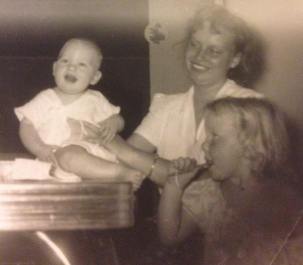
Twyla with my dad, Tom, in 1953.
Carrying the cells
of the generations The chain of life
continuing to spiral through time, and place,
and distance and falling leaves.
What do I say as life thins, as breath fades
What do I say when all that remains is the space between us
What do I say
when I catch a glimpse of the swift unraveling of time the wrinkles in eternity
What do I say
as time folds in on itself and now it is me in the bed and my son, gray-haired, blue-eyed is reading to me in a quiet voice
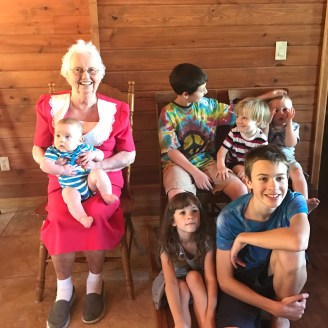
Grandma Johnson with her great-grandchildren in April, 2017.
as the chapter comes to a close.
Part 2: The Answer
That night, I dreamed of my grandmother she shrank to the size of a small child I picked her up and held her against my body We looked in the mirror cheek to cheek and smiled together I kissed her face and told her: “You are wonderful.” Then we danced around the room together her head against my shoulder I kissed her again on her white hair and no more words were needed.
Part 3: The Memorial
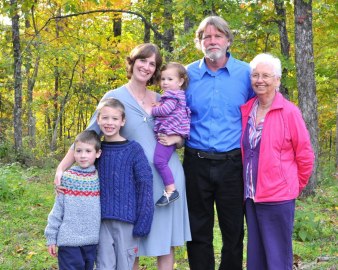
At this time last year, as the leaves fell and the wheel of the year dipped into darkness, my last grandparent died. I recognize that I am fortunate in having reached nearly forty while still having a living grandmother, but there is still such a sensation of finality and ending in saying goodbye to the final grandparent. Twyla was my paternal grandmother and I was not as close to her as I was to my maternal grandmother who died in 2013, but she is the woman who wove my father’s bones into being, and her death left a hole in our family and a sensation of an ended section in the tapestry of generations.
After the dream I write of above, I went back to see her a final time, five hours before she took her last breath. This time, I sat with her alone. I kissed her on her white hair and told her she was wonderful. I played her a song (Beyond the Gates by T. Thorn Coyle and Sharon Knight). I spoke to her of her good work in the world, that she had done it, that she’d finished her work, and that she had given so much and done so well. As a mother myself, the sensation of how powerful it is to have seen all your babies through to adulthood and into grandparenthood themselves filled the room. My dad, her second child and only son, has teenage grandchildren now himself. My grandmother’s youngest child of her five children is in her mid-fifties (and also a grandmother to teenagers). Sitting in the darkened room, listening to the song play, I was staggered by the magnitude of having seen each of your own children through their lives and into grandparenthood. While there are many ways to leave a legacy and it is not a “failure” by any means to not see all of your children into grandparenthood or to not have children yourself, what a gift it must be to bear witness to these generations if it does, in fact, unfold in that way, and to see your own tiniest baby have grandchildren of her own. This is something I hope to see for myself.
My dad holding his youngest grandchild at the memorial.
I then had the blessing, the honor, the privilege of being asked to prepare a memorial service for my grandmother. Five years ago, I was also asked to facilitate the memorial ceremony for my other grandmother. The unique, uncommon blessing of fulfilling this role for both of my grandmothers is not lost on me, as I know no one else who has had the experience of serving both sides of their family of origin in this way. I felt so honored to be trusted to help guide my family through both of these experiences of loss and grief. I spoke to my husband of how humbled, grateful, and fortunate I feel that I have a family who would let me do this, not just for one grandma, but for both of them, and he said, “you know, honey, maybe we should all be grateful to you that you’re willing to do this for us.” So, I received that recognition into my heart with appreciation as well.
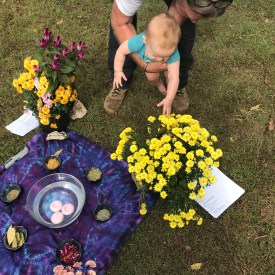
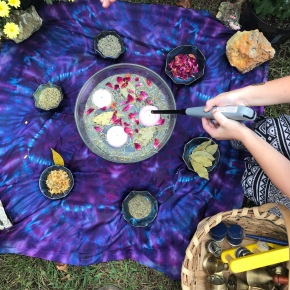
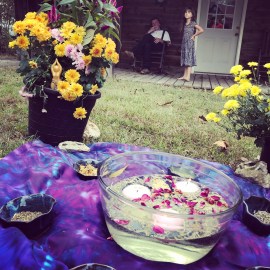
My daughter, then six, keeping the candles lit and tended on the altar space during the memorial.
It is powerful to create ceremonies that acknowledge transitions within the life of your family. During this ceremony for my grandmother we each had time to speak of her, I had poems I had written, and readings to share. We had a centerpiece with flowers, floating candles, and photos of her, and we each held handfuls of herbs that we offered into the bowl of water as we shared our stories and memories. Each person took time to do so and spoke with care, tenderness, love, and laughter. Sharing this time and space together and creating a container for people to be heard in their grief and love rather than participating in the type of “canned” or impersonal memorial service that may be more commonly offered by religious groups, was what we needed to say goodbye to this woman who wove a part of our souls. My aunt said: this is the kind of send-off that everyone needs, and that felt very true and real.
My extended family is not pagan or liberal or alternatively religiously minded and as I planned the memorial I was conscious of not wanting it to be “too much” for them. As I typed my outline, I’d first included a song and other practices common to other rituals and retreats I lead and when I heard that my aunts and cousins were coming, I’d removed the song and some ritual elements, fearing making them uncomfortable. They then said they weren’t coming, so I added the singing back in. On the day of the memorial, they did in fact come, and I decided we would sing anyway, whether comfortable and familiar or not. We sang the same song to begin and to end the memorial (“We Are a Circle”) and when I looked around the circle the second time we sang and saw that everyone there holding hands, their faces wet with tears, were all singing too, I knew that it had worked.
If you have the opportunity to create ceremonies and rituals of personal meaning for your own family, please do it. It holds so much value, such life and power and love, in a way that is difficult to create by someone outside of the family. A small group of people who really care and who are willing to connect with each other in a meaningful, connected, vulnerable way, births so much real magic together. This container can be created by you, for you, and for the ones you love the most.
“Everyone can do the life-changing, world-renewing work of magic…the Dalai Lama said, ‘It’s not enough to pray and meditate; you must act if you want to see results.’ We are called to offer real service to others, to the Goddess. That service may take many forms: mopping the floor after the party, priestessing rituals, healing, planning, teaching, carrying the heavy cauldron from the car, sitting with a dying friend, writing up the minutes for a neighborhood meeting, organizing a protest to protect a sacred place from development, writing letters to Congress, training others in nonviolent civil disobedience, growing food, or changing the baby’s diapers. All of these can be life-changing, world-renewing acts of magic…”
—Starhawk and Valentine, The Twelve Wild Swans
There is a companion audio recording available about this memorial service preparation, the death of my grandmother, and about how to weave a strong “ritual basket” to carry a ceremony. The first part is an audio ritual for my online circle with thoughts about claiming your magic, fear of the label of witch, etc., so if you want to skip past that only to the memorial information and ritual theory, skip to 16:20 in the audio:
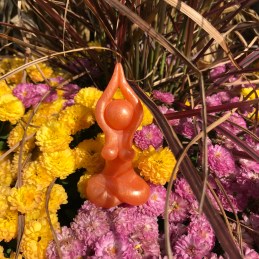
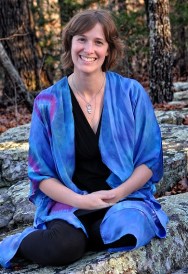
Molly has been “gathering the women” to circle, sing, celebrate, and share since 2008. She plans and facilitates women’s circles, seasonal retreats and rituals, mother-daughter circles, family ceremonies, and red tent circles in rural Missouri and teaches online courses in Red Tent facilitation and Practical Priestessing. She is a priestess who holds MSW, M.Div, and D.Min degrees and wrote her dissertation about contemporary priestessing in the U.S. Molly and her husband Mark co-create Story Goddesses, original goddess sculptures, ceremony kits, and jewelry at Brigid’s Grove. Molly is the author of Womanrunes, Earthprayer, and The Red Tent Resource Kit and she writes about thealogy, nature, practical priestessing, and the goddess at Patreon and at Brigid’s Grove.
This semester I’m teaching a course titled “The Abrahamic Traditions: Women and Society.” Because I believe story is one of the best ways to understand a point of view, I use a novel or memoir to accompany each tradition. The novel I use in the Judaism unit is Anita Diamant’s, The Red Tent.
The Red Tent focuses on Dinah, Leah and Jacob’s daughter. Early in the novel, the narrator says, “My name [Dinah] means nothing to you. My memory is dust….The chain connecting mother to daughter was broken and the word passed to the keeping of men who had no way of knowing.”
The biblical account (Genesis 34) tells us that Shechem, King Hamor’s son, “seized her [Dinah] and lay with her by force.” It also says that Shechem’s “soul was drawn to Dinah” and “he loved the girl,” and insisted that his father arrange things so Dinah could be his wife. Nowhere in the biblical account do we hear Dinah’s voice. She’s portrayed as a victim and used as a bartering tool by Jacob and his sons in their attempt to gain power in the region. Jacob and his sons required that Hamor and all the men within his kingdom be circumcised as a condition for the marriage between Dinah and Shechem. King Hamor agreed, but on the third day after the men were circumcised and in pain, Simeon and Levi, two of Jacob’s sons, entered the city “and killed all the males,” for “defiling” their sister. “Should our sister be treated like a whore?” Dinah then disappears from the narrative.
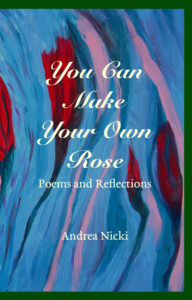
You Can Make Your Own Rose by Andrea Nicki is a collection of poems infused with the spirit of feminist sensibility, social justice and activism. The poems offer more than mere therapeutic comfort while depicting shamanic-inspired healing rituals and magical encounters. They are trauma-free in the sense that Nicki doesn’t ask for our sympathy nor does Nicki simply wish to share traumatic memories. On the contrary, she utilizes somewhat analytical and educational language, interlaced with subtle picturesque and lyrical details alongside a severe social critique, to depict the emotional, intellectual, and social landscape of her reflections on incest and other gender-related forms of abuse.
The United States used to get some respect. But now, except for the most gullible Trumpeters, people all over the world are seeing the damage the Troll-in-Chief is doing to our nation with his narcissism and corruption. What can a community like ours do? We can certainly vote next month and in 2020…and maybe we can also create some magic.
In her book The Cosmic Doctrine, originally written in 1923-24 as channeled from the Inner Planes, British occultist Dion Fortune (1890-1946) describes the Ring-Pass-Not, which is the ultimate outer limit of the universe. Fortune tells us that the Ring-Pass-Not (which was also described, but in a different way, by Madame H.P. Blavatsky) is a purely abstract ring of energy that protects our universe from the demons in other universes. Primal atoms also exist at the Ring-Pass-Not. It sounds like a highly useful place to send the Ogre-in-Chief so that, for once in his narcissistic life, he can clearly face the multitude of demons he embodies. Let us visualize a magical journey for him.
Most of us are trying to make it to a place of material comfort where we are living in a way that feels honorable. Some of us feel we could have made better decisions in the past so that we might have figured out how to do such before the age we are now. I recently did a tarot card reading that I interpreted as mainly positive or neutrally-revelatory. But one of the cards stood out from the rest, and I really didn’t understand it. I was feeling positive that day, and, even though I have often felt unsure and longing in my recent travels despite all I have accomplished materially and psychologically, I have to say it wasn’t a card I was expecting: the III of Swords, which symbolizes disappointment and heartache, especially due to mental happenings. What could I feel heartache at? Perhaps I am disappointed that creating that place of safety and material comfort seems a long way down the road.
Our whole lives, we are taught to be nice. To be considerate of others. To play fairly. To fess up when we mess up. Do unto others, turn the other cheek, respect your elders, obey the rules.
And for what? For what?
So some hyper-entitled coldhearted sneering rapist fuckheads can cheat and steal and lie and game the system until rape survivors are criminals and rapists are victims, while they rob us all blind, crush our freedoms, and rip away our future?
Fuck this sexist shit.
I am so done with this fucking misogynist society, where the president of the most powerful world empire mocks a rape survivor and laughs about assaulting women.
Over the summer, I started at a new job, which I’ve decided I can safely describe as a “dream job” – one to which I can bring my full self, and in which I can use all my gifts and strengths. Whereas my old job focused primarily on anti-sexual violence work from an advocate perspective, my new job focuses primarily on sexual violence occurring in the context of human trafficking from an advocate, trainer, and policy perspective. Sex trafficking exists along and as part of the spectrum of gender violence, and yet the history of the modern movements against sexual violence and human trafficking have had very different drives and trajectories.
A few months ago, I attended a training webinar in which Marissa Castellanos of Catholic Charities of Louisville presented on best practices for faith-based organizations involved in anti-trafficking work. She encouraged agencies to use trauma-informed practices, and spoke clearly and strongly against the somewhat common practice of tying services to participation in faith-based activities. “We don’t want to replicate the patterns of the traffickers,” she said, noting that trafficking survivors, by definition, have a traumatic history of being required to do things they don’t want to do in order to have their most basic needs met. When our actions as advocates require survivors to cede their power to our concerns, we counteract any verbal messages we may offer about empowerment, agency, and freedom. Continue reading “God, Consent, and Freedom by Chris Ash”
My dad took me to see Bill Cosby in Columbus, Ohio when I was a kid. We used to listen to a record of him talking, which I could only pretend to find funny even then, but dad liked it and wanted to see him in person. The venue had really narrow seating, and although I could barely hear Cosby’s routine, I laughed for most of the show. I had brought a friend with me, who was heavier set, and she squirmed miserably the whole time, at one point looking pleadingly at me and whispering, “I’m trying to get comfortable.” Now, he’s in the slammer, and I get a little ill every time I think of Pudding Pops.
Not too long ago, Uncle Frank died. He terrorized three generations of women in my family. My mom was a little girl when he exposed himself behind a door jam, so that all she could see was his ghostly pale member protruding through the open walkway. She would laugh when she told the story but reminded us to stay clear of him. He was regarded as a family clown, but on his death bed, as my mom put it, he finally “got her.” As she sat at the edge of his bed to bid him farewell, his toes wriggled contentedly into her buttocks. He died with a smile on his face. We laugh, but it isn’t funny. Who knows what he did on his free time?


 I am at such a loss over the state of things these days. What’s left for me seems to be a process of assessing where I have agency at this exact moment and of taking refuge in small things.
 comfortable and familiar or not. We sang the same song to begin and to end the memorial (“We Are a Circle”) and when I looked around the circle the second time we sang and saw that everyone there holding hands, their faces wet with tears, were all singing too, I knew that it had worked.
 ‘It’s not enough to pray and meditate; you must act if you want to see results.’ We are called to offer real service to others, to the Goddess. That service may take many forms: mopping the floor after the party, priestessing rituals, healing, planning, teaching, carrying the heavy cauldron from the car, sitting with a dying friend, writing up the minutes for a neighborhood meeting, organizing a protest to protect a sacred place from development, writing letters to Congress, training others in nonviolent civil disobedience, growing food, or changing the baby’s diapers. All of these can be life-changing, world-renewing acts of magic…”
 She plans and facilitates women’s circles, seasonal retreats and rituals, mother-daughter circles, family ceremonies, and red tent circles in rural Missouri and teaches online courses in

 Over the summer, I started at a new job, which I’ve decided I can safely describe as a “dream job” – one to which I can bring my full self, and in which I can use all my gifts and strengths. Whereas my old job focused primarily on anti-sexual violence work from an advocate perspective, my new job focuses primarily on sexual violence occurring in the context of human trafficking from an advocate, trainer, and policy perspective. Sex trafficking exists along and as part of the spectrum of gender violence, and yet the history of the modern movements against sexual violence and human trafficking have had very different drives and trajectories.
 Feminism and Religion