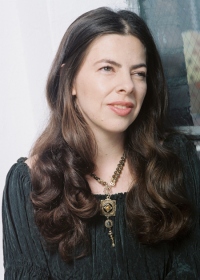
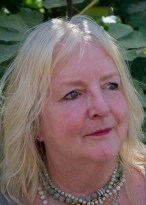
La Llorona by Sara Wright

The legend of La Llorona has been a part of Hispanic culture in the Southwest since the days of the conquistadores. Though the tales vary from source to source, the one common thread is that La Llorona is a woman named Maria who is always dressed in a white gown, the spirit of a young Mexican mother who drowned her children in the river in a moment of rage or abandonment by her lover and then took her own life in her deep shame and sorrow. La Llorona’s disembodied spirit is said to haunt the rivers at night – especially the Rio Grande – where she can be heard weeping in remorse for her dead children. Children are cautioned not to go out after dark because La Llorona might murder or drown them too. Because the tale of the Weeping Woman originated with the Patriarchal Spanish conquest I have always been suspicious of the various versions of this story believing that its meaning has been distorted.

Immediately what comes to mind is the Mater Dolorosa, Our Lady of Sorrows, or Mother of Sorrows. All refer to the Virgin Mary, the only goddess left in Christianity. Our Lady of the Seven Sorrows is another name used to refer to this goddess. The Mater Dolorosa is also a key subject for Marian art in the Catholic Church.

Continue reading “La Llorona by Sara Wright”

Religions and the Abuse of Women and Girls by Carol P. Christ

At the 2009 meeting of the Parliament of World Religions, former US President Jimmy Carter called the worldwide abuse of girls and women the greatest unaddressed human rights crisis of our time. He stated that this problem is “largely caused by a false interpretation of carefully selected religious texts and a growing tolerance of violence and warfare.” Carter discussed these issues in A Call to Action.
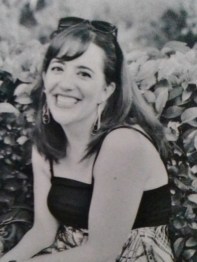
In my address to the Parliament of World Religions on November 5, I will agree with Carter that religions play a major role in the abuse of women and girls, but I will question his view that religion’s contribution to the abuse of women and girls stems from the misinterpretation of a few selected texts. Rather I will argue that patriarchal ideas permeate most of the so-called great religions. Continue reading “Religions and the Abuse of Women and Girls by Carol P. Christ”

I Believe Dr. Blasey Ford by Anjeanette LeBoeuf

Anjeanette

I had a completely different post that I was going to submit for my FAR contribution this month, but that went out the window on Thursday September 27th with the Supreme Court Justice Nomination hearings of Brett Kavanaugh and the testimony of Dr. Christine Blasey-Ford. And with the Friday’s senate committee’s vote to allow for Brett Kavanaugh to be one step closer to being sworn in as a Supreme Court Justice, I am reminded once again how important our work here on Feminsmandreligion.com is. It has put a spotlight on the pervasive and pernicious rhetoric that surrounds sexual violence, toxic masculinity, and hatred.

Continue reading “I Believe Dr. Blasey Ford by Anjeanette LeBoeuf”

The Great Seal: Yom Kippur and The Ancient Practice of Making Incantation Bowls by Jill Hammer

The liturgy of Yom Kippur states: “On Rosh haShanah it is written, on Yom Kippur it is sealed: who will live and who will die, who by fire and who by water…”  This prayer refers to a legend mentioned in the Talmud, in which the righteous are written in the book of life while the wicked are written in the book of death (and those of us who fall in-between get our own book of “in between” people.).  During the High Holiday season Jews pray again and again to be written in the book of life, but by the end of Yom Kippur the language has changed: we pray to be “sealed” in the book of life.  But what is this “sealing”?

This season, as part of my sabbatical writing project, I have been studying the magical practices of Mesopotamia in the 6th-8th centuries.  One fascinating example of these practices is the making of “incantation bowls.”  This ritual, done by Jews as well as Christians and Mandaeans, involves inscribing a ceramic bowl with a spell of protection or healing, and then burying it under a threshold or in the corner of a home.  The words frequently are written in a spiral or other pattern, and sometimes include an image of a chained demon at the bottom of the bowl.  Typically the spells invoke divine and angelic names against demonic forces. Sometimes the bowls even speak of “divorce”—particularly, divorcing the demon Lilith and sending her away. Most typically, the bowls use the language of “sealing”—i.e. sealing demons out of a home.  Continue reading “The Great Seal: Yom Kippur and The Ancient Practice of Making Incantation Bowls by Jill Hammer”

Poem: #MeToo, We Re-Member by Marie Cartier

I need the grandmothers to help me

re-member my rage.

Cross stitch. Double knot.  I sew it back on. The raggedy parts I let fly loose

when I thought it was OK to not be “so angry.”

“Boys will be boys.”

And so then, girls will be angry.

And we will re-member—our rage.

I need the great aunts, and all the old women with the signs that read,

“We are still protesting this shit.”

I need them, this herstory to help me

re-member my rage, feel it strong and tight. Cross stitch. Double knot. Those women re-member

me. I am that woman. She is me.

Our rage is a song.

After all this time, we are still singing it. Our rage

is a river and we swim in it, even if it’s upstream. There is a fierce mermaid goddess,

Yemaya. She protects us. She knows

our rage is our best defense.

Our rage is a

swarm of bees. Not yet extinct. Our rage

is holy. Terror. Continue reading “Poem: #MeToo, We Re-Member by Marie Cartier”

Coming Home to the Sacred by Carolyn Lee Boyd

My grandparents and mother at their home in 1929.In 1929, my grandmother wrote the word “HOME” in resounding letters across the bottom of a photo of a herself and my grandfather, smiling lovingly and confidently, with my infant mother propped in between them on a rattan chair.  Within a few years the Great Depression stole that house, rendering them desolate and homeless, cutting a psychic wound so deep that it never healed.

I recently found the photo and thought of our family’s ancestors who, millennia ago in Old Europe, worshipped the Goddess in peaceful, egalitarian societies.  Then and there, as in so many cultures outside modern western societies, “home” was a sacred place. As discovered by Marija Gimbutas and others, small statues of the Goddess were frequently found by the ovens inside family dwellings, and temples included rooms for both sanctuaries and workshops for making bread and weaving cloth. Houses and temples were extensions of one another. 

Continue reading “Coming Home to the Sacred by Carolyn Lee Boyd”

Pig/Sow – Animal Spirit Guide by Judith Shaw

judith shaw photoPigs, who were called boars in the wild, were the first animals to be domesticated. Pig domestication occurred about 9,000 – 10,000 years ago in two places – central China and Neolithic Anatolia in modern day southwestern Turkey.

Around 7,000 years ago when the Anatolians moved into Europe with their domestic animals and plants, they interacted with the indigenous Mesolithic hunter-gatherers and facilitated an interbreeding of their domestic pig and the local wild boar. The European swine descends from this interbreeding.

The mythical and cultural associations assigned to Pig in all its forms is very contradictory – sacred and beneficial to some, demonic and unclean to others. For our purposes here, we will concentrate on the positive associations. Continue reading “Pig/Sow – Animal Spirit Guide by Judith Shaw”

The Cost by John Erickson

Brett Kavanaugh is a piece of shit.

Brett Kavanaugh is a piece of shit.

KavaNope

There, I said it. I know that we are supposed to “use our words” or “take the high road” but I no longer can. I am completely and totally done with the fact that it is Sunday night and I sit here wondering whether or not our Democracy will be around by the end of the week.

If you are like me, you have found yourself, more times than one I am guessing, watching the news, mouths agape, mind in disbelief, and your heart heavy with grief and sadness. While these great travesties occur, I find myself wondering what is the cost? How many children must be locked in cages? How many women must come forward with accusations of sexual assault and rape? How many more people must accuse the President of harassment and assault? How many more anonymous op-eds and faulty promises must be made before we finally all see that the real cost, is that these great travesties themselves (too many to recall here) are what it really takes to take down imperialist white supremacist capitalist patriarchy. Continue reading “The Cost by John Erickson”

“What Would Happen If One Woman Told the Truth about Her Life?” by Carol P. Christ

According to poet Muriel Rukeyser, “the world would split open.”

This poem accurately describes what many women experienced in consciousness raising in the 1970s and what many women experience today in the #MeToo movement.

For many of us the world did split open. We began to take ourselves and our experiences seriously. To do so we had to question received wisdom encoded in such questions as: “What was she doing there in the first place?” “Was she drinking too?” “Why didn’t she change out of her bathing suit?” Underlying these questions is the assumption that: “whatever happened, she must have asked for it.”

A lot of people are wondering why congressmen and voters who claim to uphold Christian principles are not more outraged about credible allegations of sexual assault against a child whose name was Christine Blasey. Continue reading ““What Would Happen If One Woman Told the Truth about Her Life?” by Carol P. Christ”

Playing Safe: BDSM & The Ethics of Justice and Care By Angelina Duell

From the archives – 9/23/11 – our first FAR year! 

This post is written in conjunction with the Feminist Ethics Course Dialogue project sponsored by Claremont School of Theology in the Claremont Lincoln University Consortium,  Claremont Graduate University, and directed by Grace Yia-Hei Kao.

It is Wednesday night and I am alone in the house. It’s dark; the only light is from my computer screen. A bead of sweat rolls from my brow as I delicately tap the keys of my keyboard until two words stare back at me, “BDSM feminism.” With bated breath, I press enter.

Just kidding.  Continue reading “Playing Safe: BDSM & The Ethics of Justice and Care By Angelina Duell”