

 Did the ancient Celts believe in heaven and hell? Not exactly – because of their belief in reincarnation they did not identify a particular place that one went to after death. Instead the Celts believed there to be a home for their supernatural figures, to where occasionally humans strayed during life and at other times as a resting place between lives. This place is referred to as The Otherworld.
Parenting and Politics: How I’m Showing Up by Katey Zeh
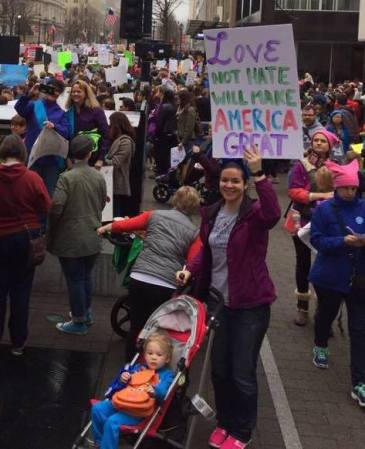
When I was ten weeks pregnant I gave an impassioned speech in front of the Supreme Court during the Hobby Lobby hearings about why universal access to contraception was part of my own religious understanding. I’d wanted to share about my own planned pregnancy, but at that point I wasn’t far enough along to feel comfortable telling that in a public way.
I didn’t know it at the time, but that would be my last protest for almost three years. After the birth of my daughter I cut my travel significantly. I spent most of my weekends in the cocoon–or what sometimes felt more like the prison–of our home rather than out in the public square. As someone deeply ensconced in the activism world this turning inward felt like I was betraying the causes and the people for whom I cared deeply. How could I be an effective advocate if I couldn’t show up?
Over the last few months I’ve done a lot of reflecting on how parenting has shifted the way that I think about myself as an activist. Whether rooted in parental love, self-preservation, or some combination of these two, I’m less willing to put myself in harm’s way than I was before I became a mother. Continue reading “Parenting and Politics: How I’m Showing Up by Katey Zeh”
Authoritarian Followers: What’s Feminism and Religion Got to Do with It? by Carol P. Christ
 There are two types of authoritarians: those who jump out in front and say “follow me, only I can solve the problem”; the far greater number of authoritarian personalities are those who want to be told how to think, what to do, “this is daddy, I’ll take care of you.” Those are the people who are the followers and while some of those would like to be leaders themselves, most of them are just happy to follow, and they don’t want to ask questions, and they want to be told what to do and how to think. And that’s a very scary lot. —John Dean
On her Saturday program on MSNBC, Joy Reid asked former Nixon White House Counsel John Dean why those who support Trump seem so uninterested in facts that show a deeply troubled and compromised presidency. Dean’s response was that the authoritarian personality does not want to think. Continue reading “Authoritarian Followers: What’s Feminism and Religion Got to Do with It? by Carol P. Christ”
Is Evil Winning? by Michele Stopera Freyhauf
If you are li ke me, today (and most days lately) it is difficult to be positive in a world that seems so full of hate. In fact, I struggled with a topic to write about because, in all honesty, it is hard to see the greener grass from where I sit – with all of the hatred spilling out in neighborhoods, churches, schools, and college campuses – even between family and friends. As I scrolled through Facebook, I came across a video and was struck by its message – we must be relentless in our kindness otherwise evil will win.
“Relentless” is a word that currently echoes through the United States –on both sides of the aisle. We have been relentless in raising our voice – writing, calling, e-mailing, visiting, marching – expressing our unhappiness with the current President and all that is happening in the White House.
Instead of struggling to find the words, I share the video and offer a transcript.
Continue reading “Is Evil Winning? by Michele Stopera Freyhauf”
Get Serious: Don’t Die in Character by Oxana Poberejnaia
 Recently I had a few experiences that brought home to me the meaning of a saying by the Buddha:
What’s the laughter, why the joy,
When the world is ever burning?
Plunged into darkness,
Won’t you look for a lamp?
Dhammapada, 146, translated by Valerie J. Roebuck
 This saying is one of those that sound a bit curious to a Western ear. It is almost as if the Buddha was against fun or humour. However, we all are familiar with the Buddha’s depictions where he smiles. The canonical texts also bear witness to the Buddha’s smiling.
It has become clear to me that the Buddha points here at the preciousness of the limited time we have in this human life. In short, he was saying that suffering is not a laughing matter, and life is not a joke.
Time is running out – the message that is even more relevant today, as it relates now not only to each of us individually, but to all of us as a species.
Continue reading “Get Serious: Don’t Die in Character by Oxana Poberejnaia”
 I have been thinking about deserts lately, what places are desired, which ones are deserted, and by whom. Cabo de Gata of Andalusia is one of the four deserts in Spain. In 2010, it became public knowledge that the Ministry of Development planned to locate a nuclear waste dump there. The last I have heard was that they had ordered a feasibility survey with nuclear scientists, but I can find no other updates. Why would the government and academic institutions penetrate a protected region, sacred for its ecological richness and beauty? The dump would be created 1,000 meters below the surface where the radiation would be dissolved (so they said) and then carried into the sea. Whether we hide waste inside the earth or shoot it up into space or keep it in someone else’s backyard, when will we pause?
Deadly in Love: No Flowers, Dignity and Rights by Vanessa Rivera de la Fuente
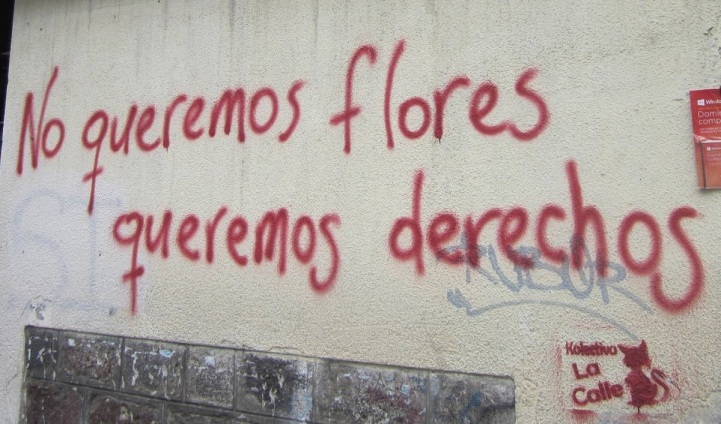
Vanessa Vazquez Laba, a scholar feminist and researcher in gender studies in Argentina, with whom I share a first name, activism, and intellectual interests, hits me on Valentine’s Day with the following message:
There have been 57 femicides in the first 43 days of 2017 in the country, and the government has suspended the funding of universities for research on gender based violence.
57 femicides in 43 days…
A heartbreaking message to receive in Valentine’s day, isn´t it?
What does this mean? According to the definition accepted by the majority of women’s rights activists and scholars, “Femicide is a sex-based crime, generally understood to involve intentional murder of women because they are women.” . The World Health Organization states that a Femicide is:
Usually perpetrated by men. Most cases of femicide in the world are committed by partners or ex-partners, and involve ongoing abuse in the home, threats or intimidation, sexual violence or situations where women have less power or fewer resources than their partner.
57 women in 43 days… It means 57 human beings were murdered, most of them in the hands of someone they trusted and shared an intimate relationship with, after a painful process that included different types of violence to deplete their sense of value and personhood.
One woman murdered every 18 hours.
57 women most of whom were abused for one they loved. Continue reading “Deadly in Love: No Flowers, Dignity and Rights by Vanessa Rivera de la Fuente”
Welcome to the Resistance by John Erickson
 There comes a time in all of our lives when we have to make important decisions. What do I believe in? Who do I want to be? What and who will I stand up for? There has been a lot going on in the world lately and a lot of it, sadly, is pretty awful. While people are learning pretty quickly that elections have very real and long-lasting consequences, what is critical to make clear in the next 4 years of this fascist regime isn’t just that we are taking to the streets to make our voices heard, but that we are willing to disrupt society at every turn to make sure that people on the other side of the proverbial political coin know we will not go gently into that good night.
I’ve been questioning G-d a lot lately; wondering what has happened to that shining “City on a hill” that John Winthrop called for in his 1630 sermon “A Model of Christian Charity.” The idea that the United States of America is “G-d’s country” is based in an American exceptionalism based not only the rich bounty of land and resources many would soon benefit from, but also on the potential for a different kind of society that America represented in a world full of monarchs. Continue reading “Welcome to the Resistance by John Erickson”
Mindful of the Bond We Share in these Trying Times by Vibha Shetiya
 I’m sitting in my parents’ balcony in Pune, India, on a quiet morning. Well, this being a bustling Indian city of six million, it can’t really be quiet. As I sit with cup of tea in hand, I try and meditate – I’ve been practicing mindful meditation of late, and so, rather than block out the noises, I embrace the various sounds that make up this Monday morning.
I count the variety – sparrows gently chirping away while a noisy crow tries to outdo them in a contest he easily wins, a street hawker starting his day (and ours) on a rather cacophonous note, the sweeper from the neighbouring complex pouring his heart and soul into cleaning the grounds that will need re-sweeping in an hour or two, the put-putting rickshaw carrying squawking kids to the school down the alley, chirping chipmonks that temporarily develop wings as they fly from branch to branch in a cheerful chase, the honking car warning of its over-the-limit speed (reaffirming the fact there are two things we Indians especially love: honking for no reason, and breaking traffic rules), my mother’s footsteps as she peers out to see what I’m doing by myself…nine in all.
In the past I would have tried hard to block these out, straining to keep my mind on my breathing, worrying I’ll never find a quiet enough spot to help me master (hah!) the art of meditation. But today, I am grateful. Grateful that I am a part of a larger picture. And as I scan my body from head to toe, feeling the tension most in my shoulders while the cold mosaic tiles below keep me momentarily grounded to the fullness of living, I remind myself that I am just a speck in this montage called life. Continue reading “Mindful of the Bond We Share in these Trying Times by Vibha Shetiya”
Feeling the Earth Move by Carol P. Christ
 Magnitude 5.2 earthquake Feb 6, 5:51 AM I awake to the sound of the windows and shutters rattling and the bed moving up and down beneath me for a few seconds.
Magnitude 5.4 earthquake Feb 6, 12:58 PM This is the first time I can remember two big earthquakes coming so close together.
Magnitude 4.9 earthquake Feb 6, 1:45 PM A friend calls to ask if I think the earthquakes are building up. “The big ones are rare” I say.
The first seismologist to weigh in assures us there is nothing to worry about, as this new series of quakes is not on a major fault.
Magnitude 5.1 Tuesday Feb 7, 2:24 Shake, rattle, and roll.
Magnitude 4.5 Tuesday Feb 7, 5:15 Awakened.
Magnitude 4.6 earthquake Feb 7, 21:35 PM Another jolt.
Magnitude 4.3 earthquake Feb 8, 12:53 AM The bed shaking and the windows rattling.
Magnitude 4.9 earthquake Feb 8, 3:38 AM Awakening again, feels bigger this time.
A second seismologist warns that the series of quakes could be building up to a big one like the 6.6 quake that caused significant damage to the island in 1865.
I become uneasy. My friend decides to move temporarily to a hotel at the other end of the island, farther away from the epicenter.
Magnitude 3.5 Feb 8, 15:31 I wonder if I should leave the village too.
I decide to sleep in my study, fearing the ceiling fan above my bed could fall on me.
Magnitude 3.6 Feb 9, 12:37 AM The couch makes less noise than the bed.
Magnitude. 4.0 Feb 9, 10:13 AM Louder than the one in the night.
Magnitude 3.6 Feb 9, 15:01 PM Not as big as the last one.
I sleep in my study a second night. No quakes.
In the morning I move my blankets and pillows back to the bed.
Magnitude 4.5 earthquake Feb 10, 10:55 AM. The house shakes.
Magnitude 4.3 Feb 10, 12:27 PM A sharp jolt gives me a slight whiplash.
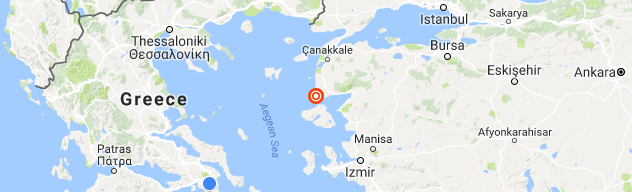
Mithimna (also known as Molivos), Lesbos, where I live is at the top of the triangle that is Lesbos, about 11 miles from the epicenter of the earthquakes. Besides the larger quakes, there have been one or two smaller ones just about every hour during the past week.
There have been no major quakes for more than twenty-four hours. Is it over?
In the long run, it is not. The Anatolian fault runs from below Istanbul to just above Lesbos and out into the Aegean Sea. The Anatolian plate is being pushed westward by the Arabian plate and northward by the African plate. The Anatolian plate is being prevented by moving northward by the European plate. Many years from now the African plate will collide with the European plate and there will be no Mediterranean Sea.
The movement of the earth’s plates is a result of its molten core. “The planetary community has long accepted that as the Earth lost its internal heat, it would eventually settle into a quiescent stagnant state much like Mars.”
Like it or not, uncertainty and instability in the ground under our feet is part of what makes ours a living planet. This is the literal truth. Is it also a metaphor for our lives?
Update: After a quiet day on Saturday we had a 4.8 at midnight and a 5.2 at about 4 in the afternoon. 3.7, 3.6, and 3.5 on Sunday night and early Monday morning, rounding out a full week of tremors. NO it is not over.
(Note: Though there are cracks in the plaster in many of our buildings, including in my house, there has been no significant damage at this time.)
***
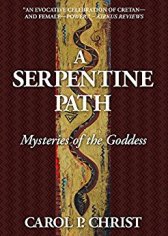
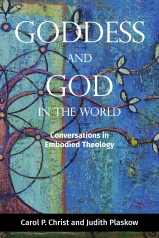 Be among the first to order A Serpentine Path, Carol’s moving memoir. Carol’s new book written with Judith Plaskow is Goddess and God in the World: Conversations in Embodied Theology.
Carol wrote the first Goddess feminist theology, Rebirth of the Goddess and with Judith Plaskow co-edited the path-breaking Womanspirit Rising and Weaving the Visions.
Join the spring Goddess Pilgrimage to Crete by Feb 15. Save $200.

