The Story of Changing Woman, part 2 by Sara Wright

Part 1 was posted December 7th. You can read it here.

Commentary:

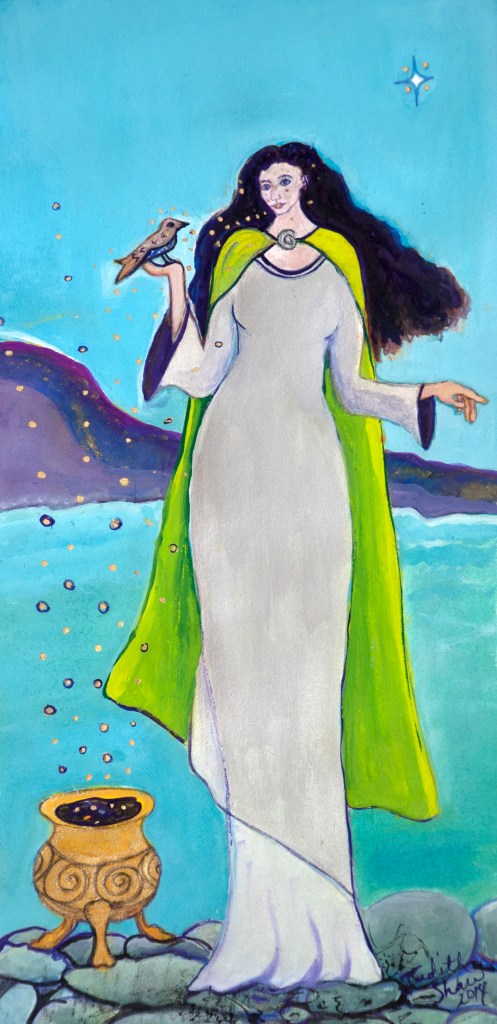
I love this story because it demonstrates the evolutionary and eternal nature of Woman; her intimate relationship to Nature, her ability to give birth, to mother, to let go, her ability to endure, her need for animals and plants as companions and her willingness to stand her ground until she is able to get what she needs. Changing Woman matures from a passive figure who is acted upon by the forces of Nature into a self-directed female power who knows what she wants, and one who finds peace in choosing relationships with animals, plants and humans on her own terms.

Initially, Changing Woman is impregnated by the wind – the power of the spirit moving across the land – and not through sexual intercourse. Spirit and the Body of the Earth are the two equally creative aspects involved in her birth. The same holds true for her children, who are male, but conceived and birthed in a similar manner without the need for male insemination (no room for Patriarchy to enter here), suggesting to me that all three are parts of one spiritual/bodily whole that cannot be separated. As creative principles (beyond gender stereotypes) they work together as a triad to rid the world of monsters, to make the Navajo world a safe place, and to secure the matrilineal line. According to Navajo mythology securing the matrilineal line is primarily how Changing Woman saves the world.

Continue reading “The Story of Changing Woman, part 2 by Sara Wright”

Legacy of Carol P. Christ: LOVING LIFE*

This post was originally published on June 11th, 2012

My religious views have changed over time, but the spirituality I learned from my grandmothers has remained constant. I have been Protestant, Catholic, a lover of Judaism, an admirer of Christian Science, and a Goddess feminist.  I have always loved life.

I was born in Huntington Hospital just before Christmas in 1945 and brought to my grandmother’s home on Old Ranch Road in Arcadia, California.  Peacocks from the adjacent Los Angeles County Arboretum screeched on the roof. There was another baby in the house, my cousin Dee, born a few months earlier.  My mother and her sister were living with their mother. The war was over, and they were anticipating the return of their husbands from the Pacific Front.  My earliest memory, recovered during healing energy work, is visual and visceral. I am lying crossways in a crib next to the other baby. There is a soft breeze. The other baby is kicking its legs, and I am trying to do the same.  I look up and see three faces looking down at us.  Although the faces are blurry in the vision I see, I feel them as female and loving.  I got off to a good start. Continue reading “Legacy of Carol P. Christ: LOVING LIFE*”

Bo: On Passing Over.

On August 12, 2018, I announced that I would begin my feminist reflections on Torah portions. I have seven left, but the timing of them are all in the beginning months of the year. This means, that the following seven posts about the parshot will not be aligned with the actual calendar dates in which they are read, especially since I only post once a month. But, in each post, I will note when they will be read next (in 2025). I hope that is not too much of a bother for the reader as I complete this project.

The parshah for Feburary 1, 2025 is Bo. It covers the final three plagues (locusts, darkness, and death of the firstborn males), the instructions for Pesach (Passover), and the beginning of the flight out of Egypt. The parshah makes two mentions of women. First, Moses includes the daughters of Israel among those who will leave Egypt (10:19). This mention comes in a list of opposites: young and old, sons and daughters, and (what I assume to have been considered opposites at the time) flocks and cattle. To me, this stylistic set-up signals that the entirety of the Israelite community would leave Egypt – a combination of seeming opposites thus represent the whole (that would be an interesting post for another time!). The second mention of women is in verse 11:2; men and women will ‘borrow’ gold and silver items from their (Egyptian) friends. This borrowing allows them to later leave Egypt with the items and thus rob Egypt of its riches (13:35). I do not find this necessarily all that interesting except to note that it helps to tell the story of how an oppressed, enslaved people had enough gold to build a golden calf (Ki Tisa), Exodus 32:2-3. 

Continue reading “Bo: On Passing Over.”

The Story of Changing Woman, part 1 by Sara Wright

Moderator’s comment: Sara wrote this in April, 2019. It has even more resonance today.

Changing Woman – who grows old and then young again. Navajo Sand Painting.

I want to begin by recounting the story of how Changing Woman came to be and why she was so important to Navajo mythology. In these dark and tumultuous times I think Changing Woman’s story has a deep resonance for all of humanity. We seem to have forgotten who we are and are in desperate need of guidance that will help shift our current paradigm.

The Navajo word Diné means the People (every Indigenous group defines its inhabitants by using the same word in their own language).

Continue reading “The Story of Changing Woman, part 1 by Sara Wright”

Kamala Gave us a Tremendous Gift by Karen Tate

So I’m going to assume my readers don’t think meditation is a gateway for the devil to enter our minds and it’s not too woke.  I mean, it’s a pretty mainstream practice these days going way back.  Meditation originated in India, a very long time ago.  According to the Live and Dare website, the oldest documented evidence of the practice of meditation are wall arts in the Indian subcontinent from approximately 5,000 to 3,500 BCE, showing people seated in meditative postures with half-closed eyes. In fact today it’s a recommended self help tool and who among us didn’t need some self help after November 5?

So, I was doing a guided meditation and this figure comes toward me and hands me a box with a key inside but the meditation ended without my knowing what the key symbolized.  Then a few days later I was in another meditation circle and that box and key reappeared, only this time I got the message.  The key was certainty.  The key reminded me of a period in my life, some of my darkest days, when the road ahead was not clear, everything I’d planned for my life seemed gone and I had every reason to despair.  I felt those feelings again as I touched the key in the meditation, but I also felt that glimmer of certainty I had back then that if I just kept making my famous lists, putting one foot in front of the other, following my logic, everything would work out and in the end, it did.  Actually, in the end, there were even unexpected gifts in the troubles.  Call it my Higher Self, my Soul, God, Goddess, my intuition – whatever – I was being reminded in those guided meditations of my ability to persevere.  Of my resilience.  That good things are ahead and there are gifts in the suffering and challenges if we are willing to see them.

Continue reading “Kamala Gave us a Tremendous Gift by Karen Tate”

MOTHER OAK by Dale Allen

We sat on the in the leaves, my daughter and I, in the warm autumn sun under the Great Mother Oak.  Here and there fallen leaves danced lightly in the breeze.  It felt good to be directly connected to the ground, bent knees and bare feet on the land.  We leaned back and looked up at the tree in all her glory.  She was still filled with yellow green leaves… her canopy so high that from up there, she can “see” the other neighborhood trees with many years like she has.

She has been here in this place since the end of the 1700s or the beginning of the 1800s. She was here with the first European settlers of this place. Her mother had been here before that, with the last generations of the people who were of this land for 15,000 years or more: the Paugussett People. We could feel this history. We could feel the tree’s mother. And then, from beneath the ground where their energy remains steady, we heard the voice of the Paugussett. They thanked us for acknowledging their presence. They said that they can feel our profound love for this place where we live, here in Black Rock, Connecticut… our love for the trees, the leaves, the flowers, the osprey, the red tail hawks, the fox, the squirrels, the rabbits, the insects, the shore, the waters of coastal Connecticut (Long Island Sound), the shells, the sand, the sparkles, the historical homes, the families, the new babies. We love this land. We love our home. And the Paugussett saw this love. The Mother Oak saw this love.

Continue reading “MOTHER OAK by Dale Allen”

The Practices of Our Hope by Xochitl Alvizo

Years ago while I was a student at Boston University, a student group organized a spoken-word event. There were already some among the student body who were spoken word poets, but they also brought in Edyka Chilome, a poet, and as she refers to herself, a “cultural worker, futurist, and community weaver” (who’s also written with FAR as Erica Granados de la Rosa). She was not the first to speak, but before she did, she first took a minute to light some sage, lay it in a bowl in the middle of the circle space she had opened up in front of her, she called the four directions, and then said a prayer. 

Continue reading “The Practices of Our Hope by Xochitl Alvizo”

Morning Prayer For December by Sara Wright

 Walk lightly
pay keen attention…
practice gratitude
but not at the expense
of truth
take sparingly
 share

 an Underground Web
writes the Story
but my roots
belong to earth
at the crossroad –
I choose
‘both and’

 Listen to
feathered voices
keep breathing deep
into the forest floor
feel that luminous Light
hidden beneath my feet
Balance fear and pain
with turkey flight.

Continue reading “Morning Prayer For December by Sara Wright”

Legacy of Carol P. Christ: A Daughter of the American Revolution and a Daughter of Quaker Slave Owners in Long Island, New York

This post was originally published on June 4th, 2012

I did not ever think that genealogical research would reveal that I am descended from slave owners.

My family’s early American roots are in New York and the upper Midwest—not in the American South. While watching genealogy programs that reveal slave-holding ancestors in the lines of white and black Americans with roots in the South, I have breathed a sigh of relief accompanied by the thought–not me!

I have not expended a great deal of energy researching Searing ancestors who settled in Hempstead, Long Island in the 1640s, because my Uncle Emery had already traced the family line. Bored one afternoon and wondering if my ancestor Samuel Searing had left the Hempstead Quaker community because he fought in the Revolutionary War, I entered the Searing family surname into a general internet search.

I found that my 4x great-grandfather Nathaniel Pearsall–whose daughter Sarah and her husband Samuel Searing are my 3x great-grandparents–is indeed listed for “patriotic service” in the Daughters of the American Revolution database.  As an anti-war activist, I wish there had never been a revolutionary war–we could all have been Canadians!  I would have been pleased to learn that my ancestors were all Quaker pacifists. Still, I must admit that I felt a twinge of pride to be able to trace my ancestry back to our country’s beginnings.

Continuing to follow up links to Searing ancestors, I stumbled upon the wills John and Elizabeth Searing. John was a brother of my 5x great-grandfather, Jonathan Searing.

In the name of God, Amen, April 22, 1746. I, John Searing, of Hempstead, in Queens County, being very sick. My executors are to pay all my debts. I order all my negroes to be sold, except the oldest negro boy; Also my wheat, except enough for family use. I leave to my wife Elizabeth, one bed and furniture and a side saddle, and the use of 1/2 my farm, until my children are brought up…

In the name of God, Amen, November 27, 1760. I,Elizabeth Searing, of Hempstead, of Queens County, being sick. I leave to my son, John Searing, my negro man and a bed and three blankets, etc. To my daughter, Mary Searing, a negro girl, and she is to have clothing and linen of mine so much as my other two daughters have had. …  I leave my granddaughter, Mary Searing, daughter of my son Jacob, a negro girl, and to my daughter Anne long cloak, and the rest of my apparell to my daughters.

If I am a daughter of the American revolution, I am also a daughter of Quaker slave-holders. It is well-known that the Quakers were among the most vociferous abolitionist voices in America.  Who would have thought that Quakers had also owned “negroes.” How did this come about? Continue reading “Legacy of Carol P. Christ: A Daughter of the American Revolution and a Daughter of Quaker Slave Owners in Long Island, New York”

Blue Raven and Murmurations by Margot Van Sluytman/Raven Speaks

Meandering
 Murmurations.
Myth and mystery
Beckon. We do not
[As yet]
Resist.
© Margot Van Sluytman

I have been fighting with myself to eradicate or somehow fit in the fact that I am in the throes of a profound transition. With “the new adventure’s” approach, death, roommates we have been for decades and decades, a new conversation between us is unfolding. Me and my compelling companion, daily and diligently, engage in what can sometimes feel a relentless row. Sculpting our symbiotic connection with meaning. Aligning dull and divine evocative evocations, as we share tea, toast, temerity, tempestuous alarm, sympathy, chagrin. Intermittent joy. Explorers we are. Searching out hope. Seeking sightings of simple strength. Seated at simple repasts. Inviting courage. Encouraging surrender. Crying out for creativity. Debating and discussing if Camus is correct in writing that suicide is disavowed because the meaningless of life, is, in fact, its very meaning.

Continue reading “Blue Raven and Murmurations by Margot Van Sluytman/Raven Speaks”