A Tale of Two Sisters by Carol P. Christ

When I first returned from my ancestor quest in Germany, I fell ill with a bad cold and cough and had little physical energy. For two weeks I lived in the dreamtime, communicating with the ancestors and trying to make sense of the information about their lives I had discovered. After I got better, I had difficulty returning to daily life. The ancestors wanted to speak through me. Their stories, based on facts, come to me in waking trance.

A happy moment in the life of girl like Agnes
Feeding the ducks

Agnes Lattauer Sweitzer : I was born in Ober-Floerscheim (Hessen Darmstadt) on July 9, 1812. I was the first in a family of five children. Four years after me came Jakob, named after Father, and three years later, Rudolph. It was nice to have brothers, but my dream of a sister came true when Catherina was born a month and a day after my tenth birthday. My mother was busy with Jakob and Rudolph, so I became a second mother to Catherina. I could not nurse her, but I could sing to her and rock her to sleep. I changed her diapers and gave her a bath. It was so wonderful to have a baby to take care of. Three years later little Johanetta was born two days after my thirteenth birthday. Another baby for me and Mother bring up together.  I was in heaven. I was both mother and sister to the little girls. When they got older, I took my little sisters to play by the stream, where they giggled and cooed as we fed the ducks and the geese. In the summer, Mother and I brought them with us to the fields where we hoed and planted, weeded and harvested. They tried to pull weeds with their little fingers. It was my job to keep them from pulling up the plants too. Continue reading “A Tale of Two Sisters by Carol P. Christ”

Hamilton Part 1 – “History Has Its Eyes on You” by Anjeanette LeBoeuf

AnjeanetteHamilton The Musical, the newest sensation to hit Broadway is sweeping the nation. It is being touted as a fresh new way to produce a Broadway play, introducing hip hop and rap into the lexicon of musicals. From the very beginnings, Hamilton has been turning heads, moving mountains, and making waves. Its unorthodox lyrics and beats help to give life to key American historical figures. The sick beats of the music are only part of why Hamilton is storming the nation. Of the 10 principle cast members, only one is a white male (in the role of mad King George). Hamilton is a racially diverse cast; one that is very rare amongst the streets of Broadway. Black and Latino actors play key American figures like Hamilton, Washington, Jefferson, Burr, and Madison.
Continue reading “Hamilton Part 1 – “History Has Its Eyes on You” by Anjeanette LeBoeuf”

She Changes Everything She Touches by Deanne Quarrie

Deanne QuarrieShe Changes Everything She Touches and …

Everything She Touches Changes….

As a way of entry to this post, I wish to let readers know that this is not a typical kind of post for this blog. It is however, the work of an accomplished priestess and about how she has been reminded of what she knows about manifesting wants and needs in her life. It is personal and it is real. In my professional life I was big on accountability and know that it applies to my magical life as well. This post therefore witnesses my intentions!

I have been feeling horribly scattered lately, almost as though I have acquired ADHD in my old age. Each day is incredibly busy and yet at the end of the day, when I reflect on how busy, I realize I have not gotten anything productive done! I have a lot of irons in the fire and recently have added even more. I added them because they seem important, as they might prove helpful to me for accomplishing some of my goals.

So, I was talking to my friend and fellow Priestess, Letecia Layson, on the phone the other day, lamenting about this as well as other things that I wish to develop in my life that have to do with family and friend connections and spending more time with in-person relationships.

At the end of our conversation, in which my friend used her skills at listening, she remarked, “Bendis, you are a remarkable woman and have accomplished so much in your life. You have shared marvelous things with your students, but in listening to you, I can clearly see that, right now, you are not using what you teach in your own life.” Continue reading “She Changes Everything She Touches by Deanne Quarrie”

Novel Excerpt III: That Christmas Morning Feeling by Marie Cartier


MarieCartierforKCETa-thumb-300x448-72405I have posted selections from my novel in progress before here and here and here…I am again. My last post here at FAR was about women and silence. Silencing women—from the powerful (Hillary Clinton) to the obscure (this girl that in this novel excerpt is now a teenager) women are silenced.
In this novel, as you can read from the previous excerpts a journal is found by a brother who is twin to his sister. The journals he finds are addressed to him after his parents’ house sells. Upon reading them he begins to discover that they are written by his sister when she was younger and in all likelihood she does not now as an adult remember having written them. She does not remember what it looks like happened to her. Incest. What must he do? This grown up person that he now is finding this information out? She has been silenced and he is holding the key to the only voice she had at the time. I have been working on this novel for over ten years and am currently immersed in trying to pull together all of the pieces I have written over the years. What I have posted so far is excerpts from the journals he, Chris, finds. This excerpt continues that story line. Continue reading “Novel Excerpt III: That Christmas Morning Feeling by Marie Cartier”

Woman Is Not Anonymous by Vanessa Rivera de la Fuente

Vanessa Rivera Virginia Woolf

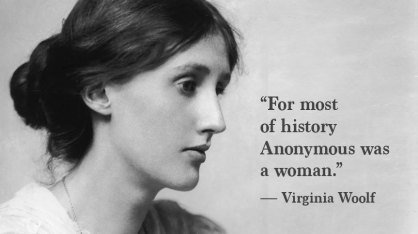
Lately I have been reflecting on this quote of Virginia Woolf: “For most of history, Anonymous was a woman.” Here she points out the deliberate invisibilization of women’s contribution in all areas of human endeavors.

Patriarchy always takes these contributions for granted. For centuries, domestic labor has been invisible and not considered work. It has put beauty over intelligence, even with women of outstanding intelligence. And in terms of knowledge and intellectual production, patriarchy has appropriated women’s ideas and in presenting them as “anonymous,” presents them as it’s own.

Thanks to the feminist reclaiming of history, and proving the accuracy of the premise that “Anonymous is woman,” we have learned of the long list of inventions that were made possible due to women’s ideas who were kept invisible, unnamed, unquoted,  and erased;  after all, she was “just” a “woman.” Continue reading “Woman Is Not Anonymous by Vanessa Rivera de la Fuente”

Women First, Rivals Later by Vibha Shetiya

VibahSita, as many know, is the tragic heroine of the Ramayana who gets discarded by her husband Rama because he doubted she had remained chaste while in his arch enemy Ravana’s captivity. Moreover, she is the “ideal Indian woman” in popular imagination because she remains loyal to Rama no matter how unfair his treatment of her. But there is another female character in the epic who meets perhaps a far more violent fate.


Unlike Sita, however, Shurpanakha gets little sympathy from the readers because she does not stick to her socially assigned roles. I would like to talk about Shurpanakha and how she comes to symbolize all women who transgress societal boundaries, while also stressing the fact that although she is often presented as Sita’s opposite, the two share far more in common as women; both Sita and Shurpanakha deserve our compassion and empathy.

In the traditional Sanskrit text, Valmiki describes Shurpanakha as “maddened with desire” when she first beholds Rama’s beauty. The poet then goes into a rather lengthy description of what she is not by comparing her “unsightly” presence with Rama’s exemplary beauty, thereby affirming the fact that she does not deserve to be visible because of the physicality of her body. Upon his enquiring, Shurpanakha tells Rama that she, who roams the forest alone and according to her own will, is the sister of Ravana (who later kidnaps Sita), and she makes it a point to add that she is more powerful than all her brothers. She then declares her undying love for Rama and asks him to be her husband, after which the two of them could seek adventure amid the forest together. Continue reading “Women First, Rivals Later by Vibha Shetiya”

From Competition to Collaboration: Reflections on Humility, Self-Promotion, and Gender

photo-1422190441165-ec2956dc9ecc

“Is self-promotion sinful?” Author Marlena Graves asked this question on Christianity Today’s Her.Meneutics blog back in 2010. Reflecting on her experience of having a manuscript rejected by publishers for being a “no name” and not having a big enough platform, she wrestles with questions like “how much of what we do as Christians and churches is about promoting ourselves?” and “are we using the church as a vehicle to make a name for ourselves?”

Graves never directly answers the question  but she imples that most of the time self-promotion is sinful. She concludes that when we are presented with platform-building opportunities, most of the time the most righteous path is to for us to take a step back in order to revaluate and humble ourselves. But, other than turning down opportunities to grow our professional presence, what does humbling ourselves mean? Continue reading “From Competition to Collaboration: Reflections on Humility, Self-Promotion, and Gender”

The Pope Punts and Catholics Vote with Their Feet by Carol P. Christ

Reading the receCarol Molivos by Andrea Sarris 1ntly released papal letter “The Joy of Love,” I was surprised to see that it opens a “new” discussion of marriage and the family with a very old patriarchal trope from Psalm 128:

Blessed is every one who fears the Lord,

who walks in his ways!

You shall eat the fruit of the labour of your hands;

you shall be happy, and it shall go well with you.

Your wife will be like a fruitful vine

within your house . . . (see ch. 1, pp. 7-8)

Notwithstanding the “inclusive language” translating the male generic in Hebrew as “one,” there is no way around the fact that this psalm is addressed by a male God to men. It compares women to property owned and tended by men. Nor does it provide any opening to consider the blessings of same sex marriage. Continue reading “The Pope Punts and Catholics Vote with Their Feet by Carol P. Christ”

Celebrating National Poetry Month by Elizabeth Cunningham

Elizabeth Cunningham headshot jpegOne of my morning practices is Lectio Divina, divine reading. Instead of reading scriptures, I read poems. The practice calls on me to be alert and contemplative. Recently, I have been reading The Shambhala Anthology of Women’s Spiritual Poetry, an extraordinarily diverse selection of poems from 2300 BCE to the late 20th century. I won’t be quoting from the collection, but I do recommend it to FAR readers as a sample of our literary, religious and feminist legacy.

Writing has always been one of the more accessible forms of expression for women. You don’t need expensive paints or canvas, clay or stone. To complete your work, you don’t need access to a theatre or an orchestra. Just a scrap of paper, a writing implement, a stolen moment, and, yes, the opportunity to be literate, not easily come by in many times and places for women or men. If you are literate, the act of writing itself does not require even Virginia Woolf’s much-to-be-desired room of one’s own. Jane Austen is said to have written at the dining room table surrounded by the chaos of family life. Continue reading “Celebrating National Poetry Month by Elizabeth Cunningham”

Feminism and Buddhism: constructive wave interference by Oxana Poberejnaia

oxanaAlthough it can be said that the Buddhist teaching can benefit all, including feminists, it can also be argued that Feminism has a lot to teach Buddhist practitioners. Rita M. Gross made this point brilliantly in her “Buddhism After Patriarchy: A Feminist History, Analysis, and Reconstruction of Buddhism.”

While Buddhism generally encourages investigation, it is still easy for a Buddhist practitioner to become complacent. This complacency can be caused by the feeling of safety that your particular school of Buddhism provides. How your mind works, how the world works are all explained, all is well, just keep practising in the assigned paradigm, there is no need for thinking outside the box.

However, Buddhists often forget that it is exactly outside the box where the Buddha has been pointing with his every teaching, ever since he got liberated. When a Buddhist practitioner is stuck, the vigour of Feminism can provide inspiration. Feminists simply never stopped, do not intend to stop now.

Continue reading “Feminism and Buddhism: constructive wave interference by Oxana Poberejnaia”