What We’ve Learned from Steubenville by Gina Messina-Dysert

Gina Messina-Dysert profileThe nation has watched over these last several months as the rape case in Steubenville, Ohio has unfolded in the media.  On March 17, 2013 the verdict was announced and the two teenage boys accused of raping a 16 year old girl were found guilty on all counts.   Although the verdict was just, all other circumstances surrounding the case, including the sentence, support the existence of a rape culture.  What we have learned from Steubenville is that the humanity of women and girls continues to be of little importance in today’s society.

To begin, the assault itself was horrific.  While two teenage boys took turns raping and abusing the body of Jane Doe, the other boys present took great pleasure in watching, taking pictures, texting, tweeting, facebooking, and video recording the brutality.  It was a scene out of The Accused (the film that recounted the real life rape of a woman while a crowd watched a cheered) all over again–this time with the “benefit” of modern technology.  Not only were those in the room witnesses to this gruesome attack, the entire world became voyeurs as video, pictures, and text went viral. Continue reading “What We’ve Learned from Steubenville by Gina Messina-Dysert”

Dialogues With Our Children by Kelly Brown Douglas

Son: My friends and I were stopped for going 61 mph in a 55 mph zone, frisked and had our car searched. We thought the police were going after the car of white boys in front of us going at least 70, but they stopped us instead.

Mother: It’s not the first time.

Intergenerational dialogues are key to Alice Walker’s womanist definition. This definition includes a dialogue between a mother and a daughter in which the daughter announces that she is going to Canada and taking others with her. The mother replies that she would not be the first one to make such a journey.  During this Women’s History Month, I as a womanist am reminded of the dialogues that haven take place between black women and their children. These inter-generational dialogues have been fundamental to helping black children to “survive and be whole” in a world that looks down on their blackness and attempts to limit their ambitions. Continue reading “Dialogues With Our Children by Kelly Brown Douglas”

Remembering Audre Lorde and “The Uses Of The Erotic” by Carol P. Christ

carol p. christ 2002 colorI was  given a copy of Audre Lorde’s essay “The Uses of the Erotic” in my first year of teaching at San Jose State by a young white lesbian M.A. student named Terry.  It was 1978.  I was in my early 30s.  This essay came into my life and the lives of my students, friends, and colleagues at “the right time.”  It became a kind of “sacred text” that authorized us to continue to explore the feelings of our bodies and to take them seriously.

The second wave of the women’s movement was about to enter its second decade. We had already been through years of consciousness raising groups.  There we learned to “hear each other to speech” about feelings we had learned to suppress because we had been told they were not acceptable for us as women to have or to express.  Those early days of the women’s movement were one big “coming out” movement.  We were bringing our feelings and ourselves out of the closet.

Many of us had been exploring various forms of body and feeling based therapies broadly called “humanistic” that encouraged the open acknowledgment and expression of feelings.  It was also the time when large numbers of women were beginning to “come out” as lesbian.  Some of these were women who had theretofore not “known” or even had any idea that they were lesbian. The song by Lavender Jane Loves Women with the refrain “any woman can be a lesbian” was well-known in feminist circles.  Women who did not stay lesbian explored their sexuality with other women. Women who did not do that were naming and recognizing the importance of female friendship and its life-saving and life-transforming part in their lives—an act that was in itself transgressive.

Audre Lorde told us that all of this was not only good–it was sacred. “The erotic is a resource exists in each of us on a deeply female and spiritual plane.”  Continue reading “Remembering Audre Lorde and “The Uses Of The Erotic” by Carol P. Christ”

The Child of the Bog (continued) By Barbara Ardinger

The story so far. In the ancient land beside the river, the God-King lies in what appears to be death. No one can awaken him. In the house of a court Magician, the peasant girl Ubastet is dusting and conversing with a magical stork when two minor miracles occur. The Magician consults the Hierophant, but they cannot explain the miracles. Now the Queen has come into the room. She is determined to figure out what’s going on. (Where do they fly to? Romania, another land of great enchantment.)

Before the sun set that day, the Queen of the golden land called a convention of priests and wizards and magicians and astrologers and seers and prophets and physicians. When they had all assembled in the throne room, she set the matter before them. Day after day, the learned ones debated, night after night, they performed their high magics and gorgeous rituals. In their secret places, the animals gathered together as well and performed their own rituals. But the mirror, whose thousand pieces had been gathered up and cleansed and set back into the frame in a sublime mosaic, the mirror refused to speak again. The golden beetle remained cold and silent.

child of the bog, barbara ardinger
Isis

Continue reading “The Child of the Bog (continued) By Barbara Ardinger”

The Child of the Bog By Barbara Ardinger

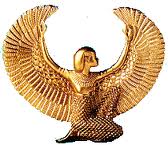
Isis, She of Ten Thousand Names, was worshipped in ancient days for longer than any other deity. What is sometimes called her cult (remember, if it’s ours it’s a true religion; if it’s theirs, it’s only a cult) can be traced back six thousand years. Her worship spread throughout the lands around the Mediterranean and the Roman Empire, going as far north as London. The last temple of Isis was razed by fanatical Christians in the 6th century. But Isis did not die! As we can see in any representation of the Madonna and Child, the iconography of Isis—a mother nursing her son—was adopted by the early Christian church. Worship of Isis was reborn in the 20th century with the establishment in 1976 of the Fellowship of Isis to renew worship of the Great Goddess in modern times. Another temple of Isis, established in 1996, is located at the Isis Oasis in Geyserville, California. It is a legally recognized religion in California.

The name Isis is the Hellenized version of her Egyptian name, approximately Auset. If you want to know more, read The Golden Ass by the Roman author Apuleius (translated by Robert Graves) and Plutarch’s Of Isis and Osiris.

The story below is partly based on the myths of Isis and Osiris and partly on European fairy tales (which almost never have fairies in them) and comes from my imagination, although the motifs are, of course, common ones. Talking animals and miraculous births are common in fairy tales, and the animal gods of Egypt are well known, and storks and other birds are held to be sacred by many cultures. 

Continue reading “The Child of the Bog By Barbara Ardinger”

Do Women’s Circles Actually Matter? By Molly

“We need rituals of memory…because a political movement, the public policy and tactics of our movement, does not come from our ideas, but from the bloody and joyful substance of our lives. We need to be conscious about what our lives have been, to grieve and to honor our strength, in order to break out of the past into the future.” –Minnie Bruce Pratt

I’ve been feeling depressed and discouraged lately after reading some really horrifying articles about incredible, unimaginable violence and brutality against women in Papua New Guinea who are accused of being witches as well as a book about human trafficking around the world (I wrote about this book in a recent post for Pagan Families). Then, I finished listening to David Hillman on Voices of the Sacred Feminine, in which he issued a strong call to action to the pagan community and to “witches” in the U.S. to do something about this violence, essentially stating that it is “your fault” and that rather than spending energy on having rituals to improve one’s love life (for example), modern witches should be taking to the streets and bringing abusers to justice. And, he asserts, the fact that they don’t, shows that they don’t really “believe”—believe in their own powers or in their own Goddess(es). Continue reading “Do Women’s Circles Actually Matter? By Molly”

Water, Spiritual Source By Deanne Quarrie


We are creatures of water.  Water is our original source as well as what makes up at least 70% of our bodies. It is part of every cell and fiber in us and is our essence.  What if water were the common denominator weaving all of life (earth, animal, human, and plant) together? Is it what connects us all?   It is pretty incredible when you realize that the water we have here on Earth right now is the same water that has always been here.   Do you suppose there are messages contained within water?  Do you think it is possible for our ancestors to speak to us through water?

When I think about water I am immediately taken down memory lane to the various “waters” I lived near or visited.  As a child I spend several summers on Hermosa Beach in Southern California where the intertidal zone reaches far out, gently sloping to deeper waters.  There is an abundant kelp forest off the shore there in the warmer Southern California waters.  For a child, kelp was the food for imagination, as we dressed ourselves in it, becoming sea monsters chasing each other about! In addition, I found pleasure in popping the pods, which sprayed seawater upon bursting. Continue reading “Water, Spiritual Source By Deanne Quarrie”

Rhiannon, Goddess of Birds and Horses by Judith Shaw

judith shaw photoRhiannon, Goddess of Birds and Horses, is also know as the Queen of  Fairies.  She is a Sovereignty Goddess who the king must wed to legitimate his rule.  A Goddess of Transformation, she uses her powers for love of others or self.  She shines in our hearts as an example of true love and beauty. She appears in both the first and third branches of the Medieval Welsh stories, The Mabinogion, a narrative which grew out of the ancient myths of the Celtic Gods and Goddesses.

Rhiannon is associated with Epona, the Gaulish Horse Goddess.  They are probably both derived from the ancient Celtic Goddess, Rigatona, whose name means “Great Queen”.  Unfortunately, Rigatona’s stories  and meaning are lost to us today.

Things sacred to Rhiannon are the moon, horses, horseshoes, songbirds, gates, the wind, and the number 7.

In the Mabinogion Rhiannon first appears to Pwyll, King of the new tribes of Dyved, as a beautiful  dream vision, riding a glowing white horse. Her hair shining in the sun, her birds twittering in circles around her head, She seems to be clothed by golden light.   Thus begins her journey to attain the man of her desires.  She possesses deep magic and can manifest her dreams and desires both for herself and for the good of all.

Rhiannon painting by Judith Shaw

Continue reading “Rhiannon, Goddess of Birds and Horses by Judith Shaw”

Our Mother Whose Body Is The Earth by Carol P. Christ

carol p. christ 2002 colorThis prayer came to me recently in waking sleep:

Our Mother whose body is the Earth,

Blessed are you,

And blessed are all the fruits of your womb.

You give us this day our daily bread,

And we share it with others.

Our Mother whose body is the Earth,

We love you with all our hearts,

And our neighbors as ourselves.

Continue reading “Our Mother Whose Body Is The Earth by Carol P. Christ”

Purim and the Value of Courage by Ivy Helman

Ivy HelmanThe Jewish Festival of Purim and the book of Esther offer us an opportunity to reflect on the value of courage from a feminist perspective. The online Webster’s Dictionary defines courage as, “mental or moral strength to venture, persevere, and withstand danger, fear, or difficulty.” In religious discourse, courage is often categorized as a virtue or a moral principle. Aristotle (384BCE – 322BCE), one of the most famous of the virtue ethicists, believed a virtue like courage should be practiced according to the mean or the right amount. Too much courage leaves one rash, possibly too reactionary and hot-headed while too little makes one cowardly and weak, but just the right amount in a given situation leads to moral behavior. Virtuous living leads to happiness, or perhaps is itself happiness, for Aristotle.  Yet, as a feminist, I understand the worth of courage differently.  To me, the value of courage lies not in individualistic gains nor in personal happiness but in its use toward achieving justice and equality in society.

In the book of Esther, we read about Queen Vashti and Esther both of whom demonstrate courage. (There are many feminist commentaries on the inherent sexism of the book of Esther. While I acknowledge the need for such critique, I am not approaching Esther from this perspective as much as I am approaching it from what we can gain from the actions of the women in the story.) As the book opens, King Achashverosh asks Queen Vashti to parade her beauty at a feast for him and his guests. She refuses to be paraded and thus objectified. Men in the king’s royal court react harshly telling the king that if he lets her get away with such disobedience other women will surely follow suit. This is surely problematic for the kingdom as well as their households. Vashti is replaced as punishment. Continue reading “Purim and the Value of Courage by Ivy Helman”