A Girl God Anthology Edited by Arlene Bailey, Pat Daly, Sharon Smith and Trista Hendren
Women’s Sovereignty and Body Autonomy Beyond Roe v. Wade was not what I was expecting. Given the title, I thought it would be similar to Robin Marty’s New Handbook for a Post-Roe America – a practical guide for ways to gain access to reproductive care in the wake of the overturning of Roe v. Wade. Instead, I found, in contributor Mary Saracino’s words, “the howl of ages” – a deeply passionate and spiritual collection of poetry, prose, and visual art expressing women’s outrage, grief, resistance, and empowerment in response to the U.S. Supreme Court decision of June 2022 denying women the right to abortion care that had been settled law in the U.S. for nearly fifty years.
I was on my way home from a wonderful morning spent with my son when I heard the news of the horrific attack by Hamas on Israeli citizens. We had risen early to witness the mass ascension of balloons at the Albuquerque Balloon Fiesta, joining tens of thousands of people from around the world. For 10 days, a diverse crowd gathers on a vast field, experiencing childlike wonder as they watch brightly colored balloons ascend into the early morning sky. It was a joyful morning.
But then, after all that wonder, the car radio delivered the shocking news of the Hamas attack. My joy was shattered.
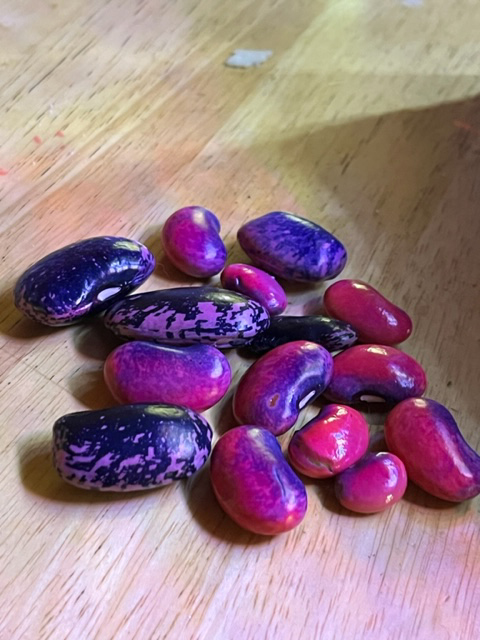
I have grown scarlet runner beans ever since I can remember. I have heirloom seeds that I collect every fall to dry and store for the winter. During the last few years as the weather began to shift planting became tricky. The deer were also decimating my plants before they could produce seeds pods so eventually after sharing seeds with others, I gave up growing my own…
Last winter I had an opportunity to look at lichens, molds, and stones under a powerful microscope at the Mineral and Gem Museum (MGM) and since I had one old seed from many years past, I took it in along with some slime molds because I wanted to see the colors. To my utter shock when I opened the damp packet the seed had produced a big fat white root.
The charge of “essentialism” has become equivalent to the “kiss of death” in recent feminist discussions. In this context it is taboo to speak of Mother Earth. Yet, I would argue there are good reasons for speaking of Mother Earth that do not add up to essentialism. What if the values associated with motherhood are viewed as the highest values? What if the image of Mother Earth encourages all of us to recognize the gift of life and to share the gifts we have been given with others?
For those not familiar with the “essentialism” debate in feminist theory, it might be useful to define “essentialism.” In philosophy, essentialism is the idea that every “thing” has an “essence” which defines it. In its pure form, essentialism is a by-product of Platonic “idealism” which states, for example, that the “idea” of table is prior to every actual table and that every actual table is an embodiment of the idea of table.
While I celebrate the rise in status of Hildegard to official saint and soon to be Doctor of the Church, I cannot help but be suspicious of the Vatican’s motivations. One only has to take in the last two months behavior of the CDF, sanctioned by Pope Benedict, to see the real intentions of this papacy—the continued subjugation of all women to clerical authority.
The past month or so has been a very busy time for the Congregation for the Doctrine of Faith or CDF and their examination of women. First they (and this includes Pope Benedict XVI) decided American nuns are guilty of the sin of silence by not speaking out on abortion & homosexuality. Their “radical feminist” ideology of standing with the poor and disenfranchised, while good, is not good enough for the CDF. The firestorm of solidarity coming from both laity and religious surely caught the Vatican off guard. Right? Well, not quite. This past week the CDF began its investigation of the Girl Scouts for their purported association with the likes of Planned Parenthood and Oxfam. While both address the needs of the poor, it is the latter and its troubling advocacy for safe sex via condom use that initiated the inquiry. Keep in mine that in 2010 Pope Benedict retracted from his earlier position and bane on condoms, seeing instead their use as a “lesser evil” in the fight against HIV/AIDS. The CDF angst is that the message of condom use might be too much sex-talk for impressionable young women. And now the real conundrum, Pope Benedict officially declared Hildegard von Bingen a saint and will soon declare her the fourth female Doctor of the Church along with Catherine of Sienna, Theresa of Avila & Teresa of Lisieux. News articles credited the pope as feminist-friendly and minded by his endorsement of Hildegard. It is stated that Pope Benedict turned to the writings of the 12th century visionary with her sharp critique of clergy and the church during her own 12th century milieu as a contemporary diagnosis for the sins of its priest in the global sex scandal. So what is it that attracts Pope Benedict to Hildegard?
The other night I hosted a First Moon Circle for my fourteen year old daughter. I have been hosting Circles almost a decade, but outside of having them on the ‘periphery’, walking through the sunroom where I host, talking and laughing with all of us after Circle as we eat, occasionally a short ‘sit-down’ in Circle, but nothing where they are included beginning to end.
Because my attitude up until now has been that Circles are work and so are they. Why mix the two?
But I find myself at new juncture: when you become very strong on who you are, feedback becomes so less relevant. And I have learned how to hold the rim of the Circle allowing it to flow and sway with minimum effort on my part.
Nowadays I find myself ‘receiving’ from Circles no matter who else is sitting in them and what they are contributing.
In Part 1 of this series on labelling, I highlighted the difference between naming and labelling, and the search for a personal label as ‘participation ticket’ for life.
In Part 2 on professional and spiritual identity, I looked at what we can learn from the autoethnographic practice of disclosing various selves in research situations. I also discussed the effects of Christianity on the suppression of pagan traditions in northwestern Europe, and nature-based spirituality as part of our generic spiritual DNA.
Today I share a few final reflections including what groups celebrate their differences with ‘prides and games’, and which ones remain invisible? What are the effects of woke ideology on fear of expression and loss of voices, and an invitation for embodied presence as one characteristic of our shared humanity.
FAR was founded in June 2011 by four women, Xochitl Alvizo, Cynthia Garrity-Bond, Caroline Kline, and Gina Messina. They are and have been revolutionary thinkers in the world of feminism. Below is a portion of what they write on our “About” page
“There is no single definition of feminism and this is a place of many voices. Important work in women’s studies in religion continues as more attention is paid to the intersection between gender, race, culture, and sexual identity, within feminism and religion.” They go on to say: “We establish this blog in the hope that feminist scholars of religion — and all who are interested in these issues — will use this forum to share their ideas, insights, and experiences, so that this community of thinkers will be nurtured as we explore diverse and new directions.”
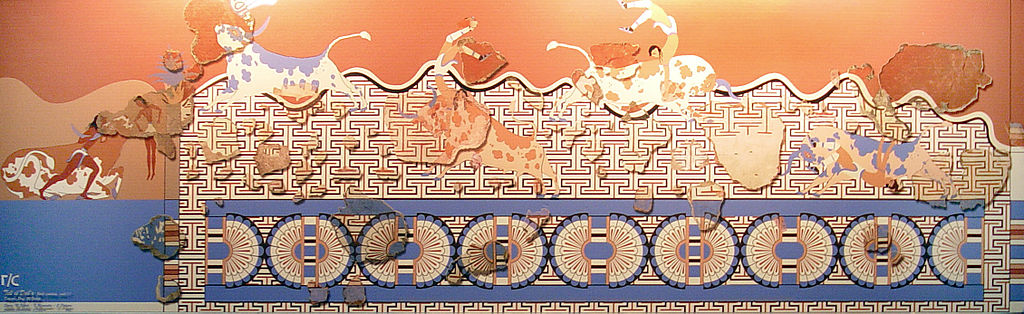
Imagine a world where beauty is revered just for bringing pleasure and joy; where buildings abound in graceful, naturalistic, lively renderings of animals and plants; where the human body is magnificent art; where everyday objects for all are ornamented with complex, graceful imagery. Imagine a world where “beauty” is not a narrowly defined style of attractiveness or an attribute of works created by a small elite, but a revelation of life’s joy created by all, an expression of delight in the Earth, and a bridge to the worlds within us. If we look back across human history, we will find all these expressions of “beauty for beauty’s sake,”
From our earliest millennia, “where you find humans, you will find art,” says pre-historian Jean Clottes (Marchant). People carved zig zags in shells 500,000 years ago (Handwerk). About 164,000 years ago, people left behind in South African caves ochre and pierced shells, perhaps for jewelry (Marchant). Artists created the oldest cave paintings yet found, stunning in their realism and movement, in Spain 65,000 years ago (Handwerk).
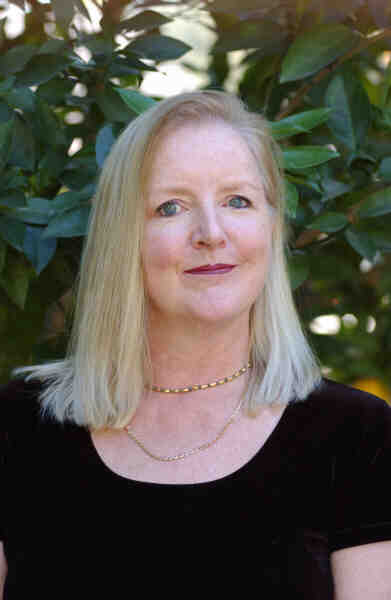
Moderator’s note: Our long time writer Sara Wright fell recently and broke her hip. I am writing this with her permission. Here is how she describes herself on our contributor’s page: Sara Wright is a naturalist, ethologist (a person who studies animals in their natural habitats) (former) Jungian Pattern Analyst, and a writer. She publishes her work regularly in a number of different venues and is presently living in Maine.
Sara is always reminding us to listen deeply to the earth, the animals, the plants and all of nature. Her revelations are always poignant, instructional and helps, encourages, pleads with to the re-member that we are the natural world and we must cherish our “roots.”
To Sara, heal quickly and continue to write for us.





 Feminism and Religion