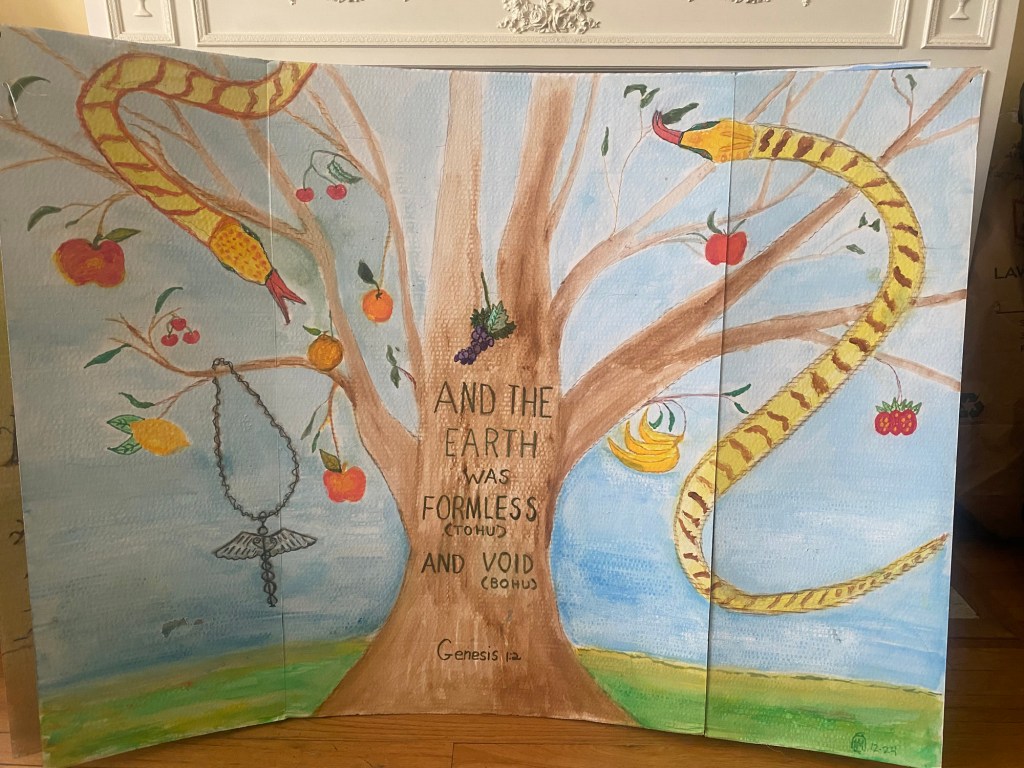
SheSpeaks! Eve by Janet Maika’i Rudolph

Author’s Note: I have begun a project called She Speaks! Women of the Bible Have Their Say. As part of this project, I have done five films with some very dedicated actors (friends of mine) who have dubbed themselves the SheSpeaks!Ensemble. I showed 4 of the films at the recent Yerusha Symposium. Based on the comments and reception, the project is now expanding. I am looking to create longer films that include story arcs. The first one will be of Eve. Below is the script for Eve along with the link to the video.

EVE speaks:

Why hello I don’t get visitors very often! Welcome. Come, come sit under my tree, let’s share some tea. I have the most wonderful and flavorful herbs here in my garden.

Look around at my most marvelous paradise. It is all filled with magical treasure. I’ll tell you a secret, the treasure I care for spans both the heavens and the earth. You see, we are at the place where spirit, breath and matter intersect. Where the living beings of earth and the animating forces of the divine join in harmony.

It is so hard to look at your holy book. I can’t imagine why I keep getting blamed for . . .well . . . just about everything.  It’s strange that your world wants to connect me with curses as I am the giver of life. In fact, did you know that my name Eve means life. I don’t understand what has become of you, my children. It is said that I brought a curse to humanity. Do you see life as a curse?  Let me tell you a bit about myself. Perhaps then you will see me differently.

Continue reading “SheSpeaks! Eve by Janet Maika’i Rudolph”

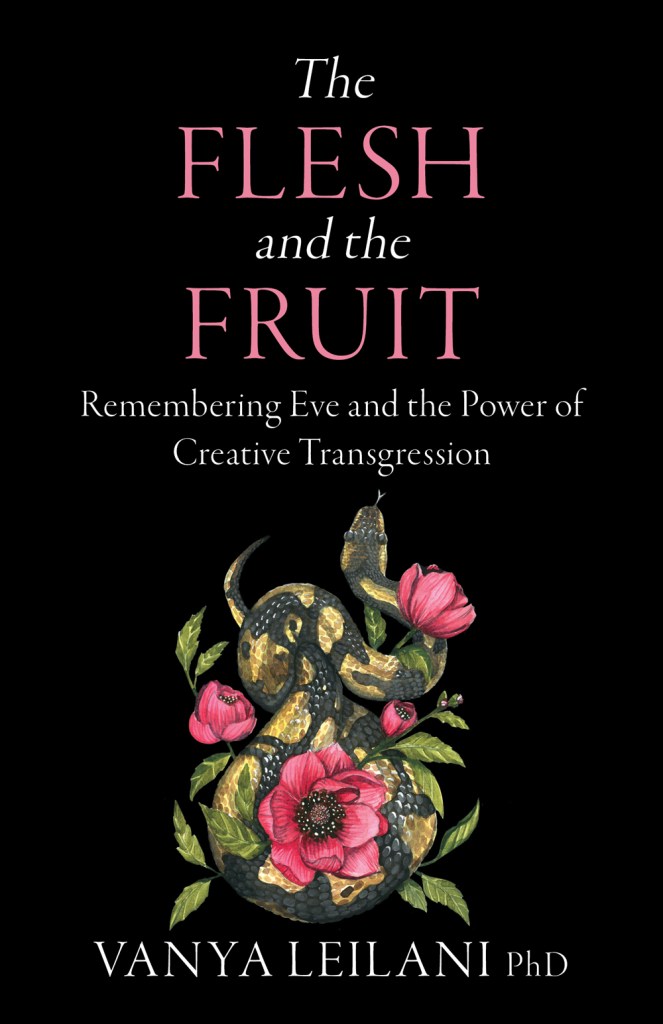
The Flesh and the Fruit by Vanya Leilani, PhD: Book Review by Janet Maika’i Rudolph

Subtitle: Remembering Eve and the Power of Creative Transgression

I have learned that every good story of spirit has many layers of meaning and pathways of understanding. Dr Leilani has found particularly relevant and even beautiful aspects of the biblical story of Eve. She uses Eve’s actions as a template of her own spiritual journey. Her pathway begins in obedience (listening to the voice of authority), travels through transgressive acts (eating of the fruit), and finally results in a self-knowing that had not been possible at the beginning of her journey.  In this book we follow along on her quest to learn about herself with Eve as her inspiration.

This is a luscious book. Vanya Leilani’s insights are not only profound but are written with a poetic sensibility. I found myself speaking some of her passages out loud because the vibration of her words are powerful and feel so sensuous on the tongue. I wanted to take them into my body, as well as read them on the page.

Continue reading “The Flesh and the Fruit by Vanya Leilani, PhD: Book Review by Janet Maika’i Rudolph”

From the Archives: I Sing Asherah Exalted! by Janet Maika’i Rudolph

This was originally posted Dec. 16th, 2021

With this season of the festivals of light upon us (Hanukkah, Christmas, Solstice, Kwanzaa), I wanted to focus on the more joyful aspects of our lives. For that, I have been diving into passages about joy and singing in the bible.

Sometimes when I write these posts, they take me in directions I never thought to go. This post is one of them. The surprise direction I found is in the Psalm below:

Sing unto him, sing psalms unto him: talk ye of all his wondrous works.
Glory ye in his holy name: let the heart of them rejoice that seek the LORD.
Psalm 105:2-3 KJV

Continue reading “From the Archives: I Sing Asherah Exalted! by Janet Maika’i Rudolph”

What an Outdoor Movie Taught me about Biblical Women By Alicia Jo Rabins

Once I went to a free outdoor movie in Miami Beach. The film was projected on the side of the giant concert hall. There was a grassy park with palm trees stretching out from the wall; families brought picnic dinners and cans of beer and stretched out to watch the movie once the sky darkened.

The movie was Star Wars, but as Princess Leah appeared, I was thinking about a different mythic canon. For over twenty years I’ve been studying and teaching stories of Biblical women from a feminist Jewish perspective, and after all this time, I was surprised to find that the way I feel while interacting with these stories was oddly, powerfully similar to the feeling of watching Star Wars projected on the side of a building on this Miami night.

Continue reading “What an Outdoor Movie Taught me about Biblical Women By Alicia Jo Rabins”

From the Archives: Aren’t We All Divine Children? by Janet Maika’i Rudolph

This was originally posted March 18, 2021
Note from Janet: Thank you all who supported the launch of my book Desperately Seeking Persephone on May 19. Due to a printer’s error, the original books sent out were deeply damaged without formatting, editing and with uncertain content. If you received one of these books you are entitled to a free replacement. I have put instructions at the bottom of the post for anyone affected to receive their copy.

Consider the following four birth stories:

Continue reading “From the Archives: Aren’t We All Divine Children? by Janet Maika’i Rudolph”

Biblical Poetry – Trees by Janet Maika’i Rudolph

Image from an Egyptian tomb ca. 1314-1200 BCE. Isis is giving nourishment in the form of fruit and drink,

In many cultures of the world, including our own, trees are considered the ancestors of humanity – own our ancestors.

Trees are connected with great goddesses throughout antiquity. We see this in the bible where, as I’ve noted before, the Tree of Life is Eve’s tree for the word Eve means life. It is, in essence, the Tree of Eve. Goddesses in trees feeding humans were common themes in ancient Middle Eastern art. The tree was Hers to give freely of as she wished.  

Anthropologist and religious scholar, Mircea Eliade writes extensively about the associations of trees ancestral connection to humans. He calls them both mystical and mythical.[1] His examples include the Miao groups of Southern China and Southeast Asia who “worship the bamboo as their ancestor.” He also notes Australian tribes who view the mimosa as their progenitor. And there is a tribe from Madagascar, called Antaivandrika which means “people of the tree,” who considered themselves descended from the banana tree.

Continue reading “Biblical Poetry – Trees by Janet Maika’i Rudolph”

Moses and the Rambo Problem by Janet Maika’i Rudolph

Moses is an interesting character is in the pantheon of religious leaders. He is such a major personage, considered the founder of Judaism and yet there are no extra-biblical accounts of his life and his deeds. He only exists in the bible. You’d have thought that such a major event as leading a whole class of people away from Egyptian slavers, would have shown up on the radar of other written or mythical accounts from the time. Nothing!

Even his name is interesting. When the Egyptian princess gathered Moses out of the waters she said:

She named him Moses, explaining,

“I drew him out of the water.”

Exodus 2:10

This is one meaning of his name. But there are others. In Egypt, the land where he was born and raised, the M-SH (variations: m-s or m-ss) root simply means “son.” Or it can mean “child” in a non-patriarchal sense. We see this in other Egyptian names Ramses is the child of the sun god Ra. Tutmose is the child of Tut. 

Continue reading “Moses and the Rambo Problem by Janet Maika’i Rudolph”

Asherah, Blessed, Asherah by Janet Maika’i Rudolph

Once upon a time, the Great Goddess was the spiritual focal point of ancient culture. Her worship included honoring women, living in harmony with the earth, and cherishing the processes of the cycles of nature. Asherah was one of those Goddesses. When the Patriarchs moved in and worked to suppress the old goddess religions, Asherah and her fellow Goddesses were diminished, and in a propaganda coup we might recognize today, defined Her as evil. I imagine that some brave people fought to hold onto the Goddess in Her glory but when they saw they were losing the battle, they encoded Her and Her Sister Goddesses into their cultural mythology. Hidden in this manner, She found Her way into the bible. If we can uncover those codes, we can reclaim Her, others and their Earth-based spirituality.

Continue reading “Asherah, Blessed, Asherah by Janet Maika’i Rudolph”

Biblical Poetry, Continued by Janet Maika’i Rudolph

This is the 4th in a series of work I have been doing to translate passages of the bible into poetry that strips out the patriarchal overlays. You can read the previous ones here: Part 1, Part 2, and Part 3.

In this installment I have picked out some passages I really like but that I feel their power and beauty have been deeply hidden. I seek to reveal those hidden wisdoms.

To review; my usage of the 2 main names of divinity:

YHVH or LORD, I translate as Vibration.Being

EL or god, I translate as All-Potential Powers.

I discuss my reasons for these translations in my prior posts referenced above.

Genesis 3:6

And when the woman saw that the tree was good for food,
 and that it was pleasant to the eyes,
and a tree to be desired to make one wise,
she took of the fruit thereof, and did eat,
and gave also unto her husband with her; and he did eat.
KJV (King James Version)

and the woman saw that the function of the tree
is for nourishment and that he is yearning to the eyes
and the tree was a craving to make calculations
and she took from his produce and she ate
and she gave also to the man with her and he ate
Benner Mechanical Translation[i]

When the woman saw the tree, she recognized herself
She recognized and remembered beauty and wisdom
She took its seeds within her in knowing wholeness
She gifted its seeds to her husband in knowing wholeness
MPV (Mystic Pagan Version – my own translations)

Note for Genesis 3:6 – the word for “food” in the KJV version of this passage is “maakal” (Strong’s 3978). The word used for to eat is “akal” (Strong’s 398). Both are built on the root word “kl” which means complete or whole and traditionally refers to how food or nourishment makes us whole.[ii] I would add that in the context of spirit, it is that essence or element that we fill ourselves with to achieve a sense of wholeness.  

Genesis 49:25

Even by the God of thy father,
who shall help thee;
and by the Almighty, who shall bless thee with blessings of heaven above,
blessings of the deep that lieth under,
blessings of the breasts, and of the womb:
KJV

from the mighty one of your father,
he will help you,
and with Shaddai [my breasts] he will respect you,
presents of the sky from upon
the presents of the deep sea stretching our underneath
presents of the breasts and bowels.
Benner

The All-Potential Powers of your ancestors
Who watches compassionately over you
With nourishment from the dripping milk of the cosmos
And blessings from the misty cauldrons of the goddess Tiamat
Blessings of the breast, and the loving womb
MPV

Notes on Genesis 49:25: this passage had to have been a very old pre-biblical blessing. We don’t often see blessings that are clearly given by female divinity figures, or in this case, a divinity that has breasts and womb. Even in the conservative, male-centric King James Version the blessing is of the breast and the womb. The word for breasts is “shad.” To take this theme a step further, the phrase El Shaddai or Shaddai appears 48 times in the Bible. In English, El Shaddai is usually translated as “God Almighty” and Shaddai as “Almighty.” Sometimes they are translated as “God, the One of the Mountain.”[iii] Both are almost always referred to in scholarly discussions with the pronoun “he.” 

I have put the following two passages together because they speak to the same theme. One is a Psalm and the other a Proverb. I really like them because they both speak to the condition of our hearts. As some of you know I am an alaka’i of Aloha International. That is a spiritual guide of Huna or Hawaiian Adventure Shamanism. I love the lessons of Huna which foremost and foundationally remind us to keep a loving and open heart. Aloha not only means hello and good-bye, it means “the breath [ha] we all share,” and it means LOVE. Picture this, the Hawaiian people greet and part from each other which a statement of connection and love. The first principle of Huna is “the world is what you think it is.” The lesson behind this is that what is in our hearts will shape our experiences and ultimately our world. I believe that this is the lesson behind these biblical passages. (I have also included the New International Version for Proverb 4:23 because I think it is particularly beautiful.)

Psalm 37:4

Delight thyself also in the LORD;
and he shall give thee the desires of thine heart.
KJV

Cherish thyself in harmony with Vibration.Being
And gifts will be returned as per the radiance of thy heart.
MPV 

Proverbs 4:23

Keep your heart with all diligence,
For out of it spring the issues of life. 
KJV

Above all else, guard your heart,
For everything you do flows from it.
 (New International Version)

Treasure your heart in lovingkindness,
For it is the wellspring of your life.

MPV 


[i] https://www.ancient-hebrew.org

[ii] Benner, Lexicon; 146-147.

[iii] The Jewish Study Bible; 37.

Bio

Janet Maika’i Rudolph. “IT’S ALL ABOUT THE QUEST.” I have walked the spirit path for over 25 years traveling to sacred sites around the world including Israel to do an Ulpan (Hebrew language studies while working on a Kibbutz), Eleusis and Delphi in Greece, Avebury and Glastonbury in England, Brodgar in Scotland, Machu Picchu in Peru, Teotihuacan in Mexico, and Giza in Egypt. Within these travels, I have participated in numerous shamanic rites and rituals, attended a mystery school based on the ancient Greek model, and studied with shamans around the world. I am twice initiated. The first as a shaman practitioner of a pathway known as Divine Humanity. The second ordination in 2016 was as an Alaka’i (a Hawaiian spiritual guide with Aloha International). I have written three books: When Moses Was a ShamanWhen Eve Was a Goddess, (now available in Spanish, Cuando Eva era una Diosa), and One Gods. In Ardor and Adventure, Janet.now available in Spanish. Cuando Eva era una Diosa

More Biblical Poetry by Janet Maika’i Rudolph


This is the 3rd in a series of Biblical poetry where I am “translating” verses of the Bible. You can read the first two here: Biblical Poetry and Biblical Poetry, Part 2.

One of my primary purposes of doing this work is to strip away patriarchal veneers that have been layered upon original teachings. I reach into ancient pagan knowledge in order to reclaim what I believe to have been lost.

Below is each verse in 3 versions. First is the King James Version (KJV) for familiarity, the second is Jeff Benner’s Mechanical Translation (Benner) which uses a consistent translation for each word. I use his translations to get a better sense of how the words originally fit together.[i]

Continue reading “More Biblical Poetry by Janet Maika’i Rudolph”