A Middle: Understanding the Relationship between Violence and Power by Katie M. Deaver

In my last post here on Feminism and Religion I unpacked the three primary understandings of atonement theology as well as some of the feminist critiques of those understandings.  In this post I’d like to focus a bit more on how the relationship between power and violence influences how Christian women view the atonement.

In her book, On Violence, Hannah Arendt puts forth a new analysis of the relationship between power and violence.  Arendt’s analysis, though primarily focused around concepts of the potential for worldwide destruction and war following major global occurrences such as the Second World War and the struggles for civil and women’s rights within the United States context, supplies an interesting framework with which to consider this relationship as it relates to domestic violence.    Continue reading “A Middle: Understanding the Relationship between Violence and Power by Katie M. Deaver”

A Beginning: Atonement Theology and the Feminist Critique by Katie M. Deaver

Since many of the comments on my last post expressed interest in my dissertation topic I will use my next couple of posts to talk a little bit more about my work and research in that area.  When we talk about theories of the atonement we are trying to describe a narrative structure of what took place within the Christian cross event.  Generally speaking, Christians believe that atonement serves at the reconciliation between God and humanity and that this reconciliation is realized through the person of Jesus Christ.  The three primary theories that try to explain this event are Substitutionary/Satisfaction, Moral Influence, and Christus Victor.

The Substitutionary/Satisfaction theory of atonement suggests that Christ takes on the guilt and punishment that humanity deserves because of our sinfulness and so becomes our substitute, paying the debt we owe for our sins.  Because of humanity’s sinfulness we deserve death, but instead of giving us what we deserve God instead offers God’s son as a sacrifice to pay our debt, to atone for our sinfulness, and to save us from the eternal punishment of death.

The Moral Influence theory of the atonement focuses primarily on the life and ministry of Christ rather than on his suffering and death.  This theory is centered on the belief that God loves God’s creation so much that God would hold back nothing from us, God would even give God’s own Son in order to save us and remain in relationship with us.  As a result this theory encourages Christians to live as Christ lived and focuses on imitating his life and ministry in order to bring about justice in our own world.

Continue reading “A Beginning: Atonement Theology and the Feminist Critique by Katie M. Deaver”

Becoming Myself by Katie M. Deaver

Last weekend was a special one for me.  After many years of study and dedication I graduated with my Ph.D. and am now, officially, Dr. Katie Deaver.  The weekend was filled with celebrations to mark the completion of a milestone that I have spent years working toward.  The amazing outpourings of love, support, and care that I have experienced throughout the last few days is quite humbling.  The happiness and pure joy of my family, friends, professors, mentors, and multiple church communities have left me in awe.  As I reflect on this love and support it helps to heal the wounds and scars that have accumulated throughout the process of earning this degree.

The undertaking of a Ph.D. program is significantly more difficult than anyone tells you.  This difficultly lies not necessarily in the course work or the dedication to constant reading, writing, and learning but rather in the personal growth and vocational affirmation that takes place within the process.  My dissertation explored the primary understandings of the doctrine of atonement and addressed how this doctrine can, and has, been used in ways that perpetuate, and in some cases even encourage, domestic violence.

My own fascination with the topic of atonement and its links to domestic violence was brought about at the suggestion of one of my undergraduate professors at Luther College, Dr. Jim Martin-Schramm.  From the moment that Dr. Martin-Schramm explained the links between theologies of the cross and domestic violence I knew that I had found my new passion.  Writing a dissertation on the topics of domestic violence, theology and women of faith was an extremely personal, and intimate experience for me.  This topic forced me to accept my own lived experience.  To claim myself… out loud… as a survivor of domestic violence. As a result the writing of my dissertation was particularly personal, and painful, as well as extremely life giving.

Continue reading “Becoming Myself by Katie M. Deaver”

Patriarchy is Killing Us by Vanessa Rivera de la Fuente

FemicideLA

And not softly..

More than 2000 died by feminicide … More than 700 disappeared in Argentina … And more in Latin America and the world.

A few days ago they found Micaela dead. Her family, friends and my fellow activists searched for her for days, campaigned on social networks, shouted her name everywhere, without quitting and  accepting her death—totally avoidable. Micaela Garcia, a 21-year-old girl, raped and murdered by a repeat sexual offender who was questionably released by Judge Carlos Alfredo Rossi in Argentina. Micaela is one more victim of the depredation with which colonial and capitalist patriarchy attacks the lives of women in Latin America.

I just completed my first six months in South Africa. I live in Cape Town. I love this city, I am delighted by its colors and flavors. I am studying a Master’s in Women and Gender Studies—a goal I had longed struggled for.

In my trip from my home to the university, I think of Micaela Garcia and also of Stasha Arend and Tracy Roman—two girls killed in Cape Town recently. Their lives were violently interrupted while they were returning home. At the end of each of my days, 27 women will be raped, likely by someone they know. Some of them will be killed and thrown in the garbage or into a soccer field, or half-buried in an abandoned house; even in death it seems that we have no right to some dignity.

No matter where, death is my guest and part of my landscape; the scenario of its violence has as background the Andean Cord or Table Mountain. It is the same, because it is the same indolence when it comes to the life of a woman, here or there. And I think: I can move my city and even change the country, and start a new life, even with another name, and my life will remain insignificant because I am a woman—a woman of color, from the south, with all the oppression surrounding me in the air.

How to deal with that pain? Well, I have enrolled as a Rape Crisis facilitator. It is not only for solidarity; it is for survival. Do you see what I see? How could I just watch?

The body of a murdered woman is becoming something so common that daily dead had to receive their own name to describe this horror: FEMICIDE. In Mexico, Susana Chavez coined the slogan “Ni Una Más” (Not One More) to lead the fight against femicides. The writer and activist was herself found murdered in 2011.

About two years ago, women from all over Latin America got together to claim “Ni Una Menos, Vivas nos Queremos” (Not One More, We Want Us Alive). And I wonder why this clamor is not yet worldwide, if everywhere patriarchy is killing us, one by one, on our way home and in broad daylight, with no shame or remorse.

Patriarchy is killing us and many murders only matter while selling magazines and newspapers. Then, the rest is silence, as the silenced femicides of indigenous women whose bodies oppose the last stronghold in territorial conflicts against agro-business or mining corporations, as silenced as those women murdered in the “tranquility of their houses” in the name of love for their jealous partners, as silenced as the girls kidnapped on the way to school to appear later killed with their hands and feet tied, with signs of having been raped.

It is no longer just about reporting and visibilizing, but also about counting them: 57 femicides in the first 43 days of 2017 in Argentina, 3 this week in Chile, 27 rapes per day in Cape Town, all of those lost in the trafficking networks. The hunting of women is systematic. Human beings have bad memories, and who has no memory tends to repeat the horrors. As Karina Bridaseca says:

We must check the systematicity. The bodies, found, disappeared, the bones in the desert, are claimed today and always. Our strength is to have managed to gather them all, to alter the regime of the invisible. This feeds the hope of making the account closed. What is important is that today we all share the same language and demand that the account closes.

Patriarchy is killing us … and not softly. Every time the news reports another woman or girl dead, I check my mother, my sister, my daughter, my friends in Chile. I double check my close friends in Cape Town, to know that they are as I saw them last time: OK. And then I can sleep, knowing that they have returned home.

In Santiago de Chile and in Cape Town we must count, dead or alive. Hope for the figthers and memory for those who are no longer here. We won’t stop asking about all of you. We want to know you have returned home. Our lives must matter.

Vanessa Rivera de la FuenteVanessa Rivera de la Fuente works in community development, gender equality and communication for social change. She has led initiatives for women’s empowerment in Ecuador, Peru, Argentina, Morocco and South Africa. As a Gender Justice advocates with a broad scope of interests, she is a social and digital entrepreneur committed with the strengthening of grass roots organizations and the developing of an independent pathway of thinking, research and academic writing around Gender, Politics and Religion. Loyal lover of books, cats and spicy chai.

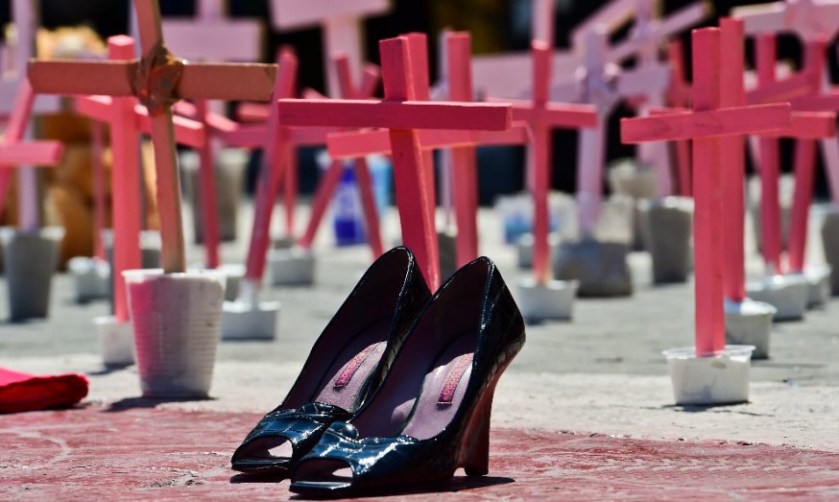
Photo: Artivism installation. Crosses represent the women dead and shoes, the gender bias of femicide. Shoes are one of the first things found at the site of a murder.

Poppaea Sabina: A Victim of Domestic Violence– But Why Does That Matter Now? by Stuart Dean

Poppaea Sabina as portrayed on a Roman coin minted 62-65 CE.
Poppaea Sabina as portrayed on a Roman coin.

It has been nearly 2000 years since the Roman emperor Nero kicked his pregnant and sick wife, Poppaea Sabina (hereafter Poppaea), killing her and what was probably the near full term fetus she was carrying.  That Poppaea was murdered deliberately should not be doubted, for not long after her death Nero had her son by an earlier marriage, who was then still a minor, killed by being drowned (a fishing ‘accident’).

Given that domestic violence has a history that repeats itself with sickening regularity it is necessary to explain why this particular case should matter now.  It is because at the time of her murder Poppaea was, with the sole exception of her murderer, the wealthiest and most powerful person in the world, whose attention was curiously focused not on Italy or Rome but on Judaea and Jerusalem.  There is evidence to suggest that had Poppaea not been murdered the history of Judaism and Christianity would have been substantially different than it has been, especially with respect to the role of women. Continue reading “Poppaea Sabina: A Victim of Domestic Violence– But Why Does That Matter Now? by Stuart Dean”

Domestic Violence: The Sin that Sin Created by Kelly Brown Douglas

Rev.-Dr.-Kelly-Brown-Douglas - Version 2In these last several weeks, the horror that one out of four women will encounter domestic violence- sometimes referred to as “intimate partner” violence- in their life time has come to the national forefront. Indeed, women are more likely than men to be killed by their “intimate partner:” one in three women who is a victim of homicide is killed by an intimate partner. While sixty percent of domestic violence incidents occur in the home, this is not where domestic violence begins. It is the perhaps inevitable result of a culture of violence against women. It is the violence that violence creates.

This is a culture of violence in which women’s work continues to be grossly undervalued. One third of all women are living in or near poverty, what has been described as “the brink of poverty.” Two-thirds of minimum wage workers are women. The average white woman is paid 77 cents for every dollar her male counterpart man makes; for African American women it is 64 cents and Hispanic women 55 cents for every dollar made by white men. Women devote more than double the hours as men to “unpaid interactive children care.” Women over 65 “are twice as likely as men of the same age” to live in poverty—primarily because they are full or part-time caregivers. A 2013 “State of the World’s Mothers Report” ranked the United States 30th of the 30 best countries in the world to be a mother, based on indicators such as economic status, political opportunities and universal health care. And what this report makes most clear is that the status of children reflects the status of their mothers. This means that at least 28 million children are living in poverty in the United States.

As for physical violence, one in four college aged women experiences an attemptted or actual date rape. Forty-two percent of women who have been date raped consider suicide. In the Shriver Report, Sister Joan Chittister suggests that in the United States, “rapes in military and rapes on college campuses go unpunished because ‘boys will be boys,’ and winning wars and football games are more important than protecting the integrity of the women who are victims of rape.” These statistics represent nothing less than systemic and cultural violence against women and their children.[i] And, such violence is a sin. Continue reading “Domestic Violence: The Sin that Sin Created by Kelly Brown Douglas”

Losing my Mother and Realizing her Resurrection by Gina Messina-Dysert

Gina and momFive years ago today I buried my mother.  Violence took her life; however because of this patriarchal culture we live in, there was no prosecution in her death.  Violence against women is of little consequence in our society.

She died at the very young age of 56 on June 29, 2008, the same day I was moving to California.  I was just about to get into our moving truck when I got the call.  I will never forget the moment I heard the words, “your mom passed away last night.”  It was as if I felt her dying in that moment, as if my heart was falling from my body.  I cried out so violently and fell to the floor.  How could this be real?  How could my mom be gone?  The day before we had stood in my kitchen, danced, sang, laughed, embraced.  She was so alive, but in a moment, she was gone.  I begged and pleaded with God, I thought it was a mistake, Continue reading “Losing my Mother and Realizing her Resurrection by Gina Messina-Dysert”

Response to “The Islamic Solution to Stop Domestic Violence” by Samar Esapzai, Shireen Ahmed, Vanessa D. Rivera, Ayesha Asghar, and Hyshyama Hamin

0 0 This article is in response to a post by Qasim Rashid of the Muslim Writers Guild of America titled, “The Islamic Solution to Stop Domestic Violence” published in the Huffington Post‘s Religion Blog on March 5th, 2012.

Although this post came to our attention a year after it was written, as young Muslim women who have worked with and/or written about gender-based violence issues that have  personally affected some of us, we deemed it fit to respond. Also, the points we will discuss here are not only limited to the particular post written by Rashid, but rather address similar arguments that have been made by other writers as well on this issue.

0_20_3It is a concern to us that Rashid uses the Quran verse 4:34* and proposes that it contains the “Islamic solution” to domestic violence. He states that according to the perspective of an American social scientist Dr. James Q. Wilson, known for his controversial works on the criminal justice system, men are more prone to anger and aggression and less capable of self-restraint than women. This, we assume, the author took from Wilson’s essay, “The Future of Blame” in which he cites what he calls “the claim” of research by neuropsychiatrist Dr. Louann Brizendine.  Interestingly, Wilson is also a rational choice theorist on the causation of crime and violence; he argues that individuals make clear, rational decisions after evaluating all possibilities and do that which benefits them the most. Continue reading “Response to “The Islamic Solution to Stop Domestic Violence” by Samar Esapzai, Shireen Ahmed, Vanessa D. Rivera, Ayesha Asghar, and Hyshyama Hamin”

Second Class Rape Victims: Rape Hierarchy and Gender Conflict

Deconstructing masculinity isn’t the key to solving social, sexual, and domestic violence across the world but it is a step worth taking when attempting to engage men in affecting change to stop these violent actions since men, statistically are the perpetrators of such crimes that both cause such outcry as well as perpetual silence.

johnThe most disturbing part of the 2006 documentary Deliver Us from Evil isn’t the fact that Father Oliver O’Grady is rewarded by the Catholic Church with a new congregation in Ireland after his short stint in prison for the rape of dozens of children in the 1970s, but rather the hierarchy of gendered victimization which is often created throughout the various rape cases that are both reported and unreported throughout history.

I am often troubled by the ways in which rape cases are discussed and deconstructed via mediums such as blogs, online communities, social media networks, the news, and popular culture.  No series of events troubled me more than the Jerry Sandusky trial, but more importantly, the ways in which the young boys and adult men who were subjected to Sandusky’s abuse quickly overshadowed the other rape cases that are reported on a daily basis, specifically those involving young girls and women. Continue reading “Second Class Rape Victims: Rape Hierarchy and Gender Conflict”

On Love, Theodicy and Domestic Violence by Ivy Helman

ivyandminiLast week, I introduced my students to the theological concept theodicy.  Theodicy is a theological explanation of why suffering and evil occur that usually includes some kind of defense of divine attributes.  For example, if G-d is all-knowing (omniscient), ever-present (omnipresent), all-powerful (omnipotent) and all-loving then how do we explain hurricanes, illness, mass murder, airplane crashes and other forms of evil and suffering?  This is quite difficult because, as my students point out after a few minutes of discussion, most explanations are often unfulfilling or inadequate.  The discussion turns quite quickly to two reactions.  Either, G-d isn’t what we thought G-d was or science does a better job explaining these examples of evil and suffering.  Science explains that hurricanes happen because of various environmental factors or a plane crashes because of mechanical problems. Even the concept of humanity’s freewill as the cause of evil often circles back to G-d’s creation of humanity and leaves students unsettled.  If G-d created within humanity the possibility of evil, how, then G-d can be all-loving?

The love/evil dichotomy is often the real conundrum of theodicies in monotheism.  This has been pointed out by numerous theologians throughout the ages.  How do we account for evil when there is only one divine Being?  How can an all-good, all-loving Being clove-1345952464afLreate or even be responsible for evil?  Which leads to the next question, is evil the absence of love?  These are extremely difficult philosophical and theological questions.

To explore then, we should start where it is often suggested that we learn most about love: family, close friends and intimate relationships.  Take this for example.  Continue reading “On Love, Theodicy and Domestic Violence by Ivy Helman”