

I went to the lake this morning . . . by Beth Bartlett

I went to the lake this morning, seeking the peace, sustenance, and perspective it so often provides. I had been particularly distressed and distraught the day before after watching the documentary on Christian Nationalism, “Bad Faith.” It was chilling to say the least.  Among other things, the film demonstrates the longevity of Christian Nationalism in this country, dating back at least to the Ku Klux Klan, founded in 1865.  However, the central theme of the documentary is the staggering influence of conservative political operative Paul Weyrich, who orchestrated the merger of conservative Evangelical Christians with the Republican Party in the 1980s.  He founded the Moral Majority with Jerry Falwell, the Heritage Foundation which authored Project 2025, the American Legislative Exchange Council, and the Council for National Policy – all of which seek to undermine democracy in order to bring about what these organizations and their followers call a “Christian nation,” by force if necessary.  But as former Republican strategist Steve Schmidt states in the film, there is nothing “Christian” about this movement.  It is pure nationalism, a striving for power requiring the dismantling of the institutions of democratic government as we know them. These extremist Republican strategists found a powerful base of voters by tapping into Evangelical Christians and manipulating the messages they received to fill them with fear, and found just the puppet they needed in the charismatic and amoral figure of Donald Trump.  As we’ve seen in recent years, they have been quite successful in the destruction of government.  After filling the Supreme Court with their chosen nominees during Trump’s first term, getting Christian Nationalist Mike Johnson installed as Speaker of the House, and getting Trump elected a second time despite the January 6th insurrection, or perhaps because of it, they are now successfully dismantling or otherwise destroying the Departments of Education, Health and Human Services, Energy, Defense, Agriculture, Justice and more along with the Environmental Protection Agency, the Food and Drug Administration, the Social Security Administration, the Federal Regulatory Agency. . . the list goes on. It’s all part of the plan to fulfill the “Seven Mountain Mandate” of dominionism[i], which seeks to impose its beliefs in seven spheres of influence: religion, family, education, government, media, arts and entertainment, and business. As one of the Christian Nationalists interviewed in the film proudly said, “It’s the Christian Taliban.”

Continue reading “I went to the lake this morning . . . by Beth Bartlett”
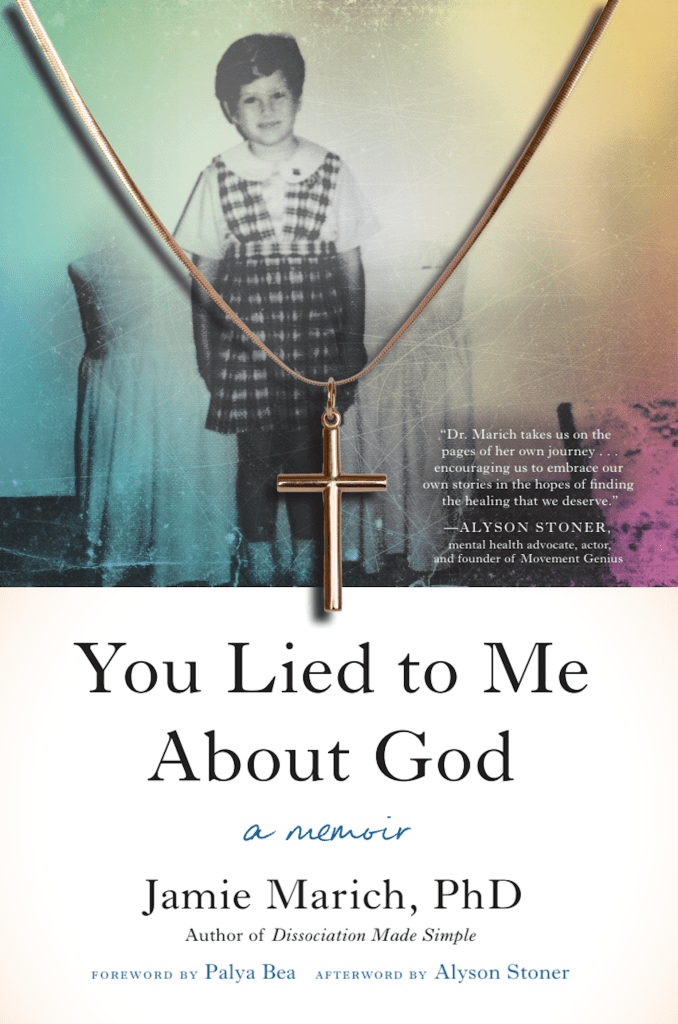
You Lied to Me About God, a memoir by Jamie Marich, PHD, book review by Janet Maika’i Rudolph

This was a hard book for me to review. Perhaps because she writes about such difficult issues and yet she does so in a compelling and at times even humous manner.  I feel a responsibility and yet find it hard to capture how she manages a breezy manner while discussing heavy material. Perhaps, even though our backgrounds are vastly different, I was also relating to so much of what she said. Jamie also covers so much ground; it is hard to pick out individual aspects to discuss.

As a child Jamie Marich was caught in the web of different religious systems, Catholicism from her mother and Evangelical from her father. They were at soul-hurting odds with each other (both parents and religions). Each one proclaimed they were the one true path so there was the ever-present threat of choosing the wrong one and facing a parent’s wrath along with that of eternal damnation. She labels this spiritual trauma. It cuts to the soul of a person being trapped into a no-win situation. It’s a conflict-driven, shame-filled, guilt-ridden way to grow up.

Continue reading “You Lied to Me About God, a memoir by Jamie Marich, PHD, book review by Janet Maika’i Rudolph”

Sing Anyway by Dr. Jamie Marich

I often find myself sitting in conservative Catholic spaces. My brother is a Roman Catholic priest in the Dominican order and I remain in support of his vocation. Every time, before a Mass officially starts, I’m overcome with a sense of: “You belong here…and you don’t.”

The part of me that has always felt at home in a Catholic setting is that love of the ritual and ceremony, the smell of the incense, the familiarity of the chants and songs. It was a Catholic priest, the late Fr. Ciaran O’Donnell, who taught me how to play the guitar and got me started with the healing practice of songwriting. When I sink into these associations, I feel connected to my Croatian ancestors and our Catholic faith. And there’s the other part of me—the queer feminist and an advocate for other queer and transgender people to live the fullest, most open expressions of themselves in all spaces of life, especially faith-based spaces. As a survivor of several forms of sexual assault and as a trauma specialist who has guided countless other survivors in their healing process over the years, I can’t sit in a Catholic Church and not feel uneasy about the legacy of abuse and silencing survivors within the church. Between my queer identity and dedication to supporting survivors, I feel that I don’t belong.

Continue reading “Sing Anyway by Dr. Jamie Marich”

Acting Out by Esther Nelson

I’ve had two distinct vocations during my lifetime—so far.  Three, really, if you count parenting a vocation.  Parenting took up a lot of my time for many years.  There were aspects to it that were fulfilling, enlightening, and satisfying, but parenting doesn’t last a lifetime.  Children grow up before long and then what?
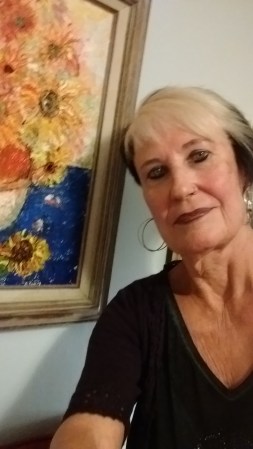

I grew up in Temperley, a suburb of Buenos Aires, Argentina, with fundamentalist, evangelical missionary parents, the second of five children.  My parents met at Moody Bible Institute, Chicago, Illinois, an ultra-conservative, Bible-believing school that encouraged and prepared students to go into the world and preach the Gospel.  My parents were zealous to reach Jews for Jesus and sailed to Argentina in 1941, a country where many Jews from Europe emigrated to in the 19th century to escape various upheavals. Continue reading “Acting Out by Esther Nelson”

Remembering Ginny by Esther Nelson

My husband’s stepmother, Ginny, died last week.  She lived several months past her 97th birthday.  Here is her obituary.

Ginny shared her life with three husbands, outliving each one.  Three sons were born from her first union.  She then married John, my husband’s father, and warmly welcomed us (John’s family) into her life.  When John died, Ginny married Fred.  After Fred’s death, Ginny told me, “Of all my husbands, Fred was my favorite. He was fun.”

Ginny lived at the Brethren Village Retirement Community in Lancaster, Pennsylvania—a home with several levels of care—for over 30 years, moving there a few years after marrying my father-in-law.  She said, “We made a good decision.  I never wanted to be a financial burden on my children.”  And she wasn’t.

Throughout her life, Ginny attended a fundamental, evangelical church.  Had she been able to vote in the 2016 national election, she would no doubt have voted Republican.  She had no use for feminism (women who rail against God’s ordained order), liberalism (the Devil’s message), homosexuality (perversion of God’s perfect creation) and immigrants (they siphon resources from hard-working Americans).

Yet, at the same time, Ginny was generous, giving to causes that fit with her ideological worldview such as missions.  It was important to her that people come to understand the “truth” as seen through the prism of the theology she embraced.  Within her community, she was loving, actively engaged, and caring, helping people in practical ways—donating food and other necessities to organizations sponsored by her church.

Continue reading “Remembering Ginny by Esther Nelson”

Sunday Shaming by Alison Downie

On a recent Friday, I learned that the 43 year old husband of someone I went to graduate school with, parent of four young children, died suddenly. Though I had been out of touch with my grad school friend for some years, I felt deeply for her loss, her unexpected plunge into single parenting, the way her life and the lives of her children would forever be shaped by this grievous tragedy.



I carried this family in my heart as I drove to my weekly Sunday visit with one of my adult sons, who lives about 75 miles from me. At this time, disabled by mental illness, he lives in an AA recovery house, surviving on Supplemental Security Income of $740.00/month and SNAP food allotments. Now 27, he dropped out of college after one semester, has never held a job for more than a month, and has been hospitalized three times for psychiatric care.

I usually enjoy our weekly visits, during which we sit at a coffee shop or do an errand. But I never know how he will be doing. When he is doing poorly, my own tendency to depression means that being present as best I can, even for just a few hours, to his deep suffering may utterly deplete me for the rest of the day or several days following. Continue reading “Sunday Shaming by Alison Downie”

The Trouble with Boaz by Katey Zeh

The Trouble with Boaz (1)

I’ve always been troubled by the story of Boaz found in the Book of Ruth. While there are plenty of biblical narratives that horrify me–Hagar, Tamar, and other “texts of terror” as Phyllis Trible called them–the story of Boaz is uniquely problematic in how it has been interpreted and applied by some Christian traditions, particularly among evangelicals. What is so insidious about this biblical re-telling is how the relationship between Boaz, a wealthy landowner, and Ruth, a foreign widow, is idealized as some kind of romantic love story.

Ruth and Boaz social media meme

Waiting for your Boaz is a popular blogging platform among single white evangelical women who desire a husband. Their Facebook page alone has nearly 300,000 likes. For purchase on the main site is a book entitled 31 Days of Prayer for your Future Husband: Becoming a Wife Before the Wedding Day. The premise of Waiting for your Boaz is that if single women quit searching for a husband (i.e. dating) and pray for one instead, God will “write your love story” and like a matchmaker, will bring them one eventually.

While there are many troubling theological issues at play in this framework, for this particular piece I will focus on the cooption of the biblical narrative to uphold a worldview in which the fate of women is left to the whims of men and a male God.

In the biblical narrative Boaz is the distant relative of Naomi, Ruth’s mother-in-law.  When the women are widowed suddenly and thus left destitute, they return to Naomi’s homeland in Bethlehem. (Orpah, Naomi’s other daughter-in-law who is also a widow, remains in Moab.) With no other known male relatives available to help them, Boaz is the women’s only hope for sustenance. He permits Ruth to glean the leftover crops after his fields have been harvested and instructs the workers not to bother her while she gathers food. While I acknowledge that Boaz acts kindly–or at least neutrally–toward Ruth, we ought not forget the immense power dynamics at play: Boaz is a native, wealthy, land-owning man while Ruth is a foreign, widowed woman with no rights.

At no other point in the narrative is this difference in power more evident than when Naomi insists that Ruth put herself at even greater risk–again for their collective well-being–by offering herself sexually to a drunk Boaz in the hopes that doing so might result in their continued protection.

This is not a fairytale. This is a story of survival.

In the end Boaz does offer Ruth and thus Naomi his protection through marriage. For two widows with no rights whatsoever, this is the best possible outcome, but it comes at great cost: namely Ruth’s bodily safety and autonomy which are threatened not only by her being a foreign woman working in the field, but also by her own mother-in-law’s admonition that Ruth offer herself as sexual collateral.

Single women ought to be praying for this? I think not.

Ruth does not wait. She cannot wait. Like many women, both ancient and contemporary, she uses what little power she has to do what is necessary in order to stay alive at great risk to her personal safety. Instead of admiring Boaz and his benevolent paternalism, our focus ought to be on removing the restrictions and confronting the injustices that leave women like Ruth and Naomi in such desperate circumstances in the first place.

RA82Katey Zeh, M.Div is a strategist, writer,  and speaker who inspires communities to create a more just, compassionate world.  She has written for outlets including Huffington Post, Sojourners, Religion Dispatches, Response magazinethe Good Mother Project, the Journal for Feminist Studies in Religion, and the United Methodist News Service. She is the co-host of Kindreds, a podcast for soul sisters. Her book Women Rise Up will be published by the FAR Press in March of 2018.  Find her on Twitter at @kateyzeh or on her website kateyzeh.com
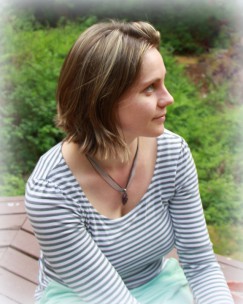
From Evangelical Christianity to Feminist Evangelism by Andreea Nica

AndreeaI always knew I was a feminist, despite my lack of knowledge in the movement and philosophy growing up. I did, however, have the religious support of my family and community to be an Evangelical Christian. I knew all the right words, mannerisms, and behaviors to represent myself as the proper Christian woman. I went on mission trips abroad, wore purity rings, attended sexual purity retreats and church camps, prayed fervently, spoke in tongues (glossolalia), contributed 10 percent of my meager earnings, and above all, fell in love with God.

As a first-generation college student, I was thirsty for knowledge and ready to take on the world. Some of my favorite courses during my undergraduate career included: “Psychology of Women,” “Women, Gender, and Ethnicity,” and “Psychology of Sexuality.” My coursework in gender, sexuality, and the social sciences compelled me to pursue graduate studies in gender, culture, and media at a university abroad. My studies in gender theory and feminist philosophy, and how it intersects with religion and social institutions ignited my spirit.

As a result, my relationship with god suffered. My newfound feminist beliefs were not solely to blame, however. Rather, a variety of reasons contributed to my detachment from god and the Evangelical church which I explain in my post, “Leaving Behind My First Love.” My new feminist identity was the main driver for questioning my relationship with god. Everything from the male-dominated language and rhetoric used in the church, to the discrimination and prohibition of female pastors, to the stringent gender roles expected of congregants. Continue reading “From Evangelical Christianity to Feminist Evangelism by Andreea Nica”

Evangelical Missionaries Preach Death in Uganda by Andreea Nica

Andreea Nica, pentecostalismA former evangelical Christian friend of mine sent me information on the intriguing documentary God Loves Uganda. The newly released documentary addresses how the American evangelical movement has prompted a political and social shockwave in the country of Uganda. While missionaries are typically associated with delivering aid and improving the conditions of third world countries, the spreading of Christian values and ideals has inflicted suffering upon ethnic communities through evangelical indoctrination.

The intent of the film is to raise awareness of the political and social brutality that the evangelical missionaries are instigating; specifically through their teaching that homosexuality is a sin and should be dealt with accordingly. In Uganda this means death. Given the rise of globalization, transnational religious actors have been more enabled to engender other nations with their respective religious beliefs, often with minimal regard for the cultural and political landscape of the nation they wish to transform. Continue reading “Evangelical Missionaries Preach Death in Uganda by Andreea Nica”

Liberations of Immigrant Women in Western Religious Conversion by Andreea Nica

Andreea Nica, pentecostalismThe prolonged debate around feminist subjectivity and religious participation continues to evoke much compelling discussion in academia, political arenas, and public space. There have been a number of academic studies around the intersection of gender, religion, and migration, specifically on how gender and immigration assimilation is constructed and managed within western religious systems.

I am currently researching the trajectories of immigrant assimilation and conversion, and how gender relations and religious identities are managed within these processes to further develop my proposal for doctoral study. I find this area of research fascinating as it’s so diverse and pertinent to the progression of gender equity amongst religious participants. Continue reading “Liberations of Immigrant Women in Western Religious Conversion by Andreea Nica”