The Furious Sun in Her Mane: Nine Poems to Goddesses by Annie Finch

Poet’s Note: I composed this sequence of poems for performance, for chanting, and for devotion. I wanted people who would hear, read, memorize, and speak each poem to channel the original energetic patterns that the poets who best knew that Goddess used to connect with Her. So for each poem, I researched the meter and prosody of the original language in which that Goddess was first worshipped.  Then I carried the exact rhythmical pulse of Her language into my poem to Her in English.

The sequence was set to music by composer Laura Manning and choreographed by Georgia Bonatis, and I directed and performed a devotional dance collaboration version of it in 1994. That archival video of this performance has just been recovered for the first time in 31 years. It is now posted on my Youtube channel.

Continue reading “The Furious Sun in Her Mane: Nine Poems to Goddesses by Annie Finch”
A House for the Goddess by Annelinde Metzner

For the past few years I’ve been contributing to FAR as a poet.  So grateful for the opportunity to connect with you wise women!  This month I realize I should share with you another side of me, my music.

      On June 8th, I produced, directed and composed the music for “A House for the Goddess” in Asheville, North Carolina, featuring 29 performers including two sopranos, a cellist, myself and another pianist, two dancers, an MC and a women’s choir.  The concert, whose venue was offered generously by Land of the Sky United Church of Christ, was a sellout, and over three thousand dollars was raised for the Linda Norgrove Foundation for the women and children of Afghanistan (https://lindanorgrovefoundation.org.)

      My compositions, both choral pieces and solo art songs, always find their birth through the inspiration of poetry.  At this venue, the texts of the poetry were displayed on two screens overhead as the songs were sung.

Continue reading “A House for the Goddess by Annelinde Metzner”

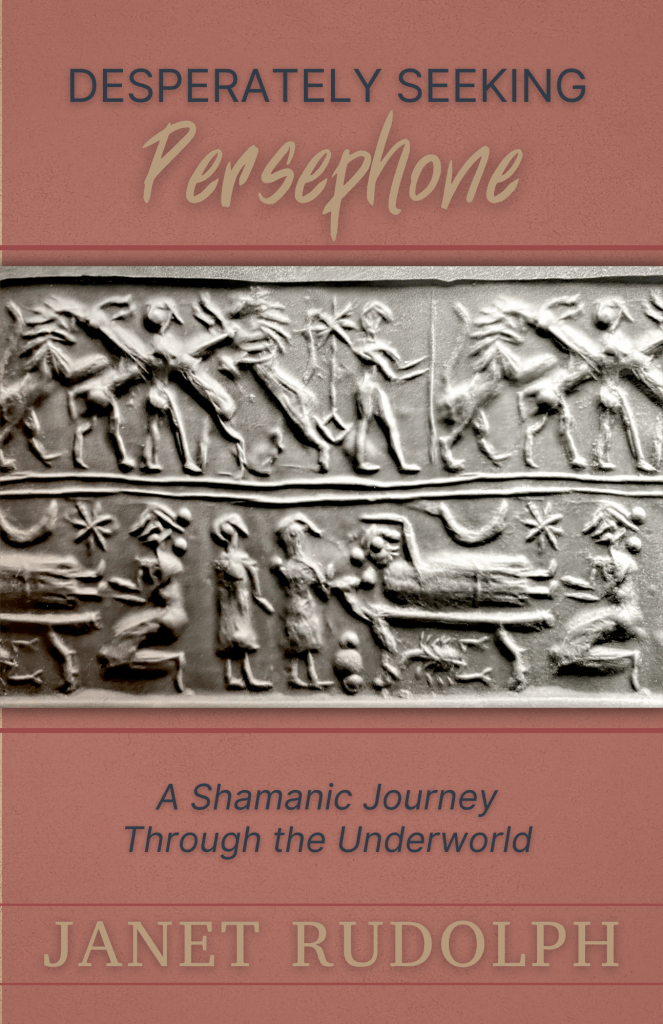
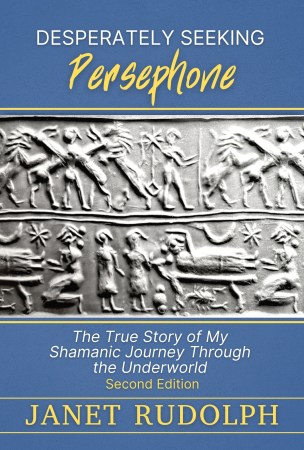
Desperately Seeking Persephone by Janet Rudolph, Book Review by Carolyn Lee Boyd, Part One

The myths of the descents of the Sumerian Inanna and the Greek Persephone to the underworld have fascinated and inspired women for millennia with their violence and betrayal, leaving behind all you love and that hold you up, and facing your deepest fears, even death. We recognize our own traumas in their struggles and seek guidance as to how to navigate our ascents back to wholeness and well being in their stories.

After her own experience of childhood abuse and stranger rape as a young woman, Janet Rudolph, one of FAR’s co-weavers, also pored over the myths in hopes of finding a helpful account of their journey home. “Once I had tumbled metaphorically, literally and mythically into the thorny quagmire of the underworld, it was devilishly hard to escape. I felt lost. I needed a guide, a role model to find my path outward”(xii). The problem is, Janet says, “The stories of their return are glossed over. There is no detailed story called From the Great Below Back to the Great Above” (15). Until now in Janet’s recently re-published book, Desperately Seeking Persephone.

Continue reading “Desperately Seeking Persephone by Janet Rudolph, Book Review by Carolyn Lee Boyd, Part One”

Why We Need to Bring Back God as a Woman, part 1 by Caryn MacGrandle

26,000 years ago, life was precarious and dangerous.  And so the human race revered the Mother.  Mother Earth, who provided food amidst scarcity, protection from the dangers of the wild and healthy babies who grew to adulthood.

The Goddess.

In her many forms.

Some of these Goddesses.

Venus of Willendorf.  The artifact known as the Venus of Willendorf dates to between 24,000–22,000 B.C.E., making it one of the oldest and most famous surviving works of art.

Continue reading “Why We Need to Bring Back God as a Woman, part 1 by Caryn MacGrandle”

From the Archives: Sacred Water by Molly Remer

This was originally posted on August 9, 2017

“Drinking the water, I thought how earth and sky are generous with their gifts and how good it is to receive them. Most of us are taught, somehow, about giving and accepting human gifts, but not about opening ourselves and our bodies to welcome the sun, the land, the visions of sky and dreaming, not about standing in the rain ecstatic with what is offered.”

–Linda Hogan in Sisters of the Earth

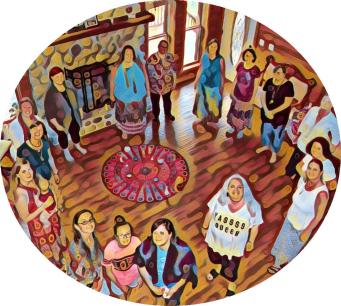
The women have gathered in a large open living room, under high ceilings and banisters draped with goddess tapestries, their faces are turned towards me, waiting expectantly. We are here for our first overnight Red Tent Retreat, our women’s circle’s second only overnight ceremony in ten years. We are preparing to go on a pilgrimage. I tell them a synopsis version of Inanna’s descent into the underworld, her passage through seven gates and the requirement that at each gate she lie down something of herself, to give up or sacrifice something she holds dear, until she arrives naked and shaking in the depths of the underworld, with nothing left to offer, but her life.

Continue reading “From the Archives: Sacred Water by Molly Remer”

A Poem for Enheduanna by Nan Lundeen

Cuneiform Tablet from Nippur, Sumeria
(Modern Iraq) 2300 – 2100 BCE
Mary Harrsch from Springfield, Oregon, USA,
CC BY 2.0 <https://creativecommons.org/licenses/by/2.0&gt;,
via Wikimedia Commons

In beautiful synchronicity, I received an invitation to submit a poem to an anthology in the voice of a female-identified persona around the same time I first learned of Enheduanna. The first named author and poet was mentioned in my New Moon Womyn’s Circle. When I looked her up, I was flabbergasted. I am a poet, a feminist, and a long-time student of Women’s Spirituality, and yet the world’s first author—a high priestess who worshipped a female supreme deity, was unknown to me.

I learned that Enheduanna was a brilliant poet who wrote with majestic metaphors, who shared her emotions, and who grappled with concepts of the divine as a female supreme deity in and with nature, and with whom she experienced a personal relationship. She lived and wrote around 2300 B.C.E. Scholars say they do not have the specific dates of her birth and death, but they do know that she served as high priestess for 40 years at the city of Ur in what is now Iraq.

Continue reading “A Poem for Enheduanna by Nan Lundeen”

Emerging from the Underworld: a book review by Eline Kieft

Desperately Seeking Persephone: A Shamanic Journey Through the Underworld by Janet Rudolph weaves together a healing journey from abuse and rape, a deep personal connection with the goddesses Inanna and Persephone, and the ups and downs of a long-term shamanic apprenticeship. These strands could have easily filled three separate books, but Janet masterfully crafts an integrated tapestry of personal and mythical strands. She integrates everyday life experiences, liminal space and the archetypal realms until something new emerges that is more than personal story, more than myth, and more than a description of discovering a shamanic path.

Continue reading “Emerging from the Underworld: a book review by Eline Kieft”

The Return of the Goddess to Our Human Consciousness by Caryn MacGrandle

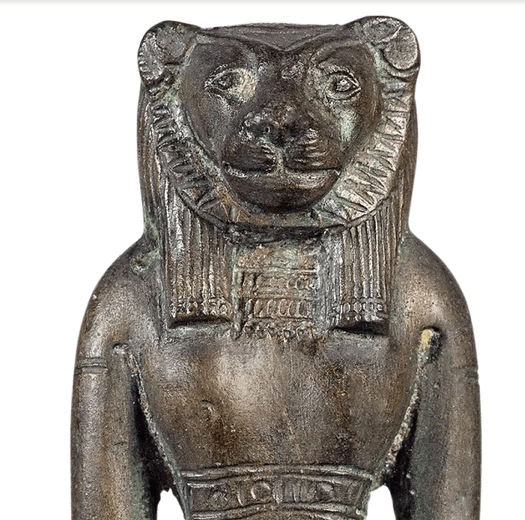
One of the over 700 granodiorite statues made of the Goddess Sekhmet almost 3500 years ago, “the Lady of the Place of the Beginning of Time.” 

Molly Remer of Brigid’s Grove, a fellow contributor here at Feminism and Religion recently wrote on the Mother Well section of the divine feminine app: “I feel like Inanna & Enheduanna are all around in recent months!”

Yes. I do as well.

A year or two ago, I read a book by Lauren Sleeman entitled ‘Behold’.  The premise of the book has remained with me:  a telling of the Goddesses, in particular Lilith, the Great Mother and Crone of the Cosmos, and Hekate, Goddess of the Dark Moon and the Mysteries of Life, who have been silently watching and waiting these past few thousand years to return to our human consciousness. 

Continue reading “The Return of the Goddess to Our Human Consciousness by Caryn MacGrandle”

To Stand in the Presence of the Ancients! – Enheduanna, Part 2 by Janet Maika’i Rudolph

Yesterday I wrote about the priestess/scribe Enheduanna and her warrior/king father Sargon. I posited their connection to the codification of patriarchy. They did not invent it, as war and the diminution of women had been happening in some circles. I do wonder, however, if they furthered it along to a point of no return.

Another king of the time, Urukagina from circa 2350 bce[1] codified laws under the guise of reformation.  Some of his reforms were progressive in that they sought to protect the poorer classes against aristocracy and the priesthood.  But they also were clear to let women “know their place.” Here are the translated words from his laws:

“If a woman to a male has spoken . . .[bad] words(?) which exceed (her rank?), onto the teeth of that woman a baked brick shall be smashed, and that brick will be hung at the main gate.”

Continue reading “To Stand in the Presence of the Ancients! – Enheduanna, Part 2 by Janet Maika’i Rudolph”

To Stand in the Presence of the Ancients! – Enheduanna, Part 1 by Janet Maika’i Rudolph

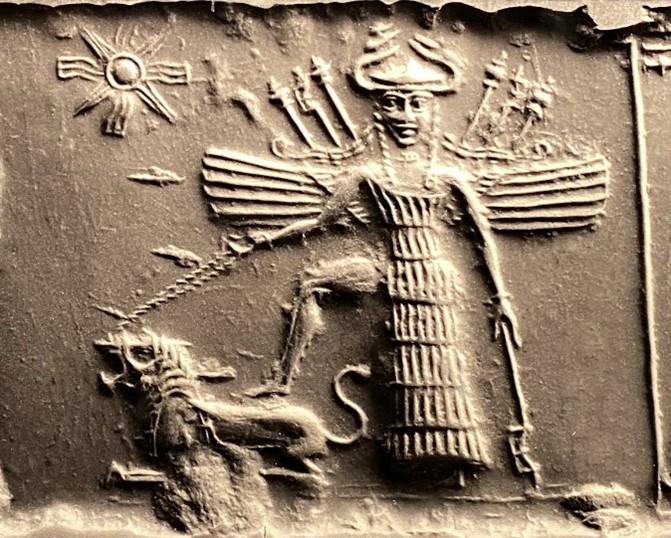
Ishtar controlling a lion ca 2334-2154 BCE

To be in the presence of antiquities is powerful. They carry an energy which is palpable.  I found this to be true at the recent exhibit at the Morgan Library in Manhattan that ran from October 14, 2022 through February 19, 2023. 

Enheduanna is a fascinating woman who lived in the lands of Mesopotamia circa the 23rd century BCE. She was a priestess who was also a writer and chronicler of her times. She named herself in her writings making her the first known author of any written works in history. She was so influential that for centuries after her death, scribes learned their craft in scribal schools by reading and copying out her work. Scholars have referred to her as the Sumerian Shakespeare[1]

Her main temple was in Ur, the very city that hundreds of years later gave rise to the biblical priestess Sarah and her husband, Abraham. We can only image how much they had been influenced by her.

Continue reading “To Stand in the Presence of the Ancients! – Enheduanna, Part 1 by Janet Maika’i Rudolph”