Yesterday I wrote about the priestess/scribe Enheduanna and her warrior/king father Sargon. I posited their connection to the codification of patriarchy. They did not invent it, as war and the diminution of women had been happening in some circles. I do wonder, however, if they furthered it along to a point of no return.
Another king of the time, Urukagina from circa 2350 bce[1] codified laws under the guise of reformation. Some of his reforms were progressive in that they sought to protect the poorer classes against aristocracy and the priesthood. But they also were clear to let women “know their place.” Here are the translated words from his laws:
“If a woman to a male has spoken . . .[bad] words(?) which exceed (her rank?), onto the teeth of that woman a baked brick shall be smashed, and that brick will be hung at the main gate.”
Continue reading “To Stand in the Presence of the Ancients! – Enheduanna, Part 2 by Janet Maika’i Rudolph”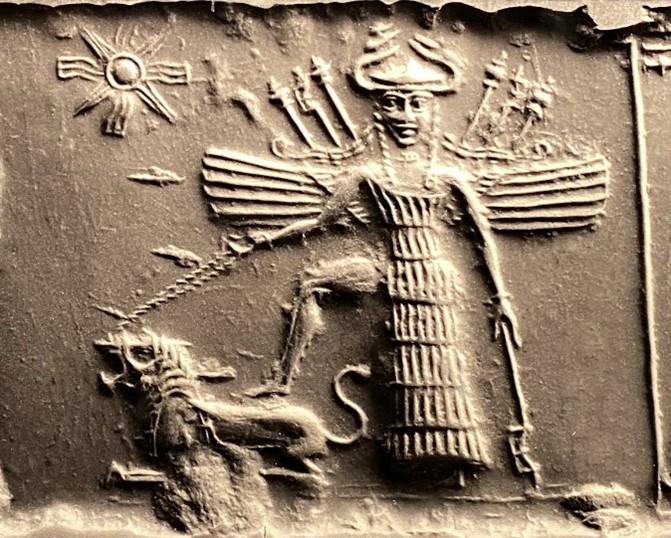

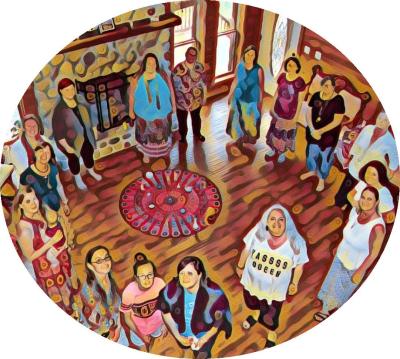 tapestries, their faces are turned towards me, waiting expectantly. We are here for our first overnight Red Tent Retreat, our women’s circle’s second only overnight ceremony in ten years. We are preparing to go on a pilgrimage. I tell them a synopsis version of Inanna’s descent into the underworld, her passage through seven gates and the requirement that at each gate she lie down something of herself, to give up or sacrifice something she holds dear, until she arrives naked and shaking in the depths of the underworld, with nothing left to offer, but her life.
 In the early 1990’s I discovered the compelling story of Inanna, the ancient Sumerian Goddess, translated and retold in the book, Inanna, Queen of Heaven and Earth by Diane Wolkstein and Samuel Kramer. I was inspired to create a series of paintings from Inanna’s story.
  As many of you may already know, on August 24, 2016, feminist theologian and scholar Rosemary Radford Ruether suffered a significant stroke. There has been some speculation from those who know or have known Rosemary about her current condition. Here is the short of it. While Rosemary has made progress, her doctors and therefore Medicare feel it is insufficient to warrant continued physical and speech therapies. Those who interact with Rosemary on a daily or weekly basis disagree with this medical prognosis. The stroke damaged the part of Rosemary’s brain that allows for communication, therefore she, at this time, is not able to speak. That said, Rosemary recognizes individuals, is able to respond to some commands and engage in therapeutic exercises. The more attention and care she receives the greater her capacity grows for a more meaningful life that includes a level of agency.
  Fall, the time of the Day of the Dead and All Souls Day, is a perfect season for us to contemplate “fearless spirituality” as we face our most essential fear, that of death. Though humans have celebrated these days for millennia, fear with a religious veneer pervades our culture, whether in hate towards women and the LGBTQ community, lies that demonize followers of other religions, terror of eternal punishment and spiritual unworthiness, and more.