Depicting Mary by Natalie Weaver

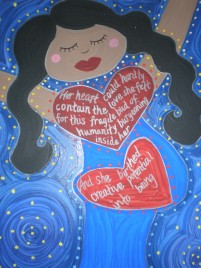
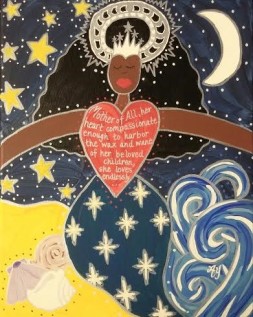
In October I had the opportunity to travel to the Louvre Museum on a free day I had from a conference I was attending in Leuven, Belgium.  I went predisposed to consider images of the Madonna as I had been thinking about her representations in art for some time.  In my own painting, I have been developing a version of the Annunciation that depicts Mary as a teenage girl reading a pregnancy test.  Her fear and consternation, coupled by the shock of the event of learning of her pregnancy strikes me as a more accessible telling of the true vulnerability and risk of the unwed child Mary than classic depictions of Mary as a reclining queenly figure quietly receiving the angel’s message.  I likewise had been working on a wood burnt figure of a Black Madonna as a study in both icon making and also understanding the tradition of Black Madonnas found throughout Eastern Europe.

I am deeply aware that representing this figure is a culturally laden task because the Madonna speaks both to some of the deepest spiritual needs and inclinations of many faithful Christians world over, just as she is almost shorthand for division among Christian communities.  Her presentation is tremendously political as it is received by fans and critics simultaneously as at once championing women (and the divine within women) and also condemning real women whose maternity and bodies can never be as morally or physically pristine as Mary’s.  Mary’s skin, clothing, age, gesturing, posture, gaze, and more speak volumes about the social location of her patrons and creators as well as the manner in which the viewer is being invited to receive her.
Continue reading “Depicting Mary by Natalie Weaver”

What I Believe (Post-2016) by John Erickson

Ever since the election of You-Know-Who, I have been doing a lot of creative writing.

Ever since the election of You-Know-Who, I have been doing a lot of creative writing. Unlike academic publications, policy reports, or my dissertation, creative writing, much like my mentor Dr. Marie Cartier has written about, provided me with a needed escape from a world that seems to grow darker with each passing day.  In college, I served as Poetry Editor for the Wisconsin Review, the oldest literary journal in Wisconsin. Continue reading “What I Believe (Post-2016) by John Erickson”

Painting Mary(s), Queering Mary(s) by Angela Yarber

Mary 1
Mary

It’s no secret that the holidays are often a difficult time for queer people. Disproportionately estranged from family, we often must create our own family. While these chosen families can be tremendously life-giving, it’s tough not to long for our families of origin during Christmas time. Many still in relationship with family are forced to retreat to the closet for fear of safety or exclusion this season.

Queer folk who have affirming families of origin still experience the twang of heteronormativity in holiday commercials, family events, and church services throughout December. There’s a reason why many refer to it as “Blue Christmas,” because, well, the holidays can leave us feeling pretty blue when our identities are invalidated, excluded, questioned, or marginalized.

In every nativity scene, we see images of a so-called “holy family” that likely doesn’t look very much like the family’s most queer folk create: a straight, cisgender couple, and a baby. This family is lauded by the Church as the quintessential iteration of what family should look like. When our families don’t look anything like this, it’s easy to see how celebrating the birth of Jesus is fraught with emotional and spiritual hardship.

Mary 5
Virgin de la Regla

There is good news, though. We can subvert this narrative of traditional family by queering the story. So, I’d like to talk a bit about the revolutionary power of queering Mary. Abolitionist and Women’s Rights Activist, Sojourner Truth, said it best at the 1851 Ohio Women’s Convention. Once a slave, Truth questioned the whitewashing done to women of color by white women working only for white women’s right to vote by asking the famed question, “Ain’t I a woman?” In that same speech, she notes that male clergy claim that women “can’t have as much rights as men ‘cause Christ was a man.”

This adage is familiar, not only to women, but also to LGBTQs who have been told that our iterations of family aren’t real or true or right because they don’t reflect the so-called holy family of Joseph, Mary, and Jesus. In an act of theological brilliance and subversion, Sojourner Truth poses this question to the male clergy gathered at the convention: “Where did your Christ come from? Where did your Christ come from? From God and a woman. Man had nothing to do with him!” Continue reading “Painting Mary(s), Queering Mary(s) by Angela Yarber”

What If Jesus Had Gone to Daycare? by Katey Zeh

Screenshot 2015-12-08 09.47.34

As a maternal health advocate, I cherish the season of Advent as an opportunity to connect a beloved Christian story to the lives of women today who struggle to bring new life into the world under horrific circumstances. Every year I write something about Mary’s pregnancy and birth. In many ways she is no different from the “Marys” around the world who are young, poor, and unexpectedly pregnant, and who go on to give birth in unclean environments. I often pose the question to communities of faith, wasn’t the Christmas miracle equally that Mary survived the birth? How different would Jesus’s life have been if he’d never known his mother?

I continue asking these questions, but after my daughter was born last October, I have found my Advent reflections shifting to mirror my own parenting experiences. I began to think beyond Mary’s birth and into her early months of motherhood. One morning last December, after a particularly awful night’s sleep, I came downstairs to hear “Away in a Manger” playing on the radio. When it got to the line “But little Lord Jesus/No crying he makes,” I rolled my eyes dramatically and pictured Mary doing the same as she bounced a screaming baby Jesus in her arms. Continue reading “What If Jesus Had Gone to Daycare? by Katey Zeh”

Painting Marys, Welcoming Refugees by Angela Yarber

angelaThis holiday season, in the midst of our ever-repeating mass shootings and debates about the welcoming of Syrian refugees, I have seen a meme, a pithy quote, a bumper sticker time and time again amidst my fellow liberals:
“If only we had a seasonally appropriate story about Middle Eastern people seeking refuge being turned away by the heartless.”

Similarly, many have posted pictures of nativity scenes with a tongue-in-cheek quip, “I’m so glad people are placing these lawn ornaments in their yards to indicate that they welcome refugees into their homes.”

Myriad articles have been published encouraging Christians to remember our calling to welcome the refugee, and as an ordained clergywoman, I affirm these thoughts. I believe it is our responsibility, as Christians and particularly as feminist Christians, to welcome the marginalized, the oppressed, the refugee. I am also a strong believer in the separation of church and state, a distinctive imperative both to my Baptist tradition and to my home country of the United States. So, in many ways, it doesn’t really matter politically that my faith tradition teaches me to welcome the refugee because my country is not a Christian nation, but it does matter that the primary symbol of my country—the Statue of Liberty—proclaims boldly and without apology: “Give me your tired, your poor, Your huddled masses yearning to breathe free, The wretched refuse of your teeming shore. Send these, the homeless, tempest-tossed to me, I lift my lamp beside the golden door!” Continue reading “Painting Marys, Welcoming Refugees by Angela Yarber”

Hail Mary: The Rosary and Why I Keep Praying by Marie Cartier

MarieCartierforKCETa-thumb-300x448-72405My mother-in-law is currently in hospice and expected to cross over any time now. My wife is with her. Those two sentences alone—since I am a woman writing this blog—signify historic/herstoric change. I am a woman and I am writing about my mother in law and I am writing that my wife is with her. We are in a sea change regarding gay marriage. I will be allowed bereavement to go with my wife, when the time comes, for the services.

What has not changed in my life is my dependence on traditional prayer. Although I am a witch/Wiccan, have done all kinds of meditation from Transcendental Meditation, and Buddhist chanting, to visualization, spell work, and New Age affirmation—when push comes to shove as they say, I get out the Rosary.

Why? Continue reading “Hail Mary: The Rosary and Why I Keep Praying by Marie Cartier”

A Family Conceived, Lost, and Resurrected by Gina Messina-Dysert

Gina and SarahGood Friday marks the second anniversary of one of the most significant dates in my life – the adoption of my daughter, Baby S – who by the way is no longer a baby (she will be turning 5 this May).  On Easter Sunday, 2012 I wrote about the resurrection of my family.  In the last few years that I have been blogging, this is by far my favorite post and I have been so grateful for the many wonderful responses I have received from it.  With today being Good Friday, it seems an appropriate time to revisit this incredible experience and once again, give thanks for the blessings in my life.  Continue reading “A Family Conceived, Lost, and Resurrected by Gina Messina-Dysert”

Blessed is the Womb By Dawn DiPrince

Dawn, jpgAs a Catholic, a feminist, and the grown-up version of my third grade self who dreamed of being a priest (and eventually Pope), I am simultaneously elated and deflated by the promise of Pope Francis. His bold criticisms of capitalism and inequality are breathtaking. 

Yet, much like the eager waiting that marks the season of Advent, I (naively) hold my breath awaiting the papal inclusion of women on the altar — not merely as servants — but as leaders and interpreters of scripture.

Whenever women’s ordination is raised, the Church trots out the dusty and inadequate argument that men are priests because Jesus was a man. This seemingly irrefutable based-on-biology conclusion is really a simple argument based on a difference of body parts. This ideal — something I’ve labeled the St. Peter Principle — suggests that our penislessness means that women (by natural law, of course) are to be denied priesthood. Continue reading “Blessed is the Womb By Dawn DiPrince”

Truly Our Sister by Laura Grimes

Laura GrimesMiriam of Nazareth, the fiery and courageous Jewish prophet who single-handedly enabled the incarnation of God/dess, is a profoundly ambivalent figure for Catholic feminists.  Her racist and patriarchal deformation as a sexless European Barbie has often been used to club and control other women.  Yet she refuses to be silenced or appropriated by oppressors, carrying the lost image of God/dess through the centuries and empowering women to know the sacredness of their own physical and spiritual life–giving labors in Her image.  I composed this hymn to celebrate the feast of the brown and pregnant Guadalupe/Tonantzin, and to mark the Marian feastdays of the Assumption (Aug. 15) and Queenship of Mary (August 22).  It reflects a long journey of exorcising the false misogynist Mary from my own mind and heart and claiming her as role model and mentor in my own call as thealogian, mother of four, and spiritual director.  It may be used in ritual or republished with the inclusion of author and copyright information (Laura M. Grimes, copyright 2010).

Image from: http://www.fisheaters.com/images/marialactans160020.jpg

My original inspiration, after the birth of my younger daughter, was the traditional Litany of Loreto.  I came to love its eloquent images when I was studying in Rome and prayed it daily with the old Italian women who had the last liturgical word by leading it, in Latin and from memory, after each day’s mass.   It also includes key scriptural passages about Mary and many of the traditional mysteries of the rosary.  But the work’s gestation was incomplete until I became involved in an interfaith women’s spirituality church, the Goddess Temple of Orange County, and encountered the fourfold Goddess for the first time.  Rev. Ava Park, Presiding Priestess, has been a leader in the recent movement to add the missing image of the wise and loving Queen to the traditional Maiden, Mother, and Crone as a celebration of midlife and a model for women’s leadership.  The second through fifth verses of the hymn highlight Mary’s experience in each stage of women’s life and affirm every woman’s power and beauty as an icon of these four aspects of the Divine.  The title will be recognized by many as a reference to Elizabeth Johnson’s groundbreaking book on Mary—criticized by traditionalists for a cover depicting her scripturally as the mother of a large family!
Continue reading “Truly Our Sister by Laura Grimes”