Dancing the Stories That Heal

After a near-death experience in 2019, I found myself immersed in myth and movement—sitting with Clarissa Pinkola Estés, dancing archetypes through Movement Medicine, and weaving stories like the Handless Maiden and the Red Shoes into my everyday life. This post shares some of the journey of how myths became embodied allies and an invitation for you too, to remember what lives in your bones.

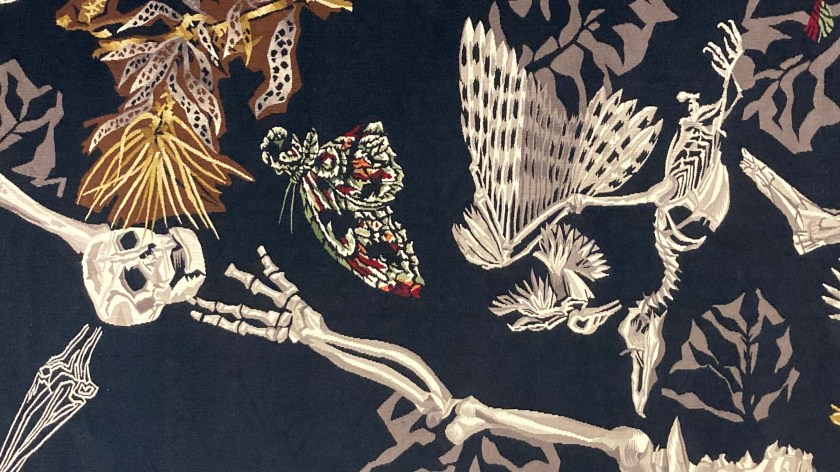
Tapestry: Le Grand Charniers (1959) by Jean Lurçat, Musée Jean-Lurçat, Angers, photographed in 2024. Image © Eline Kieft.
Continue reading “Dancing the Stories That Heal”

Blue Raven and Murmurations by Margot Van Sluytman/Raven Speaks

Meandering
 Murmurations.
Myth and mystery
Beckon. We do not
[As yet]
Resist.
© Margot Van Sluytman

I have been fighting with myself to eradicate or somehow fit in the fact that I am in the throes of a profound transition. With “the new adventure’s” approach, death, roommates we have been for decades and decades, a new conversation between us is unfolding. Me and my compelling companion, daily and diligently, engage in what can sometimes feel a relentless row. Sculpting our symbiotic connection with meaning. Aligning dull and divine evocative evocations, as we share tea, toast, temerity, tempestuous alarm, sympathy, chagrin. Intermittent joy. Explorers we are. Searching out hope. Seeking sightings of simple strength. Seated at simple repasts. Inviting courage. Encouraging surrender. Crying out for creativity. Debating and discussing if Camus is correct in writing that suicide is disavowed because the meaningless of life, is, in fact, its very meaning.

Continue reading “Blue Raven and Murmurations by Margot Van Sluytman/Raven Speaks”

Herstory Profiles: The Season of the Witch by Anjeanette LeBoeuf

Throughout the modern ages there have been stories, legends, myths, and historical accounts of threatening people, mainly women, who have been linked with the supernatural, with containing powers, engaging with elements that go beyond the natural world, and who decentralize, shake up, and counter mainstream patriarchal systems and groups. And the predominate word which can be translated and transcend languages is that of WITCH. And since we are in the month of October, when it becomes somewhat acceptable for people to deck their houses with items long been associated with witchcraft, this month’s herstory profiles is diving into all things witchy.

So, lets deconstruct what witches do and how they function in history and in modern times. When we look at the origins of magic – at the very core- is the manipulation of the natural world for supernatural outcomings. Those outcomes can be a range – from conversing with supernatural beings, healings, prophecy, alchemy, transformation, and to even holding secret knowledge. The word magic has origins in Ancient Persian and Proto-Indo-European languages with concepts of “being able to” and to “have power.” If we look at ancient cultures, civilizations, and religions we found multiple variations of people and roles being able to contain, control, and weld magic.

Continue reading “Herstory Profiles: The Season of the Witch by Anjeanette LeBoeuf”

Flowers — Gifts of Goddess by Judith Shaw


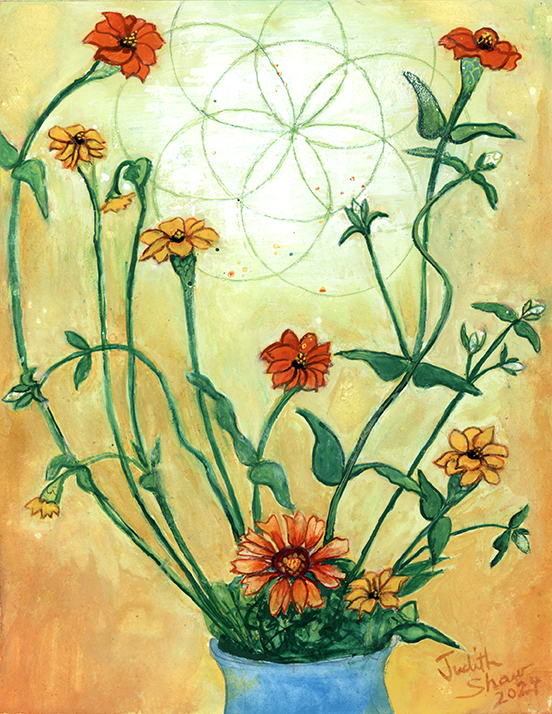
I was captivated by a bunch of wispy, weedy zinnia flowers on my dining-room table, with its bright blossoms sprinkled on the curling stems. The zinnias pulled me from my current obsession with sea goddesses into a different zone, into the Kingdom of Plants (Kingdom Plantae). The Plant Kingdom is an important part of Goddess manifest, having come into being long before the appearance of our human family. It’s no wonder that flowers and other members of the Plant Kingdom play an important part in the mythology of our ancestors worldwide. 

Zinnia Joy, gouache on paper by Judith Shaw
Continue reading “Flowers — Gifts of Goddess by Judith Shaw”

On the changing role of the Goddess

Goddess Prominence & Nature Participation through time

Today I reflect on the presence or absence of the goddess in religion and society, and how we view humanity and participate in nature as a result. 

This post is inspired by “The Myth of the Goddess. Evolution of an Image” by Anne Baring and Jules Cashford, and especially by its final chapter “The Sacred Marriage of Goddess and God: the Reunion of Nature and Spirit.” This dance of integration of apparent opposites is essential to my work.

Continue reading “On the changing role of the Goddess”

From the Archives: Aren’t We All Divine Children? by Janet Maika’i Rudolph

This was originally posted March 18, 2021
Note from Janet: Thank you all who supported the launch of my book Desperately Seeking Persephone on May 19. Due to a printer’s error, the original books sent out were deeply damaged without formatting, editing and with uncertain content. If you received one of these books you are entitled to a free replacement. I have put instructions at the bottom of the post for anyone affected to receive their copy.

Consider the following four birth stories:

Continue reading “From the Archives: Aren’t We All Divine Children? by Janet Maika’i Rudolph”

Myth and Legend – Guides for Transformational Times by Judith Shaw

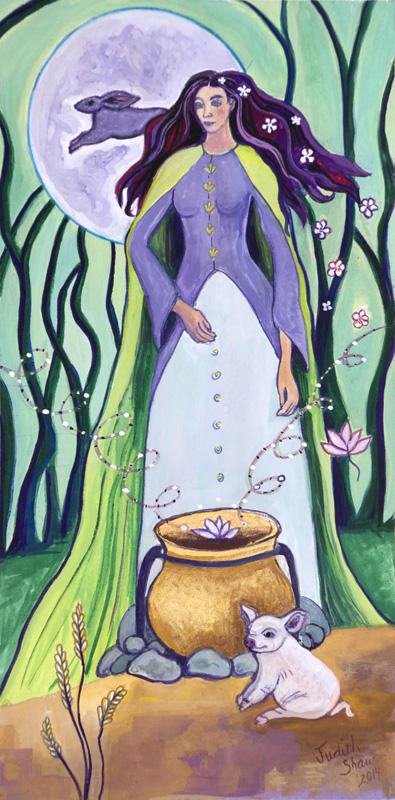
Cerridwen, Celtic Goddess, painting by Judith Shaw

Night becomes day, winter becomes spring, children become adults who become elders who become ancestors – transformation is a theme that appears again and again in our myths, legends and natural world.

But transformation is not easy as it requires us to let go of the old, the comfortable, the familiar and make way for the new and unknown. We can look to myth and legend with their many instances of transformation for guidance through these difficult moments. 

Continue reading “Myth and Legend – Guides for Transformational Times by Judith Shaw”

Persephone Rising, Part 2 by Sara Wright

Part 1, from last week, can be read here.

For those folks in the southern hemisphere who are entering fall as we the northern climates enter spring I offer this next personal narrative.

Every Autumn I buy a smooth skinned crimson pomegranate to celebrate the Fall Equinox. But until this fall I have never intentionally bought a pomegranate to acknowledge the Persephone in me although her cyclic journeys to the underworld have also been my own. I have resisted my alignment with Persephone because I have come to fear my own descents. In the last few years these periods of depression have become more severe.

The September I turned 70 on the last day of the ancient celebration of Persephone’s Eleusinian Mysteries. I spoke out loud as I set my birthday intention. I am aligning myself with Persephone. I held a pomegranate in the open palm of my hand, thinking of the fruit as a symbol of my willingness to take this step. I also saw the beautiful round fruit as the Earth, imagining the ruby –like seeds imbedded in the soft white flesh as Earth’s possibilities. As I surrendered and finally accepted my mythic identity/alignment with Persephone, I experienced a subtle energy shift. I thought about the maiden goddess who becomes Queen of the Dead, and the one who makes predictable cyclic descents into the Underworld. As I breathed through my body I experienced a palpable sense of relief… I recalled the recent dream that informed me that the “Way of the Goddess” was my way, and that I had to choose her again. Not surprisingly within a few days I once again entered a state of profound depression during which time I suddenly remembered my first encounter with a pomegranate…

Continue reading “Persephone Rising, Part 2 by Sara Wright”

Sedna’s Tale by Sara Wright

The story of Sedna is yet another rendition of the Handmaid’s Tale. This one comes from the Arctic and the Inuit people. During this time when it seems as if patriarchy has a stranglehold on so many of us, I offer this Indigenous version of the story to remind feminists that tapping into mythical patterns strengthens us in ways that are impossible to articulate beyond stating that we can access that power when we align ourselves with it.  As in all oral traditions there are many versions of the story but the roots of the myth are the same.

In one version of the story a young man comes to sleep with an entire family during a blizzard. By morning he is gone without having revealed his identity, but the father discovers large dog tracks in the snow and realizes his family has been deceived. The young man who slept with the family was a wild dog.

Continue reading “Sedna’s Tale by Sara Wright”

Aren’t We All Divine Children? by Janet MaiKa’i Rudolph


Consider the following four birth stories:

  1. A high priestess became pregnant in a manner that was forbidden in her society. She gave birth to a baby boy. Fearing for her child’s life, she fashioned a basket of rushes and cast him into a river. He was retrieved by a man named Akki whose name means “the drawer of water.” Akki raised the boy.
  2. A son was born to a young princess who had been forced to keep her pregnancy a secret because it was forbidden. When her son was born, she placed him in a basket and floated him down the river. He was found and raised by foster parents. He grew up to become a noted warrior, speaker and eventually a king. 
  3. A young boy accidentally ingested some drops of star-studded wisdom from the cauldron of a goddess and, in this manner, was suddenly awakened to divine knowledge. The goddess grew furious that her divine wisdom was stolen. Desperate to escape her life-threatening wrath, a wild chase ensued. The boy turned himself into a rabbit, but the goddess turned herself into a dog to chase him down. The boy turned himself into a fish to swim away but the goddess became an otter to continue the chase. The boy then turned himself into a bird, but the goddess became a hawk. Finally, the boy turned himself into a seed and hid in a large pile of grain. The goddess turned herself into a hen and ate up all the grain including the boy-as-seed. In this manner she found herself pregnant. She planned to kill the baby when he was born, but when she saw him, he was so beautiful that she fell in love and she could not bring herself to do so. The goddess sewed the baby into a leather sack and threw him into the river. He was retrieved by a man named Elphin who renamed and raised him.
  4. A woman of the priestly caste of her tribe gave birth to a baby boy. At the time, all boys born to her tribe were under a decree of death. To save her son’s life, she created a basket of reeds and floated him down the river. He was found by a royal princess who retrieved him from the water, gave him a new name and raised him to adulthood.

Continue reading “Aren’t We All Divine Children? by Janet MaiKa’i Rudolph”