From the Archives: Writing: Changing the World and Ourselves. By Ivy Helman

This was originally posted on October 12, 2014
20140903_180423

I still remember the first time I read Mary Daly’s Gyn/Ecology. It awoke something within me. Her use of language, the power of her writing and the ease with which she created new words taught me so much about the world around me and about the way the language, and subsequently its use in writing, shapes lives, choices, abilities and destinies. She also taught me about myself.

I was hooked, but not just on Mary Daly. Shortly after I finished her book, I moved onto other feminists writing about religion like Katie Cannon, Judith Plaskow, Alice Walker, Carol Christ, Rita Gross, Gloria Anzaldua, Audre Lorde, Adrienne Rich, Margaret Farley and Starhawk to name just a few. All of them, in fact every feminist I’ve ever read, has shown me the way in which words have power and how words speak truth to power. Ever since, I’ve wanted to be the kind of writer whose words carry a power that not only affects people but also inspires a more just, more equal, more compassionate and more humane world. In other words, I wanted to be a writer activist.

Continue reading “From the Archives: Writing: Changing the World and Ourselves. By Ivy Helman”
Mothers and Dragon-ing by Sara Frykenberg

But what if there was a space for the danger of dragon-ing? What if society expected it, welcomed it, and made room for our, women’s, subsequent growth? It might still be hard and risky, as is all growth and change. But as I believe Barnhill is trying to suggest, it might also be less traumatic, less splitting, and give us so much more space to be.

Knowing that I like dragons and feminism, a friend of mine recently recommended the book, When Women Were Dragons (2022) by Kelly Barnhill. I have been reading it (okay listening to it on audiobook, but that counts right?) all week. The premise of the book is that women dragon, as an act, and can do so by choice or spontaneously; and in the “Mass Dragon-ing of 1955” over 600,000 women flew away from American homes, “wives and mothers all” (Barnhill, 2022). But despite the destruction, eaten husbands and bosses, and destroyed homes that dragons leave in their wake, society, the government, and individual families do everything they can to forget it happened. The history is repressed. Individual memory is policed and repressed. The dragon-ing goes on.

 Beginning this book the week before Mother’s Day, I found the recommendation timely, or even fateful, because with every chapter and hour that I listen, I find myself thinking of my mother. And I wonder if or when she would have dragon-ed if given the chance.

Continue reading “Mothers and Dragon-ing by Sara Frykenberg”

From the Archives: Genderqueering by John Erickson

Moderator’s note: Today’s blogpost was originally posted March 24, 2015. You can visit the original post here to see the comments.

This post is a response to a recent blog entry titled “Who is Gender Queer?” on this site from Carol Christ. It was posted yesterday. I want to thank my friend, advocate, and upcoming scholar Martha Ovadia for reasons only she knows!  Stay brave, speak up, be heard!

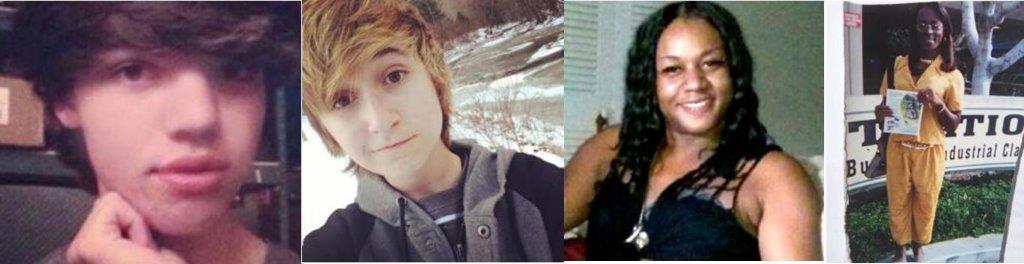
Leelah Alcorn, Ash Haffner, Aniya Knee Parker, Yaz’min Shancez

It is terrifying to know that something is wrong but not be able to speak truth to power.

Continue reading “From the Archives: Genderqueering by John Erickson”

From the Archives: Does the Term “Women of Color” Bother You? By Grace Yia-Hei Kao

Moderator’s note: This marvelous FAR site has been running for 10 years and has had more than 3,600 posts in that time. There are so many treasures that have been posted in this decade that they tend to get lost in the archives. We are beginning this column so that we can all revisit some of these gems. Today’s blogpost was originally posted August 11, 2015. You can visit it here to see the original comments.

Grace Kao

I recently came back from a weeklong camping retreat for Christian faculty and their families in beautiful Catalina (an island an hour’s boat ride away from the Southern Californian mainland). This year’s conference theme was “Power Revealed: Gifts, Dangers, and Possibilities.” Not surprisingly, the topics of race, race relations, and institutional racism came-up repeatedly in sessions and informal conversations.

Continue reading “From the Archives: Does the Term “Women of Color” Bother You? By Grace Yia-Hei Kao”

From the Archives:“Vaginas are Everywhere!”: The Power of the Female Reproductive System by John Erickson

Moderator’s note: This marvelous FAR site has been running for 10 years and has had more than 3,600 posts in that time. There are so many treasures that have been posted in this decade that they tend to get lost in the archives. We are beginning this column so that we can all revisit some of these gems. Today’s blogpost was originally posted June 19, 2012. You can visit it to see the original comments here.

I have a beautiful picture of vagina hanging on my wall.  However, for the longest time it was in the back of my closet, with a plastic bag covering it.  I wasn’t ashamed of it but my ex-boyfriend, like most gay men, refused to have it on the wall where he could see it.  He is now long gone; the vagina is now out and proud.

I bid on the picture one fall during a showing of the Vagina Monologues at Claremont School of Theology.  One of my best friends was in the show and I had always loved its powerful message.  I walked out of the theatre, waiting for my friend, and there it was: the picture of the vagina.  I found myself caught up in its beauty.  Its gaze had mesmerized me.  The outlying layers of red, the contours of its shape, they all began to mold into a figure before my eyes.  While I have never thought of myself as a religious person, I realized that at that moment I was no longer looking the old photo but rather I was staring at the outline of the Virgin Mary.  At that moment, I realized that I had to have the picture.

Continue reading “From the Archives:“Vaginas are Everywhere!”: The Power of the Female Reproductive System by John Erickson”

On Tetzaveh by Ivy Helman

29662350_10155723099993089_8391051315166448776_oThe Torah parshah for this week is Tetzaveh (Exodus 27:20 – 30:10).  Mostly it describes the priesthood, both of Aaron and his sons. It details how they should be consecrated, what they should wear, the difference between the garb of the high priest and the others, institutes the daily burnt offerings of rams, and provides instructions for the construction of an altar for locally-sourced incense.  
The parshah works to establish differences between members of the Israelite community through consecration as well as in function and in dress by decreeing the institutionalized of the priesthood.  Priests undergo an elaborate consecration ceremony which includes the sacrifice of animals, the smearing of their blood, the waving of various animals parts into the air and the burning/cooking of the sacrificed animals’ flesh.  In addition to the blood smearing and animal sacrifices, the priests are also anointed with oil and offer oil and grain offerings to the divine. In terms of function, priests should offer daily sacrifices to the divine in the form of two rams (one in the morning and one in the evening).  Also, all priests have four items of similar clothing: tunic, girdle, turban and short pants. However, the high priest has four special items only he wears, like the breastplate and a golden forehead piece. His clothes are laden with gold, precious stones, and royal dyes.   Continue reading “On Tetzaveh by Ivy Helman”

Women’s Ritual Dances and the Nine Touchstones of Goddess Spirituality-Part Three by Laura Shannon

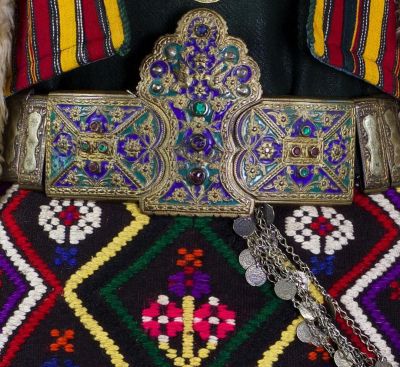
Women’s apron from Pentalofos, Greek Thrace

In Rebirth of the Goddess, Carol P Christ offered Nine Touchstones of Goddess Spirituality as an alternative to the Ten Commandments. The Nine Touchstones are intended to inform all our relationships, whether personal, communal, social, or political.[1] In this series of blogs I am exploring ways in which these Nine Touchstones are embodied in the traditional women’s ritual dances of the Balkans, which I have studied as a spiritual practice for more than thirty years.

Carol P Christ’s Second Touchstone is: ‘Walk in love and beauty.’ As she says, ‘love and beauty are the great gifts of bounteous earth’.[2] Dancing women of the Balkans walk in love and beauty each time they put on their festive dress to dance together in the courtyard or the village square. Their ceremonial costumes are created from the bounty of the earth – just a couple of generations ago, this was literally the case, as the women tended the sheep, prepared and spun the wool, wove, sewed, embroidered and ornamented their garments with the work of their own hands. Even now, the cloth they buy is purchased with money they have earned from working and harvesting the land.

Continue reading “Women’s Ritual Dances and the Nine Touchstones of Goddess Spirituality-Part Three by Laura Shannon”

Women’s Ritual Dances and the Nine Touchstones of Goddess Spirituality-Part Two by Laura Shannon

In the first part of this article, I looked at how Carol P Christ’s Nine Touchstones of Goddess Spirituality from Rebirth of the Goddess are related to traditional women’s ritual dances of the Balkans. After more than thirty years of researching and teaching these dances and the way that they pass on information in encoded symbolic ways, I have come to see them as an educational system, a women’s mystery school.[1] The main message which the dances convey is an ethic of community, partnership, mutual support, and other life-enhancing values aligned with the Nine Touchstones, which can be directly experienced in the dance.

We know from the research of Marija Gimbutas that these values were central to the Old European civilizations which honoured the Goddess, while Yosef Garfinkel and Elizabeth Wayland Barber show that circle dances have their roots in these same early Neolithic cultures of Eastern Europe and the Near East. This leads me to suggest that Balkan women’s circle dances surviving today may have their origin in early egalitarian matriarchal cultures of Neolithic Europe. The Nine Touchstones of Goddess Spirituality provide an perfect template through which to explore the ethics of women’s ritual dances.

Continue reading “Women’s Ritual Dances and the Nine Touchstones of Goddess Spirituality-Part Two by Laura Shannon”

Open Letter to the Pope and all the King’s Men by Natalie Weaver

Dear Sirs,

It breaks me down.  My anger, my revulsion, my powerlessness.   I have been searching for the way since I was a child old enough to remember my mind.  For a time, I thought Jesus was a white guy knocking on my door after having seen a religious pamphlet placed under our windshield wiper.  I’m not sure he has blond hair anymore, but I still feel him knocking.  I have been in love with him for as long as I have been a self, so much so that I baptized myself as a little girl.

Somewhere along the way, I figured my little, lonely way wasn’t good enough, and I wanted a church home.  I finished a doctoral dissertation trying to find some place I could hang my hat.  I picked the Roman Catholic Church, despite what I knew of it and what I had to defend about its patriarchy and history to family and friends.  I loved the conversation, the so-called “Catholic Intellectual Tradition.”  I always felt myself to be a covert, a conversa, a definitive outsider, and someone not to be trusted entirely as a cradle Catholic might be trusted, yet I tried to be family. I’ve been bringing up my kids in the Church, volunteering, working in Catholic education, paying the boys’ tuition.  I do work-arounds, making excuses for the exclusion of women, defying the Church’s stance on sexuality with a critical repertoire of cross-disciplinary scholarship.  Lord, I even had to help my Seventh-Day Adventist mom with a hostile annulment process that was dropped on her unsuspecting by a horrendously insensitive marriage tribunal.  It wounded us all. Yet, here I have sat, until this.

Continue reading “Open Letter to the Pope and all the King’s Men by Natalie Weaver”

On Guilt and G-d, the Parent by Ivy Helman.

29662350_10155723099993089_8391051315166448776_oSometimes, being overwhelmed with guilt makes one unable to act.  Other times, guilt manipulates and attempts to control.  It might offer a sense of responsibility and concern. More often than not, guilt comes bundled in small doses of should-haves and could-haves.

For example, when you feel guilty for skipping exercise and instead lay in front of the television binge-watching your new favorite show.  It’s not the end of the world, but you really should have gone and exercised.  Or, when you feel bad for getting into a fight with a friend and saying something mean when you could have done otherwise.  In general, I think there is such a thing as a healthy amount of guilt which spurs right actions, sincere apologies, forgiveness and knowledge of the good.

Jewish tradition generally agrees with me that a measured amount of guilt is often quite helpful.  Guilt instructs us in right and wrong and guides us to be more responsible, more mature individuals.  Indeed, it even clues us into a better understanding of G-d.   Continue reading “On Guilt and G-d, the Parent by Ivy Helman.”