Stalé mám žlutou knihu tak neumím slova. (I’m still in the yellow book, so I don’t know the words). Mluvíš o něčem ale nevím co říkáš. (You are talking to me about something I don’t know what you are saying). Neznám jí. (I don’t know her).
The Czech language has three verbs that express knowledge. The first umět expresses one’s ability. Literally, one doesn’t know because one lacks the skill or hasn’t been taught how to do something. The second vedět captures more the idea of stating facts or events. It almost always requires a connecting word like “that, what, which, etc.” One can’t use this verb with a direct object with one exception: to vím (I know (it)). The third verb znát signals familiarity and it can only be used with a direct object. So, if you want to ask if someone knows someone else, you use znát, if someone knows when the movie starts, vedět, and if someone knows how to play the piano, umět.
So in other words, the three sentences above are better translated as follows: I’m still in the yellow book so I haven’t learned the words; you are talking to me about something but I don’t understand what you are saying; I’m not familiar with her.
Lately I have been reflecting on this quote of Virginia Woolf: “For most of history, Anonymous was a woman.” Here she points out the deliberate invisibilization of women’s contribution in all areas of human endeavors.
Patriarchy always takes these contributions for granted. For centuries, domestic labor has been invisible and not considered work. It has put beauty over intelligence, even with women of outstanding intelligence. And in terms of knowledge and intellectual production, patriarchy has appropriated women’s ideas and in presenting them as “anonymous,” presents them as it’s own.
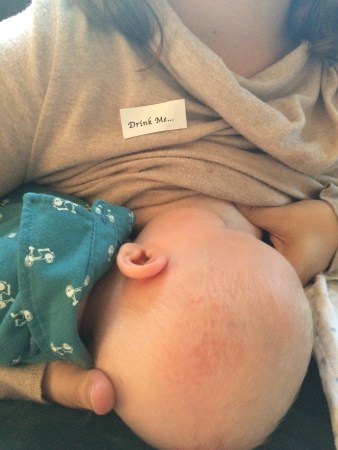
The trappings of motherhood are all too powerful reminders that, as Catherine Keller reminds us in her book From a Broken Web, mother goddesses have to be continually slain for patriarchal heroes to be born. Indeed, she suggests that conceptions of Western selfhood are based upon this symbolic matricide—so it is no wonder that breast milk might be considered abject…
Once upon time formula companies and complicit medical experts launched a serious campaign to sell more formula, telling a generation of mothers that this product was both superior to breast milk and far better for baby and mother. Some were convinced, others found formula a good alternative to breast milk given their employment status, hormonal changes, their particular baby’s needs,personal choice, difficulty producing their own milk, or the like; and still others chose to breastfeed despite criticism, like my mother-in-law, who received scorn and derision from medical personnel as the only breastfeeding mother in the hospital in which she gave birth in 1970.
Despite this effort, science has finally “proven” that breast milk, when it is possible to give it, is better for your child than synthesized alternatives. Wow. Well, the politics of believability aside, women in the U.S. are now encouraged to trust their own bodies to feed their babies and give the breast a try. In fact, every new book, article, website and internet forum, birthing class teacher and hospital nurse will tell you that “breast is best,” repeatedly, for months, asking you about your breastfeeding plan, and urging you to keep trying until you and baby get it right. A counter-campaign, this vigorous encouragement is working to undo the attitudinal changes within popular culture that placed a stigma on the breastfeeding woman. Continue reading “Breastfeeding and the Abject? by Sara Frykenberg”
The creative ‘Wisdom of the Goddess’ Journey Within Program I am facilitating has moved into its’ second trimester, ‘Transformation’. It is winter here in the South; a time to release what no longer serves us and look at the shadow aspects of ourselves. I decided that the goddess Kali Ma, often referred to as the “Dark Mother” was most suitable to explore at this stage. Kali Ma is the Hindu goddess of creation, preservation, and destruction and is better known for her destroyer aspect. She serves as the archetypal image of the birth-and-death Mother, simultaneously the womb and tomb, the giver of life as well as the taker. She is the primordial female principle of manifestation and embodies shakti – feminine energy, creativity and fertility.
Kali is a warrior and is usually depicted with her tongue protruding, brandishing a sword in one hand a decapitated head of a demon in the other. She wears a necklace and belt of skulls, and she drips with blood. The demons she slays however, are the demons of the ego and the attributes of ignorance. Kali is the enlightening force that dismantles preconceived notions, frees you from conditioned beliefs, false personal identities, and anything else that keeps you from recognizing your true identity. In other words, part of what Kali represents is the power to release that which is true in you. Even in destruction, She reminds us that good really can come of bad situations. If you find your hopes and dreams have been crushed, Kali can change the cycle and produce life out of nothingness. Where there is sorrow, She dances to bring joy. Where there is fear, She dances in courage. Continue reading “Kali Ma by Jassy Watson”
To speak ones truth is oftentimes a difficult and nearly impossible act. However, to live one’s truth, on a day-to-day basis, is an aspect of life that has become so foreign to individuals who have become so comfortable in their own skin that I fear the activist and social justice roots that we all claim to hail from have fallen at the wayside and been replaced by complacency and reductionism.
I’m deeply troubled by some of the anti-trans and anti-queer commentary that has been taking place on some of the comments on this blog in recent months. I’ll never forget when this project first began—talking with the founders about its original purpose: to bring the “F” word back into the mainstream religious discourse and more importantly, to be a place where scholars, young and old, senior or junior, could write, collaborate and eventually converse with across cyberspace.
However, in recent months, I’ve found myself being more of a watchdog rather than a frequent commentator on issues pertaining to feminist religious discourse. I’ve found myself reading comments about issues I may not frankly identify or agree with just to make sure that the cisgendering or anti-trans narratives do not become symbolic of what this blog is now rather than what was supposed to be at the beginning.
When I sat down to write my very first post I was scared. I was terrified that feminists from all communities would see me only as I appeared and not for whom I actually was. I was afraid that all I had worked for throughout my life would be moot with the first bad comment on one of my posts. While all of those fears were real and valid they quickly faded away as I was embraced by this community and many others for my passion rather than my gender; my life’s work rather than my privilege; and more importantly, the personal mission to make the world a safer and better place for women and girls everywhere.
To speak ones truth is oftentimes a difficult and nearly impossible act. However, to live one’s truth, on a day-to-day basis, is an aspect of life that has become so foreign to individuals who have become so comfortable in their own skin that I fear the activist and social justice roots that we all claim to hail from have fallen at the wayside and been replaced by complacency and reductionism.
Caitlyn Jenner’s story is one that many individuals, often not highlighted on this blog, know all too well. Caitlyn Jenner’s story and personal experiences are valid and for members of the feminist community to refer to her as not “feminist” or merely as a man “masquerading” as a woman while still utilizing his privilege from being biologically born as a man is troubling and the root of the problem facing many trans individuals today when they’re negotiating coming out as their true selves.
Trans individuals face a cadre of other horrible social, physical and mental statistics that oftentimes lead them to be more likely to self-harm. However, as feminists, isn’t it our job to make sure that all groups have access to the same freedoms rather than working towards denying it for certain groups while trolling the comments sections of posts?
Shakespeare said: “To thine own self be true” and for those of us who identify with the Golden Rule, if we no longer treat others as we would like to treat ourselves, then we really have failed as feminists; and if the comments on recent blogs are any indication, we still have a long way to go before all voices can feel welcomed not only on FAR but also in the world at-large.
John Erickson is a Ph.D. Candidate in American Religious History at Claremont Graduate University. He holds a MA in Women’s Studies in Religion; an MA in Applied Women’s Studies; and a BA in Women’s Literature and Women’s Studies. He is a Permanent Contributor to the blog Feminism and Religion, a Non-Fiction Reviewer for Lambda Literary, the leader in LGBT reviews, author interviews, opinions and news since 1989 and the Co-Chair of the Queer Studies in Religion section of the American Academy of Religion’s Western Region, the only regional section of the American Academy of Religion that is dedicated to the exploration of queer studies in religion and other relevant fields in the nation and the President of the University of Wisconsin Oshkosh’s LGBTQA+ Alumni Association. When he is not working on his dissertation, he can be found at West Hollywood City Hall where he is the Community Events Technician and works on policies and special events relating to women, gender, sexuality, and human rights issues that are sponsored or co-sponsored by the City of West Hollywood. He is the author of the blog From Wisconsin, with Love and can be followed on Twitter @JErickson85
We find our versions of home in these communities and it is within these spaces where our home not only begins to define who we are but we, as a reflection of that space, begin to outwardly redefine the spaces we exist in. If we slowly begin, through our experiences to shape our homes based on privilege and power without self-reflection and acknowledgment of others, then we are no better than those oppressive forces we say we’re against.
This post is a response to a recent blog entry titled “Who is Gender Queer?” on this site from Carol Christ. The post can be read by clicking here.I want to thank my friend, advocate, and upcoming scholar Martha Ovadia for reasons only she knows! Stay brave, speak up, be heard! _________________________________________
It is terrifying to know that something is wrong but not be able to speak truth to power.
It is even more terrifying to know something is wrong, be able to speak to it, and then silence those voices that do not have that same privilege, power, or position.
The struggle that many of us in positions of privilege and power face is not just that of being ostracizing and essentializing forces—it is that we, as allies, members of communities, or even those dedicated to a cause, can ourselves participate in the oppression we are fighting against and can do harm.
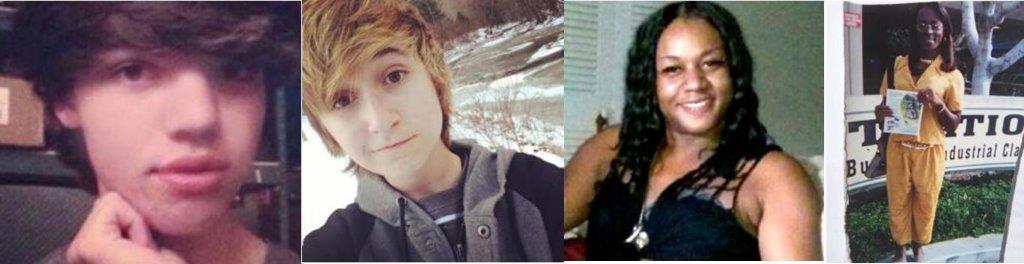
It’s taken me a long time to not only be comfortable with who I identify as, but also how I go about fighting and defining my life based on said identity and experience. However, the one thing that I have the ability to do is choose that identity more freely than others. Unlike Leelah Alcorn, Ash Haffner, Aniya Knee Parker, or Yaz’min Shancez pictured above, I did not have to face the types of oppressions they did, to which they sadly lost their lives, as a result of the fact that we exist in a society that can’t deal with the inability to leave things undefined or to allow people to define who they are on their own terms.
It is vital that although my lived experiences could never meet nor match the same types of oppression that these brave individuals had to face, I, as a white, cisgendered gay male, do not become part of their oppression through my own position and privilege.
As a man who exists in the world of feminism and within various women’s communities, I walk a daily tightrope of privilege and power to insure that I do not silence those that I consider allies, friends, mentors, or colleagues. As a man who exists in the world of the LGBTQ community, I walk an additional tightrope to additionally not take away from or diminish the experiences of those members of our community that do not have the same type of lived experiences as myself. Even within minority communities, there are positions of hierarchy and within these hierarchies of knowledge, identity, or power, comes a responsibility to insure that the oppressed do not become the oppressors.
We find our versions of home in these communities and it is within these spaces where our home not only begins to define who we are but we, as a reflection of that space, begin to outwardly redefine the spaces we exist in. If we slowly begin to shape our homes based on privilege and power without self-reflection and acknowledgment of others, then we are no better than those oppressive forces we say we’re against.
I can’t speak for what identity feels like –I can only speak for what essentializing does, and what it does is reflected in the deaths of Lelah, Ash, and the many others who die nameless. It is our responsibility, as allies, members of communities, and those fighting to end sexist, patriarchal, and, even now, homonormative oppression, to make sure that no more deaths occur on our watch or that truth is spoken to power even when power is masquerading around as truth.
John Erickson is a Ph.D. Candidate in American Religious History at Claremont Graduate University. He holds a MA in Women’s Studies in Religion; an MA in Applied Women’s Studies; and a BA in Women’s Literature and Women’s Studies. He is a Non-Fiction Reviewer for Lambda Literary, the leader in LGBT reviews, author interviews, opinions and news since 1989 and the Co-Chair of the Queer Studies in Religion section of the American Academy of Religion’s Western Region, the only regional section of the American Academy of Religion that is dedicated to the exploration of queer studies in religion and other relevant fields in the nation and the President of the University of Wisconsin Oshkosh’s LGBTQA+ Alumni Association. When he is not working on his dissertation, he can be found at West Hollywood City Hall where he is the Community Events Technician and works on policies and special events relating to women, gender, sexuality, and human rights issues that are sponsored or co-sponsored by the City of West Hollywood. He is the author of the blog From Wisconsin, with Love and can be followed on Twitter @JErickson85
I still remember the first time I read Mary Daly’s Gyn/Ecology. It awoke something within me. Her use of language, the power of her writing and the ease with which she created new words taught me so much about the world around me and about the way the language, and subsequently its use in writing, shapes lives, choices, abilities and destinies. She also taught me about myself.
I was hooked, but not just on Mary Daly. Shortly after I finished her book, I moved onto other feminists writing about religion like Katie Cannon, Judith Plaskow, Alice Walker, Carol Christ, Rita Gross, Gloria Anzaldua, Audre Lorde, Adrienne Rich, Margaret Farley and Starhawk to name just a few. All of them, in fact every feminist I’ve ever read, has shown me the way in which words have power and how words speak truth to power. Ever since, I’ve wanted to be the kind of writer whose words carry a power that not only affects people but also inspires a more just, more equal, more compassionate and more humane world. In other words, I wanted to be a writer activist.
Yet, I’ve always carried around with me a sneaky suspicion that people don’t consider writers true activists. If you aren’t holding a sign, screaming or participating in some sort of public demonstration or civil disobedience, then you have no right to call yourself an activist. Is that really true? Continue reading “Writing: Changing the World and Ourselves. By Ivy Helman”
When I sat down to write my article this month, I browsed through my computer for ideas. As I did, I found this article that I wrote about 18 years ago for a newsletter I prepared for my workplace. Because it is still a very relevant topic to me today, I thought I would share it here. ( food for thought – I am an introvert, a triple Aries and a Myers Briggs INFJ)
I have spent a lot of my life sorting through very strong feelings in order to decide to express them or not. Of course, there are those that erupt before given the opportunity for that kind of sorting! Just ask my friends and family! I have often wondered if everyone has this going on inside their heads. It is part and parcel of being an introvert to ponder such things. I have even wondered if perhaps some just don’t have that experience of heavy duty “feeling”! Of course, that’s a ridiculous idea. We all have feelings. We all just have varying levels of willingness to share them. Continue reading “Apathy by Deanne Quarrie”
The start of the Spring 2014 semester is right around the corner, which means that many academics like me are madly trying to put the finishing touches on their syllabi.
The process of doing so has always been equal parts exciting and stress-inducing. Right now, however, I am feeling the pain. Why?


 Stalé mám žlutou knihu tak neumím slova. (I’m still in the yellow book, so I don’t know the words). Mluvíš o něčem ale nevím co říkáš. (You are talking to me about something I don’t know what you are saying). Neznám jí. (I don’t know her).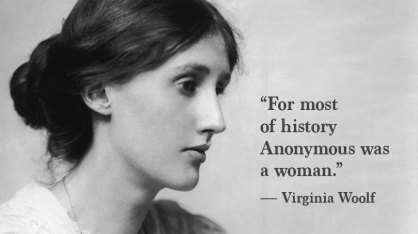
 Once upon time formula companies and complicit medical experts launched a serious campaign to sell more formula, telling a generation of mothers that this product was both superior to breast milk and far better for baby and mother. Some were convinced, others found formula a good alternative to breast milk given their employment status, hormonal changes, their particular baby’s needs,personal choice, difficulty producing their own milk, or the like; and still others chose to breastfeed despite criticism, like my mother-in-law, who received scorn and derision from medical personnel as the only breastfeeding mother in the hospital in which she gave birth in 1970.


 Feminism and Religion