

This was originally posted on December 3, 2103
Growing up in an evangelical Christian church, I was taught that human beings should serve one another and put others before themselves. These two different teachings, paired with patriarchal misogyny, have sometimes been very problematic for me. I tend(ed) to give too much. Too many demands with which I complied were self-negating (which after all, helped me to make other people more important than myself). It took me a long time to learn how to appropriately prioritize my own needs, to stop mistaking self-esteem for the”‘sin of pride,” and how to say no when I needed to… Actually, I am still learning some of these lessons.
Conversely, my ritualized service to the church was sometimes confusing, awkward or embarrassing. I clearly remember having the opportunity to serve as something like an usher during Thanksgiving at our family’s church as a child. This involved wearing a pilgrim costume, which for me meant finding a Puritan style costume in the church’s closet that fit my overweight childhood frame. This was not an easy task and left me feeling ashamed. Later as an adolescent, my youth group asked us to wash one another’s feet as Jesus did for his disciples. Now, don’t misunderstand me here— I do believe that this ritual has the potential to be very powerful and meaningful for those involved. However, my teenage self could not identify with the symbolic gesture beyond realizing that:
1) I thought touching other people’s feet was gross, as was having my dirty feet touched and,
2) I knew I ‘should’ get something out of the ritual but did not, so I felt spiritually guilty or inadequate.
Overall, I often associated Christian service with guilt, inadequacy, my role as a daughter or woman or my sacrificial duty.
Despite these issues, I usually genuinely enjoy serving others and giving to other people. I love to host people and care for them. I like to help. I even prefer to help. Serving one another we can express and allow others to express love. But this past week, one day before Thanksgiving, a dear friend of mine gently challenged me to allow myself to be served or, as she put it, “to give someone else the gift of giving to me.” Specifically, she was referring to a pending holiday meal for which I expressed my anxiety and frustration with not being allowed to help—which somehow makes me feel like a child. Even writing this phrase, “makes me feel like a child,” I know that I have touched deeper feelings of helplessness or vulnerability that at some point, I learned to battle with competence and over-achievement. I do often feel like a child or guilty when other people do for me what I think I could or should do for myself; and my friend’s brief words encouraged me to explore this relationship to being served.
“Service” can sometimes feel uncomfortable for the reasons I mention above, but more so, for its connection to the coercive “servitude” required by existent hierarchies within andro-kyriarchal oppressive systems. I have been subject to this coercive servitude, and also, its beneficiary. As a white, middle class, Western woman I have far too much privilege that is contingent upon the forced labor and oppression of other people. This kind of forced servitude is very wrong; and I am still learning how and where to choose other than to be complicit in this abuse. But, there have also been many distinctive instances in my life where I have felt reciprocally and undeniably “served” by people around me, without abuse and without manipulation.
Driving to Colorado one summer to see the friend I mentioned above, my two companions and I served one another. The individual in the back seat was responsible for cutting bagels and spreading cream cheese on them for the driver and navigator, while the navigator held the drink, food or whatever other item that the driver could not. This may sound like a small thing, but it wasn’t. I felt taken care of and loved in this small and traveling community. We also had a safe word that meant, “leave me alone, I’m grumpy” on our long trip. We made agreements to account for one another’s discomfort and effort. We respected one another and cared for each other.
Beginning my work as an adjunct professor, I encountered a great deal of stress and often long and awkward work hours. Many times I felt like I needed help, but there was nothing I could ask for help with when it came to my job: I needed to grade my own papers, plan my own lectures, and yes, write my own blogs. My husband has responded by taking care of me in other ways. He makes me dinner, goes to the store and makes sure I take breaks. We take turns taking care of one another, and I am grateful for him.
This past week after talking to my friend, I noticed how willing people were to touch me to soothe aching muscles. I’m not sure how to describe what I felt, but it was like something invisible in certain spaces was suddenly visible. I also realized that it had been a very long time since I had freely and openly received this touch. Later during the weekend, a friend came to my house and she made me dinner! My husband rubbed my chest after a long night of coughing yesterday because I still haven’t completely rid myself of the smoldering in my lungs. I was defensive for so long. Shedding my defender allows me to rediscover all those things for which I am thankful.
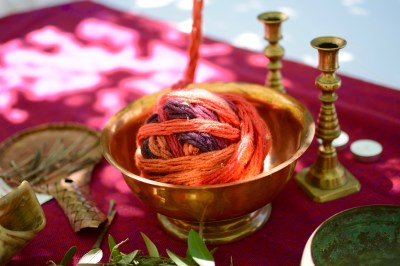
Gratefulness is an action. It can be found in those expressions that return, receive and allow for mutual loving. I am learning new rituals that help me to remember that this kind of mutual serving and being served is sacred. In a summer ritual, my friend and I washed one another’s hair instead of our feet. I am still learning to ask for assistance from the goddess after freeing myself from an abusive omnipotent god, but I am starting to ask.
I am starting to pray again.

BIO: Sara Frykenberg, Ph.D.: Graduate of the women studies in religion program at Claremont Graduate University, Sara’s research considers the way in which process feminist theo/alogies reveal a kind transitory violence present in the liminal space between abusive paradigms and new non-abusive creations: a counter-necessary violence. In addition to her feminist, theo/alogical and pedagogical pursuits, Sara is also an avid fan of science fiction and fantasy literature, and a level one Kundalini yoga teacher.


 My ancestors built great circles of stones that represented their perception of real time and space, and enabled them to tell time: the
  The reason and the importance of ritual in all world religions and spiritual paths, is the achievement of a more awakened consciousness, to touch on all of the physical senses in such a way as to awaken one to a higher level of spiritual awareness. Think, for example, of the movements of the ministers on TV. Everything moves in a certain order, and if this order is not followed, people are unsettled.
 I have been writing and celebrating ritual for half of my life. The equinoxes and solstices and the cross quarter days (May 1, August 1, All Hallows, and February 2) comprise the eight spokes of the year. What I have learned from my research is that virtually every Indigenous culture follows this calendar in a general way – What I have gleaned from personal experience is that during these ritual periods my body is opened to the Powers of Nature in very specific ways that can be positive or/and negative.

 Feminism and Religion