The Legacy of Carol P. Christ: THE REFUGEE CRISIS IN GREECE: A TEST OF OUR COMMON HUMANITY by Michael Bakas, translated by Carol P. Christ

This was originally posted on June 22, 2105

Note from Carol Christ: I returned home from the Goddess Pilgrimage to Crete a week ago to find my island, Lesbos, and my village, Molivos, overwhelmed with a refugee crisis of enormous proportions. We are a town of about 1000 permanent residents, and I would estimate that 10,000 or more refugees from the wars in Syria and Afghanistan have passed through our village in recent months. Local authorities and volunteers are exhausted, and there is an urgent need for help from the European Union. This week instead of my own blog, I am offering my translation of a moving plea for help from my dear friend and colleague in the Green Party, Michael Bakas, who by the way is himself a feminist.

Refugees in Mytiline 1914-1918There is nothing new about refugees fleeing from war. At the beginning of World War I, more than 50,000 people arrived in Lesbos from the nearby shores of what is now Turkey. At the end of the war many of these refugees returned to Asia Minor, but after the Greek army invaded and was driven back, the Asia Minor Catastrophe of 1922 sent nearly a million refugees to Greece.

Continue reading “The Legacy of Carol P. Christ: THE REFUGEE CRISIS IN GREECE: A TEST OF OUR COMMON HUMANITY by Michael Bakas, translated by Carol P. Christ”

Legacy of Carol P. Christ: Forty Years and Counting: Women and Religion in the Academy

This post was originally published on Oct. 21st, 2011

Carol P. Christ is a founding mother in the study of women and religion, feminist theology, women’s spirituality, and the Goddess movement.  She teaches in the Women’s Spirituality program at CIIS and through Ariadne Institute offers Goddess Pilgrimages to Crete. Her books include She Who Changes and Rebirth of the Goddess and the widely used anthologies Womanspirit Rising and Weaving the Visions.

The receipt of an invitation to the Fortieth Anniversary Celebration of the Women’s Caucus in the American Academy of Religion and the Society for Biblical Literature this week, takes me back to the summer of 1971.  At the first meeting of Women Theologians at Alverno College (which was followed up at Grailville in succeeding years), I proposed that we form a feminist caucus in the field of religion, as had already been done by feminists in several other fields.

Since I was one of the few women at Alverno who had attended the annual meetings in the field of religion, I was delegated to call Harry Buck, then director of the AAR, to ask for space on the program. Harry, who continued to support the work of women in the field through lecture series at Wilson College and the magazine Anima which he founded, offered not only space at the meetings, but a print-out of the names and addresses of all of the members of the AAR who were not obviously male. I invited all of them to come to a feminist meeting at the AAR in Atlanta. It is hard to imagine now, but before 1971, the women who attended the AAR in any given year could probably have been counted on one hand. Continue reading “Legacy of Carol P. Christ: Forty Years and Counting: Women and Religion in the Academy”

Legacy of Carol P. Christ: 1, 2, 3, 4: FEMINISTS DON’T WANT ANOTHER WAR

This was originally posted on March 19, 2012

War is a feminist issue for many reasons, most importantly because war is always war against women.

Patriarchy, war, rape as the “spoils” of war, and the taking of women and children as slaves in the wake of war arose together.  Recent blogs on Feminism and Religion have addressed the war on women—from the rape culture, to Humane Vitae, to the Catholic Church’s and other church’s  attempts to remove birth control from health care, to the tolerance of sexist hate speech in the culture at large. While the issue of Rush Limbaugh calling Sandra Fluke a slut is being focused on in the press, the drums of war are being sounded again in the Middle East:  the US is considering bombing Iran or supporting Israel if it decides to do so.  Feminists must stand together against war and the harm it does to women, children, and all living things.

Continue reading “Legacy of Carol P. Christ: 1, 2, 3, 4: FEMINISTS DON’T WANT ANOTHER WAR”

Legacy of Carol P. Christ: EASTER OF THE GODDESS: A VIEW FROM GREECE

This was originally posted on April 16, 2012

On Good Friday, Easter Saturday, Easter Sunday, and Easter Monday the blogs on feminismandreligion.com celebrated mothers and God the Mother.*

 This is my body, given for you.
This is my blood, given for you.

While these words are the center of a Christian liturgy celebrating the sacrifice of Jesus as the Christ, they are more appropriately spoken of our own mothers. Your mother and my mother and all mothers, human and other than human, mammalian, avian, and reptilian, give their bodies and blood so their offspring might have life. True, mothers do not always make conscious choices to get pregnant, but almost all mothers affirm life in their willingness to nurture the young who emerge from their bodies and from their nests. Had mothers—human and other than human–not been giving their bodies and their blood from time immemorial, you and I would not be here.

Continue reading “Legacy of Carol P. Christ: EASTER OF THE GODDESS: A VIEW FROM GREECE”

The Vows We Make, by Molly Remer

I make a vow of self-sovereignty,
a declaration of wholeness,
a promise to myself that I will keep:
I vow to listen to my heart,
to claim my power and my voice.
I vow to live my own magic,
to step into the center of my own life
and live from there.
I vow to live a life
that includes space for me,
to stand up for what I need,
to listen to my longings,
to honor my inner call,
to do my own work with trust.
I vow to never abandon myself.
I vow to inhabit my own wholeness
in all ways.

In February, I signed up for a Vow of Faithfulness class with WomanSpirit Reclamation. Guided by Patricia Lynn Reilly (of “Imagine a Woman” and A God Who Looks Like Me fame) and Monette Chilson, the class was based on Patricia’s book, I Promise Myself: making a commitment to yourself and your dreams. Structured as a seven week online women’s circle, the class took us on a deep dive into vow-making, culminating in a vow ceremony in which we made a public (to the class that is) declaration of our own vows to ourselves. As the class unfolded, I found myself reviewing past vows as well as sensing new vows bumping up against my consciousness, whispering to be heard.

Continue reading “The Vows We Make, by Molly Remer”

The People Who Have Always Had Questions by Liz Cooledge Jenkins

A few weeks back, author and historian Jemar Tisby tweeted that an acquaintance of his “described their general experience with white evangelicals as ‘people who don’t have any questions.’ I immediately knew what they meant.” The tweet gained some traction, with 62.1k “likes” at the time I’m writing this. The next week, Tisby followed up with a thoughtful reflection piece, expanding on his own experience with white evangelicals needing to have answers to every question, from “How old is the earth?” to “How should Christians vote?” Tisby unpacks the dangers of this kind of arrogant certainty, inviting Christians instead to embrace mystery, curiosity, and learning.

I resonate with many of Tisby’s observations and reflections. From my experience (including thirteen years in evangelical churches and a Master of Divinity degree from an evangelical seminary), I wouldn’t say these things are true of every single white evangelical—but they’re definitely true enough of the movement as a whole that they are very much worth naming, engaging, and challenging. I appreciate Tisby’s work.

Continue reading “The People Who Have Always Had Questions by Liz Cooledge Jenkins”

From the Archives:“Vaginas are Everywhere!”: The Power of the Female Reproductive System by John Erickson

Moderator’s note: This marvelous FAR site has been running for 10 years and has had more than 3,600 posts in that time. There are so many treasures that have been posted in this decade that they tend to get lost in the archives. We are beginning this column so that we can all revisit some of these gems. Today’s blogpost was originally posted June 19, 2012. You can visit it to see the original comments here.

I have a beautiful picture of vagina hanging on my wall.  However, for the longest time it was in the back of my closet, with a plastic bag covering it.  I wasn’t ashamed of it but my ex-boyfriend, like most gay men, refused to have it on the wall where he could see it.  He is now long gone; the vagina is now out and proud.

I bid on the picture one fall during a showing of the Vagina Monologues at Claremont School of Theology.  One of my best friends was in the show and I had always loved its powerful message.  I walked out of the theatre, waiting for my friend, and there it was: the picture of the vagina.  I found myself caught up in its beauty.  Its gaze had mesmerized me.  The outlying layers of red, the contours of its shape, they all began to mold into a figure before my eyes.  While I have never thought of myself as a religious person, I realized that at that moment I was no longer looking the old photo but rather I was staring at the outline of the Virgin Mary.  At that moment, I realized that I had to have the picture.

Continue reading “From the Archives:“Vaginas are Everywhere!”: The Power of the Female Reproductive System by John Erickson”

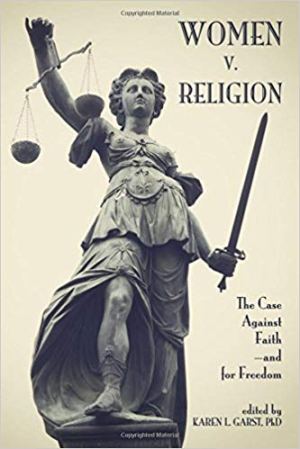
Women v. Religion: The Case Against Faith and for Freedom BOOK REVIEW by Katie M. Deaver

In the book, Women v. Religion: The Case Against Faith and for Freedom, editor Karen L. Garst puts together the voices of women from a variety of backgrounds in an effort to present a case against faith.

While the introduction to the full volume suggests that women ought to turn away from all forms of religion the majority of the individual pieces that the book features focus on the Abrahamic religions: Judaism, Christianity, and Islam.  The included pieces are written from a variety of disciplines and viewpoints, some feature historical facts and timelines, while others are the raw and difficult personal stories of women struggling to leave the religions they were raised within.

Most of the articles dig into many of the traditional critiques of religion.  For example that the Abrahamic faiths are inherently patriarchal, and cannot be redeemed for women.  Others take these traditional arguments against religion a step further and argue that in addition to religion being a tool for female subjugation, religion has in fact inhibited Western progression and is a key reason why the United States has not yet had a female president, and why women continue to have to fight for their bodily and human rights.

Continue reading “Women v. Religion: The Case Against Faith and for Freedom BOOK REVIEW by Katie M. Deaver”

What We Can’t See by Sara Frykenberg

As a professor, I find myself returning to a similar struggle again and again. I know what I know; and I know what I hope students will gain from the class, in terms of content knowledge, critical thinking, classroom community-making, etc. But often, I don’t know what they don’t know.

This might seem a silly kind of observation. No duh, Sara, you barely know this group of people. Also, this may seem an easy question to answer. And sometimes it is; and I do have part of the answer when I begin a class. My “Intro to Ethics” students, for example, will understand and be frustrated by the way people use the Bible to justify their own positions, but they usually won’t know the term “proof texting,” or easily understand “hermeneutics.” My “Women in Christianity” students will understand sexism and often, the idea of gender as a social construct, but they are usually unfamiliar with the dualistic gendering and ranking of larger social realities, like nature and culture, production and reproduction, etc.

There are obvious differences in academic training—that’s why I’m allowed to teach at a university after all. But I’m not really wrestling with what I can contribute in terms of content knowledge or historical/ theoretical contextualization. I think what I don’t know is what understandings of reality they bring into the classroom and what these realities have allowed them to see. Learning and/or teaching feminist theory and theo/alogy for the last fifteen years at least, I also often take my own reality for granted. I “know what I know,” after all—I just can’t always remember what it was like to learn it. And all of these classroom dynamics can make it harder to catch the realities we can’t yet know or can’t see. Continue reading “What We Can’t See by Sara Frykenberg”

Friendships That Save Lives: For Rita M. Gross 1943-2015, by Carol P. Christ

Carol Eftalou - Michael HonnegerWhen Rita Gross visited me in Lesbos two summers ago, we spent many long hours discussing our lives and work. Rita and I met at the Conference of Women Theologians at Alverno College in June, 1971 when we were young women. We did not know it then, but our lives would continue to be intertwined through our common interests, first in the Women and Religion section of the American Academy of Religion, and then through our work on Goddesses and feminist theology.

When we met, Rita was a convert to Judaism working on her dissertation on Australian Aboriginal women’s religious lives, and I was a Christian about to begin a dissertation on Elie Wiesel’s stories that would lead me to express my own anger at God. Continue reading “Friendships That Save Lives: For Rita M. Gross 1943-2015, by Carol P. Christ”