Exploring the F-word in religion at the intersection of scholarship, activism, and community.
Author: Ivy Helman, Ph.D.
A queer ecofeminist Jewish scholar, activist, and professor living in Prague, Czech Republic and currently teaching at Charles University in their Gender Studies Program.
Pelišky was one of the first movies I watched in the Czech Republic. It takes place in the year (maybe years) before the Soviet Occupation. It follows the lives and struggles of ordinary families. One of the best and funniest scenes takes place at a small post-wedding dinner. The couple receives some new-fangled plastic spoons as a wedding present. The gift-giver is very proud of the fact that they were made in Eastern Germany. One of the characters stirs her tea with the spoon and is about to lick it but as she takes it out of the hot tea it bends as if it was made of rubber. Soon the scene dissolves into arguments, frustrations and disappointments.
On August 4th, I visited Auschwitz. In the beginning, the reality of the experience did not match my surrealist expectations of it. I expected to walk onto the grounds and get hit over the head with the heaviness of what happened there, to feel a sense of deep connection to the land covered in the ashes of my people, to have the opportunity to mourn the loss of the members of my family I never met and to be utterly speechless as to the twisted systematization and industrialization of murder that took place there. That blow never came. Why?
The day of my visit was out-of-this-world hot. My guided tour, in Czech, started at 2pm. I was early so I wandered among the crowd outside of the site. There were families lounging on the lawns eating ice creams and drinking cokes. There were tourists taking selfies. There were lots of conversations and lots of laughter. I was pretty convinced that I was the only Jew around.
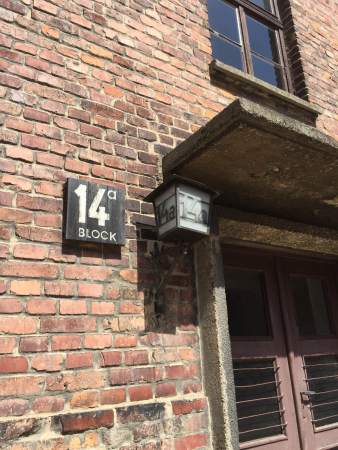
Upon entering the grounds, I was stunned by how green and lush it was. There were many old brick buildings, seemingly orderly, with lanterns and building signs hanging outside the entrances. Among it all, upwards of 500 people clustered in groups walked from place to place.
The tour began with a basic history of the events of the Holocaust with “exhibits” contained within 3 or 4 different buildings. The guide seemed to me to have memorized a script in which we went from one building to another looking at the “exhibits,” most of which consisted of nothing more than one or two oversized pictures and maps. Outwardly, I sensed no sentiment in the guide and no spirit in the exhibitions either. Her voice was monotone, pronouncing the Czech in such a syllable-by-syllable fashion that it was nearly incomprehensible. Most exhibition rooms were sparse, if they had any objects at all other than the black and white pictures and maps. The tour and exhibitions portrayed such a distance from the events it was almost as if they didn’t happen there, in that place.
Zyklon B
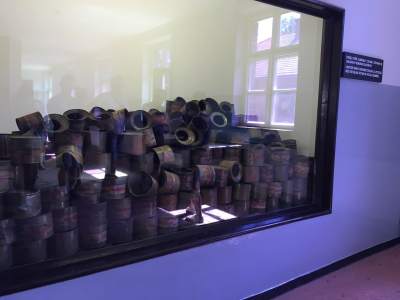
There were a few buildings with objects all hermetically sealed behind glass once again keeping us at a distance. One room housed a display of used Zyklon B canisters and had an artist’s small scale all-white model of the “process of extermination,” meaning the “changing rooms,” “showers” and crematoriums – with tiny people crammed into the areas and bodies piled on the floors next to the ovens. Two other buildings contained large displays, again behind glass and removed from their context, of what the exhibition called “evidence of the destruction:” piles of hair loosened from the burlaps sacks they had been founded in when the camp was liberated; shoes of the victims and a large (two-story) container filled with the pots and pans the victims had packed and brought with them but never used.
After we finished our tour of Auschwitz 1, we were given a 15 minute break and were instructed to reassemble by the bus that would take us to Auschwitz-Birkenau. Once there, we rushed through the camp at such a pace that we were done in about 45 minutes. In spite of the rush, I did manage to leave two stones on the pillars, which marked where the ashes of the victims were scattered (buried?). We glanced at the memorial at the back of the camp as well as what was left of the bombed-out crematoriums. Returning to the front of the camp, we ducked into a reconstructed dormitory and a reconstructed bathroom building. The guide asked if we had any questions. Silence. The tour was done.
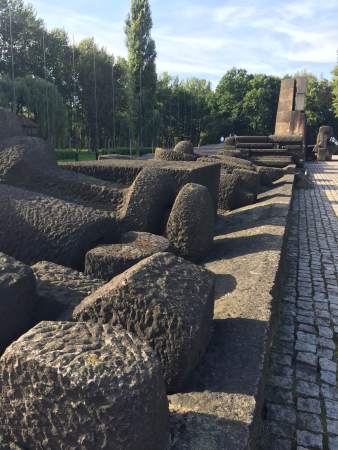
I stood there debating what to do. Do I leave? Do I stay? I was pretty confident that it didn’t feel right to just go. So, I headed back to the memorial. The tour guide had said that each of the smaller stones creating the steps and floor commemorated one of the 1.1 million Jews killed in Auschwitz. Yet, it was unclear as to the meaning of the large stones. After circling the large stones and a futile attempt to make some meaning out of them, I went and sat on the stairs of the memorial and just looked out over the place and the people there.
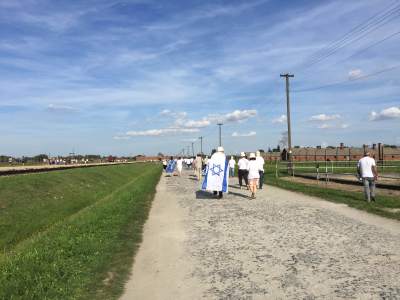
Still puzzled but needing to catch the train, I made my way to the entrance. In front of me was a group of Israeli Jews wrapped in Israeli flags, looking the Superhero part. Something changed. Maybe I didn’t need the sad, mournful, pit-of-the-stomach experience. Maybe I’ve had it enough, learned about it enough, taught it enough and lived with it enough. Maybe my pilgrimage there as a witness to the horrors was enough.
It was those Israeli Jews that I needed. Walking into Auschwitz was one thing, but they were proud Jews walking out. I followed them. We, Jews, were the lucky ones who got to leave. Isn’t that something!
Ivy Helman, Ph.D. is feminist scholar and faculty member at Charles University and Anglo-American University in Prague, Czech Republic where she teaches a variety of Jewish Studies and Ecofeminist courses. She is an Associate of Merrimack College‘s Center for the Study of Jewish-Christian-Muslim Relations and spent many years there as an Adjunct Lecturer in the Religious and Theological Studies Department.
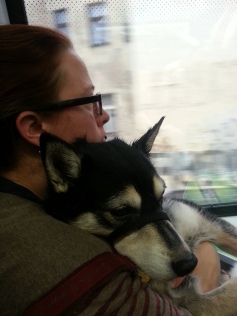
When I was in high school, I once gave a speech summarizing what I had learned about G-d through my dog. I still chuckle at the idea. I cringe sometimes and wonder what others thought of the piece. Oh, the seeming immaturity of such an idea and perhaps naiveté. I’m still embarrassed by my high school self.
The connection, on which I drew, included some of the ways I had come to love my four-legged friend as well as the way I interpreted his actions as love for me. I remember I had a list of ten things my dog had taught me about the divine. There was definitely a mention of unconditional love, being happy to see me, probably something about not being angry or ever holding a grudge, sharing secrets, perhaps a lesson on patience, and, of course, many more which I can’t remember. This is beginning to sound like my blog post about Hanukkah, isn’t it? What were the other two nights? What were the other six comparisons? Oh, never mind. Continue reading “The Dog and the Divine by Ivy Helman”
The BBC just ran a story about white supremacist and neo-Nazi groups targeting Jews by signaling each other to their presence on various social media sites through the use of (((this symbol))). Of course, this is all based on the assumption that a “typically” Jewish last name signifies the bearer is also Jewish. Through a Google app (since removed) that could recognize patterns such as ((())), these Jewish people began to receive anti-Semitic comments. There has been a general outcry of disgust among Jews and other minority groups as to the problematic targeting of Jews in this fashion.
The same cannot be said about the BDS movement and people’s willingness to call it out for what it is. This to me is hypocritical! According to its website, the BDS movement, or Boycott, Divestment and Sanctions, seeks to end what it understands to be the colonialism, apartheid and oppression of Palestinians in Israel through various financial, commercial and international means. It accuses Israel of human rights violations, genocide, ethnic cleansing and other war crimes as well as illegal occupation (of the Palestinian lands, not just the occupied territories). Continue reading “(((Israel))) by Ivy Helman”
Stalé mám žlutou knihu tak neumím slova. (I’m still in the yellow book, so I don’t know the words). Mluvíš o něčem ale nevím co říkáš. (You are talking to me about something I don’t know what you are saying). Neznám jí. (I don’t know her).
The Czech language has three verbs that express knowledge. The first umět expresses one’s ability. Literally, one doesn’t know because one lacks the skill or hasn’t been taught how to do something. The second vedět captures more the idea of stating facts or events. It almost always requires a connecting word like “that, what, which, etc.” One can’t use this verb with a direct object with one exception: to vím (I know (it)). The third verb znát signals familiarity and it can only be used with a direct object. So, if you want to ask if someone knows someone else, you use znát, if someone knows when the movie starts, vedět, and if someone knows how to play the piano, umět.
So in other words, the three sentences above are better translated as follows: I’m still in the yellow book so I haven’t learned the words; you are talking to me about something but I don’t understand what you are saying; I’m not familiar with her.
Despite all of the ways Western society has separated the spiritual pursuit from the material and deemed spirituality superior to physicality, the religious holiday of Pesach doesn’t. In fact, it is the physical liberation of the Israelites from slavery in Egypt that starts them on their path toward the covenant and an even deeper spiritual connection to the divine. The Exodus story overflows with images, tales and situations in which: bodies are not ignored; nourishment, comfort and care is addressed spiritually as well as physically and the divine’s spiritual gift, so to speak, to the Israelites is not some other-worldly paradise but a this-worldly land flowing with milk and honey.
Of course, this doesn’t mean that the story is perfect: it is replete with war, murder, militarism, forms of colonialism and other manifestations of patriarchal violence. Patriarchal influences encourage androcentric tellings of events and sexism as well. Three examples are the all-male priesthood, the tenth plague “death of the first-born” (of course the only first born that counts are boy children), and the over-the-top covenantal concern about women as menstruators, adulterers, untrustworthy and so on. These aspects are important to acknowledge and critique, but we cannot stop there. We must cherish the story for its insights as well. Continue reading “Pesach, Toilets, and Clean, Local Water: Seemingly Mundane Yet Necessary Components of an Embodied Liberation by Ivy Helman”
In “Ecofeminism and Wilderness,” Linda Vance believes that Western society defines wilderness by “… the absence of humans, we are saying, in effect, that nature is at its best when utterly separated from the human world. The idea of wilderness is thus an extreme manifestation of the general Western conceptual rift between culture and nature,” (62). Reality television shows, focusing on survival or living off the land, often reproduce this dualistic way of thinking.
At the same time they reproduce another of Vance’s concerns, “I would argue that wilderness recreation “re-creates” more than the self: it also recreates the history of the conquest of nature, the subjugation of indigenous peoples, the glorification of individualism, the triumph of human will over material reality, and the Protestant ideal of one-on-one contact with G-d. And as for the elements of physical challenge and risk, I think it goes without saying that they appeal most to those for whom day-to-day mobility is a given, and for whom danger isn’t always close at hand,” (71). However, by presenting this dichotomy, many of the shows also subvert the ideal of untouched wilderness, challenge the notions of human abilities and highlight our lack of embeddedness and embodiment when it comes to survival situations. Continue reading ““Respect: Dualism Subversion and So Much More in Survival Reality Television,” by Ivy Helman.”
I have never understood the logic behind sexism. Why is half (or so) of the human race better than the other half? Of course, patriarchy and patriarchal religious traditions offer various seemingly logical reasons, sometimes even divine explanations for the inequality between the sexes. Still, the –isms of patriarchy, whatever their “reasons” or perhaps better excuses, puzzle me.
Even more puzzling are the steps patriarchy-orientated men and women take to preserve these distorted systems. Violence usually goes hand-in-hand attempting to control others in order to preserve the status quo. Obviously if you need to resort to violence to keep people in their place, there is something horribly wrong with society. That being said – one could say that almost no society, nation or culture in our modern times doesn’t have some form of patriarchal violence within it. One would be correct to attribute some measure of the increase of violence to globalization, capitalism, fear, past colonialism and/or neocolonialism. Nonetheless one is hard pressed to find a culture without sexism, without patriarchy and without the need to keep the system in place through violence. Continue reading “Mazel Tov Tzidkaniyot of the Wall by Ivy Helman”
We plan so many areas of our lives. We make big complex plans, like family get-togethers, vacations, business trips, conferences, large events, etc. We also plan weekly, daily and monthly smaller tasks. Some examples are doctors appoints, day trips, sports schedules, weekly dinner menus and perhaps even the clothes we are want to wear for a job interview or the first day of school.
Many plans happen without a hitch and then there are those plans that don’t. Usually we attribute a plan falling through to something unexpected like an illness leading to cancelling vacation or because of some mistake on our part like when we burnt dinner because we forgot we had food in the oven (which has never happened to me!). All of this is assuming we have some level of control over our plans, our lives and, even, our destiny. But how much control do we really have, and likewise, how much control do others have over our lives?
I’m not so sure there is any sort of easy answer to this question. However, if I were to offer my view, I would say it’s a mixed bag. There are so many parts of our lives we have no control over even if we’d like to think we do. We can’t control where and when we were born. It is debatable if we have some control or not over the ways in which our lives are affected by patriarchy, capitalism, racism, classism and the like. We can’t control whether others drive drunk. We can’t control thunderstorms, tornados or earthquakes. Continue reading “On Planning: Reflections on Control and Hope by Ivy Helman”
When I first started back on my journey to reclaim Judaism, I distinctly remember the first Hanukkah I lit candles. Not only was I bringing light into the literal darkness of night, I was also kindling the divine spark within myself. Each night I walked through a meditation I had created using the letters of the word Hanukkah, since there were eight letters and eight nights. I remember some of the words I had assigned to the nights: Holiness, Attentiveness, Night, Understand, Knowledge and Keep. I can’t remember the rest, but I do remember feeling the calm of the candlelight and the deepness of the meditation. I also remember that at some point, either I missed a night of lighting or I repeated one night twice because the days were officially over, and I still hadn’t lit all eight candles.
That has happened to me twice since I returned to Judaism. Yes, twice. Maybe three times. Oh, I don’t know. Now every time the festival approaches I worry that I’m going to do it again. I’m constantly rechecking the calendar so that I am certain I know which night we are on and so that I don’t miss one. I know it sounds like a mundane worry. Yet, in many ways Judaism works on turning the mundane into the holy. This was clearly a lesson on the ways in which the routine of life had too much control over me. Continue reading “I Missed a Day Again: Reflections on Hanukkah by Ivy Helman”


 Pelišky was one of the first movies I watched in the Czech Republic. It takes place in the year (maybe years) before the Soviet Occupation. It follows the lives and struggles of ordinary families. One of the best and funniest scenes takes place at a small post-wedding dinner. The couple receives some new-fangled plastic spoons as a wedding present. The gift-giver is very proud of the fact that they were made in Eastern Germany. One of the characters stirs her tea with the spoon and is about to lick it but as she takes it out of the hot tea it bends as if it was made of rubber. Soon the scene dissolves into arguments, frustrations and disappointments.
 When I was in high school, I once gave a speech summarizing what I had learned about G-d through my dog. I still chuckle at the idea. I cringe sometimes and wonder what others thought of the piece. Oh, the seeming immaturity of such an idea and perhaps naiveté. I’m still embarrassed by my high school self.

 I have never understood the logic behind sexism. Why is half (or so) of the human race better than the other half? Of course, patriarchy and patriarchal religious traditions offer various seemingly logical reasons, sometimes even divine explanations for the inequality between the sexes. Still, the –isms of patriarchy, whatever their “reasons” or perhaps better excuses, puzzle me.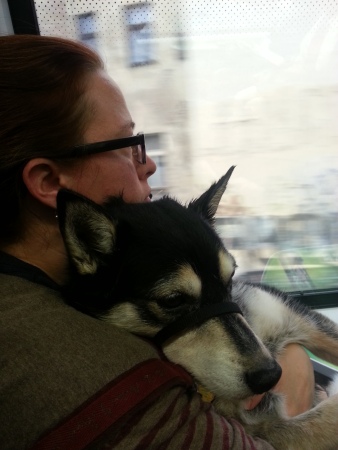
 Feminism and Religion