Remembering to Be Thankful by John Erickson

Remembering to be thankful may just be a privileged illusion that individuals in positions of power get to write about in the December of each year to self-congratulate themselves about being actually able to be able to be thankful. It may just seem like people who write about being thankful are complaining or pontificating that being thankful is in itself a chore.

WEHO CA (June 7, 2015)©2015 Rebecca Dru Photography All Rights Reserved    www.rebeccadru.com
WEHO CA (June 7, 2015)©2015 Rebecca Dru Photography All Rights Reserved
http://www.rebeccadru.com

With the holidays just around the corner and the frazzled, crisp ping of anxiety, rush, and panic take over the air around us, it is easy to forget to stop and “smell the roses.”  In times where teaching positions continue to shrink and more universities switch to adjunct labor, fees and class costs continue to rise, or just simply life becomes a little more complicated, due to the nature of balancing life, activism, work, friendships, or relationships, remembering to remind myself to be thankful is another task, I find adding to the never-ending list of stuff I always seem I have to do.

However, remembering to be thankful, scheduling it into one’s daily schedule are vital to our success as new and emerging faculty or activists or just in general because being thankful reminds us that we have aspects of our lives that are worth being thankful for.  Remembering to be thankful proves that we are in some way, connected to a larger sense of life that, at times, grants our wishes, wants, or desires, brings us despair, and then allows us to get through it, or even makes us feel alive.

As I sit back and look at the personal and professional landscape around me I understand that I have a lot to be thankful for both consciously and unconsciously.  Most recently at AAR, I participated on a panel in response to Bernadette Barton’s Pray the Gay Away.  During the course of our panel, the conversation of chosen vs. biological families came up.   Most recently, my mentor and panel moderator, Dr. Marie Cartier, talked about the same topic here on FAR and the difficulties many of us experience in regards to our chosen families vs. our biological families.   With the holiday season all around us, and regardless of what or if, you celebrate it or not, it is quite hard to get away from it all without realizing who your “family” is and whether or not you’re close or connected with them can be traumatizing during these times where we’re taught or expected to be with them.

After our discussion on the panel and then at the hotel bar, people discussed the pains and traumas in relation to not having a biological family to go home to during the holidays.  Sitting there and listening to the conversations, I realized that, for once in my life, I had nothing to say. Continue reading “Remembering to Be Thankful by John Erickson”

All Male Panels and Feminist Movement Building by Vanessa Rivera de la Fuente

All Male Panels and Movement BuildingMaking visible gender inequities in the accessibility, acquisition, and transmission of knowledge is essential to breaking ceilings and barriers that prevent women from full participation. This is especially critical in religion, an area in which Patriarchy has bashed women in a systematic, deliberate and cumulative way throughout history.

The current dominant discourses about Muslim women: idealization (sustained by religious patriarchy) and demonization (which corresponds to a Western vision) universalize their own particular way of seeing reality through privilege and representation of female otherness and don´t give women a voice or the chance to declare an epistemic space, meaning a symbolic place of discussion where our experiences with knowledge are relevant.

This is why initiatives like “Not More All Male Panels” and other similar are important. Who dominates knowledge, manages explanations and represents reality is important. If women are excluded, then it is as if women do not exist. The inclusion of women in knowledge serves two purposes: one is simply our presence in instances where knowledge is produced; the other, which my reflection is about, concerns appropriation of knowledge and spaces via movement building.

Panels, Ceilings and Walls

A few weeks ago I participated in a panel to discuss women and feminism in religion. One of my peers spoke to me about the perception of Islamic Feminism. To paraphrase my fellow panelist:

In ‪‎Islamic‬ ‪Feminism‬, your voice is ignored and disposable, because you lack all of what gives one authority in that field– You are a Latina, living in the South, with no formal education in Islam. You have no Arab/Asian name and you speaks Spanish. In a Feminist world that should be ‪‎Intersectional‬ and ‪Decolonial‬ by definition, you’re a woman racialized in contrast with you peers. If not, tell me in how many lists of Muslims Feminist your name is written.

That was hard to hear, but led me to think that the struggle against our lack of presence in matters of knowledge has not only to do with visibility, but also with access and representation. In this sense, I wonder: who is in charge of knowledge in Islamic Feminism? What are the possibilities for any Muslim woman to become a scholar? This is still something only privileged women seem to be able to do. Continue reading “All Male Panels and Feminist Movement Building by Vanessa Rivera de la Fuente”

Friendships That Save Lives: For Rita M. Gross 1943-2015, by Carol P. Christ

Carol Eftalou - Michael HonnegerWhen Rita Gross visited me in Lesbos two summers ago, we spent many long hours discussing our lives and work. Rita and I met at the Conference of Women Theologians at Alverno College in June, 1971 when we were young women. We did not know it then, but our lives would continue to be intertwined through our common interests, first in the Women and Religion section of the American Academy of Religion, and then through our work on Goddesses and feminist theology.

When we met, Rita was a convert to Judaism working on her dissertation on Australian Aboriginal women’s religious lives, and I was a Christian about to begin a dissertation on Elie Wiesel’s stories that would lead me to express my own anger at God. Continue reading “Friendships That Save Lives: For Rita M. Gross 1943-2015, by Carol P. Christ”

Finding My Voice By Grace Yia-Hei Kao

In my work with doctoral students, I’ve noticed that what often sets apart “good” graduate students from “good” junior scholars is the ability for the latter to say something important and distinctive. That is, while it may be sufficient during coursework and qualifying exams to master the canon of whatever counts as good scholarship in one’s field, success beyond graduate school will require academic hopefuls to make a bona-fide scholarly contribution to her field of study.

For this reason, I am frequently asked by the graduate students I mentor, particularly those who are women, about the process by which I came to find–or claim–my scholarly voice.

What follows bellow is a version of a talk I gave at the annual conference of the Pacific, Asian, and North American Asian Women in Theology and Ministry (PANAAWTM) in 2014 on this very question.
Continue reading “Finding My Voice By Grace Yia-Hei Kao”

#LoveWins by John Erickson

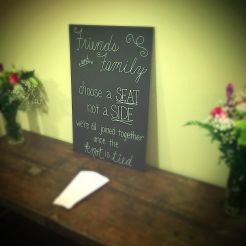
On Saturday, September 19, 2015 I married two of my best friends Andrea and Cindy in holy matrimony in Appleton, WI.

John Erickson, sports, coming out.Don’t urge me to leave you or turn back from you.
Where you go, I will go, and where you stay, I will stay.
Your people will be my people and your God my God.
Where you die, I will die, and there I will be buried.
May the God deal with me, be it ever so severely, if even death separates you and me.
Book of Ruth 1:16-17

On Saturday, September 19, 2015 I married two of my best friends Andrunnamedea and Cindy in holy matrimony in Appleton, WI.  Having been ordained since 2009, I truly never thought I’d ever get the chance to use these credentials until they asked me a few months back.  Although my answer was an automatic yes, I sought to make sure that my homily and the words of advice I gave them on their special day were something unique, not always heard at wedding ceremonies. Continue reading “#LoveWins by John Erickson”
Two Wrongs Don’t Make a Right by John Erickson

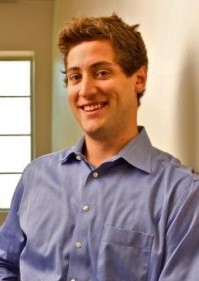
Kim Davis does need a lot of things but saying of suggesting that she needs a haircut, a makeover, or even to lose weight, makes you and those that continue to repeat it no better than she is; to state such statements doesn’t purport the ideal that #LoveWins, which took over social media just mere months ago, but changes the whole narrative to symbolize that sexism and hate are more important than love and equality.

John Erickson, sports, coming out.Kim Davis, the defiant county clerk, is currently sitting in isolation in a jail cell after refusing to issue marriage licenses to same-sex couples in Rowan County, Kentucky, even after she was ordered by a judge to comply with the Supreme Court’s ruling on same-sex marriage or be held in contempt of court.

Everywhere I turn on both social media or in person people are talking about Ms. Davis, her actions, personal history and for some weird reason her hair and looks.   I’m all for individuals taking a virulent stand against an individual who chooses to not uphold the law of the land as well as continually acting in an unjust discriminatory way but bringing her looks or anything else about her physical appearance into the narrative is not only just plain wrong it is sexism in its worst form. Continue reading “Two Wrongs Don’t Make a Right by John Erickson”

Argument from “Absence” and Absence of Dialogue by Carol P. Christ

Carol in Crete turquoiseRecently in a conversation with a noted archaeologist and his male graduate student assistant, I proposed that the absence of war and the trappings of war, including images of larger than life-size warrior kings, suggested to me that we should not understand the social structure of ancient Crete on the model of patriarchal kingship. “Kings are always warriors,” I said, “yet there is no clear and convincing evidence of organized warfare in ancient Crete. And,” I continued, “because warrior kingship is not a ‘natural state,’ but one achieved through warfare and domination, kings must legitimate and celebrate their power through larger than life-size images of themselves. Such images were common in ancient Sumer and in ancient Egypt, but are not found in ancient Crete.”

The response I received was unexpected: both archaeologists seemed dumbfounded. “Is kingship always associated with war?” they asked. “Yes,” I responded, “this is a conclusion I reached many years ago while studying the cultures of ancient Greece and ancient Israel, and I have recently elaborated this theory in a series of essays on the blog Feminism and Religion ( See “Patriarchy as a System of Male Dominance Created at the Intersection of the the Control of Women, Private Property, and War”).” Continue reading “Argument from “Absence” and Absence of Dialogue by Carol P. Christ”

Is There a Such Thing as a Code of Ethics in Academia?  by Michele Stopera Freyhauf


One of things that has dismayed me since I began graduate school and started focusing my study on the Bible, is how much sensationalism exists. We are told in the academy not to use Wikipedia or watch the History Channel. The first, as we know, is unreliable due to the fact that anyone can enter information and make changes. The other caters to the general public. What compounds this problem is the fact that scholars, many times – even reputable ones – appear on these shows. Sometimes creative licenses are exercised by the producer distorting or otherwise shifting the message of what the scholar was trying to explain. Other times, scholars will just give the producers and the public exactly what they want to hear and thus perpetuating myths rooted in literalism.

Alpocalypse_Cave
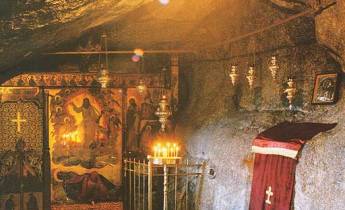
Cave in the Church of the Apocalypse in Patmos, Greece

This is not the only time this issues manifests.  The other time I encountered this is when I travel to sacred or holy sites in the Middle East.  The people in charge of sites may want raise money and increase tourism – so they give the people what they want.  What do I mean by this?  Walking into a place that has a story whether true or not provides pilgrims a sense of awe and wonder.

Certainly I am not saying that this experience should be diminished or should be taken away. What I am saying is that we should be a bit more truthful in our descriptions and remove the shroud of literalism that seems to fuel tourism and not faith. What was difficult for me when visiting Patmos is the rhetoric surrounding the island. It may or may not have been where John had his visions, but certainly the mystique surrounding the Church of the Apocalypse seems to perpetuate the literalism that surrounds the Book of Revelation as being prophetic in dealing with the end times.  Moreover, the vendors around the Church certainly focus their merchandise to support this myth.  However, while I study the Book of Revelation and teach that it is something other than prophetic, a person visits the island and the church, are told that it is prophetic – who is a person to believe?   Me or the religious order running the Church or the vendors living on the island?

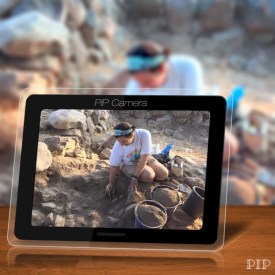
This also happens at dig sites.  If a tourist is led by a guide or lead at a holy site being excavated and they tell them what they want to hear so they come back and tell their friends, who has more creditability – me or the person who guides on the site?  When scholars like myself, write about a topic that seems to gel with what the commonly held view of the academy, and goes against literalism or fundamentalist beliefs, we become heretics in relation to the information being fed by the sensationalism on the History Channel and the tourist industry.  So the popular view does not change and the academic view is left on the margins and Biblical literalism wins.

Continue reading “Is There a Such Thing as a Code of Ethics in Academia?  by Michele Stopera Freyhauf”

The Book Is Finished, Now On to Publicizing It by Carol P. Christ

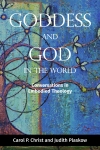
Carol in Crete turquoiseGoddess and God in the World: Conversations in Embodied Theology by Carol P. Christ and Judith Plaskow, forthcoming from Fortress Press in 2016.

In Goddess and God in the World, two leading theologians model a new method of embodied theology, rooted in experience and tested in dialogue. Christ and Plaskow agree that the God who is dead in our time is the transcendent and omnipotent male God of traditional theology. They believe that we must create new understandings of divinity because theologies not only help us to make sense of the world, but also provide guidance as we face the urgent social, political, and environmental issues of our time. In contrast to traditional views, Plaskow and Christ situate divinity in the world and place responsibility for the fate of the world firmly in human hands. They argue for an inclusive monotheism that affirms the unity of being through a plurality of images celebrating diversity and difference. Carol believes Goddess is the intelligent embodied love that is in all being, a personal presence that can inspire us to love the world more deeply. Judith understands God as an impersonal power of creativity, the ground of being that includes both good and evil. Their intense questioning of each other’s views provides an exciting model for theological conversation across difference.
Continue reading “The Book Is Finished, Now On to Publicizing It by Carol P. Christ”

Barth and Woman at Yale by Carol P. Christ

Carol P. Christ at Alverno College 1
Carol P. Christ at the Conference of Women Theologians, Alverno College, 1971

I recently located a copy of an essay on Karl Barth and women that I wrote as a graduate student at Yale University in the Alverno College archives. Rereading it decades later, I am a-mazed at the brilliance and tenacity of my younger self. Had I been a male graduate student, I imagine that I would have been encouraged to publish this paper. Instead, though distributed by Alverno College after the Conference of Women Theologians, it was never published. I am correcting that oversight here. Read  A Question for Investigation (Barth and Women)-Carol P. Christ (1971) and view the original typescript Barth’s Theology and the Man-Woman Relationship by Carol P. Christ (1970). Please note that the essay does not restrict itself to Barth’s view of women, but rather uses Barth’s view of women to raise questions about his theology and theological method. Continue reading “Barth and Woman at Yale by Carol P. Christ”