Thanks for Coming (Out): Sexuality, Sports, and Spirituality by John Erickson

I have to be honest, Jason Collins’ admission that he was a homosexual, albeit brave, upset me. While coming out is an completely unique experience to every individual that does it, Jason Collins’ story was just another example of the rampant sexist and heteropatriarachal world that privileges male bodies and sexualities over women’s similar experiences. While I applaud Jason’s story and it’s timing, the first thing I asked to my colleagues was: Where was the hubbub over Sheryl Swoopes or Martina Navratilova?

John Erickson, sports, coming out. Like marking off items on a proverbial checklist, closeted LGBTQ individuals who exist within and outside of the world of professional sports, can recount the numerous things they struggle with in terms of their sexuality.  From fearing of the actual coming out process, dressing in their car or at home to avoid the subtle glances and whispers of individuals in the locker room, to wondering what coming out would mean not only for their game but also for their social and, if they choose, spiritual lives, closeted and out LGBTQ individuals within the multi-billion dollar professional sports industry must grapple with that age old question: what does it mean to be gay and open about it?

The Locker Room

I have to be honest, Jason Collins’ admission that he is a homosexual, albeit brave, upset me.  While I understand that coming out is an completely unique experience to every individual who does it, for me Jason Collins’ story was also an example of the rampant sexist and heteropatriarachal world that privileges male bodies and sexualities over those of women.  While I applaud Jason’s story and the timing, the first thing I asked to my colleagues was: where was the same hubbub over Sheryl Swoopes or Martina Navratilova? Continue reading “Thanks for Coming (Out): Sexuality, Sports, and Spirituality by John Erickson”

What About Contraception in Pope Francis’s Promise to the Poor? by Dawn DiPrince

Pope Francis, at nearly every opportunity – including the choice of his name, has symbolically expressed a commitment to the poor. In just a little over a month, he has declined the customary gold papal cross, the ermine-trimmed red velvet cape, and the showy red loafers worn by his predecessor. He has refused the palatial papal penthouse apartment and is currently living in a two-room suite among the Vatican’s cardinals.

In additional to a more austere lifestyle, Pope Francis has spoken out about the world’s poor. His namesake is St. Francis of Assisi, who famously worked for the poor and for peace. The Pope claims he was inspired to take the name Francis when remembering a friend’s urging to “not forget the poor.” More to the point, Pope Francis has stated that he wants “a Church which is poor and for the poor!” Continue reading “What About Contraception in Pope Francis’s Promise to the Poor? by Dawn DiPrince”

(Femen)ism? by Kile Jones

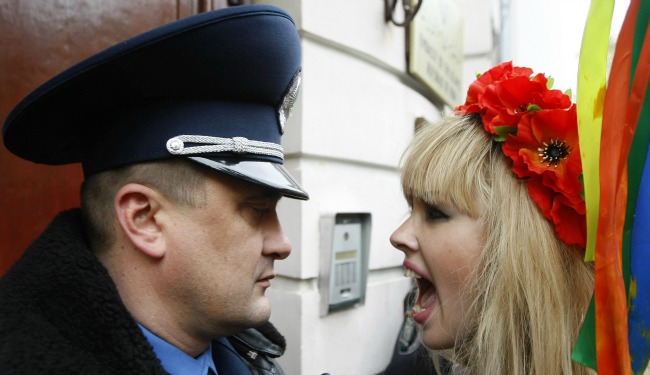
Kile Jones, atheistAs most of us are aware by now, there is a “feminist-sextremist” group from Ukraine called “Femen.”  This group has been very controversial by their public demonstrations of nudity, the words they paint on their bodies, and their explicit condemnations of political structures and organized religions.  They were started by Anna Hutsol in 2008 and have now spread throughout Europe and the Middle East.  The question I pose for this post is: Does Femen harness or hinder the power of the feminist critique?

Image from Konstantin Chernichkin/Reuters

Femen is precisely the kind of movement that pushes us in our understanding of feminism, the means by which it is best expressed, and the issues surrounding moral condemnation and religious sensitivity. Continue reading “(Femen)ism? by Kile Jones”

For the Love of Gaia by Jassy Watson

For the Love of Gaia Jassy WatsonOn January 26, 2013 a rare, devastating tornado hit our community in Queensland, Australia, a coastal town on this sub-tropical coast. My family experienced nature’s elemental force firsthand and hopefully will never again. The tornado viciously shattered houses, peeled away roofs, uplifted cars and trees, and took down power lines, tearing apart everything in its path. With absolutely no warning, literally out of the blue, it formed over the churning sea, rapidly intensifying before striking land, awakening the vulnerability and fragility of all life in its midst.

When it struck, our four kids and I were waiting in our car while my husband ducked into a mate’s house to borrow a tool. We heard the sound of a roaring jet plane overhead, as my husband came running, screaming at us to get out of the car. Turning to my left, in a vision imprinted forever, a spiral of debris flew toward us. Scrambling, we got the kids out of their harnesses and safely indoors. I lagged behind, taking care of the children first, and fell out of the side door of the van with the wind’s impact. As I got up to run, a large piece of roofing tin flew straight for my head. I dove, seeking safety under the front of our running car. My life flashed before my eyes. All of us in a state of shock, the tornado was gone as quickly as it had come, we were unscathed except for a few minor cuts and bruises. It was only a few moments before the immediate danger passed. We ventured outside to inspect the damage, destruction surrounded us. Continue reading “For the Love of Gaia by Jassy Watson”

Dancing with Kali Gets Us to the Other Side by Carolyn Lee Boyd

carolyn portrait

Deep in the New England woods, Kali leaps from behind a pine tree, skulls jangling from her waist and an upraised knife in her hand. A band of women halts and the goddess and mortals face one another.  “What must you do to pass?” Kali demands. After a few silent seconds, I step forward and take Kali’s hands, waltzing with her until I reach the other side where I continue on to the moon ceremony that was our destination that night.

 A decade ago I waltzed with a priestess dressed as Kali at a Goddess camp.  When I stared at the recreated wrathful goddess blocking my way, I knew that I could not run past or fight her, so dancing with all that She represented was my only option. I cannot say that I encountered Kali Herself that night but, since then, I have experienced over and over the transforming power of choosing to engage the wildness, mystery, beauty, truth, and chaos of our dynamic universe  and of expressing both creative and destructive aspects of this spirit in our everyday lives.

Grief Beyond Belief and Rebecca Hensler by Kile Jones

Kile Jones, atheistIn my last post, “A Pro-Science, Skeptical Woman Speaks” I interviewed a woman with whom I share many views in common.  One of my goals here at Feminism and Religion is to introduce different secular, atheistic, liberal feminists who share many of the same ethical views as regular contributors and readers, but not the same “religious” or “spiritual” ideas.  In this post I examine an online support network for unbelievers, Grief Beyond Belief, and ask a few questions to its founder, Rebecca Hensler.

I met Rebecca in February in San Francisco while on a visit I made to meet with the Unitarian Universalist Association in regards to my ordination.  My girlfriend and I met Rebecca in North Beach, San Francisco for dinner and drinks.  I experienced her as a compassionate, friendly, and genuine person.  Her experiences and insights inspired me to think more about the role of grief and pain among unbelievers.  I mean, atheists cry, agnostics experience loss, skeptics lose family members, and we do it all without a “God” or “spirit” to help us.  And if we were to meet C.S. Lewis, we would make

sure to exclaim, “No…pain is not some megaphone for God to rouse a deaf world.”

R Hensler

Why did you start Grief Beyond Belief?

The original idea was born of my own grief.  After my son died, I found a group in which to share comfort and compassion with other grieving parents: The Compassionate Friends, a mainstream parental grief support organization with a strong online presence.  It was so close to exactly what I needed, but I frequently felt alienated by the religious and spiritual content — not just the offers of comfort that depended on beliefs I do not hold, but the assumption that everyone there held some sort of belief in life after death. And the assumption, so common in mainstream grief support, that even if I am not the same religion as you are, I have a religion, and I believe in some sort of afterlife was equally alienating and hurtful. Continue reading “Grief Beyond Belief and Rebecca Hensler by Kile Jones”

Marriage as a Commodity (Satisfaction Guaranteed) by Michele Stopera Freyhauf

Freyhauf, Feminism, Religion, Durham, Old Testament, Blogger, Bible, Gender, Violence, Ursuline, John CarrollThis Saturday I will be presenting a paper about Cyberbrides at the United Nations Commission on the Status of Women.  While my focus for that paper is the impact on mothers and families, my research also revealed how some Cyberbrides (or Mail-Order Brides) are selected from internet catalogues with “satisfaction guaranteed” and how “International Marriage Broker” may be a cloak hiding the agencies’ involvement with human trafficking.

Cyberbrides are essentially mail-order brides, but like pen pals, they can chat and exchange pictures on the Internet and interact through video or instant chat.  There are almost 2.9 million website matches that turn up when Google-ing “Mail-Order Brides” within 19 seconds of pressing the “return” button. With the low cost of social media, a new venue to market and display this “commodity” is available.  Presently,  about 30 Facebook sites exist that advertise “Mail-OrderBrides. Continue reading “Marriage as a Commodity (Satisfaction Guaranteed) by Michele Stopera Freyhauf”

Gendercide: Words and Poem by Bernedette Muthien

engender, Bernedette Muthien, gendercide, poetry, violence against women, patriarchy,

gendercide  

 it took a full week

of straitjacketing generations

of genocidal femicidal trauma

for the clay dam wall to explode

and flood me in torrents

of collective grief

a poet with no words

a lifelong activist struck dumb

i choke on love for the dead

thousands of beautiful women and children a year

i puke for my incested cancerous country

and gag grappling for compassion of

perpetrators and the morally blind

in this breathtaking country

so brutally drenched in the blood

of ordinary women and children

i discover anew

that i fail to

swim

my spiritual cadaver

is dragged under by the concrete limbs

of victims perpetrators witnesses

majority blinkered burdens

too busy scrabbling for survival

to fight for justice

as i contemplate the imminent refreshment

of my childhood starvation

my hunger for food agency adventure

leads me to stare the dragon in its ambered eyes

like a mirror of my ever-present shadows

Demon! Patriarchy…

how can I love you to death…?

— Bernedette Muthien (15 feb 2013)

for the billion women martyrs around the world… Continue reading “Gendercide: Words and Poem by Bernedette Muthien”

A Valentine Towards an Ethics of Loving Women Making Art by Marie Cartier

It is still a radical and generous act to love a woman for who she is apart from, as well as with, others.

My favorite artist is Frida Kahlo because she was a woman who dared to do art about her own self, in fact often about her own physical self. When she did that it was brave; and it still is brave to consider your life as a woman important enough to focus on. Let’s face it– women are not considered a priority in a world which still underpays women for the same jobs that men do. When I entered the work force in 1976 women made 60.2% of what men make. In 1986 they made 64.3%; in 1996 73.8%; in 2006 76.9%; and in 2010 women made 77.4%.

Continue reading “A Valentine Towards an Ethics of Loving Women Making Art by Marie Cartier”

Ringing In the Lunar New Year with LGBT Activism By Grace Yia-Hei Kao

Grace Yia-Hei Kao  On Sunday, February 10, the Tet parade in Little Saigon, Westminster (CA) went on as planned. Several thousand people turned up to celebrate the Vietnamese New Year, or what Khanh Ho, Assistant Professor of English at Grinnell College, has likened to “Mardi Gras, New Years, and Christmas all rolled into one.”

Continue reading “Ringing In the Lunar New Year with LGBT Activism By Grace Yia-Hei Kao”