A Meditation on Revolution In the Vagina Monologues by Marie Cartier

Photos by Kimberly Esslinger

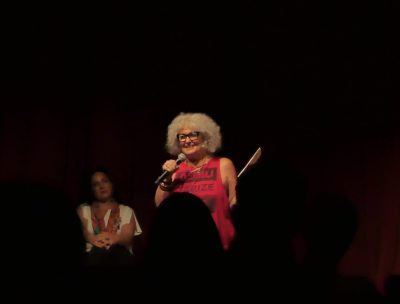
“It’s like feminist summer camp, except it’s in February,” said Shaina, the director, “I’m not sure how to re-enter the world.”

I agreed. How to re-enter the world where vaginas have little voice? Where asking a woman what her vagina would wear does not make sense. Or what would it say? It’s not just what would it say, it’s not having a voice at all.  My vagina.

I have performed in West Hollywood, California’s production of the Vagina Monologues (to benefit Planned Parenthood, check it out here and here) for the past three years. This year we raised over $5,000.

Continue reading “A Meditation on Revolution In the Vagina Monologues by Marie Cartier”

I Celebrate Love by Elise M. Edwards

Happy Valentine’s Day!  I know, I know… so many of us do not like this holiday.  It’s too commercialized, we say.  We don’t need card-makers or florists to tell us how or when to show affection.  Some of us don’t like Valentine’s Day because it reminds us of loves we have lost or never found.  I get it.  This day can seem shallow, overhyped, and falsely sentimental.  It can be lonely.  And yet, I won’t let today pass without celebrating and honoring love.  Love is too important to concede to commercial interests.

Love, in its many forms, keep us alive and able to endure. Love is powerful because it is expansive, growing in unexpected places and ways.  We tend to separate our celebrations of romantic love, friendship, familial love, self-love, and religious devotion.  We make distinctions between our valentines and “galentines.”  Rarely do we shout for joy in ecstatic worship while also celebrating the passionate longings of our innermost desires.  But occasionally, in my religious tradition, we let our disparate loves come together.  We unite them on holy feast days, enjoying the sensual pleasures of good food and company to mark spiritual occasions.  So that’s my inspiration.  Today, I’m celebrating love by reflecting on various forms of love merged together and sharing insight from poets and mystics about the power and beauty experienced in love.

Continue reading “I Celebrate Love by Elise M. Edwards”

Generosity and Community: the Alternative Worldview of Women’s Ritual Dances, Part 2 by Laura Shannon

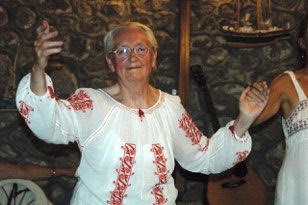
Dr. France LeJeune Milchberg taking her turn to lead the dance line, Lesvos 2007. Photo: Sheryl Ackerman

Starhawk describes the work of her Reclaiming collective as the creation of ‘spaces of refuge from a harsh and often hostile world, safe places where people can heal and regenerate, renew our energies and learn new skills.’[i] These words also apply to the women’s traditional dances. One participant on my courses expresses it thus: ‘In the circle no-one is left out, no-one is ignored, all are held and included, all have their place, all are connected.’[ii]

Crucially, women’s ritual dances empower everyone to develop leadership skills. Every woman must know how to lead the line at the appropriate time, and she must also know how to pass on the responsibility afterwards. Continue reading “Generosity and Community: the Alternative Worldview of Women’s Ritual Dances, Part 2 by Laura Shannon”

Generosity and Community: the Alternative Worldview of Women’s Ritual Dance, Part 1 by Laura Shannon

My life’s work with traditional women’s circle dances of Eastern Europe and the Near East has been a natural interweaving of feminism, activism and Goddess spirituality. In more than thirty years of experience, my students and I have gained valuable insight into their potential as tools for healing and transformation.

These simple and ancient dances connect us with women’s ritual practices from the past which are rooted in a Goddess-reverent paradigm honouring the earth, the body and the female face of the divine. In the present day, the practice of mindfully dancing traditional circle dances which embody this worldview can help us imagine and create a more equitable society in the future.

Continue reading “Generosity and Community: the Alternative Worldview of Women’s Ritual Dance, Part 1 by Laura Shannon”

Holly Near’s Music and a Holistic Feminist Perspective of Peace by Elisabeth Schilling

It’s hard for me to be dignified and peaceful sometimes. To produce and sacrifice without rewards, making sure I’m not “sacrificing” in a way that quells my truth and power, making sure I look at dignity in a liberating way. Words continually need to be unpacked, and I do that. I know the work. According to the OED, it means “The quality of being worthy.” For me, ‘dignity’ is just being aware of your self-worth and celebrating that. It feels hopeful and romantic and raw. To sacrifice, to me, in the way I’m using it in this moment, is to be life-giving and co-creator; I think of it in the same way as what the earth does, so that it can continue. Like a leaf fallen to nourish its own soil.

The OED definition of ‘sacrifice’ I like is “The destruction or surrender of something valued or desired for the sake of something regarded as having a higher or more pressing claim.” We can decide what is more pressing. For me it is the ethic of generosity and production in a non-greedy way. I do not sacrifice in this more self-empowered, law-of-the-universe way I’ve recently come to understand much. But I would like to. Sometimes, though, I feel tired in my production, like I need more feedback, even if it is another woman willing to listen to me, which is why posting on FAR is so healing and life-giving because there is all of you.

I’m glad I have wisdom in my body. Even if “I” (my mind?) goes chaotic, feels overwhelmed and lost, my body has this natural intelligence to heal and regain balance if I can listen and get out of its way. That reminds me a lot of the earth—regions harmed by human mindlessness have been known to restore itself, even after radiation or toxic explosions, when humans leave for awhile. But if “I” equate myself with my mind, isn’t that also a part of the body? Wouldn’t the mind (the brain? the processes that help mental consciousness and thoughts arise?) then be wise, seeking balance? It just does not feel like it. So if anyone can weigh in on that. . . why so easy for my body-body but not my mind-body?

Continue reading “Holly Near’s Music and a Holistic Feminist Perspective of Peace by Elisabeth Schilling”

Eve is the Hero of the Garden of Eden, Part 1 by Janet Maika’i Rudolph

She is a tree of life to those who embrace her

and those who lay hold of her are blessed.

Proverbs 3:18 (Berean Study Bible)

Eve’s story, as it has been passed onto us from the Bible, makes Her responsible for manki . . .ahem . . .humankind’s being cursed for all time. The story as our culture sets it up is that the serpent is an evil tempter with Eve as a weakling co-conspirator. Both Eve and the serpent are considered guilty parties, responsible for their own drawing down of the curse.

At the risk of being rude: BULLSHIT!

In truth, Eve’s story is a powerful tale complete with a magical talking serpent. And it only communicates directly with Eve, and never with Adam. Why?

BECAUSE THIS IS EVE’S STORY.

Continue reading “Eve is the Hero of the Garden of Eden, Part 1 by Janet Maika’i Rudolph”

Tree of Life: The Festival of the Trees in an Age of Treefall by Jill Hammer

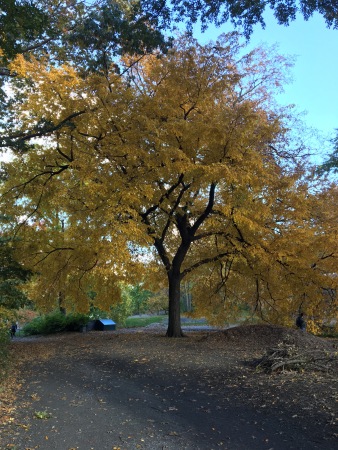
Almost every day, I walk in Central Park.  There are certain trees there I’ve come to know: the gnarled cherry trees by the reservoir, the bending willows and tall bald cypress by the pond, the sycamores that drop their bark each summer, the hawthorn not far from Central Park West.  Lately I’ve been taking photos of the trees to try to capture their essence, their posture in the world.  The trees around me feel like friends, which is what an ancient midrash (interpretation/legend) called Genesis Rabbah says about trees: that they are friends to humankind.  To me, they’ve always been a central manifestation of Mother Earth.

Currently, the national parks in the United States have no staff because of the government shutdown. Some people have taken the opportunity to cut down the rare and endangered Joshua trees in the Joshua Tree National Park—just for fun, I guess, or as a trophy of some kind.  Meanwhile, President Bolsonaro of Brazil recently has indicted that he wants to remove protection for the rainforest, in order to allow development.  It appears that my friends the trees have enemies.  Sometimes the enmity is for personal/corporate gain, and sometimes the enmity seems to have no reason at all.

Continue reading “Tree of Life: The Festival of the Trees in an Age of Treefall by Jill Hammer”

Ancient Dreamer by Elizabeth Cunningham

Raised view fallen autumn leaves deciduous trees

The poems below are excerpted from my new (I hope forthcoming) collection, Tell Me the Story Again. Ancient dreamer’s voice is one among many voices including sorrow singer, temple sweeper, sword woman, morose fool, merry drunk, grey cat and mouse, stone mountain, skeleton woman, mother rain and many more. The voices speak from a time perhaps just after (or long before) our time, in a real and magical world.

I chose to excerpt ancient dreamer’s poems because winter is the time, in Celtic lore, of the Cailleach, the old one, the divine hag.  When I began writing the poems in 2014, my mother-in-law, then age 101, was in the last stages of her life. She slept and dreamed most of the time, and I would sit and daydream with her. She died two months before her 102nd birthday. When I took up the collection again in 2018 to complete it, ancient dreamer remained a strong presence and has the last word.  

Continue reading “Ancient Dreamer by Elizabeth Cunningham”

The Santa Goddess from The Goddess Project: Made in Her Image by Colette Numajiri

Frau Holda Poem

Hail to Frau Holda, the beautiful and bright,
Crowned and clothed, all in glistening Winter white.
Ay seeking and searching, She sweeps o’er the land,
Scourge for the slovenly, held firmly in hand.
As Holda fares forth, with Her own Holy Host,
May She deem distaffs full, befitting a Yule boast.
For when all is cleanly, content She shall be,
Thus Her bedding she flaps, with a whirlwind flurry.
Soon crisp snowflakes, come falling feather light,
Cleverly She shakes, cloaking the clutter with white.
‘Til Earth is enclosed, by a fine fluffy down,
A bedecked beauty, in Her sparkling snow gown.
Heed well and hear, when Holda’s housework doth end,
A faint satisfied sigh, for the mess Frau did mend.
© Rhonda Turner


Once I became a mother I found the demands as well as my own expectations for holiday gifting, decor and celebrations to be SO taxing that I quickly felt a bit of resentment toward Santa Claus for getting all of the credit. Now I tell my children that Santa Goddess is posing as homekeeping MRS. CLAUSE and that SHE and the elves do all of the work, and that “Santa” is merely their courier. Engulfed in modern society, I don’t think my young children hear me as they still dance with glee at any mention of Santa Claus.

Continue reading “The Santa Goddess from The Goddess Project: Made in Her Image by Colette Numajiri”

This Is What Rape Culture Looks Like in “Great” Art by Carol P. Christ

Warning: contains images of rape portrayed through the lens of the objectifying pornographic male gaze

When I reflected on the discovery of a rape fresco from ancient Pompeii that depicted Leda and the swan, I did not mention that the image of the rape of Leda by Zeus along with related images of Zeus raping Europa as a bull and raping Danae as a shower of gold are favorite themes in the history of western art up to the present day. Myths of rape not only give artists permission to paint or sculpt naked women but also to normalize rape as an aspect of culture. In the imagination of western artists, noble or immortal women are portrayed as passively accepting and even enjoying being raped. The fact that these women are understood to be icons of female beauty delivers the message that female beauty invites rape.

I am beginning to understand my university education as brain-washing. I was 17 years old and in my first semester of college when I was shown images of Zeus raping women on a large screen in a darkened auditorium while being told that I should pay attention to perspective, brush-work, and detail. I understood that in learning to appreciate great works of art I would be considered intelligent and sensitive by other intelligent and sensitive people whose ranks I hoped to join. I learned what I was being taught. I was not told was that my “education” was grooming me to accept rape as part of high culture and as beautiful. Continue reading “This Is What Rape Culture Looks Like in “Great” Art by Carol P. Christ”