Liam Neeson and White Toxic Masculinity by Janet Maika’i Rudolph

Several weeks ago, Liam Neeson was doing a press tour for his latest movie. He caused quite a stir by bringing up an event from his life from 40 years ago. Actually, it was an event that happened not to him but to a female friend. She had been raped and characterized the rapist as “a black man.” In typical male bravado, he took offense and set off to act out a what has been called “a racist revenge fantasy” by taking a weapon and looking for a black man to beat up and/or kill.

Here is a link to an article of his interview.

I am in a fairly unique position to respond as I myself was raped at knifepoint also about 40 years ago. On second thought, and truly sadly, it is unlikely that I am in a unique position. Rape is the coin of violence. It is used in war, arguments, power plays, where our bodies become the battlefield on which such violence is played out. There is truly nothing sexual about it.

Here is what rape does to the psyche. It tells us that our bodies are for someone else’s ephemeral pleasure, not our own. It tells us that we are not safe in the face of someone, usually a male’s violent whims. It tells us that we are objects without full personhood. It slashes a hole in our core selves that fills with rage and pain instead of love and wholeness.

Continue reading “Liam Neeson and White Toxic Masculinity by Janet Maika’i Rudolph”

Yoga, Resilience and Learning Self-Care by Marie Cartier

All Photos by Kimberly Esslinger

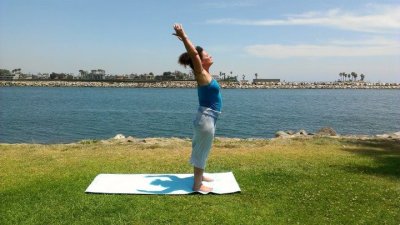
It is spring and it is warm in California. I haven’t been exercising over the winter because it has been extremely cold for California. I had the bug everyone else had. But, now I am back, and we have just experienced Spring Equinox on March 21st, 2019.

And I am headed back to yoga classes.

Why did I start doing yoga? It’s a good question, since I started as a senior in high school, which would have been 1973. I was a lower middle class kid who had very few resources. I was also from an abusive family, where I was responsible for taking care of my younger five brothers and sisters. This meant I almost always had to come home from school and start peeling potatoes, getting dinner ready for when my father would walk through the door—and hopefully be in a good mood.

I learned to not be around when he walked in that door, because he would take out his anger on whoever was first in his path. I remember thinking this was very smart on my part, and also feeling guilty that I hadn’t imparted this to the other kids. Someone had to be in his path when he got home, and I didn’t want it to be me. I still feel guilty about that—even though as the oldest I was punished physically by him more than the others.

Continue reading “Yoga, Resilience and Learning Self-Care by Marie Cartier”

Magical Women by Elisabeth Schilling

Are Women’s Bodies too Magical for Professionalism?

I feel I’m at times strategizing ways to hide my magic. I contemplate, for instance, whether that college in [conservative state] is going to like that I had a poem published in a lit mag called Pussy Magic (they call their staff a “coven,” which I adore – I’m quite proud to be in this magazine – I think I have a crush on the entire staff). Sometimes, I’m so used to asking questions such as this, that I find myself surprised and unprepared for when other people manage to, admirably, give fewer fucks.

For instance, I was watching an old YouTube clip the other day of Alexandria-Ocasio Cortez on Stephen Colbert’s Late Show about her preparation for being sworn in.

Colbert was asking her about her experience, and she was asked to explain the story behind her nails (good question because it is a good story). She told him that when Sonia Sotomayor was being sworn in, she was advised to choose a neutral color of nail polish because something like red would bring in too much scrutiny and comments. Continue reading “Magical Women by Elisabeth Schilling”

“What Could be Sadder?” I’ll tell you…by Esther Nelson

You’ve probably seen the following meme circulating on social media:

This meme is designed to be evocative.  Specifically, it plays into the concept of the sanctity of motherhood that so often oozes into a popular sentimentality about children.  In Christian-majority countries, we read and hear the story of the Virgin Mary acquiescing humbly and readily to her pregnancy when the angel of the Lord tells her she is with child, something done to her by the Holy Spirit.  “And Mary said, Behold the handmaid of the Lord; be it unto me according to thy word.  And the angel departed from her” (Luke 1:38).  Mary is often elevated in Christian circles as a role model for women.

Putting aside the question (for now) that asks when life begins, let’s consider this “sad sight” the meme talks about—“women marching for the right to kill their own children.”  Abortion aside (for now), there are many examples—both in literature and history—of women having killed their children.  I offer the following two:

The novelist Toni Morrison (b. 1931) won the Pulitzer Prize for Fiction (1988) for her book, BELOVED.  Morrison tells Sethe’s story, a mother who knows firsthand the horrors of slavery, who kills her child rather than seeing her enslavedContinue reading ““What Could be Sadder?” I’ll tell you…by Esther Nelson”

Re-reading Mary Shelley’s FRANKENSTEIN by Joyce Zonana

And so is born the “monster” most people associate with the name Frankenstein–a lone and lonely terrorist who lashes out against a world that has no place for him. One by one, he strangles all the people his “maker” holds dear: his brother William, his best friend Clerval, and his cousin/bride Elizabeth. Yet the novel invites us to have compassion for the creature, even while it condemns the society that makes him as he is. Victor, raised by a devoted mother and tenderly loved by a doting cousin, should have known better. As should we.

jz-headshotA few weeks ago, a former colleague invited me to visit one of his classes, to discuss Mary Wollstonecraft Shelley’s 1818 novel Frankenstein; or, The Modern Prometheus and the essay I’d published about it almost thirty years ago, “‘They Will Prove the Truth of My Tale: Safie’s Letters as the Feminist Core of Mary Shelley’s Frankenstein.”  To prepare for that visit, I’ve spent the past few days re-reading the book, and I’m overwhelmed anew by the beauty of Shelley’s language, the brilliance of her plot, and the profoundness of her themes. The book moves me even more today than when I first read it.
Continue reading “Re-reading Mary Shelley’s FRANKENSTEIN by Joyce Zonana”

A Meditation on Revolution In the Vagina Monologues by Marie Cartier

Photos by Kimberly Esslinger

“It’s like feminist summer camp, except it’s in February,” said Shaina, the director, “I’m not sure how to re-enter the world.”

I agreed. How to re-enter the world where vaginas have little voice? Where asking a woman what her vagina would wear does not make sense. Or what would it say? It’s not just what would it say, it’s not having a voice at all.  My vagina.

I have performed in West Hollywood, California’s production of the Vagina Monologues (to benefit Planned Parenthood, check it out here and here) for the past three years. This year we raised over $5,000.

Continue reading “A Meditation on Revolution In the Vagina Monologues by Marie Cartier”

The Bodies of Christ, Broken for You by Tallessyn Zawn Grenfell-Lee

Years ago, I learned of a small Christian sect that has an unusual sexual practice due to an interpretation of each Christian as the literal ‘bride of Christ.’ Every member of this religion is instructed from the age of 12 to imagine their sexuality always in relation to the (male) person of Jesus; men are encouraged to imagine they are women during intercourse and masturbation, to avoid a homoerotic relationship with Jesus; and they basically imagine their wives are Jesus.

I admit that I find this idea both bizarre and alarming. Yet, ironically, this sexual practice does accomplish one interesting goal: men imagine women as the literal Body of Christ.

Huh. Continue reading “The Bodies of Christ, Broken for You by Tallessyn Zawn Grenfell-Lee”

I Celebrate Love by Elise M. Edwards

Happy Valentine’s Day!  I know, I know… so many of us do not like this holiday.  It’s too commercialized, we say.  We don’t need card-makers or florists to tell us how or when to show affection.  Some of us don’t like Valentine’s Day because it reminds us of loves we have lost or never found.  I get it.  This day can seem shallow, overhyped, and falsely sentimental.  It can be lonely.  And yet, I won’t let today pass without celebrating and honoring love.  Love is too important to concede to commercial interests.

Love, in its many forms, keep us alive and able to endure. Love is powerful because it is expansive, growing in unexpected places and ways.  We tend to separate our celebrations of romantic love, friendship, familial love, self-love, and religious devotion.  We make distinctions between our valentines and “galentines.”  Rarely do we shout for joy in ecstatic worship while also celebrating the passionate longings of our innermost desires.  But occasionally, in my religious tradition, we let our disparate loves come together.  We unite them on holy feast days, enjoying the sensual pleasures of good food and company to mark spiritual occasions.  So that’s my inspiration.  Today, I’m celebrating love by reflecting on various forms of love merged together and sharing insight from poets and mystics about the power and beauty experienced in love.

Continue reading “I Celebrate Love by Elise M. Edwards”

Help, My Daughter Got a Bunch of Princess Stuff for Christmas! by Trelawney Grenfell-Muir

Every year, I see multiple pleas from concerned mothers (rarely fathers, because (straight) fathers rarely take on emotional labor of child rearing) wondering what to do about the pile of pink plastic that just came into their home. It’s such a scary pile. It whispers, “come here, little girl… let go of your individuality, your power, your freedom. Join me in the glamour and popularity of gendered subordinate dehumanized servitude… everybody’s doing it… first one’s free….” Mothers (well, the ones who pay attention) look at that pile and see a desolate road ahead of princess girls who grow into teens that think they need to look like pornified sex kittens, who grow into young adults that think it’s ok for men to treat them like sex objects, and on into a bleak dystopian future of internalized misogyny.

I can’t promise that I’ve come up with a magic formula to prevent all that. After all, our girls are met with a barrage, a deluge, of toxic messages luring them down that path in every movie, TV show, magazine, billboard, and media around them. Even female meteorologists can’t just wear suits or have short hair or look plump. And none of my strategies will work if family members are modeling that females should try to please the “male gaze.” So I am not offering a magic bullet. All the same, here is how I handled the Pink Plastic Menace – as usual, a joint effort with my sister Tallessyn Grenfell-Lee.

Continue reading “Help, My Daughter Got a Bunch of Princess Stuff for Christmas! by Trelawney Grenfell-Muir”

Shedding Shame by Joyce Zonana

As I follow my program, I grow clearer and stronger. I know exactly what I want and I take it. When I sit down to eat, I feel my appetite, healthy and strong. I feed that appetite, choosing just what I need and what will truly nurture me. When I get up from the table, I am complete and whole within myself. Whether I reach my “goal weight” or not, I’ve already succeeded. And so, this New Year, I won’t be making any new resolutions. I’m already on my path, shedding shame.

jz-headshotAt the lovely small Chanukah party I attended earlier this month, I did not taste the latkes, those delicious potato pancakes fried in oil and typically served with sour cream and applesauce. My hostess offered them to me repeatedly, proudly noting that she’d used her Polish grandmother’s recipe. But I politely said “no thank you,” I’d just started a diet. “Who starts a diet in December?” someone asked. Someone else pointedly wondered “How can you not eat latkes at Chanukah?” but I quietly insisted that I needed to refrain. I promised, though, that I’d have some next year, once I’d shed the extra pounds that were making me uneasy in my own body.

In my Middle Eastern Jewish home it was the height of rudeness not to partake of what someone offered you to eat. So my refusal was difficult on many levels. But in fact, we never ate latkes at Chanukah. Instead we had deep-fried beignets, little balls of dough, sticky-sweet and drenched in rosewater-scented sugar syrup. I wouldn’t be having any of those this year either. And though another friend at the party assured me I didn’t need to lose weight— “You’re zaftig and beautiful just as you are,” she said—I’d decided a few weeks earlier that, Chanukah or no Chanukah, Christmas or no Christmas, this December was exactly when I wanted to begin my journey to what I believe is, for me, a healthier body weight.

Continue reading “Shedding Shame by Joyce Zonana”