A Meditation on Revolution In the Vagina Monologues by Marie Cartier

Photos by Kimberly Esslinger

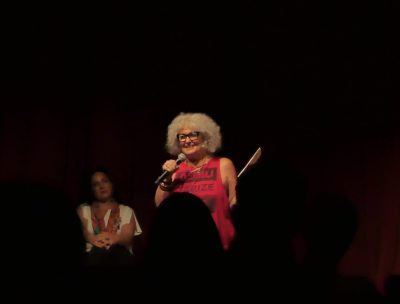
“It’s like feminist summer camp, except it’s in February,” said Shaina, the director, “I’m not sure how to re-enter the world.”

I agreed. How to re-enter the world where vaginas have little voice? Where asking a woman what her vagina would wear does not make sense. Or what would it say? It’s not just what would it say, it’s not having a voice at all.  My vagina.

I have performed in West Hollywood, California’s production of the Vagina Monologues (to benefit Planned Parenthood, check it out here and here) for the past three years. This year we raised over $5,000.

Continue reading “A Meditation on Revolution In the Vagina Monologues by Marie Cartier”

The Bodies of Christ, Broken for You by Tallessyn Zawn Grenfell-Lee

Years ago, I learned of a small Christian sect that has an unusual sexual practice due to an interpretation of each Christian as the literal ‘bride of Christ.’ Every member of this religion is instructed from the age of 12 to imagine their sexuality always in relation to the (male) person of Jesus; men are encouraged to imagine they are women during intercourse and masturbation, to avoid a homoerotic relationship with Jesus; and they basically imagine their wives are Jesus.

I admit that I find this idea both bizarre and alarming. Yet, ironically, this sexual practice does accomplish one interesting goal: men imagine women as the literal Body of Christ.

Huh. Continue reading “The Bodies of Christ, Broken for You by Tallessyn Zawn Grenfell-Lee”

I Celebrate Love by Elise M. Edwards

Happy Valentine’s Day!  I know, I know… so many of us do not like this holiday.  It’s too commercialized, we say.  We don’t need card-makers or florists to tell us how or when to show affection.  Some of us don’t like Valentine’s Day because it reminds us of loves we have lost or never found.  I get it.  This day can seem shallow, overhyped, and falsely sentimental.  It can be lonely.  And yet, I won’t let today pass without celebrating and honoring love.  Love is too important to concede to commercial interests.

Love, in its many forms, keep us alive and able to endure. Love is powerful because it is expansive, growing in unexpected places and ways.  We tend to separate our celebrations of romantic love, friendship, familial love, self-love, and religious devotion.  We make distinctions between our valentines and “galentines.”  Rarely do we shout for joy in ecstatic worship while also celebrating the passionate longings of our innermost desires.  But occasionally, in my religious tradition, we let our disparate loves come together.  We unite them on holy feast days, enjoying the sensual pleasures of good food and company to mark spiritual occasions.  So that’s my inspiration.  Today, I’m celebrating love by reflecting on various forms of love merged together and sharing insight from poets and mystics about the power and beauty experienced in love.

Continue reading “I Celebrate Love by Elise M. Edwards”

Help, My Daughter Got a Bunch of Princess Stuff for Christmas! by Trelawney Grenfell-Muir

Every year, I see multiple pleas from concerned mothers (rarely fathers, because (straight) fathers rarely take on emotional labor of child rearing) wondering what to do about the pile of pink plastic that just came into their home. It’s such a scary pile. It whispers, “come here, little girl… let go of your individuality, your power, your freedom. Join me in the glamour and popularity of gendered subordinate dehumanized servitude… everybody’s doing it… first one’s free….” Mothers (well, the ones who pay attention) look at that pile and see a desolate road ahead of princess girls who grow into teens that think they need to look like pornified sex kittens, who grow into young adults that think it’s ok for men to treat them like sex objects, and on into a bleak dystopian future of internalized misogyny.

I can’t promise that I’ve come up with a magic formula to prevent all that. After all, our girls are met with a barrage, a deluge, of toxic messages luring them down that path in every movie, TV show, magazine, billboard, and media around them. Even female meteorologists can’t just wear suits or have short hair or look plump. And none of my strategies will work if family members are modeling that females should try to please the “male gaze.” So I am not offering a magic bullet. All the same, here is how I handled the Pink Plastic Menace – as usual, a joint effort with my sister Tallessyn Grenfell-Lee.

Continue reading “Help, My Daughter Got a Bunch of Princess Stuff for Christmas! by Trelawney Grenfell-Muir”

Shedding Shame by Joyce Zonana

As I follow my program, I grow clearer and stronger. I know exactly what I want and I take it. When I sit down to eat, I feel my appetite, healthy and strong. I feed that appetite, choosing just what I need and what will truly nurture me. When I get up from the table, I am complete and whole within myself. Whether I reach my “goal weight” or not, I’ve already succeeded. And so, this New Year, I won’t be making any new resolutions. I’m already on my path, shedding shame.

jz-headshotAt the lovely small Chanukah party I attended earlier this month, I did not taste the latkes, those delicious potato pancakes fried in oil and typically served with sour cream and applesauce. My hostess offered them to me repeatedly, proudly noting that she’d used her Polish grandmother’s recipe. But I politely said “no thank you,” I’d just started a diet. “Who starts a diet in December?” someone asked. Someone else pointedly wondered “How can you not eat latkes at Chanukah?” but I quietly insisted that I needed to refrain. I promised, though, that I’d have some next year, once I’d shed the extra pounds that were making me uneasy in my own body.

In my Middle Eastern Jewish home it was the height of rudeness not to partake of what someone offered you to eat. So my refusal was difficult on many levels. But in fact, we never ate latkes at Chanukah. Instead we had deep-fried beignets, little balls of dough, sticky-sweet and drenched in rosewater-scented sugar syrup. I wouldn’t be having any of those this year either. And though another friend at the party assured me I didn’t need to lose weight— “You’re zaftig and beautiful just as you are,” she said—I’d decided a few weeks earlier that, Chanukah or no Chanukah, Christmas or no Christmas, this December was exactly when I wanted to begin my journey to what I believe is, for me, a healthier body weight.

Continue reading “Shedding Shame by Joyce Zonana”

Navigating Social Space as Power-Struggle, Pt. 2 by Elisabeth Schilling

Disclaimer/Trigger Warning: This post contains details about unwanted sexual advances. Read Part I here.

After Sicily, I went to the English countryside for an intended two weeks in a work exchange. A retired, but part-time, lecturer of Greek and Latin in his 60s was moving house and needed help packing and cleaning and cooking. There would, in a day or two, also be a male student from Lithuania and a Brazilian couple joining the communal house, and I found the position through workaway.info, a site one must pay for that I used three years ago with no problem.

On one hand, I have to use sites like this from time to time due to financial reasons. On the other hand, after traveling alone for awhile, I long for the communal exchange. I enjoy helping someone learn a language, cook for their family, organize their clutter because of the conversations along the way. They have a house and extra food. I have the time (my two classes I teach at university online do not take much) to help. If the people involved are mindful and truly grateful for community and shared work and resources, it can be a sacred return to a way of life where people can practice sharing, non-greed, and carrying each other’s burdens. We practice living with strangers, with all the challenges that presents, instead of isolating ourselves in presumed comfort. Continue reading “Navigating Social Space as Power-Struggle, Pt. 2 by Elisabeth Schilling”

Navigating Social Space as Power-Struggle, Pt. 1 by Elisabeth Schilling

The space we take up by our bodies is an element of the sacred. As we move from bed in waking, through our houses and then out into the world, if any of that movement places a woman in close proximity with a man or men, she might do well to observe how the male presence may modify her behavior, from adjusting orientation, position, and flow.

I was in Sicily for four weeks, and as I lived about 15 km from the town center, I took the bus. There is no on-the-minute bus schedule for my stop, but I could calculate when the bus would depart from the station and how long it might take to get to where I lived. Sometimes if felt like the bus just wouldn’t come. Continue reading “Navigating Social Space as Power-Struggle, Pt. 1 by Elisabeth Schilling”

Jewish Hair, Witch Hair, and the Problem of Identity by Jill Hammer

This is a time of increased vulnerability for many minority populations in the United States: people of color, immigrants, LGBT people, native peoples. The policies and rhetoric of the current administration have left all these groups exposed to hostility.  Women are also feeling the pressure, as the gender split in voting in the past election suggests. And, Jews also are facing increased visibility.  In addition to the murders in Pittsburgh, anti-Semitic incidents around the country have increased in the last few years.  All this has me thinking about visibility, chosen and unchosen.

My father, an Ashkenazi Jew with curly black hair, green eyes and dark skin, came from an immigrant family that arrived here in the early 20th century from the region of Poland known as Galicia.  His mother in particular valued assimilation into American identity, and prized blond hair as a sign of this identity– she in fact later dyed her black hair blond.  His aunt had blond hair and it was considered a family coup.  (There’s much to say here about developing an assumed American identity of whiteness, as well as the presumption of Christianity.) When I was a little girl, I had blond hair and blue eyes.  My father used to call me his blond-haired, blue-eyed girl.

“No,” I would insist.  “My hair is brown and my eyes are green.” Continue reading “Jewish Hair, Witch Hair, and the Problem of Identity by Jill Hammer”

Lei by Elisabeth Schilling

Mauro Drudi’s installation of LEI (SHE/HER/YOU – formal) in the Chiesa de San Cristoforo on the Sicilian island of Ortigia where I usually take a bus to daily has become the shrine of women I’ve been searching for. Each time I cry, I am glad I can feel something: those tears are a mixture of communion, comfort, and recognition.

When one enters the church, there are two converging walls. On either side, a woman’s face is painted in shadow and light, gazing off toward the light, is reproduced over and over so that the number of women looks almost countless. They are the same face, a reproduction of Antonello da Messina’s “Annunziata” in the mode of pop art. The difference is not in expression. They all wear the same thoughtful, complicated, neutral countenance, holding deep thoughts and experiences of suffering and wise knowing, both acceptance and maybe resistance; they have lived and might be any age, although I see in our connection my own. The difference is between glossy, unblemished surfaces of wood vs. surfaces weathered, slightly ragged, sometimes scribbled on with ink. The former, found on the right when one enters supposedly represents the “positive” woman, the “western woman [. . . representing someone] happy, gorgeous, well-kept.” On the left, about these representations, Drudi says, “Which artist can paint the skin of a woman who has been abused, beaten, exploited, captivated or disfigured with acid? In my opinion, nobody, and so I let the material speak: the wall of a beach hut destroyed by a storm; woods and materials used and abused [. . .]; exhausted panels deriving from carrying tons of goods, tables, packagings, production wastes.”

Continue reading “Lei by Elisabeth Schilling”

I Was Brainwashed to Believe I Wasn’t Human. Now I’m on a Mission Against that Cult-Part 3

Trigger warning: rape, sexual assault, domestic abuse, graphic sexual content

In Part 1 of this story, I introduced a discussion of Johan Galtung’s theory of cultural violence as it relates to my experience as a young woman in an abusive relationship. To recap:

Cultural violence is: “…any aspect of a culture that can be used to legitimize violence in its direct or structural form. Symbolic violence built into a culture does not kill or maim like direct violence or the violence built into the structure. However, it is used to legitimize either or both.”

Cultural violence against women is: Normalization and promotion of pornography, prostitution, degradation, and sexual objectification of females in media, predominantly male language in civic, business, and religious institutions, gender roles and stereotypes, misogynist humor, gaslighting, minimizing or denying any of these forms of violence.

Continue reading “I Was Brainwashed to Believe I Wasn’t Human. Now I’m on a Mission Against that Cult-Part 3”