On Staying and Leaving by Katey Zeh

Katey HeadshotThe pastor couldn’t have been more than five minutes into his sermon when I starting getting antsy. I leaned over to my husband and whispered, “He needs to be careful with this.” We were visiting a new church, an experience that nearly always puts me on edge. Whenever I attend a worship service for the first time, I come prepared with my mental checklist of liturgical offenses, ready to check each one off, so I can tally them up later and justify why we need to eliminate yet another congregation from our list of possibilities.

I recognize that my attitude about church is downright terrible, and that if I want to participate in a faith community, I have to find a way to deal with this impulse to judge so quickly and fiercely. Up until that point I had been working really hard that morning not to go to that negative place in my mind. If that meant cutting the pastor some slack, then so be it. “Give him a chance,” I said to myself.

The sermon was the first in a series about church membership and was loosely inspired by the story found in both Mark and Matthew in which a man is healed of demons which Jesus casts into a herd of pigs.  When the man begs to stay with Jesus, Jesus says that he must go back to his community and share about how God had healed him. The pastor spoke about this as an example of when God calls us not to a new place, but to remain where we are. To stay put.

The pastor spoke about his own affinity for fleeing,  how almost like clockwork every four years he gets the itch to move to a new place. Speaking to a congregation of mostly young adults, he talked about the generational shift among millennials who unlike their older counterparts no longer expect to live in a single place for their entire lives, nor to work for a single employer for their entire careers. Millennials, of which I am technically a part, have grown so accustomed to upheaval and transition that fleeing has become our default mechanism for coping with boredom, conflict, and discomfort. When the going gets tough, the millennials get going…out the door.

This trend among young people is particularly alarming for institutions like the church, so it’s no wonder that a pastor preaching a sermon on church membership would focus on it. He talked about how over the last few decades our collective understanding of what it means to be a regular church attendee has shifted from showing up weekly to showing up a few times a year. To commit to a church, the pastor continued, means that we agree to show up and stay put.

Remain where you are.  Commit. 

Gazing  around the packed room I looked at all of the women, men, and children taking in his words. How many of them, I wondered, were in situations of abuse that they are trying to flee? What were these words on the virtue of staying put doing to them? Didn’t the pastor know that this was the first Sunday in October, and that it was Domestic Violence Awareness Month? I prayed a quick prayer that his words wouldn’t cause them harm.

Stay put.  Commit. 

As he continued talking, I couldn’t help but return to that my mental checklist of typical church behavior that irritates me: a white, privileged man not acknowledging his bias, referencing only biblical men, male scholars, and other male ministers. Check. Check. Check! The more he talked, the more agitated I became. But since the sermon was about staying, I stayed even though his words made me squirm. I listened even though I wanted to disengage completely. I tried my best to give him the benefit of the doubt. I waited patiently for the caveat that would surely come. But it never did.

Resist the urge to flee. Commit.On Staying

I’ve grown weary of the notion that church decline is due solely to my generation’s fear of commitment and nomadic tendencies. It’s also that we no longer subscribe to the notion that we ought to preserve the institution for the institution’s sake. As I’ve journeyed with my sisters and brothers who have made the decision to leave the church, I have witnessed their arduous struggle to break free. Sometimes leaving is a moment to be both grieved and celebrated at the same time.

Over the last few weeks I’ve had difficult, important conversations with close friends and colleagues  who are in the midst of huge transitions in their lives.  In their own ways, each of them has mustered up the strength to move on from their present circumstances, either to seek something they desperately need or to leave behind something that is sucking them dry. None of them is doing so without tremendous courage.

I know that this pastor had every good intention. In many ways his words were a much needed counterbalance to a culture that lures us into a perpetual search for “elsewhere.” But I also know that “for everything there is a season,” and there is both a time to stay and a time to leave. We must honor both.

Katey Zeh, M.Div is a strategist, writer, and educator who inspires intentional communities to create a more just, compassionate world through building connection, sacred truth telling, and striving for the common good. In 2010 Zeh launched the first and only denominationally-sponsored advocacy campaign focused on improving global reproductive health for The United Methodist Church. She has written extensively about global maternal health, family planning, and women’s sacred worth for outlets including Huffington Post, Sojourners, Religion Dispatches, Response magazine, the Good Mother Project, Mothering Matters, the Journal for Feminist Studies in Religion, and the United Methodist News Service.  Find her on Twitter at @ktzeh or on her website www.kateyzeh.com.
Reform? Progress? By Elise M. Edwards

Elise EdwardsIn my class yesterday (a survey of Christian thought and practices), I was lecturing about monastic life in the Middle Ages. Among other points, I mentioned that medieval religious orders provided settings where women could be educated and assume leadership roles (primarily among other women), thinking of Hildegard of Bingen (1098-1179) who was the Abbess of a monastic community in Rupertsberg. Other women medieval writers who developed influential writings, like Mechtild of Magdeburg (ca. 1210-1282) and Catherine of Siena (1347-80), belonged to tertiaries or third orders, which were monastic community for laypersons. This part of the lesson emphasized that monastic reforms around the 12th century opened religious orders more extensively to women and laity.

Still speaking of medieval reforms, I displayed a picture of Francis of Assisi on the screen at the front of the room. I mentioned that Francis was concerned about the poor and the animals and that he has inspired some contemporary Christians, including the current pope who took Francis as his name. We talked about how both St. Francis and Pope Francis are seen as reformers.

Because earlier in my lesson I’d made a point of speaking of women’s experience, when I spoke about the Pope’s name as a possible sign of renewal or reform, Gina Messina-Dysert’s question “What about the women?” came to mind. In her recent post, she responded to the Pope’s exclusion of many issues that concern women in his address to the US Catholic Bishops. Like Gina, I applaud many of the Pope’s reforms but I am confused about how rarely he is criticized for maintaining the long-held Catholic view that disallows women to be ordained as priests.

Let me provide an example: During the Pope’s visit to the US, one of my students described Pope Francis as “very liberal.” When I interjected that he has not supported the ordination of women, the student laughed and said the pope would be accused of heresy for supporting that! While that may be true, my more immediate concern was that in a classroom of students who are mostly supportive of women in ministry, the Catholic restrictions on the priesthood were seen as a part of the tradition not worth challenging. Why is it that preserving male leadership is excused as a part of the tradition while preserving exclusive marriage practices is something to be challenged? They are interrelated.

As we know from blogs and social media sites, many people who support LGBTQ rights were upset over news stories about the Pope meeting with Kim Davis, the county clerk who was jailed for refusing to issue marriage licenses to same-sex couples. Certainly such a meeting is disturbing to same-sex marriage advocates. But is it surprising? At least one womanist ethicist I know, Eboni Marshall Turman, pointed out in a Facebook discussion that the church has long since been public in its support of male privilege and heteronormativity. My intent is not to single out Catholicism for sexist practices. When recently asked about women’s ordination and leadership in Baptist churches in my own town of Waco Texas, I had to admit that even though ordination of women is permissible and practiced in many of the churches, the number of churches that have called women to the position of senior pastor is shockingly few.

My point is this: When we find teachings in particular religious traditions that justify the exclusion of one group, we should expect to find justifications for excluding other groups, too. In the same discussion I referenced above, Eboni Marshall Turman said, ”Oppressions are compounded and intersectional. If they come for me, it is just a matter of time before they come for you. This is basic theological ethics.”

The experiences of varied groups are not the same; our oppressions and marginalizations also differ. But practices of exclusion are constructed on the same logic that values some persons (the in-group) more than others (the outsiders). Therefore, feminists have a responsibility to advance the well-being and interests of other groups (besides women) who are being marginalized.

Another reason for this advocacy is that many women are included in other marginalized groups. To ignore the intersectionality of oppression is to deny its pervasiveness and the realities of women’s lives. This is why feminists of color are often critical of white feminism. (The recent debate over the photo shoot for the movie Suffragette is a new instance of a persistent critique of white or mainstream feminism. See Rebecca Carroll’s piece on “Suffragette’s Publicity Campaign and the Politics of Erasure”).

To counter the limitations of our own experiences and be consistent in our pursuit of equality, feminists should intentionally cultivate practices of solidarity and coalition-building in our work. I, like everyone else, am often unable to see the inconsistencies in my own practices and teachings without others’ experiences to expand my view. This is one reason I value this Feminism and Religion community. Thank you for the wisdom and practices you offer from your own religious traditions and your own experiences of marginalization. You make me a better feminist through your writings and comments.

Perhaps working together, we can bring about religious reforms that our descendants will recognize in the centuries to come.

Elise M. Edwards, PhD is a Lecturer in Christian Ethics at Baylor University and a graduate of Claremont Graduate University. She is also a registered architect in the State of Florida. Her interdisciplinary work examines issues of civic engagement and how beliefs and commitments are expressed publicly. As a black feminist, she primarily focuses on cultural expressions by, for, and about women and marginalized communities. Follow her on twitter, google+ or academia.edu.

Christa Interview with Edwina Sandys by Nettie Reynolds

NettieDuring the summer I had the opportunity to interview Edwina Sandys, the creator of the sculpture, Christa. Initially, I was drawn to this sculpture during a seminary class with Whitney Bodman – “Jesus and His Interpreters.”

I came to seminary in 2013, a 47 year old single mom with two teenage kids in tow having left a very difficult sixteen year marriage. Seeing the picture of Christa during our class was a sacred moment for me. It echoed my journey and pain and yet also uplifted the beauty inherent in human suffering and our daily gift of grace and promise of resurrection. The debate over the cross itself and its center in Christianity, its usage to elevate patriarchal power, is ongoing, but for me, in that moment, seeing Christ as female was deeply spiritual. Continue reading “Christa Interview with Edwina Sandys by Nettie Reynolds”

#LoveWins by John Erickson

On Saturday, September 19, 2015 I married two of my best friends Andrea and Cindy in holy matrimony in Appleton, WI.

John Erickson, sports, coming out.Don’t urge me to leave you or turn back from you.
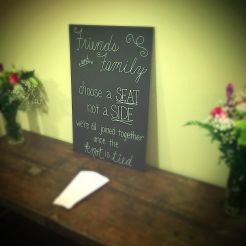
Where you go, I will go, and where you stay, I will stay.
Your people will be my people and your God my God.
Where you die, I will die, and there I will be buried.
May the God deal with me, be it ever so severely, if even death separates you and me.
Book of Ruth 1:16-17

On Saturday, September 19, 2015 I married two of my best friends Andrunnamedea and Cindy in holy matrimony in Appleton, WI.  Having been ordained since 2009, I truly never thought I’d ever get the chance to use these credentials until they asked me a few months back.  Although my answer was an automatic yes, I sought to make sure that my homily and the words of advice I gave them on their special day were something unique, not always heard at wedding ceremonies. Continue reading “#LoveWins by John Erickson”

Feminist Interpretations by Elise Edwards

Elise EdwardsI’ve written a few posts recently referencing biblical themes or stories. I’m not a biblical studies scholar; I’m an ethicist and theologian. So I know that ways I use the texts disturb some people who study them from a historical or biblical studies perspective. To say I don’t use the Bible as those scholars do, though, doesn’t mean I don’t have a disciplined approach. I aim to apply a consistent approach to scripture and to encourage my students to do the same.

I get really annoyed when someone proclaims a variation of “The Bible says it; I believe it; that settles it!” in moral debates. Obviously, people within a religious tradition are going to believe there is truth in the scriptures of their tradition. That’s simply how scripture functions. So I’m okay with “I believe it.” I have a problem with the two other parts of the statement – the Bible says it, and that settles it. The assertion that “the Bible says it” masks the task of interpretation that anyone encountering a text takes on. The statement “that settles it,” when adopted in moral debate, rejects the accountability and humility in sharing our interpretations with others. Continue reading “Feminist Interpretations by Elise Edwards”

Two Wrongs Don’t Make a Right by John Erickson

Kim Davis does need a lot of things but saying of suggesting that she needs a haircut, a makeover, or even to lose weight, makes you and those that continue to repeat it no better than she is; to state such statements doesn’t purport the ideal that #LoveWins, which took over social media just mere months ago, but changes the whole narrative to symbolize that sexism and hate are more important than love and equality.

John Erickson, sports, coming out.Kim Davis, the defiant county clerk, is currently sitting in isolation in a jail cell after refusing to issue marriage licenses to same-sex couples in Rowan County, Kentucky, even after she was ordered by a judge to comply with the Supreme Court’s ruling on same-sex marriage or be held in contempt of court.

Everywhere I turn on both social media or in person people are talking about Ms. Davis, her actions, personal history and for some weird reason her hair and looks.   I’m all for individuals taking a virulent stand against an individual who chooses to not uphold the law of the land as well as continually acting in an unjust discriminatory way but bringing her looks or anything else about her physical appearance into the narrative is not only just plain wrong it is sexism in its worst form. Continue reading “Two Wrongs Don’t Make a Right by John Erickson”

Why Is Pizza Round? The Black Goddess of Rome by Stuart Dean

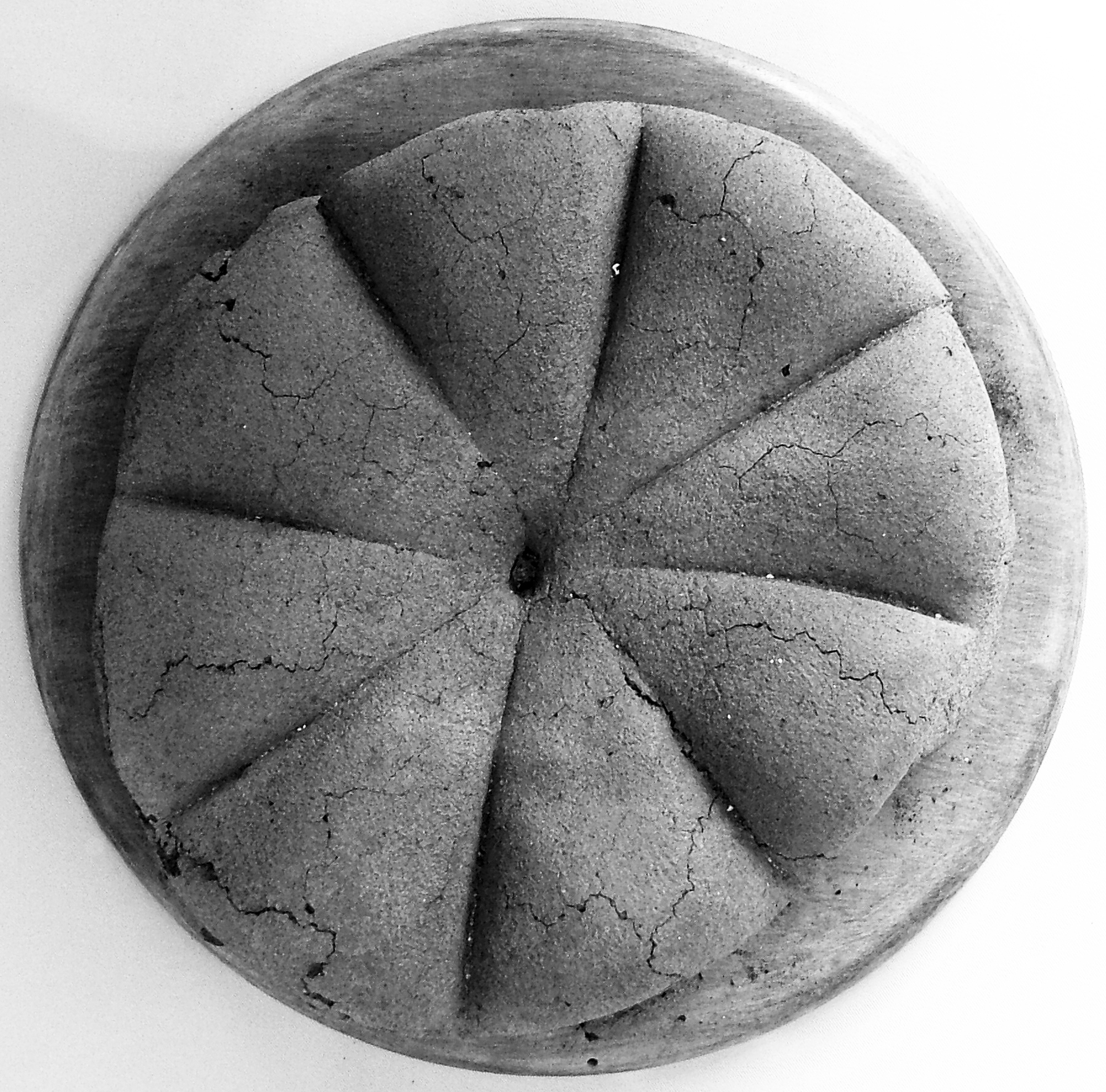
The remains of an ancient Roman bread pie from Pompeii, carbonized in the eruption of Vesuvius in 79 CE
The remains of an ancient Roman bread pie from Pompeii,
carbonized in the eruption of Vesuvius in 79 CE

The poem Moretum (discussed in my last post) narrates the preparation of a meal that can be characterized in modern English as ‘pizza.’  Round flatbread is baked; to go on it, a cheese spread is mixed.  The details of the narration are such as to create a recipe of its ingredients and related cooking instructions.  

The most important ingredient, however, is not an ‘ingredient’ as such, but a shape.  The bread, the cheese, and the cheese spread are all round.  That by itself might not seem remarkable, but the Latin terminology (words from which ‘orbit’ and ‘globe’ derive) is identical to then contemporary astrological terminology.  The bread is even scored into quadrants, symbolizing, among other things, the four elements and the quadrants of an astrological observer’s circle. 

The ancient audience of Moretum would have recognized in all this the world view of the Italian poet from southern Campania, Parmenides.  Though the only poem he is known to have composed is in Greek, the combination of the fact that he likely wrote it while in Italy and that it had over the centuries since its composition become one of the most influential philosophical works of pre-Christian antiquity meant Parmenides had special importance to Romans.  It is not surprising Moretum has the same meter and many of the poetic images as are found in the poem of Parmenides. Continue reading “Why Is Pizza Round? The Black Goddess of Rome by Stuart Dean”

It’s All About the Story by Esther Nelson

esther-nelsonEvery August my friend and colleague, Dale, preaches–does pulpit supply–at his local parish (St. Mark’s Episcopal) in our hometown.  He always has something valuable to say so I ventured forth eagerly on a recent Sunday morning to hear him even though “church” is something I gave up years ago.

Dale began his sermon noting that the news he reads online every morning while striving to keep an “ordered” and “routine” life is overwhelming.  Institutionalized racism, poverty, addiction, and lack of healthcare are problems that affect us all.  We live in the “wilderness”–both physically and existentially.  How do we cope?  He asserted that the Bible explores humanity’s response to what we call “the human condition” and then proclaimed, “Darkness does not have the last word.  God does.  Hope triumphs.”  Dale’s sermon reflected a perspective based on the tradition (story) he embraces–Christianity, however, the “particulars” of Biblical stories have universal themes.  One of the functions of religion is to create a “reality” that enables hope.  Dale gave three Biblical examples of “wilderness experience”–examples that included the promise of hope.  Continue reading “It’s All About the Story by Esther Nelson”

The Francis Blindspot by Gina Messina-Dysert

Gina Messina-Dysert profileThe day Pope Francis was elected is a memorable one for many Catholics, myself included.  Watching our new pope walk out on to the balcony of the Vatican and bow to the crowd left me in tears.  It seemed in Pope Francis we would have a leader who recognized the full humanity of every person in the community; and in asking the people for their blessing, he acknowledged the role we all play in the ministry of Jesus.

Named Time Magazine’s Person of the Year, boasting an astronomical approval rating of 90% among American Catholics, and more than 12 million Twitter followers, Francis has taken the papacy to a new level. People around the world continue to be mesmerized by his acts of kindness and mercy.  His commitment to social justice for the poor, simplistic living, welcoming message to persons of all faiths, and proclamation “Who am I to judge?” is refreshing to say the least.  Nonetheless, this does not mean Pope Francis does not have blind spots, nor that we do not have a responsibility to remind him of them. Continue reading “The Francis Blindspot by Gina Messina-Dysert”

My Problem with the “Proverbs 31 Woman” by Elise M. Edwards

elise-edwardsIn my home, in my journals and notebooks, and in my office, I display proverbs and quotes of all kinds around me to inspire me to live meaningfully. Proverbs and fables from around the world are stacked on my bookshelves and bedside tables. I love reading what is called “wisdom literature” in the Christian Scriptures. But when I get to those final lines of the Book of Proverbs in the Bible, Proverbs 31 sets me on edge.

Proverbs 31 is a poem that begins with sayings of King Lemuel described as “an inspired utterance his mother taught him.” Lemuel’s mother instructs him to not spend his strength on women, to refrain from drinking and to defend the rights of the poor and needy. Verses 10-31, the ones I’ve heard most often read in church settings, follow that advice. They are an acrostic poem of verses that begin with the successive letters of the Hebrew alphabet to describe a noble wife. Instead of reciting the entire A-Z list (A is for adoring, B is for busy, C is for caring, D is for dutiful…), Christians will frequently read aloud only the verses selected below.

Epilogue: The Wife of Noble Character

10 A wife of noble character who can find?
She is worth far more than rubies.
11 Her husband has full confidence in her
and lacks nothing of value.
12 She brings him good, not harm,
all the days of her life.

25 She is clothed with strength and dignity;
she can laugh at the days to come.
26 She speaks with wisdom,
and faithful instruction is on her tongue.
27 She watches over the affairs of her household
and does not eat the bread of idleness.
28 Her children arise and call her blessed;
her husband also, and he praises her:
29 “Many women do noble things,
but you surpass them all.”
30 Charm is deceptive, and beauty is fleeting;
but a woman who fears the Lord is to be praised.
31 Honor her for all that her hands have done,
and let her works bring her praise at the city gate.

I’ll admit it–the woman described here does sound honorable and praiseworthy.   My problem with this poem has more to do with the way I’ve heard it used than its content. In all but one setting, I’ve heard these verses proclaimed as a model for the ideal woman or as a guide to virtuous living for young women.

My first concern about that is a common feminist criticism: Not all women aspire to be wives and mothers. Some of the poem’s statements could apply to all women, like verse 21: “She opens her arms to the poor and extends her hands to the needy.” But others are specific to marital domestic life, like verse 28 (above) and verse 15: “She gets up while it is still night; she provides food for her family.” Women without husbands and children cannot meet all Proverbs 31’s standards. And while family is of primary importance to many women, it is not the only area of a woman’s life that can provide her value and meaning.

I am also concerned that defining Proverbs 31 as a standard of womanhood communicates the idea that it is about women only. While there are references to tasks that have been traditionally gendered (women cook and sew, men take leadership roles outside the home), many of the qualities extolled here are commendable for adults of all genders. Strength, dignity, wisdom, and care are not gender-specific virtues. So why haven’t I heard this proverb set as an example for men, too?

My third concern about making this a guide to womanhood is that it seems to reinforce a standard of perfection. The Proverbs 31 woman is certainly industrious—no one can call her idle! But she also sounds exhausted. By my count, this woman does 23 things surpassingly, including buying fields, planting vineyards, making clothes and selling them. I’m concerned that when emphasizing the Proverbs 31 woman tells Christian women that they are not good, are not lovable, or are not enough until they meet this standard. For me, the message of the Christian gospel is about God’s radical, all-encompassing love for humanity in the face of our imperfection. While I do know some women with a healthy self-image, many are painfully aware that they do not meet some standard set for them. They could stand to be told more often that they are loved simply because they exist, not for what they do.

When I heard Proverbs 31 read at my Aunt Ruby’s funeral , I began to see something more meaningful in these words than an impossible standard for women to attain. The preacher quoted “She is worth far more than rubies” noting my beloved aunt’s name and her character. However, the message he preached that day wasn’t to set a standard of a good wife. It was to honor a woman who had lived a noble life. She was strong, dignified and wise. Her family knew she was blessed and that they were blessed by having her in their lives. She worshiped God and communicated her love of the Lord to successive generations.

When I heard Proverbs 31 spoken about my aunt, I began to find resolution to my concerns. In that setting, the poem was an affirmation of a life lived well, not an exhortation to perfection. Honoring someone is primarily about demonstrating love or respect to that person, not a list of qualities or accomplishments. Certainly, the person we admire may have qualities we seek to adopt to our own lives, but following their model involves more creativity and agency than reducing a poem like Proverbs 31 into a list of standards allows. Integrating those qualities into our own lives requires adapting their traits to our own circumstances and even rejecting some of our model’s qualities that don’t fit the unique vision of our lives that we (or God) have. While I admire the Proverbs 31 woman’s work ethic, I strive for a life with regular periods of rest and renewal.

Elise M. Edwards, PhD is a Lecturer in Christian Ethics at Baylor University and a graduate of Claremont Graduate University. She is also a registered architect in the State of Florida. Her interdisciplinary work examines issues of civic engagement and how beliefs and commitments are expressed publicly. As a black feminist, she primarily focuses on cultural expressions by, for, and about women and marginalized communities. Follow her on twitter, google+ or academia.edu.