Feminist Interpretations by Elise Edwards

Elise EdwardsI’ve written a few posts recently referencing biblical themes or stories. I’m not a biblical studies scholar; I’m an ethicist and theologian. So I know that ways I use the texts disturb some people who study them from a historical or biblical studies perspective. To say I don’t use the Bible as those scholars do, though, doesn’t mean I don’t have a disciplined approach. I aim to apply a consistent approach to scripture and to encourage my students to do the same.

I get really annoyed when someone proclaims a variation of “The Bible says it; I believe it; that settles it!” in moral debates. Obviously, people within a religious tradition are going to believe there is truth in the scriptures of their tradition. That’s simply how scripture functions. So I’m okay with “I believe it.” I have a problem with the two other parts of the statement – the Bible says it, and that settles it. The assertion that “the Bible says it” masks the task of interpretation that anyone encountering a text takes on. The statement “that settles it,” when adopted in moral debate, rejects the accountability and humility in sharing our interpretations with others. Continue reading “Feminist Interpretations by Elise Edwards”

Two Wrongs Don’t Make a Right by John Erickson

Kim Davis does need a lot of things but saying of suggesting that she needs a haircut, a makeover, or even to lose weight, makes you and those that continue to repeat it no better than she is; to state such statements doesn’t purport the ideal that #LoveWins, which took over social media just mere months ago, but changes the whole narrative to symbolize that sexism and hate are more important than love and equality.

John Erickson, sports, coming out.Kim Davis, the defiant county clerk, is currently sitting in isolation in a jail cell after refusing to issue marriage licenses to same-sex couples in Rowan County, Kentucky, even after she was ordered by a judge to comply with the Supreme Court’s ruling on same-sex marriage or be held in contempt of court.

Everywhere I turn on both social media or in person people are talking about Ms. Davis, her actions, personal history and for some weird reason her hair and looks.   I’m all for individuals taking a virulent stand against an individual who chooses to not uphold the law of the land as well as continually acting in an unjust discriminatory way but bringing her looks or anything else about her physical appearance into the narrative is not only just plain wrong it is sexism in its worst form. Continue reading “Two Wrongs Don’t Make a Right by John Erickson”

Why Is Pizza Round? The Black Goddess of Rome by Stuart Dean

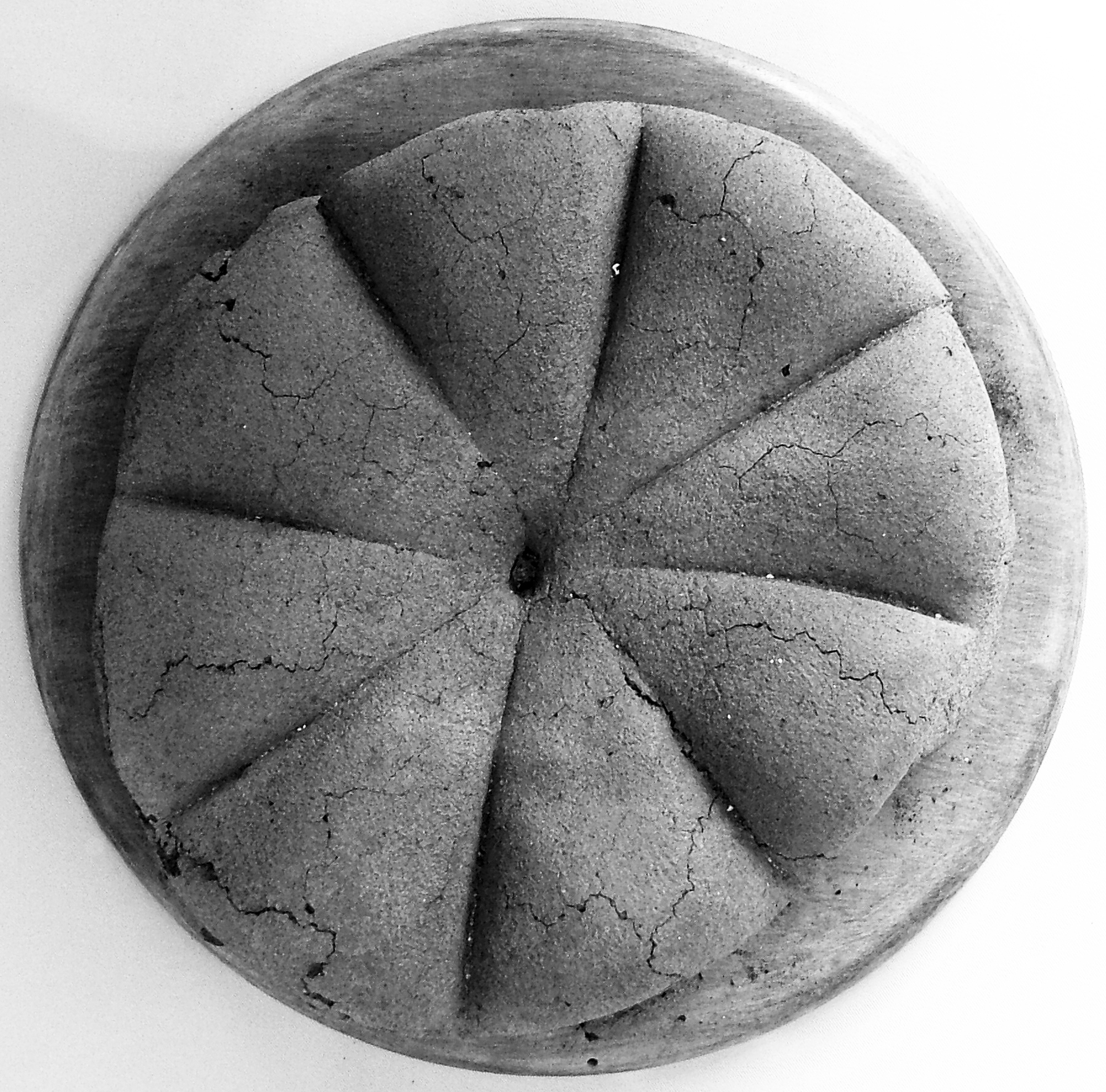
The remains of an ancient Roman bread pie from Pompeii, carbonized in the eruption of Vesuvius in 79 CE
The remains of an ancient Roman bread pie from Pompeii,
carbonized in the eruption of Vesuvius in 79 CE

The poem Moretum (discussed in my last post) narrates the preparation of a meal that can be characterized in modern English as ‘pizza.’  Round flatbread is baked; to go on it, a cheese spread is mixed.  The details of the narration are such as to create a recipe of its ingredients and related cooking instructions.  

The most important ingredient, however, is not an ‘ingredient’ as such, but a shape.  The bread, the cheese, and the cheese spread are all round.  That by itself might not seem remarkable, but the Latin terminology (words from which ‘orbit’ and ‘globe’ derive) is identical to then contemporary astrological terminology.  The bread is even scored into quadrants, symbolizing, among other things, the four elements and the quadrants of an astrological observer’s circle. 

The ancient audience of Moretum would have recognized in all this the world view of the Italian poet from southern Campania, Parmenides.  Though the only poem he is known to have composed is in Greek, the combination of the fact that he likely wrote it while in Italy and that it had over the centuries since its composition become one of the most influential philosophical works of pre-Christian antiquity meant Parmenides had special importance to Romans.  It is not surprising Moretum has the same meter and many of the poetic images as are found in the poem of Parmenides. Continue reading “Why Is Pizza Round? The Black Goddess of Rome by Stuart Dean”

It’s All About the Story by Esther Nelson

esther-nelsonEvery August my friend and colleague, Dale, preaches–does pulpit supply–at his local parish (St. Mark’s Episcopal) in our hometown.  He always has something valuable to say so I ventured forth eagerly on a recent Sunday morning to hear him even though “church” is something I gave up years ago.

Dale began his sermon noting that the news he reads online every morning while striving to keep an “ordered” and “routine” life is overwhelming.  Institutionalized racism, poverty, addiction, and lack of healthcare are problems that affect us all.  We live in the “wilderness”–both physically and existentially.  How do we cope?  He asserted that the Bible explores humanity’s response to what we call “the human condition” and then proclaimed, “Darkness does not have the last word.  God does.  Hope triumphs.”  Dale’s sermon reflected a perspective based on the tradition (story) he embraces–Christianity, however, the “particulars” of Biblical stories have universal themes.  One of the functions of religion is to create a “reality” that enables hope.  Dale gave three Biblical examples of “wilderness experience”–examples that included the promise of hope.  Continue reading “It’s All About the Story by Esther Nelson”

The Francis Blindspot by Gina Messina-Dysert

Gina Messina-Dysert profileThe day Pope Francis was elected is a memorable one for many Catholics, myself included.  Watching our new pope walk out on to the balcony of the Vatican and bow to the crowd left me in tears.  It seemed in Pope Francis we would have a leader who recognized the full humanity of every person in the community; and in asking the people for their blessing, he acknowledged the role we all play in the ministry of Jesus.

Named Time Magazine’s Person of the Year, boasting an astronomical approval rating of 90% among American Catholics, and more than 12 million Twitter followers, Francis has taken the papacy to a new level. People around the world continue to be mesmerized by his acts of kindness and mercy.  His commitment to social justice for the poor, simplistic living, welcoming message to persons of all faiths, and proclamation “Who am I to judge?” is refreshing to say the least.  Nonetheless, this does not mean Pope Francis does not have blind spots, nor that we do not have a responsibility to remind him of them. Continue reading “The Francis Blindspot by Gina Messina-Dysert”

My Problem with the “Proverbs 31 Woman” by Elise M. Edwards

elise-edwardsIn my home, in my journals and notebooks, and in my office, I display proverbs and quotes of all kinds around me to inspire me to live meaningfully. Proverbs and fables from around the world are stacked on my bookshelves and bedside tables. I love reading what is called “wisdom literature” in the Christian Scriptures. But when I get to those final lines of the Book of Proverbs in the Bible, Proverbs 31 sets me on edge.

Proverbs 31 is a poem that begins with sayings of King Lemuel described as “an inspired utterance his mother taught him.” Lemuel’s mother instructs him to not spend his strength on women, to refrain from drinking and to defend the rights of the poor and needy. Verses 10-31, the ones I’ve heard most often read in church settings, follow that advice. They are an acrostic poem of verses that begin with the successive letters of the Hebrew alphabet to describe a noble wife. Instead of reciting the entire A-Z list (A is for adoring, B is for busy, C is for caring, D is for dutiful…), Christians will frequently read aloud only the verses selected below.

Epilogue: The Wife of Noble Character

10 A wife of noble character who can find?
She is worth far more than rubies.
11 Her husband has full confidence in her
and lacks nothing of value.
12 She brings him good, not harm,
all the days of her life.

25 She is clothed with strength and dignity;
she can laugh at the days to come.
26 She speaks with wisdom,
and faithful instruction is on her tongue.
27 She watches over the affairs of her household
and does not eat the bread of idleness.
28 Her children arise and call her blessed;
her husband also, and he praises her:
29 “Many women do noble things,
but you surpass them all.”
30 Charm is deceptive, and beauty is fleeting;
but a woman who fears the Lord is to be praised.
31 Honor her for all that her hands have done,
and let her works bring her praise at the city gate.

I’ll admit it–the woman described here does sound honorable and praiseworthy.   My problem with this poem has more to do with the way I’ve heard it used than its content. In all but one setting, I’ve heard these verses proclaimed as a model for the ideal woman or as a guide to virtuous living for young women.

My first concern about that is a common feminist criticism: Not all women aspire to be wives and mothers. Some of the poem’s statements could apply to all women, like verse 21: “She opens her arms to the poor and extends her hands to the needy.” But others are specific to marital domestic life, like verse 28 (above) and verse 15: “She gets up while it is still night; she provides food for her family.” Women without husbands and children cannot meet all Proverbs 31’s standards. And while family is of primary importance to many women, it is not the only area of a woman’s life that can provide her value and meaning.

I am also concerned that defining Proverbs 31 as a standard of womanhood communicates the idea that it is about women only. While there are references to tasks that have been traditionally gendered (women cook and sew, men take leadership roles outside the home), many of the qualities extolled here are commendable for adults of all genders. Strength, dignity, wisdom, and care are not gender-specific virtues. So why haven’t I heard this proverb set as an example for men, too?

My third concern about making this a guide to womanhood is that it seems to reinforce a standard of perfection. The Proverbs 31 woman is certainly industrious—no one can call her idle! But she also sounds exhausted. By my count, this woman does 23 things surpassingly, including buying fields, planting vineyards, making clothes and selling them. I’m concerned that when emphasizing the Proverbs 31 woman tells Christian women that they are not good, are not lovable, or are not enough until they meet this standard. For me, the message of the Christian gospel is about God’s radical, all-encompassing love for humanity in the face of our imperfection. While I do know some women with a healthy self-image, many are painfully aware that they do not meet some standard set for them. They could stand to be told more often that they are loved simply because they exist, not for what they do.

When I heard Proverbs 31 read at my Aunt Ruby’s funeral , I began to see something more meaningful in these words than an impossible standard for women to attain. The preacher quoted “She is worth far more than rubies” noting my beloved aunt’s name and her character. However, the message he preached that day wasn’t to set a standard of a good wife. It was to honor a woman who had lived a noble life. She was strong, dignified and wise. Her family knew she was blessed and that they were blessed by having her in their lives. She worshiped God and communicated her love of the Lord to successive generations.

When I heard Proverbs 31 spoken about my aunt, I began to find resolution to my concerns. In that setting, the poem was an affirmation of a life lived well, not an exhortation to perfection. Honoring someone is primarily about demonstrating love or respect to that person, not a list of qualities or accomplishments. Certainly, the person we admire may have qualities we seek to adopt to our own lives, but following their model involves more creativity and agency than reducing a poem like Proverbs 31 into a list of standards allows. Integrating those qualities into our own lives requires adapting their traits to our own circumstances and even rejecting some of our model’s qualities that don’t fit the unique vision of our lives that we (or God) have. While I admire the Proverbs 31 woman’s work ethic, I strive for a life with regular periods of rest and renewal.

Elise M. Edwards, PhD is a Lecturer in Christian Ethics at Baylor University and a graduate of Claremont Graduate University. She is also a registered architect in the State of Florida. Her interdisciplinary work examines issues of civic engagement and how beliefs and commitments are expressed publicly. As a black feminist, she primarily focuses on cultural expressions by, for, and about women and marginalized communities. Follow her on twitter, google+ or academia.edu.

No Longer Moved … by Symbols that Once Moved Me Profoundly by Carol P. Christ

Carol in Crete croppedThis week Judith Plaskow and I submitted the final version of our new book Goddess and God in the World to our publisher at Fortress Press. Just before completion, I added a shorter version of the following passage to my final chapter. In it I tried to describe the odd feeling of not being moved any longer by a religion that once moved me profoundly. Our book, which explores an embodied theological method, will be out in the summer of 2016.

I have never regretted my decision to leave Christianity. Although I have a sentimental attachment to Christmas trees, Christmas dinners, Christmas carols, and some hymns, I miss little else about Christianity. At a distance of several decades, I find that I quite simply have no feeling for the Christian edifice of doctrines and rituals based on the life and death of a single individual. Jesus was a visionary, but there have been many others like him—including Martin Luther King, Elizabeth Cady Stanton, and Gandhi, all of them flawed, as Jesus must have been as well.

A few years ago, I decided to participate in the Greek Orthodox Easter week services, because they are attended by so many of my neighbors. But while enjoying the company of the women who decorated the epitaphios (tomb for Jesus), the procession through the streets of our town on Friday night, and the lighting of candles at midnight on Saturday, I came to a clear understanding that the Easter drama is no longer my drama. During the Thursday night services, I realized that many of the women were openly grieving the death of Jesus. Though intellectually I could understand that the Easter drama allowed my friends to release pent-up and repressed feelings, I found their deeply emotional response to the re-enactment of the death of Jesus bizarre.

P6115475
Idean Cave

In leaving Christianity, I had gained the freedom to name the sacred in my own experience, confirmed my deep inner knowing about the human connection to nature, and found the power to create and participate in rituals that have meaning in my life. For me now, the rituals on the Goddess Pilgrimage to Crete are at the center of my spiritual life. To listen to Alice Walker’s words, “We have a beautiful/mother/Her green lap/immense/Her brown embrace/eternal/Her blue body/everything we know”* on a mountaintop or to repeat Ntozake Shange’s cry, “we need a god who bleeds now/whose wounds are not the end of anything”** at the mouth of a cave, moves me more than any passage from the Bible.

Singing “Light and Darkness” in the depths of caves is an embodied act of reclaiming the womb as a symbol of creation and the darkness as a place of transformation. I still enjoy singing the Doxology (Hymn of Praise)—and doing so connects me to my history. But I now sing it in front of altars laden with summer fruits or winter vegetables and with words that express my spirituality: “Praise Her from whom all blessings flow/Praise Her all creatures here below/Praise Her above in wings of flight/Praise Her in darkness and in light.”***

*Alice Walker, “We Have a Beautiful Mother,” Her Blue Body Everything We Know: Earthling Poems 1965-1990 (New York City and Orlando, FL: Harcourt Books, 1991), 459-460.
**Ntozake Shange, “we need a god who bleeds now,” A Daughter’s Geography (New York: St. Martin’s, 1983), 51.
***See Carol P. Christ, She Who Changes: Re-imagining God in the World (New York: Palgrave Macmillian, 2003), 238, for a discussion of the meaning of the new words.

Carol P. Christ leads the life-transforming Goddess Pilgrimage to Crete (facebook and twitter).  Carol’s books include She Who Changes and and Rebirth of the Goddess; with Judith Plaskow, the widely-used anthologies Womanspirit Rising and Weaving the Visions and forthcoming in 2016 from Fortress Press, Goddess and God in the World: Conversations in Embodied Theology. Explore Carol’s writing. Photo of Carol by Maureen Murphy. Photo of Idean Cave by PJ Livingstone.

A Day of Peace: On the Anniversary of Michael Brown’s Death by Qumyka Rasheeda Howell

Q Howell

I remember when I heard of the death of Michael Brown who was shot by a Ferguson, Missouri Police Officer exactly one year ago today. His bloody body laid in the middle of the street for four hours before receiving help. I wondered if Michael Brown would still be alive today if he hadn’t been shot and left for dead. I remember looking at my beautiful black sons that night as they slept. I wept until my knees gave way. I do not think I have stopped weeping as I continue to be imbued with reports of black and brown bodies dying at the hands of police officers month after month.

One year later, I am still grieving and praying. I am still tired. I am now joined into a call with my sisters who work alongside me in the anti-violence movement. We held each other as we listened over the phone.  Then my friend Corine Reed gets our attention. She says it’s time for peace. That word, peace, was the divine pause I needed. I think it is what the world needs right now – PEACE. Continue reading “A Day of Peace: On the Anniversary of Michael Brown’s Death by Qumyka Rasheeda Howell”

Mary Magdalen’s Cave by Elizabeth Cunningham

Elizabeth Cunningham headshot jpegMy first post for FAR appeared on July 22, 2012, the feast day of Mary Magdalen. I like to dedicate my July posts to her and include an excerpt from The Maeve Chronicles, the novels I spent 20 years writing, which feature a feisty Celtic Magdalen who is no one’s disciple. This year’s excerpt is from Bright Dark Madonna, the third in the series, which follows her (mis)adventures from Pentecostal Jerusalem, to the wilds of Turkey’s Taurus Mountains, the port city of Ephesus, and finally to her legendary cave in France.

While doing research for the novel, I made a pilgrimage to Le Grotte de Marie Madeleine in Southern France. A forty-five minute climb, past a spring leads to a high cliff wall where a spacious cave has been made into a chapel to the saint. There were no other people at the site except my husband and daughter who kindly gave me time alone in the cave—alone with her. As I wrote in FAR’s pages a while back, I have a longing for hermitage that I haven’t allowed myself to fully inhabit. Maeve, on the other hand, goes all out, or rather, in.   Here is what she has to say: Continue reading “Mary Magdalen’s Cave by Elizabeth Cunningham”

An Indecent Reading of Mary Magdalene by Cynthia Garrity-Bond

cynthia garrity bondRecently I took one of those on-line quizzes that show up on Facebook. Based on my response to particular questions, it promised to tell me what my Biblical name would be. To my joy I received Mary Magdalene. To my disappointment her bio lacked any of the historical tensions we have come to expect.

On July 22 we celebrate the Feast Day of Mary Magdalene, witness to the Resurrection and therefore deemed, “apostle to the apostles.” For as many depictions of Mary there are just as many interpretations. Her status in early Christianity surpassed the Virgin Mother in popularity but by the fourth century her positive image began to decline. In 594 Pope Gregory the Great delivered a sermon in which he conflated the story of the unnamed woman anointing Jesus in the Gospel of Luke with Mary of Magdala as penitent whore, a title she would embody for nearly 1,400 years until in 1969 when the Catholic Church repealed its teaching of Mary as prostitute.

On the other hand, recent feminist theological scholarship, especially by Karen King, offers a depiction of Mary as leader within ecclesial settings, where, “From the second to the twenty-first century, women prophets and preachers have continued to appeal to her to legitimate their own leadership roles,” (King, 153). By casting Mary as prostitute and adulteress, King argues, the church tarnished the image of Mary as a spiritual leader. It is this binary of Mary as repentant whore or “prominent disciple of Jesus, a visionary, and a spiritual teacher” (King, 154) that I wish to explore.

To begin I ask the question what does it mean for Mary’s role as leader for her to have been a prostitute who also functioned, in the words of King, as disciple of Jesus, a visionary and spiritual teacher? Continue reading “An Indecent Reading of Mary Magdalene by Cynthia Garrity-Bond”