On Reading, Not Reading, and Disagreeing by Linn Marie Tonstad

Linn Marie TonstadThe theology blogosphere in all its glory has been alive in recent days with furor sparked by a blog post from Janice Rees at Women In Theology, where she discusses not reading Karl Barth, the heavyweight German 20th-century Protestant theologian, as an act of resistance against his dominance in the theological academy and his status as a litmus test for serious scholarship. Reminding myself repeatedly of the great xkcd comic, I’ve resisted my urge to comment on this and a number of other recent debates. (See here for a list of links if you wish to catch up on the discussion, however.) So this is not a post on whether to read Karl Barth.* Rather, the debate made me take a look at some of my own reading practices, and the visions of theological discussion that they encode. It also brought me back to the question of feminist disagreement, which continues to lurk in the back of my mind as I pursue disagreements with some prominent feminist theologians in my current book project.

I’ve written here before about reading authors that I disagree with, and indeed working on theologians I think are wrong about certain issues. On the simplest level, as a feminist and queer theologian, many of the theologians I work on would have questioned or outright resisted my participation in the discipline to begin with – although we cannot always know whether and how they would have done so today (since many of them are dead – yes, the dreaded dead white European males). But I often – not always – find projects that I sincerely disagree with utterly fascinating. From what perspective does the system being developed in such a project make sense? Where would one have to stand to see what that author sees? What do I come to understand about my current context, or the author’s context, from the perspective of the debates and decisions that the author finds pressing? One fairly trivial example: any interest I might once have had in historical Jesus debates was settled forever by reading Albert Schweitzer as an undergraduate. I simply do not find such debates compelling in themselves. (That does not mean I think they are valueless, of course!) But reading theologians who were engaged in such debates teaches me a great deal about how the commonsense assumptions many of us today operate with came to be. And seeing how such debates accompany disagreement over right social relations, over the nature of transmission of Christian traditions, and over what counts as scholarship in theology and religious studies is simply fascinating. Continue reading “On Reading, Not Reading, and Disagreeing by Linn Marie Tonstad”

The Difference a Feminist Makes by Elise M. Edwards

Elise EdwardsOf the many reasons I am grateful for feminismandreligion.com, I have to say that I am most grateful for the time it requires of me to reflect about feminism’s impact in my life, faith, and work.  I decided it was time to reflect on this question: What difference does feminism make for the way I structure and approach my classes?

I recently started a new position as a full-time lecturer in the Department of Religion at Baylor University.  Earlier this week, I attended a gathering for the department, where I was introduced, along with a few others, as new faculty.  At the end of the evening, the wife of a retired male professor introduced herself to me and remarked about how happy she was to see more women in the department. (Four full-time faculty members were hired this year, and three of us are women.)  She had been looking forward to this kind of change for quite a while.  I was appreciative of her remarks, just as I have been generally pleased with the warm reception I have received around the University.

Her excitement about the increase in the number of women faculty provoked me to reflect on what I add to my department, particularly for my undergraduate students.  I have thought before about how, from a purely representative standpoint, I bring something different to the faculty.  I have thought about how my students may not have previously had a professor–especially a religion professor–who looks like me.  Even if they had, I’ve had different life experiences than many of my colleagues, and that this bears on my approach to theology and ethics.  Therefore, the research I do and share is distinctive in its approach.  Yet, I am slightly embarrassed to admit that I have not given much thought about how my being a black feminist woman might impact my students.  I am tempted to blame it on the fact that I have just been trying to keep my head above water in a new position.  Of the many reasons I am grateful for feminismandreligion.com, I have to say that I am most grateful for the time it requires of me to reflect about feminism’s impact in my life, faith, and work.  So I decided to reflect on this question: What difference does feminism make for the way I structure and approach my classes? Continue reading “The Difference a Feminist Makes by Elise M. Edwards”

Beyond Hemlines: What a Pope Can Teach Us About Modesty by Deborah Farmer Kris

DeborahPhotoPope Francis’ obvious decency appeals to me as a human.  His discourse and homilies appeal to me as a Christian.

But his humble actions appeal to me as a Mormon woman who is weary of witnessing, over and over, how we culturally misuse the term “modesty” and reduce it to base rules governing the attire of (primarily) teenage girls.

Pope Francis gives me hope for the future of our modesty discourse because in five months, he has somehow managed to make humility and  modesty cool again.

First, let’s look at modesty as discussed in the Catholic Catechism:

  • Modesty protects the intimate center of the person. It guides how one looks at others (author note: not how others look at you) and behaves toward them in conformity with the dignity of persons and their solidarity. Modesty inspires a way of life which makes it possible to resist the allurements of fashion and the pressures of prevailing ideologies. Teaching modesty to children and adolescents means awakening in them respect for the human person. Continue reading “Beyond Hemlines: What a Pope Can Teach Us About Modesty by Deborah Farmer Kris”

Interview an Atheist at Church Day by Kile Jones

Kile Jones, atheistAs some of you may know, I run a project called “Interview an Atheist at Church Day.”  This project aims at bettering understanding and furthering dialogue between atheists and Church-going religious persons.  So far we have had over a dozen interviews take place, and we have more in the making.  If you are a pastor interested in interviewing an atheist during service, or an atheist willing to be interviewed, please contact us here.

Our most popular interview so far is with Neil Carter (atheist) at a church in Mississippi.  You can read up on it here and watch it below.  At Feminism and Religion, I have made it my task to highlight some strong atheist women, and discuss some of the ways in which they can work together with religious women (sometimes this can cause a little friction).  Gretta Vosper, a pastor in Canada, is just such a woman.  She was interviewed as an atheist IN HER OWN CHURCH!  If you are not familiar with her work, I highly recommend it.  Another strong atheist woman who has participated in this project is Sarah Kaiser.  She works with the Center for Inquiry promoting LGBTQ rights. Continue reading “Interview an Atheist at Church Day by Kile Jones”

The Institutional Silencing of Women by Natalie Weaver

Natalie Weaver

On July 26, 2013, I had the opportunity to hear Rev. Helmut Schüller speak at the City Club of Cleveland’s Friday Forum.  He spoke to a convened audience of around 150 people, in addition to the much greater broadcast audience, and he responded to questions that ranged from wholly supportive, to sincerely questioning, to highly critical.  I myself sat with a group of vowed religious women from Pittsburgh who seemed enthusiastic about Rev. Schüller’s Austrian Priests’ Initiative, while behind me sat a table of obvious, vocal critics.

Rev. Schüller’s initiative, now represented by over 400 priests, began in 2006 as an effort to mobilize priests to lead the way for change in the Catholic Church in at least four crucial areas: women’s ordination; married priesthood; same-sex marriages; and lay participatory voting in the election of their bishops.  Of course, Catholics have been having these conversations long before the Priests’ Initiative.  What makes Father Schüller’s work different is that it is an “insider job.”  He argued that the laity have done their part, and now it is time for the clergy to speak, even at some personal and professional risk to themselves. Continue reading “The Institutional Silencing of Women by Natalie Weaver”

Rescuing Martha from the Dishes: A Challenge of Retrieval and Proclamation by Mary Grey – Part III

Rescuing Martha – A Hermeneutic of Retrieval
This is the last part of a three part post. Read Part I here and Part II here. 

Discovering another tradition means being open not only to artistic witnesses but to myth, legend, and to feminist theory. But to begin with what is uncontested: both sisters, Mary and Martha, were friends of Jesus who loved them and their brother Lazarus. Martha seems to be the householder. We are told nothing about the parents of the three – perhaps they had been caught up and killed in one of the Zealot uprisings. The Church that sprang up at the site of Bethany was one of the earliest Christian pilgrimage places.  The legends that grew up held Lazarus and his 2 sisters in great respect. And this is a sharp contrast with the tradition I began with.

Secondly, to disparage responsibility for housework as a lowly role is an anachronistic viewpoint. It is likely, as in most poor agricultural communities today that domestic work goes alongside income- generating work either inside or outside the house. Many rural women in India and Africa cope with domestic work, child care and a full day’s work in the fields. In the life-time of Jesus, women would be involved in cleaning fish and mending nets – though the Gospels do not tell us this.  Nor was this the work of the sisters at Bethany who did not live near Lake Galilee. The public/ private split between unseen work in the household and public work belongs to a much later date. Thirdly, it is diakonia or service that is at stake here, and this was part of a creative tension in the early communities. Continue reading “Rescuing Martha from the Dishes: A Challenge of Retrieval and Proclamation by Mary Grey – Part III”

Rescuing Martha from the Dishes: A Challenge of Retrieval and Proclamation by Mary Grey – Part II

What do the Gospels of Luke and John tell us?
This is the second part of a three part post. Part I is here and Part III is to follow tomorrow. 

I now return to the story of Mary and Martha in the gospel of Luke: what was its purpose for the evangelist and his community? The text itself has been a subject of multiple interpretations. An abstract interpretation sees the sisters as representing two different principles, one as justification by works and one by faith. Augustine (d.430) saw them as symbolising either the labours of this world and the bliss of the world to come. Origen (185-254), famous for his allegorising interpretation of Scripture, understood them as life according to the flesh or according to the Spirit. So, as Elisabeth Schüssler-Fiorenza points out in But She Said: Feminist Practices of Biblical Interpretation (1992:58), this typologising contrast was already established by the end of the 2nd century.  In a contemporary context Martha and Mary continue to exemplify the two vocations that the church offers to women, contemplative love of God (Mary), or social activism through service of neighbour (Martha). Continue reading “Rescuing Martha from the Dishes: A Challenge of Retrieval and Proclamation by Mary Grey – Part II”

Rescuing Martha from the Dishes: A Challenge of Retrieval and Proclamation by Mary Grey – Part I

Introduction and Martha – Patron Saint of Housewives

Here I explore a troubling issue for feminist biblical interpretation, namely the interpretations of Luke 10, 38-42, with specific reference to the figure of Martha, and the questions that arise when we compare John’s story, the Raising of Lazarus (John 11.1-44).  At first sight Luke seems clear: Martha is troubled with the domestic task of preparing food, while Mary has gone to the heart of the matter, listening to the word of God at the feet of the Lord. Mary is always depicted at the feet of the Christ, while Martha is the active one and this is often interpreted negatively. (One interesting exception is Giotto’s fresco of the raising of Lazarus, where both sisters are prostrate at Jesus’ feet). A clear message seems given for Christian discipleship and this text has had an evocative power through history. But on reading John’s story, are the roles reversed? Martha runs to greet Jesus, Mary remains at home. From Martha comes the confession of faith in Jesus:

Yes, Lord; I believe that you are the Christ, the Son of God, he who is coming into the world. (John 11.27)

What we are given is a full confession of faith on Jesus as Son of God, the confession which is on the lips of Peter in the 3 Synoptic Gospels, (Luke 9.20, Mark 8.29, Matthew 16.15-17).

Why is it, then, that Christian Tradition has largely ignored the Johannine text and followed Luke, even a negative interpretation of Luke? Continue reading “Rescuing Martha from the Dishes: A Challenge of Retrieval and Proclamation by Mary Grey – Part I”

Hidden Meanings in the Rituals of the Assumption by Carol P. Christ

carol-christ“[T]he Old European sacred images and symbols were never totally uprooted; these persistent features in human history were too deeply implanted in the psyche.  They could have disappeared only with the total extermination of the female population.” Marija Gimbutas, The Language of the Goddess, 318.

August 15 is known to Greek Christians as the date of the Koimisi, “Falling Asleep” or Dormition of the Panagia, She Who Is All Holy.  December 25 is a minor holiday in the Orthodox tradition, while Easter and August 15 are major festivals.  The mysteries of Easter and August 15 concern the relation of life and death.  In Orthodox theology, both Easter and August 15 teach that death is overcome:  Jesus dies and is resurrected; Mary falls asleep and is assumed into heaven.  These mysteries contain the promise that death is not the final end of human life.  Yet this may not be the meaning of the rituals for many of those who participate in them.

In Christus Victor, Gustaf Aulen argued that Eastern (Orthodox) and Western (Catholic and Protestant) traditions understood salvation differently.  The Western Church focuses on salvation from sin, while the Eastern Church focuses on transcending death.  This contrast is not absolute, as for the Western Church sin is the cause of death and when sin is overcome, immortal life is restored.  While Orthodoxy has strong ascetic and monastic traditions, it does not teach ordinary Christians to focus on sexual purity and impurity as Western traditions have done.  Nor is there a strong emphasis on transforming collective sin in movements for social justice.  Significantly, though Roman Catholics and others consistently refer to the “Virgin Mary,” Orthodox Christians prefer “Panagia,” She Who Is All Holy.

In Greece the ordinary rhythms of life are disrupted at Easter and in August.  During lent, many women (and some men) fast, while in August women named Mary and Panagiota–as well as others who wish to honor or petition the Panagia–wear black for two weeks.
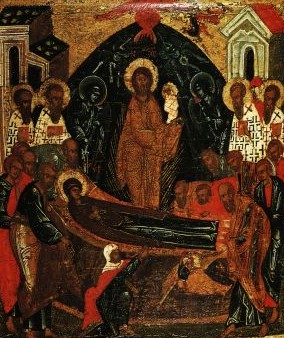
Assumption1Throughout the first 2 weeks of August, Greek Christians focus on the death of the Panagia.  According to theology, her Son appears after her death and “assumes” her into heaven.  The Orthodox icon depicts Mary surrounded by the Apostles, while Jesus holds the assumed body of Mary depicted as an infant wrapped in swadling clothes.

When she first saw this icon, my friend Naomi Goldenberg commented that it is an example of the widespread attempt on the part of men to appropriate the power to give birth.  The icon reverses the symbolism of the nativity where the baby wrapped in swadling clothes is held in the hands of his mother.  Christian baptism described as re-birth through the Father, Son, and Holy Spirit is another version of “male birth.” Continue reading “Hidden Meanings in the Rituals of the Assumption by Carol P. Christ”

Painting Georgia O’Keeffe by Angela Yarber

Hailed as the Mother of American Modernism, her seemingly vaginal flowers lauded by feminists and artists alike, Georgia O’Keeffe stands as a sentinel for strong, creative women who balk at tradition and embrace a faraway freedom.  Though she adamantly denied any association with female genitalia embedded in her sensuously up-close-and-personal flowers—even from feminist artists as famed as Judy Chicago—she remained a female force unbound, painting, living, loving, and creating on her own terms.  So, it’s no wonder that she joins my Holy Woman Icons with a folk feminist twist: Virginia Woolf , the Shulamite, Mary Daly, Baby Suggs, Pachamama and Gaia, Frida Kahlo, Salome, Guadalupe and Mary, Fatima, Sojourner Truth, Saraswati, Jarena Lee, Isadora Duncan, Miriam, and Lilith.

Born in November 1887, O’Keeffe knew she would be an artist from the young age of seven.  Whether you’re familiar with her intricate flowers, soaring skyscrapers, or desert skulls depends largely on the period of her life that interests you.  Whether it was the rural Wisconsin farm of her childhood, the bustling city of New York where she began her relationship with famed photographer Alfred Stieglitz, the peaceful lake in the Adirondack Mountains where they summered, or the harsh desert landscapes of New Mexico where she devoted her later years, she found inspiration and captured beauty wherever she lived, camped, traveled, hiked, or drove in her Ford Model A.  Continue reading “Painting Georgia O’Keeffe by Angela Yarber”