

 Part of my research is focused on how the social sciences relate to “religion” and religious studies. More specifically, I spend time examining the sociology of religion. I look at stats, demographics, and polls. I look at rates of attendance, frequency of prayer, levels of “religiosity,” apostates (or the less religiously-loaded term “exiters”), and political outlooks. I also look at how bias this area of study is in favor of religion. One facet of this work that has always interested me, is the differences in “gender” and “sex” as they relate to religious beliefs and observances. Accepting the fact that there are spectrums of sex, gender, and identity, and the presence of difficult philosophical questions surrounding self-identification and the limits of labels, some really interesting facts and statistics crop up time and time again. In what follows I will lay out a couple of these interesting facts, along with some thoughts on them: Continue reading “5 Interesting Facts about Women and Religion by Kile Jones”
Category: Christianity
Mormon Feminism and the Need for Ritual and Practice Creation by Caroline Kline
 In the past year, Mormon feminist activism has exploded. Wear Pants to Church Day, Let Women Pray, and Ordain Women are three recent projects which encouraged Mormon feminists to agitate collectively and put pressure on the institutional LDS Church to be more inclusive. I was proud to be involved in each of these, and I see this new activism as enormously important. Not only has it led to actual change (a woman did recently pray in General Conference), but this kind of public agitating also creates more space within the fold for Mormon feminists, so often silent about their questions, to discuss their feminist convictions and hopes with other Mormons.
Over the last few months, however, I have had the growing sense that pressuring the institution for change is only one part of our feminist struggle. We also need to begin developing our own community practices, our own rituals, and our own traditions. We need practices we can pass on to the next generations of Mormon women, so that our granddaughters and great nieces can turn to these traditions and find insight and inspiration in them. Continue reading “Mormon Feminism and the Need for Ritual and Practice Creation by Caroline Kline”
Painting Lilith, Leaving Church by Angela Yarber

Lilith has been a misunderstood, appropriated, and redeemed woman throughout the ages. Many feminists claim her as an empowering figure in Jewish mythology, her story reclaimed by contemporary artists such as Sarah McLachlan, who created the all-women music tour, “Lilith Fair.” Others have claimed that Lilith was a demon who seduced men and strangled children in the night.
Based almost entirely on Judith Plaskow’s beautiful Midrash, “The Coming of Lilith,” this new Holy Woman Icon with a folk feminist twist has empowered me to reject the sexism and heterosexism that was rendering me broken. So, she joins Virginia Woolf , the Shulamite, Mary Daly, Baby Suggs, Pachamama and Gaia, Frida Kahlo, Salome, Guadalupe and Mary, Fatima, Sojourner Truth, Saraswati, Jarena Lee, Isadora Duncan, and Miriam as powerful women who have done holy and remarkable things. First, her story. Then—if I may—my own.
Continue reading “Painting Lilith, Leaving Church by Angela Yarber”
Creating Ritual by Linn Marie Tonstad
 Last time, we considered whether the creation of rituals, I mean habits, might serve as an antidote to depression, or as a way of managing depression. But the creation of ritual has had a much more significant role in feminist religious practice than such an approach might suggest. Currently, WATER – Women’s Alliance for Theology, Ethics, and Ritual, a leading center for feminist religious thought – creates multiple rituals marking various seasons and events in the year, most recently for the summer solstice. These rituals can provide alternative ways of marking the year’s rhythms, and they can serve as ways to take control of liturgical spaces that have tended to exclude women or to allow women to serve only in various subordinate roles.
Yet the terminology is odd. What does it mean to create a ritual? If I think of the rituals of my childhood, what presented itself to me as ritual was connected either with religious practice, or with seasons of exception. Indeed, the most stylized rituals of the year were areligious (as I understood religion). They took place on Christmas Eve. First, during the distribution of presents, my father would put on a terrifying, horrifying, grotesque Santa mask. It was intended, clearly, to be a friendly Santa, which was why its leering was so fundamentally disturbing. My sister and I would try to run away, emotionally and sometimes physically petrified by the transformation of our father into this monster. Second, after Christmas dinner, we would eat cold rice porridge with cream and try to get an almond – “mandel i grøten” in Norwegian tradition. Getting the almond, which is blanched and hidden in the porridge, is considered an auspicious omen for the new year, and requires that the finder be given a gift – traditionally, a marzipan pig. Continue reading “Creating Ritual by Linn Marie Tonstad”
Adventures in Churchgoing by Elise M. Edwards
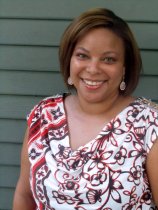 I am often greeted by warm smiles and handshakes–and sometimes even hugs–from churchgoers around me. But I wonder if the friendly people would be so welcoming if they knew that I identify as feminist.
It’s hard being a feminist and visiting a new church. I’ve recently moved to Texas from California and I’m looking for a church to attend. There are many things I love about church: corporate worship, talks with people of faith, gatherings where friendships are built, and opportunities to serve and to learn. I also love to sing, and my not-ready-for-primetime voice would love to join a choir with and contribute to other people’s worship experience.
In my past, I’ve been a member (or regular attender) of churches where I felt welcomed and affirmed. Yet, I always feel defensive when I seek out new places to worship. I question whether a church will be affirming to women and girls as whole selves – as embodied, thinking, feeling beings. I mentally prepare myself to hear male imagery and language for God and I pray themes of male headship vs. female servanthood are not expressed. I feel like an investigator seeking out clues to determine our compatibility. It’s no wonder that I’ve recently heard several people compare visiting churches to dating.
Continue reading “Adventures in Churchgoing by Elise M. Edwards”
To Have and to Hold: Gay Marriage and the Religion Question
If a conservative religious traditions can’t give their mothers or sisters full equality, how can we expect them to give a GLBT individual the time of day?
 Outrage. Anger. Fear. Hatred. These are just a few of the words that flashed across my Twitter feed as I woke up on that fateful Wednesday, June 26 morning when the Supreme Court of the United States ruled that the Defense of Marriage Act (or DOMA) was unconstitutional and that supporters of Proposition 8, the hotly contested voter initiative in California that banned same-sex marriage, had no standing. People were mad. However, it wasn’t just the typical kind of mad that is associated with hatred, it was a type
  of mad that was met with impossible anguish because what I was reading and feeling was a result of one thing: there was nothing more they could do.
What does all this mean? Questions from friends and family were filling up my inbox and although I wanted to take a moment to just hit “Reply All,” and input the words: Equality, I had to hold back and start to examine the notion that although equality may now be firmly on the proverbial table, there is still a lot of work to be done, specifically for gay marriage and those wanting to marrying inside the traditional church spaces they grew up in and not just the ones that have come out as open and affirming in recent years towards LGBT individuals. Continue reading “To Have and to Hold: Gay Marriage and the Religion Question”
The ‘Other’ as Target Market in Pentecostal Brand Evangelism by Andreea Nica
 In my last post, Leaving Behind My First Love, I mentioned I would examine the historical significance of Pentecostalism and how it relates to the marketization of the church and patriarchal standards. I realize this is a complex topic that involves many theoretical frameworks and conceptualizations, so I do welcome your thoughts. In this post, I will be highlighting trends regarding the marketization of Pentecostalism, brand evangelism as a marketing strategy, and how concepts of neo-liberalism intersect with the Pentecostal faith.
Pentecostalism stems from Evangelical Protestantism incorporating spiritual elements such as speaking in tongues (glossolalia), charismatic leadership, religious healings, and ecstatic praise and worship. Modern Pentecostalism dates back to 1906 at the Azusa Street Revival. However, the First Day of Pentecost can be found in the Book of Acts when Jesus’ disciples gathered in a room and began to speak in different languages. Continue reading “The ‘Other’ as Target Market in Pentecostal Brand Evangelism by Andreea Nica”
Women’s Erasure in Patriotic Songs by Caroline Kline
A couple of weeks ago, I attended my first grader’s school Patriotic Program. At home he had been singing snatches of “Fifty Nifty United States,” “Proud To Be an American,” and “America the Beautiful” for the last few weeks, so I was not surprised by the selection of songs. What did surprise me, when I actually sat down and listened to several verses of these songs, was the extent of the God language present in them (I thought public schools would avoid that a bit more) and the fact that many of these songs featured verses that were overtly androcentric.
Take “Proud to be an American.” The chorus is: “And I’m proud to be an American,/where at least I know I’m free./And I won’t forget the men who died,/who gave that right to me./And I gladly stand up,/next to you and defend her still today./‘ Cause there ain’t no doubt I love this land,/God bless the USA.”
Continue reading “Women’s Erasure in Patriotic Songs by Caroline Kline”
A Divine Gift by Elise M. Edwards
I recently graduated with a PhD, and I have been fortunate enough to have many occasions to celebrate this milestone within the past month. At the beginning of this month, I visited my parents in my hometown, and they threw a graduation party for me. In addition to a great number of family members and friends who came to the party, several members of the Baptist church I attended in my 20s and early 30s came to celebrate as well. I received many wonderful graduation gifts. Surprisingly, some of the gifts led me to reflect on my faith convictions, namely some of the tensions I wrestle with.
A woman whom I had served on many committees with and worked closely with on plays and other artistic activities gave me an especially thoughtful gift. It is a beautiful wooden plaque with the word “STRENGTH” at the top in capital letters and my name at the bottom in capital letters. In between the two are decorative flourishes and these words from the New King James Bible: I can do all things through Christ who strengthens me. (Philippians 4:13) Continue reading “A Divine Gift by Elise M. Edwards”
God Doesn’t Live Here Anymore: Gay Bars and the Growing Divide Between Sexuality and Spirituality by John Erickson
oes God exist within the LGBTQ community anymore or has the community itself abandoned God for all-night raves, dance clubs, alcohol, and hypersexualized and over commoditized fetishized forms of femininity and masculinity? Oftentimes, I find myself answering yes to the above questions. After surviving hate crime after hate crime and endless batches of newly elected conservative politicians hell bent on ignoring medical and social epidemic plaguing the very country they were elected to serve and protect, why would a community, oftentimes linked to sin itself, believe in a holy entity?
My good friend and fellow Feminism and Religion Contributor Marie Cartier’s forthcoming book, Baby You Are My Religion: Women, Gay Bars, and Theology Before Stonewall argues that American butch-femme bar culture of the mid-20th Century should be interpreted as a sacred space. Specifically, gay bars served as both communal and spiritual gathering spaces where butch-femme women were able to discover and explore not only their sexuality but also their spirituality. An opus of an academic accomplishment based off of the amount of in-depth interviews she conducted, Professor Cartier explores lived religion in an area that has become all too common within the LGBTQ community: the bar
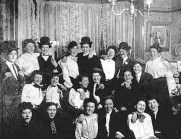
The Palms, the last local and only lesbian bar to be found in city of West Hollywood, CA is closing its doors and I can’t help but wonder where its patrons or parishioners will now go? Continue reading “God Doesn’t Live Here Anymore: Gay Bars and the Growing Divide Between Sexuality and Spirituality by John Erickson”
 Feminism and Religion