You may be tired of the controversy about Chick-fil-A, but the events of the last few weeks revealed a big issue in the organization – that of discrimination and the illusion of religious freedom. However discrimination exists beyond the LGBTIQ community, it applies to Catholics and those “outside” their strict fundamentalist belief system. However, the hierarchy in the Catholic Church seems to be embracing many of the beliefs put forth by Evangelical Fundamentalists in the political arena.
When it was time for my eldest daughter to get her first job, she applied and was hired to work at Chick-fil-A. Knowing they were a Christian organization, I felt that she would be well treated and we could still have family time on Sundays. Everything started out o.k. but the longer she worked there, problems developed. First, when I stopped through the drive-thru to show my support as her mother, I received apocalyptic material in my bag talking about the end times, where my soul would go, and inviting me to their church. I found the material offensive and never returned. Despite the organization’s community support and “Christian” values, I was still fairly naive about their discriminatory practices that many experience on a daily basis.
I haven’t eaten fast food in many years; however as a new mom Chick-fil-A offered something quite different than other fast food chains: healthy options, freshly made food, clean space, and a great spot for play dates; not to mention the organization’s commitment to the environment. My daughter and I have made many trips to our local franchise in the last year. It became a usual spot for play dates, the go to place for dinner when I was on a time crunch (grilled chicken nuggets, fresh fruit, and chocolate milk has saved the day many times over!), and let’s not forget the perfect option for Baby S to get some play time in while Mommy connected to the free Wifi to get some work done. Yes, Chick-fil-A felt like a mommy’s dream come true.
I am embarrassed to say that I had heard rumors that Chick-fil-A was anti-same sex marriage; but I ignored all the warning signs trying to hold on to the many positives I thought the chicken chain brought to my life. With the recent blow up of Dan Cathy’s response “guilty as charged,” when asked about Chick-fil-A’s support for families led by heterosexual couples, I can no longer turn a blind eye. Continue reading “Breaking Up with Chick-fil-A by Gina Messina-Dysert”
In my almost two decades as a Mormon feminist, I’ve seen my fellow Mormon feminists come and go. Mostly go. Remaining a practicing Mormon while also embracing feminist principles is for many of us a harrowing and angst-inducing endeavor. While some have ultimately found a measure of peace in our decisions to stay practicing or partially practicing, others find they simply cannot live with the dissonance. As I’ve watched myself and other women around me navigate the huge decision about whether to remain in the Church, I’ve come up with a few theories as to why some of us stay.
First, and most obviously, a Mormon feminist is more likely to stay if she fully embraces Mormonism’s basic truth claims about Joseph Smith as prophet and Mormonism’s exclusive restored priesthood. However, many Mormon feminists have nuanced takes on those questions. They might think of Joseph Smith as an inspired man who tapped into some compelling theological ideas about eternal progression and humankind’s divine potential, but might pull back on exclusivity claims. Continue reading “Why Some Mormon Feminists Stay by Caroline Kline”
All of us have the same creative power as artists to contribute to the world in our own domains. When we do so, we re-create the world and participate in its ongoing creation.
For years, my friend Lisa Cole Smith has been working with artists and thinking about their important role in the world. She has been building a community to support artists and other creative people through a Christian church in the Northern Virginia/Washington DC area and at times, I’ve been fortunate enough to participate in that effort. My conversations with Lisa are always rewarding, whether we are simply catching up as friends, giving each other encouragement for our work, or discussing theological concepts. Although she works in a church and I work in an academic setting, we have similar pursuits. Continue reading “Re-creating the World by Elise Edwards”
Spiritual Power is arguably the most dangerous power of all. In the wrong hands, it gives the power to make judgments even about the eternal fate of another person. It needs a sign on it at all times saying, ‘Handle with extreme care.’ The greater the power a person exercises, the more need there is for checks and balances before it is used and accountability after it is used.” – – Bishop Geoffrey Robinson
May 6th, I addressed the issue of abuse of power in the Catholic Church and how we seem to be unraveling any kind of progress made since Vatican II. Since writing that article, the Leadership of the LCWR met with Vatican Officials and expressed their concerns openly. A dialogue occurred and left no resolution, just information that the leadership will discuss with the community at their August meeting. That meeting will reveal their next step in this controversy – concede and follow the conditions and rules sets forth by the CDF or disband and form a new religious community or maybe there will be another option revealed.
I have to ask though – Was this a meaningful meeting or was it meant to pacify the Sisters and their supporters? Will the Vatican change its stance? Certainly, the U. S. Catholic Sisters have not been
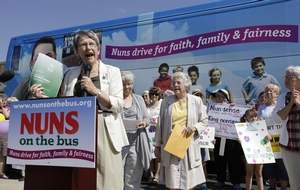
pacified, nor have their supporters. For example, there is a “Nuns on the Bus” tour traveling around the United States, prayer services for the Sisters, #nunjustice and #whatthesistersmeantome campaigns on Twitter. Even the Women’s Ordination Conference delivered a petition containing over 57,000 signatures to the Vatican in support of the Sisters. Certainly, the support for the sisters and their mission is not dwindling, but growing stronger every day.
As for the Vatican, a change in their position is doubtful, but we can continue to pray. I am, however, very discouraged by a statement attributed to Pope Benedict that indicates a desire to have a smaller more faithful Church of Catholics then a large Church of people who do not adhere to Church Teaching – seeking out a small, strong, holy community.
Obviously, it is my hope that this statement was taken out of context, but I have to be honest and say
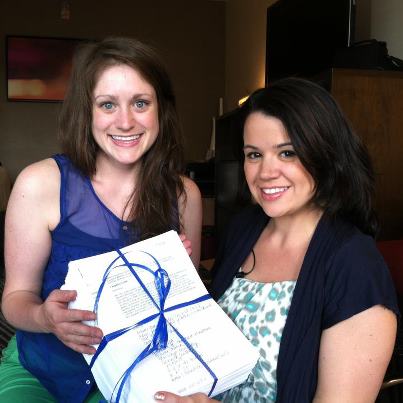
Women’s Ordination Conference delivering Petition Picture reprinted from WOC’s page on Facebook
that my hope is filled with doubt. This is not the first time I have heard clergy make this statement. Priests have made this statement in my presence – wanting a more faithful flock and dismissing those that do not adhere to their interpretation of Church teaching. This stance does not bear fruit, but is rather a power play – a play that can be called many things – misogynist, arrogant, non-pastoral, cold-hearted, and frankly un-Christian. It also plays with a person’s spiritual fate and in many cases their soul. The psychological impact of something like this is dangerous for some. Some ordained will go so far as to withhold sacraments or even compromise the person’s status in the Church, including their role in ministry, for the sole purpose of inducing compliance – a tactic that dates to the medieval period.
(a version of this was originally posted at Patheos)
Twelve years ago, a conversation with my then-boyfriend turned to the Mormon ideal of husbands presiding over wives. I couldn’t understand why such language was necessary in a relationship of equals. My boyfriend speculated, among other things, that it might simply mean that the man was ultimately more responsible for the family’s success than the woman.
We explored that idea for a bit, but the more we talked about it the sicker I felt. As this dark feeling came over me, I first articulated to myself a truth I would later often return to: that I am fully human, fully responsible before God, an agent in my own right, and an equal partner in the truest sense of the word. My future husband would need to see me as such for any marriage to survive. And God must see me as such as well.
“I rejoice in this most recent admission of institutional racism. I am not naïve enough to believe that this public acknowledgment, like previous ones to other racial-ethnic groups, was untainted by political calculations. But I am also not Kantian (so I reject the view that anything done out of mixed motives accordingly lacks moral merit).”
I wasn’t reading it to find out about the origins of the earth in the way the big bang theory explains it. I was reading it to find out what an ancient people thought about the connection between God, the heavens and the earth, and all the creatures and creations in between.
For years, I’ve been fascinated by creation myths. Yet as a feminist, I was taught to be suspicious of the biblical creation myths in Genesis. The creation of man from dust and the subsequent creation of woman from his rib have often been interpreted to support claims about women’s inferiority to men. And obviously, the accounts of Eve and the serpent and her role in “tempting” Adam have been used to justify claims of women’s susceptibility to evil and their wanton natures which lead men astray.
So it was a bit of relief when in my first weeks of study in seminary, my Hebrew Bible professor pointed out that there are two creation myths in the opening chapters of Genesis. I was relieved because Chapter 1 and the first few verses of chapter 2 told a creation story I enjoyed reading. Continue reading “Back to Beginnings by Elise M. Edwards”
I have a beautiful picture of vagina hanging on my wall. However, for the longest time it was in the back of my closet, with a plastic bag covering it. I wasn’t ashamed of it but my ex-boyfriend, like most gay men, refused to have it on the wall where he could see it. He is now long gone; the vagina is now out and proud.
I bid on the picture one fall during a showing of the Vagina Monologues at Claremont School of Theology. One of my best friends was in the show and I had always loved its powerful message. I walked out of the theatre, waiting for my friend, and there it was: the picture of the vagina. I found myself caught up in its beauty. Its gaze had mesmerized me. The outlying layers of red, the contours of its shape, they all began to mold into a figure before my eyes. While I have never thought of myself as a religious person, I realized that at that moment I was no longer looking the old photo but rather I was staring at the outline of the Virgin Mary. At that moment, I realized that I had to have the picture.
My ex boyfriend was ashamed of the photo. I let him shame me into putting it in the back of my closet and cast it away like it was nothing. Like the experience, call it religious or not, had never happened. When we ended our relationship, I found myself inconsolable and pacing up and down my stairs in a never-ending cycle of sadness and downheartedness. As I was pilfering through our items, I came about the picture. I saw it and for a split second, I was no longer sad. Continue reading ““Vaginas are Everywhere!”: The Power of the Female Reproductive System by John Erickson”
My simple daily rituals and spiritual practices are what keep me mindful of G-d and G-d’s presence in my life. They also remind me of G-d’s call to justice, care, compassion and love.
“I find by experience, not by reasoning,
but by my own discovery that G-d is near me,
and I can be near G-d at all times.
I cannot explain it but I am as sure of my experience
as I am of the fact that I live and love,
but I know I do.
In the same way, I know I am in contact with G-d.”
This poem by Lily Montagu speaks to me. I read it most mornings as I say my morning prayers, and it is one of those mantras I try to live by. I have found that contrary to popular belief, sustained religious practices can be just as transformative as instantaneous conversion experiences. This is why I have developed certain spiritual and specifically Jewish practices (For more about my joinery to Judaism, see one of my previous blogs “Reflections on my Spiritual Journey: Claiming Judaism”). I find that they help me develop and cultivate a strong relationship with G-d. For example, I keep a kosher home; wear a kippah daily; try to pray at least twice a day andbefore snacks and meals; practice the principles of Mussar; attend regularly Shabbat services Friday evenings at my Reform Congregation in Lowell and Saturday morning services at a Conservative congregation in Nashua, NH; light Shabbat candles; try not cook or create on Shabbat; make Havadalah to mark the end of Shabbat; give tzedakah as much as I can and study Torah with my friends. This list is not all encompassing and there are quite a few areas of my practice I wish were more disciplined as well.


 You may be tired of the controversy about Chick-fil-A, but the events of the last few weeks revealed a big issue in the organization – that of discrimination and the illusion of religious freedom. However discrimination exists beyond the LGBTIQ community, it applies to Catholics and those “outside” their strict fundamentalist belief system. However, the hierarchy in the Catholic Church seems to be embracing many of the beliefs put forth by Evangelical Fundamentalists in the political arena.