Mountain Mother by Sara Wright

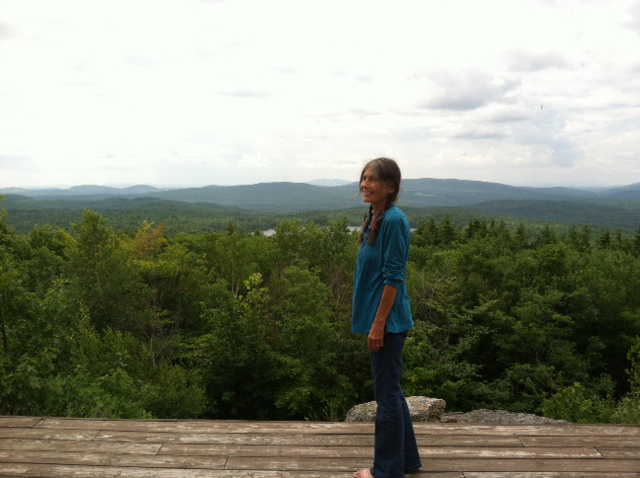
When I picked berries in the mountain field that first summer, I could sense wave after wave of feeling rising up – seeping into my feet from the ground below. The sun spread blue heat over the hills, and I bathed in summer’s glow. For the first time in my life I felt visible, witnessed for who I really was and accepted: I was loved –unconditionally loved by a Mother. That She was a mountain field didn’t seem odd at all. I loved her back – fiercely. I marveled. To be in love with my goddess, the one that lived in this field, brook, young forest, the one who inhabited each of these rolling hills and mountains seemed so natural. Remarkably, She celebrated my presence not only by gifting me with a love that ran like a great underground river beneath me but because She created a palpable sense of belonging. I belonged to Her. She loved me just because I was. I couldn’t get over it. My gratitude knew no bounds. All I wanted to do was to serve her…

She was visible in so many ways – in the riot of purple and green jack in the pulpits that sprung out of the sphagnum moss behind the camp in the moist valley that often filled with water, through the solitary pink lady slipper that appeared by the bridge that crossed the brook, the tiny white swamp violets, the blue fringed gentians and pearl-white turtleheads that popped up in the meadow fed by it’s own spring in the center of the field.

I glimpsed her face in the cedar that sprung to life in the rich wooded soil that bordered the brook, she sang to me from the wild apple branches that bowed over rippling water, she blinked through each firefly night, burst into a “high” when thunder and lightening churned up the waters and the brook overflowed – White Fire crackling out of her clouds and slamming into me.

Continue reading “Mountain Mother by Sara Wright”
Embodiment as Positive Resistance

I nearly cancelled my recent trip to the United States. The political climate felt tense, the global atmosphere uncertain, and travelling across the Atlantic seemed questionable for several reasons.

Friends encouraged me to go anyway, suggesting that meeting people in person would offer a different perspective from the one shaped by media narratives. And of course, it wasn’t headlines I was meeting, but people, in a human reality that persists beneath larger systems. Thankfully, my trust in relational experience outweighed my hesitation, and I returned from my travels with renewed inspiration.

I’m writing this essay because many people I met spoke with an apologetic tone about being American. They expressed disbelief, embarrassment or anger about their conspicuous yellow haired chief. I just want to acknowledge the warmth, generosity, care and humanity I encountered wherever I went.

The entire experience confirmed what I have long sensed in my work with movement, ritual and community: that embodied presence, especially in uncertain times, is such a remedy for heart and soul. What I encountered was meaningful human contact, even in a politically divided country.

Continue reading “Embodiment as Positive Resistance”

Dove Tales, part 2 by Sara Wright

Part 1 was posted last Tuesday. You can read it here.

That first winter after my father’s death I became obsessed with doves and finally gave in and decided to buy one. When I went to pick the dove up at the very last minute, I was drawn not to a white dove but to an African collared dove. Lily b came to live with me as a free flying house dove whose intelligence and uncanny ability to read my mind forced me to concede that something was happening that was beyond my understanding. In retrospect Lily b introduced me to interspecies communications  on a concrete level which validated my life experiences with all animals wild and tame. My beloved dogs had been life-time companions, so I already knew we spoke the same language in different ways.

Lily b became a spirit/soul guide and remains one some thirty some years later*. The first sculpture I created at the edge of the sea had the head of a dove. At that time, I still separated spirit from body as most colonized people still do. Now I believe from personal experience that the two are ONE.

Continue reading “Dove Tales, part 2 by Sara Wright”

Reflections in a Winter Forest by Sara Wright

Shimmering Seep

Yesterday’s welcome sun and warm temperatures had me out the door to lay down another round of ashes before the next storm. After packing down our woodland paths with snowshoes we were off to our favorite forest. I had planned to look for liverworts but as usual nature had other plans nudging me to note which trees might be photosynthesizing  around these forest edges. At any given moment there are thousands of interactions between tree bark and ki’s environment that most of us take for granted. If you pay attention to bark you may, like me, develop a deep respect for the unparalleled beauty and for the protective skin of every tree. Especially during the winter months.

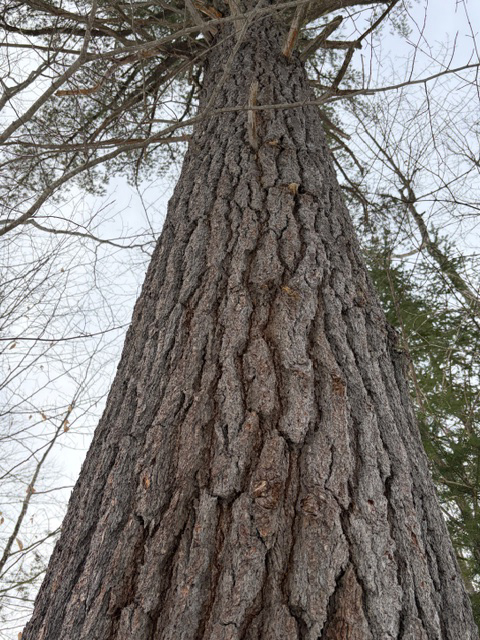
We know that bark protects the tree from insects and other damage, and the thick ridged bark of older pines or hemlocks also holds moisture in ki’s fissures as well as providing creaturely homes.

I feel compelled to stop to run my hands over these thick white pine trunks in gratitude and awe for their existence. I do the same thing at home in my modest sanctuary, but here the pines are older like the ones that once entirely covered the mountain behind me, all the way to the ledges…I remind myself that the waxy needles on conifers also photosynthesize on warm sunny days.

Continue reading “Reflections in a Winter Forest by Sara Wright”

White Pine Wonder by Sara Wright

Yesterday was mild (mid 40’s in January) so Coalie and I went to our favorite forest to walk. The roads were icy, but the seeps were brimming and ringed with footprints. Over one of my favorites (because declining wood frogs still lay eggs there in the spring), an elderberry bush arced over rippling water like some sort of plant protectoress.

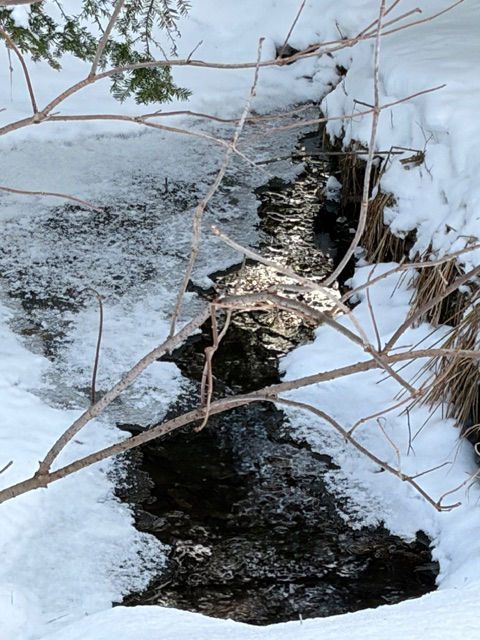
Seeps fascinate me because they defy freezing weather bubbling up through deep in the earth. Water seeps in the forest are small wetland areas where groundwater naturally emerges at the surface, often at the bases of slopes. They create moist spots with lush plants in season (like elderberries) and serve as important habitats for wildlife by providing clean water sources all year-round. They form from underground layers of rock that force water to flow horizontally until it surfaces. Seeps care for their animal and bird neighbors by providing clear waters at any time of year. There were so many fox and partridge tracks leading to and from these pools that I was surprised we didn’t startle one of the latter. (At home I have a pair that are feasting on the last of the crabapple berries). A couple of chickadees were chirping from nearby maples probably annoyed because we were taking our time. Coalie was nosing every blade of grass in the area.

Continue reading “White Pine Wonder by Sara Wright”

Omen by Sara Wright

I was driving down the road when I noticed a dead owl. Sun glare blinded me, but I stopped to identify the bird.

It has been many years since I picked up dead owls on the road – thirty five years in all. I began this practice of bringing home the bodies of these creatures when I first moved to the mountains. Finding so many dead owls in a brief span of five years was frightening, but someone in me knew that I needed to honor these Harbingers of Night. Yet the last thing I wanted was to be identified or aligned with an owl, so my behavior rose out a body that never lies. Visions of my mother’s love of owls clouded my mind. Within months of this mountain move a Navajo Medicine woman informed me that I had Owl as a Familiar. Horrified, I resisted mightily. Yet despite what seemed like a curse, I was still compelled to sculpt owl pots out of clay for five years. The losses I endured during this time changed the course of my life.

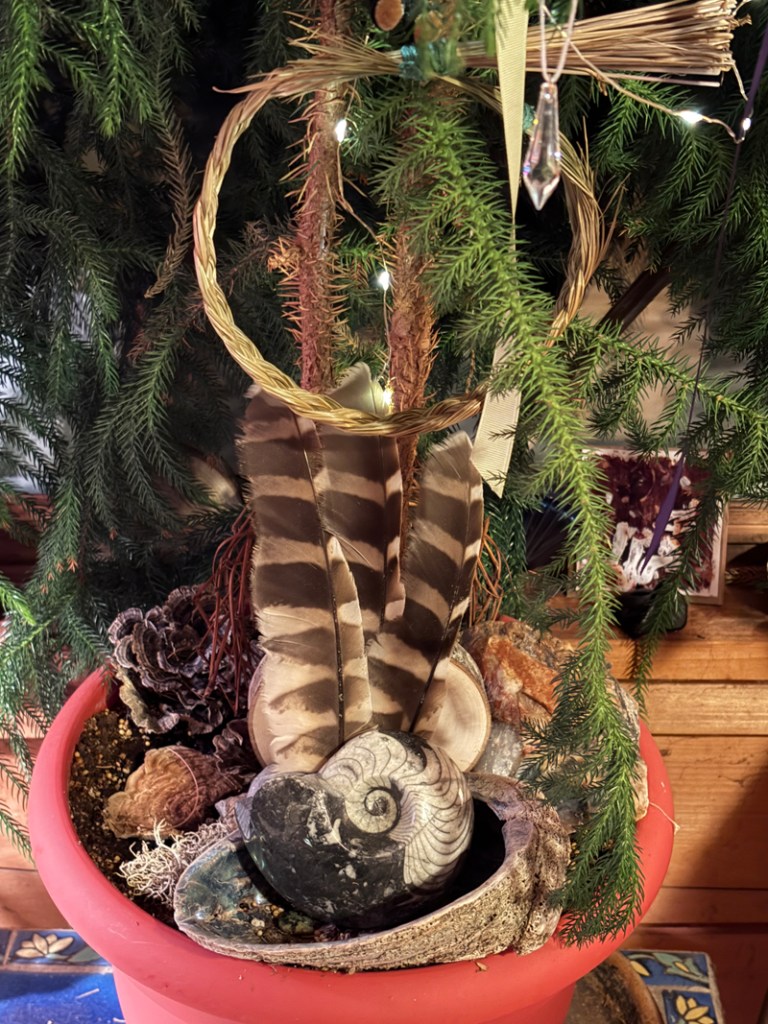
 I taught myself how to dismember owls. I burned owl remains in my woodstove as a symbol of deep respect and out of fear. I always kept feathers and wings in honor of these mysterious night beings not understanding why.

Continue reading “Omen by Sara Wright”

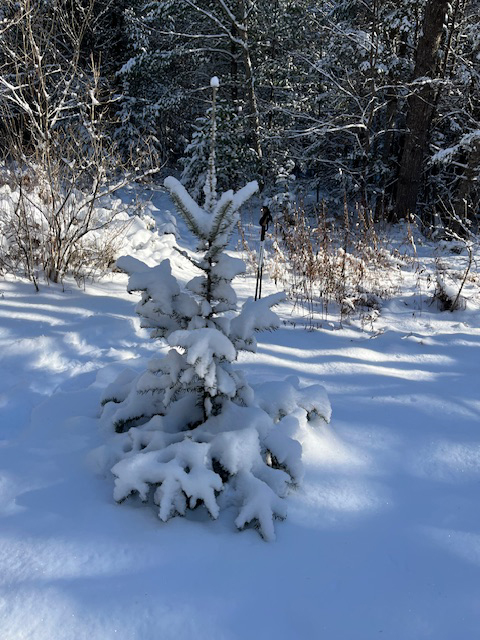
The Littlest Balsam by Sara Wright

Five years ago
I dug a seedling
in protest
ki’s deep green
needles
slender trunk
and roots
yielded
to sweet
spring earth
with prayers.

I believed.

One winter night
I will celebrate
your life
the lives of
thousands
with a
candlelit
spiral
of tiny white lights.

Tonight
white flames
adorn you
old longings
and heartbreak
we share the same
root
stilled by
simple beauty
a single
reflection
of Love.

Continue reading “The Littlest Balsam by Sara Wright”

Winter Lessons, by Molly M. Remer

Yes, it is December
already and again.
Let yourself notice the milkweed pods,
how they have split their sides
and are sending silky white seed fluffs
into the waiting air.
Witness the trees,
bare and gray and patient.

Yes, it is December
already and again.
Let yourself notice the milkweed pods,
how they have split their sides
and are sending silky white seed fluffs
into the waiting air.
Witness the trees,
bare and gray and patient.
Watch the squirrels,
tails puffed against the chill,
stored nuts in their cheeks.
Listen to the wind
how it whispers and rattles
through the empty branches.
Watch the clouds,
slow-moving white billows
in a pale blue sky.
Be patient with yourself.
Grant yourself grace.
Remember the three invitations
of the solstice season:
to listen,
to wonder,
to be content.
Remember your promise
to keep company with joy.
Remember your vow
to be in devotion
to your own life.
Think about everything
there is to do.
Open your hands.
Feel that thin, whispering
winter wind
skim over your palms.
Take a deep breath.
Allow yourself to marvel
at all this year
has held.
Bless it.
Thank it.
Cup your hands
around your own face.
Say: thank you.
Here you are in the center
of your own life’s unfolding.
There is nowhere else to be.
Be gentle with yourself.
Invite the winter crone to tea.
Look into her eyes.
See yourself reflected there,
your own winter eyes open
to the possibility
of both clarity and delight.

I have been writing for Feminism and Religion for 13 years. In the summer, I compiled a post with 13 summer lessons from 13 years of posts here at FAR. I decided to bookend that post with a Winter Lessons post as well. Here are thirteen lessons to share from past winter posts:

Continue reading “Winter Lessons, by Molly M. Remer”

A Goose Tale by Sara Wright

Coalie and the Goose

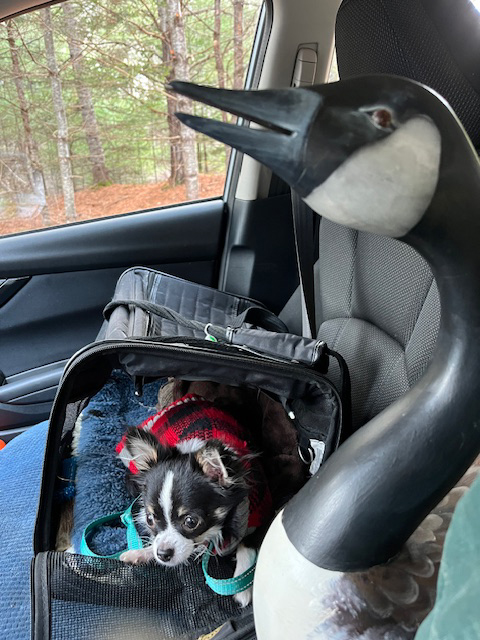
It’s the last day of November and small groups Canadian geese are still drifting around on patches of open water. I saw two small groups on North Pond. Although many skeins have flown south along the Atlantic flyway – they can migrate south as far as Mexico and South America -some geese spend the winter along coastal areas in Maine if food resources are available. It’s hard to know whether these groups are migrators from Canada who have stopped over to rest or a few that winter over nearby on the Kennebec or elsewhere along the southern coast of Maine. With warming temperatures Canadian Geese migratory patterns are changing.

Soon after their arrival the female disappears to lay 8 – 10 eggs in her nest that is securely hidden in the reeds while her mate stands watch. When the goslings are born both parents escort them through the water, one parent in front, the other behind. If threatened the male becomes aggressive, a totally appropriate behavior from my point of view. When the little ones are big enough these birds join other families for the rest of the summer and some will probably migrate together. These are such community oriented birds. They make it a habit to get along. Geese are omnivores that will eat almost anything and they mate for life, returning to their designated ‘home’ places to breed year after year. Even before the chicks arrive geese are drawn to some of the 400 million lawns in this country (especially those that are close to water) much to the dismay of some.

Continue reading “A Goose Tale by Sara Wright”

Requiem? by Sara Wright

A requiem for the seasons is an act of living remembrance for what is vanishing, be that long-cherished seasonal moments, forms of celebration that once tied us to nature’s cycles, and to more than human species – some that are going extinct.

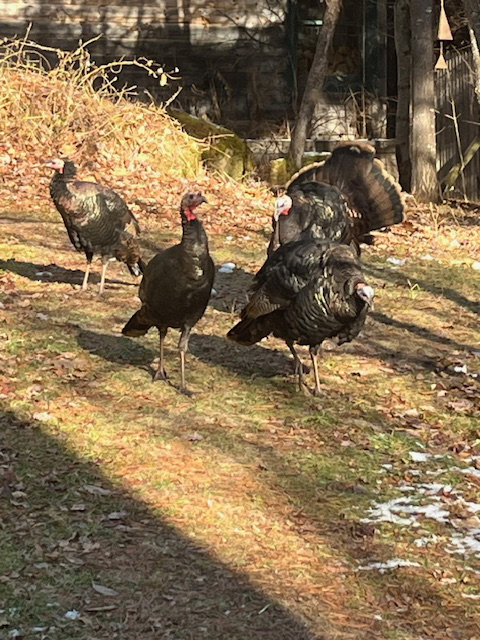
Cheeping twittering birds awakened me at dawn. The first snow of the season cast a spell over the landscape last night and this  generous dusting brought in the wild turkeys… I wished all good morning as I scattered seed under the crabapple. A couple of very friendly individuals followed me back to the door. My little dog Coalie is spellbound. She loves these birds.

I noted turkey hieroglyphics on the doormat as I came in but otherwise took no pleasure from the white shrouded landscape. I used to love snow but because each of the seasons is warming, we are getting mixed precipitation on a regular basis beginning in mid – November. The first snow opens an icy door to winters that are dominated by continuous freeze thaws. Last year I considered myself fortunate to have been able to snowshoe as long as I did.

Continue reading “Requiem? by Sara Wright”