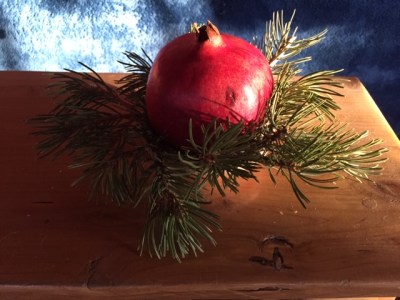
The Pomegranate by Sara Wright

It is mid November and shiny crimson Pomegranates catch the discerning eye in food markets; even Walmart carries them!

Why do these beautiful and very ancient fruits appear during this dark time of the year?

One answer to this question is that in the northern hemisphere the fruit of this deciduous shrub ripens anywhere from September to February. The reverse is true in the southern hemisphere when the fruits ripen during March, April and May. It is important to remember that in the southern hemisphere the seasons are reversed, so in both northern and southern parts of the globe these fruits appear in the fall, during the darkest months of the year.

Pomegranates are native from Iran to northern India and have been cultivated throughout the Middle East, Asia and the Mediterranean region for millennia. (Today they are also grown in California and Arizona, so they no longer need to be imported). The shrub was domesticated as early as the 5th millennium BC. Pomegranates were the first trees to be domesticated in the Mediterranean.

Continue reading “The Pomegranate by Sara Wright”

Susan B. Anthony’s Bargain with the Devil by Carol P. Christ

Matilda Joslyn Gage


[T]he most grievous wrong ever inflicted on woman has been in the Christian teaching that she was not created equal to man, and the consequent denial of her rightful place in Church and State. –Matilda Joslyn Gage, Woman, Church, and State, 1893, page 1

I do not approve of their [referring to Gage and Stanton] system of fighting the religious dogmas of people I am trying to convert to my doctrine of equal rights to women. –Susan B. Anthony to Olympia Brown, following the disputed merger of the radical National Women’s Suffrage Association with the conservative American Women’s Suffrage Association in 1889

Most readers of Feminism and Religion know that Susan B. Anthony and Elizabeth Cady Stanton were leaders in the nineteenth century struggle for women’s rights. Fewer will know that Matilda Joslyn Gage was widely understood to be Stanton’s equal as a theorist and Anthony’s equal as an organizer. The fact that Gage’s contributions have been lost to history can be attributed to Susan B. Anthony’s bargain with the devil.

If Anthony’s bargain had affected only the reputation of Matilda Joslyn Gage, that would be bad enough. But Anthony’s decision to merge the NWSA with the AWSA signaled that the women’s rights movement would cease and desist from its policy of naming and indicting Christian dogma as the source and cause of women’s subordination in the law in Christian countries. This decision meant that feminists would no longer have a clear understanding of the forces they were reckoning with. Continue reading “Susan B. Anthony’s Bargain with the Devil by Carol P. Christ”

ERA—Equal Rights for Women—in the US: Has Our Time Finally Come? by Carol P. Christ

On August 26, 1970, I borrowed an old VW bug from my mentor and summer employer Michael Novak to drive from Oyster Bay, Long Island to New York City to take part in the Women’s Strike for Equality march down Fifth Avenue. Some 50,000 women attended the march and another 50,000 took part in sister actions around the United States. The march celebrated the 50th anniversary of the passage of the Women’s Suffrage Amendment that gave women the right to vote. The ERA was on our minds, but it was not the only issue on the feminist agenda. We believed that all the walls created by patriachy would come tumbling down, and soon! Continue reading “ERA—Equal Rights for Women—in the US: Has Our Time Finally Come? by Carol P. Christ”

Firebird’s Song by Sara Wright

In response to Carol Christ’s latest post…

She came on the wings of the Owl
flew out of the crack of our imagining,
swooped low over the underground forest
hooing, hooing, hooing
screeching and clacking –
Haunting the night with her song.

I almost didn’t recognize her
inside the feathery brown cape with bars.

On Starry nights while the white moon sleeps
the cloak falls away and behold!
She steps out
in all her Firebird splendor.
Burning, crimson, gold, she crackles — turns blue
white light torching
the fire turned star.
Beaming second sight
she rises out of Earthen ashes Continue reading “Firebird’s Song by Sara Wright”

Endings, Beginnings, and Dreamings by Carol P. Christ

my dream home in Molivos

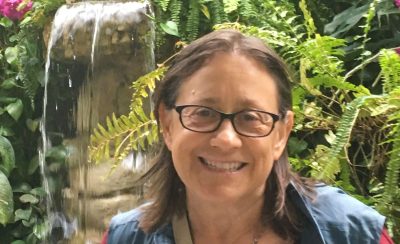
Fifteen years ago, I bought my dream home in Molivos, Lesbos, one of the most stunning villages in the world. Over the next two years I renovated a listed Neoclassical house that had been neglected for over thirty years, restoring it to its original beauty. One of my friends who visited exclaimed that it looked like a movie set. Someone else said that the final result was “more Greek than Greek.” I thought this would be my forever home. But, as I have discussed in an earlier blog, I came to feel isolated in a small village.
Two years ago, I followed my heart to Crete, renting a lovely apartment in Heraklion, followed by a house near the sea. Then back to Lesbos, travel to the US and Canada, and Crete again after Christmas. I would have been happy to move back to the apartment I had rented the previous year, but this time I would bring my little dog. The apartment under my friend’s house outside Heraklion seemed like a good compromise, but the drive to Heraklion proved treacherous and parking difficult. Continue reading “Endings, Beginnings, and Dreamings by Carol P. Christ”

Let’s Talk About Shame by Janet Maika’i Rudolph

Disclaimer/Trigger Warning: This post includes content about rape, sexual assault, domestic abuse, violence.

The recent, meaningful discussions on this forum about how so many of us feel broken due to our own personal histories have fortified and inspired me. I’ve marveled as women have spoken up so honestly and even brutally about the effects of trauma, rape, cold and dismissive mothers, abusing fathers and so on.

Some of you know my own story. I am a survivor of my father’s childhood abuse and then a rape at knifepoint in my early twenties. I carry a deep and abiding sense of shame. This feeling has always flummoxed me. Why should I feel shame when I didn’t do anything to create my own abuse? Shouldn’t my father have felt the shame? The rapist? Why did I get saddled with it? I was the victim (and survivor), not the perpetrator. But shame is indeed the feeling I carry and I’m not alone. Why is this feeling so pervasive? I don’t have all the answers, but I do have some clues about where to look.

Continue reading “Let’s Talk About Shame by Janet Maika’i Rudolph”

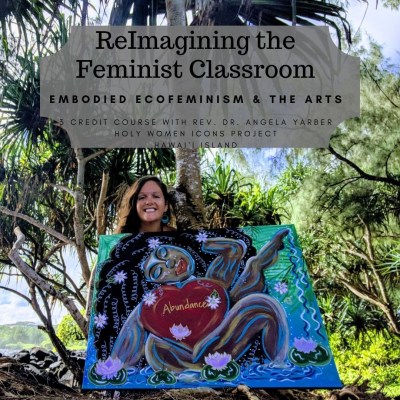
Reimagining the Classroom: Embodied Ecofeminism and the Arts Course on Hawai’i Island by Angela Yarber

“The classroom remains the most radical space of possibility in the academy.”-bell hooks

Like many academics, my “in the box” dream was to be a professor. The full-time, tenured kind. Like many queer feminist academics, I know that such dreams are rarely reality. When you’re also an artist and activist with a strong penchant for wanderlust, these dreams are simply unattainable fairytales. Never one for “in the box” living, I left the traditional academy and traditional church years ago, wandering over the garden’s walls with Lilith as my intrepid guide. I’ve told the story before. My wife and I left our jobs, sold our home, traveled full-time with our toddler, and turned the Holy Women Icons Project into a non-profit while building an off-grid tiny house on the television show Tiny House Nation in Hawai’i. It’s become old news. But since we’ve been doing this for several years now, those faraway dreams are finally starting to become reality. The academic classroom, the activist’s platform, the artist’s studio, the feminist’s megaphone, and the farmer’s orchard are fusing into one creative, life-giving, empowering space for teaching. The Holy Women Icons Project’s first academic course, “Embodied Ecofeminism and the Arts,” is actually happening. Seminarians and doctoral students from Berkeley join us in January. They’re soon followed by undergraduates from New York and seminarians from Atlanta. And I’m reaching out to more and more schools interested in creatively, subversively, and sustainably decolonizing the classroom with us for one week on the Big Island.

Continue reading “Reimagining the Classroom: Embodied Ecofeminism and the Arts Course on Hawai’i Island by Angela Yarber”

Mother – Daughter Betrayal by Sara Wright

(1)

Today is my mother’s birthday and although she has been dead for more than a decade I still think of her almost every day. At the time of her death I had not seen her for twelve years. Not by choice. After my father’s sudden demise my mother chose my children, her two adult grandsons to be her protectors, and dismissed me from her life, permanently.

When she died, my mother divided her assets evenly between my children and me, forcing her only daughter to live beneath the poverty level for the remainder of her life.

The final betrayal.

At the time of her death I was teaching Women’s Studies at the University.

Continue reading “Mother – Daughter Betrayal by Sara Wright”

This is for colored girls who are movin to the ends of their own rainbows: Ntozake Shange’s Choreopoem of Spiritual Healing by Carol P. Christ

Ntozake Shange’s choreopoem for colored girls who have considered suicide/when the rainbow is enuf has reopened at the Public Theater in New York City to rave reviews.

A scene from the new production of for colored girls

I first saw for colored girls in 1976 after my friend Carolyn Broadaway, who was visiting me in the city, insisted that we must see it.

Here is what I wrote about that experience:

Each of the three times I saw for colored girls performed on Broadway and each of the many times I read it or heard it performed [on the original cast album] on my stereo, I have felt chills of recognition up and down my white woman’s spine—shocks of recognition that tell me that something deep within me has been unlocked as I hear my experience voiced. (103)

Continue reading “This is for colored girls who are movin to the ends of their own rainbows: Ntozake Shange’s Choreopoem of Spiritual Healing by Carol P. Christ”

Metamorphosis and a Press Conference: A Kafkaesque and Shakespearean Fantasy about an Unreal Individual by Barbara Ardinger

Donald wakes up too early. Feeling confused and disoriented, he looks around the room. His bed has disappeared! He seems to be lying on the floor. Why? he asks himself, how’d I fall off my king-size bed? The floor (uncarpeted??) seems to go on around him forever, sans furniture, sans TVs, sans his solid gold toilet, sans even the doors and windows. It’s all a great big blank. All around him. Where am I? he asks himself.

He had disturbing dreams all night, and not just last night, but for…well, awhile. Since the subpoenas. He keeps seeing big, strong, silent men wearing jackets with initials on the back carrying big boxes out of his various offices. All of them. All over the world. In one repeating dream, a man dropped a box. It fell open, scattering papers filled with names and numbers. The men picked everything up, put the papers back in chronological order, and resealed the box. They kept carrying the boxes out to black vans that didn’t have names painted on them.

Continue reading “Metamorphosis and a Press Conference: A Kafkaesque and Shakespearean Fantasy about an Unreal Individual by Barbara Ardinger”