
Several years ago, I was pastor of a welcoming and affirming church. As a queer clergywoman, I thought that such a place would be the perfect place to flourish and thrive as a pastor. And yet, because of heterosexist and sexist microaggressions, I found myself anxious, depressed, and in need of physical, emotional, psychological, and spiritual care.
After a three-day retreat filled with self-care and soul-nourishment at a non-profit retreat center that catered to activists and artists , I felt as though a tremendous weight was lifted off my shoulders, that I could focus and find clarity in my vocation. Pausing to care for myself gave me the courage to leave my toxic job and live more fully into my calling. This experience taught me the vital importance of self-care.
Womanist Audre Lorde once proclaimed, “Caring for myself is not self-indulgence, it is self-preservation, and that is an act of political warfare.” Because caring for the self violates the patriarchal norms that traditionally dictate that you should be the one caring for everyone else. Yes, everyone needs to pause to care for the self. But oppressed minorities have a particular need for self-care, not simply as a way of refreshing oneself in order to do the work of justice, but as a vital part of the work of social justice. Because caring for yourself in a society—and a church—that wishes for you to do otherwise is an act of political warfare. When feminists care for themselves, it is a radical act of soul redemption, spirit rejuvenation, and a political and spiritual act of acknowledging your holy and innate self-worth. In case anyone has told you that you are not worthy, let me reassure you. You are worthy. And you deserve to care for yourself.
Continue reading “Self-Care is a Feminist Issue: Holy Women Icons Project’s 7-Day Online Self-Care Retreat by Rev. Dr. Angela Yarber”


 Despite having thought that I had resolved my issues with my father, shortly after his death I fell into a lethargy accompanied by stomach flu and a cold. After about two weeks, the only symptom was a lingering cough. But I had no energy. I knew there were a number of essays to write or edit in the pending file on my computer, but didn’t have the will to do anything.
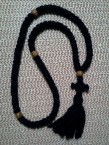 During this time, I came across the Greek Orthodox prayer rope (komboskini) that had been spontaneously removed from her person and given to me by the Mother Superior of the Paliani Convent in Crete a few years previously. Made of black wool yarn with one hundred intricately woven knots and a cross, it was not something I could easily wear in my everyday life. But as I was still lounging around in a black jersey nightgown, I put it on. I felt it on my skin and cradled between my breasts. Continue reading “Healing from beyond the Grave by Carol P. Christ”
 While the Republicans in Congress and in state legislatures across the country are working to repeal and restrict a woman’s right to control her own body, the Democratic Party has decided not to “insist” that the right to abortion is a basic human right.
 I sometimes have to work hard at spirituality.
 My father died on July 6, 2017, 98 years, 4 months, 12 days. The last time I saw him was in the spring of 2004. During that visit, he gave me “the silent treatment” (refused to look at me or speak to me) when I stepped over an invisible line. That was not the first time, but it would be the last. When I gave lectures in California in 2008 and 2010, I agonized and yet made the decision not to visit him. I did not want to give him the chance to hurt me again.
 I saw an interesting headline the other day entitled: “Olympic Gymnast Hits Back at Body-Shaming.” I immediately thought, “Wow not again.” The fact that body-shaming is even an expression is a disheartening commentary on the society we live in today. Women’s bodies have long been the subject of casual objectification in our culture and in the media. The fact that people think it’s ok to comment on a woman’s body, in whatever fashion pleases them, blows my mind. Not only is it disrespectful, but it comes from the problematic way society equates a woman’s worth with her beauty.
 While trying to find a topic for today’s blog, I came across a facebook post from July 10 by former Orthodox priest Christoforos Schuff in which he announced:
