 Asked the secret of her long and happy marriage, Dorothy Hartshorne, wife of the philosopher Charles Hartshorne, posed a question: “What do you think you must never do in a marriage?” The young woman thought for a moment and replied, “Never hurt each other?” “Oh no,” Dorothy responded, “you will hurt each other all the time. What you must never do is bore each other.”
In the years since I first heard this story, I have come to understand that a good marriage requires that both partners have their own interests and be willing to share them, and that each partner be interested in at least some of the interests of the other. Happy people share an interest in life in all of its diversity and difference. A person who is interested in life may ask herself why her neighbor is so unhappy and offer an ear to listen to her story. Or he may ask about the birds that come into his garden—learning their names and behaviors, while delighting in their beauty. It doesn’t matter if the things you are interested in are large or small, but you must be interested in life.
Second, each you must be interested in yourself and in your partner. If conflicts are to be resolved, if hurts are to be assuaged, you must always be willing to ask: why was I angered or hurt in this situation, and why did my partner act or react in a particular way? This will not always be easy. Often one of the partners will feel more comfortable talking about feelings. Patience and deep listening may be required of one of you, and moving into unfamiliar territory of the other. If you are not interested in your own feelings and those of the other, your relationship is likely to founder—not only in hurt and anger, but also in boredom.
Dorothy’s husband Charles Hartshorne was fond of saying that the golden rule to love your neighbor as yourself implies that you love yourself. This is wise counsel. We are often told that marriage involves loving another, but less often that it requires loving yourself as well.
As you, Shelby and Mark, enter into marriage, I offer you these blessings:
May you always retain your interest in life.
May love yourself as well as the other.
May you never bore each other.
May you have many long and happy years together.
* * *
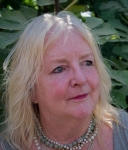 Carol gave this blessing at the wedding of Shelby Carpenter and Mark Miller on August 3, 2017 in Molivos, Lesbos.
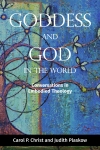
Carol’s new book written with Judith Plaskow, is Goddess and God in the World: Conversations in Embodied Theology.
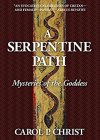
FAR Press recently released A Serpentine Path: Mysteries of the Goddess.
Join Carol on the life-transforming Goddess Pilgrimage to Crete. Space available on the fall tour.


 In a recent article from U.S. Catholic, Common Law lawyer Karen Gargamelli and her newly founded lay community Benincasa are profiled. Established in New York’s Upper West Side, Benincasa, is named and patterned after 14th century mystic and theologian, Catherine of Siena. It was established as house/retreat center, the emphasis of which is placed on prayer and the pursuit of social justice.
 While the world is falling apart all around me, I have been slowly engaged in a major cleaning and cleansing of my home.
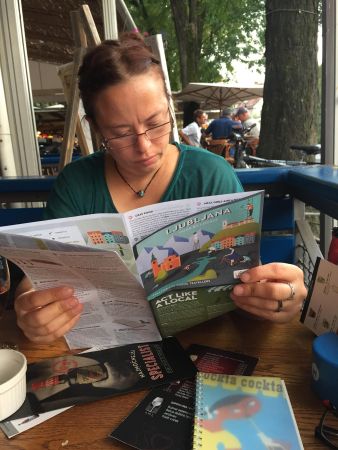 When my dad was in town for the wedding, he asked me a question about Prague. I didn’t know the answer. So, I said, “let me look on my all-knowing phone.” I googled the question, found a reliable website and told him what it said.
 On a trip to Ireland several years ago, I was fortunate to have been able to see the Sheela-na-gigs in the National Museum of Dublin. Two of these Sheelas including the one removed from the Seir Kieran Church of County Offaly, pictured below, are currently on display. They stand at the doorway of a room dedicated to items from the medieval period and easily missed. As there was little interest in them and they are not in cases, I was able to silently commune without interruption.
 Today I am finishing the last bit of the honey I hand-carried home from my most recent trip to Trentino. Sun yellow in color, it is made from the nectar of mountain flowers. Its label tells its origin—di montagna, of the mountains, and its type — mille fiore, often translated as “wildflowers.” Literally, however, it means “a thousand flowers.”
 These days I find it hard to write – I feel plagued with negativity, and the news and violence and overall hateful actions of others have weighed deeply on my soul. While I personally am ready to celebrate a milestone birthday, am another year closer to completing my Ph.D., witnessed the graduation of one daughter, experienced the independence of another, a milestone for my twins, as well as my father’s successful completing of another orbit around the sun after a year plagued with health issues – rather than joy, my heart is filled with pain – pain of the election, pain of the failure of our political system’s supposed checks and balances, pain of violence and bigotry like that enacted in Charlottesville, pain of terror attacks in England, Spain, Finland, France, etc. Where we ought to be united, we are divided. Thus, I write from a place of remembering – a place of strength – a place to say I count (as you count) – and I begin this blog in the voice of Enheduanna, where she becomes the first voice in history to reveal herself – her name, by simply stating – – “I AM.”
  In the wake of Charlottesville, and following